Archive
Woodstock Refugee
I’ve taken some flak from some prim and proper people for the dorky, woodstock-refugee-like pic I’ve posted on my LinkedIn.com profile:

(In case you’re interested, that’s actually a pic of me on Bourbon Street down in Nawlins during Mardi Gras.) One of the comments that I’ve received on this totally “unprofessional” photo is:
Are you looking for companies who want to hire clowns?
LOL! Well, yeah, I am. If I do want, or have, to start looking for a new company to work for, I don’t want to draw attention from any big and stodgy institution whose HR department members think pictures are important. You see, I think those types of orgs are probably stuck in 1920’s FOSTMA mindsets and I’d rather not spend 40+ hours a week working for them. Of course, this tactic will drastically reduce the number of opportunities available to me, but so what. I’ll take my chances and change tactics if I absolutely have to.

N Minus One Half
Other than chief patriarch, where do you think the best position is on a stratified N + 1 layer corpo org chart? Consider the N – 1/2 position. You know, the coveted “dotted line” reporting position where, for some strange reason, the lowly paid and respected exec admin is always listed with the exalted, treasury raiding conciglieres. Here’s why it’s my top choice for you to aspire to:
- By definition, and probably not by your accomplishments (if any), you’re over compensated since you’re so high up on the chart.
- You don’t have any direct reports or whining sub-hierarchies of people under you to placate.
- You have the job security that independent, highly paid consultants (who may actually add value) at your level of so-called expertise don’t have.
- You have unfettered access to the corpo monarch. This gives you virtually unlimited time to kiss arse.
So, are you gonna go for it? Not me. Just give me something interesting to work on with a group of competent people and a PHOR project manager who gets the RIRPRT. Oh, and of course, pay me fairly too.

The Sparfish
On a tip from HCL Technologies CEO Vineet Nayar, I purchased and started reading “The Starfish And The Spider“. In the book, authors Brafman and Beckstrom define seven principles of decentralized orgs of people:
- When attacked, a decentralized org tends to become even more open and decentralized.
- It’s easy to mistake decentralized orgs (starfish) for centralized orgs (spiders).
- A decentralized org doesn’t have central intelligence; the intelligence is spread throughout the system.
- A decentralized org can easily mutate.
- A decentralized org sneaks up on you.
- As industries become decentralized, overall profits decrease.
- Put people into a decentralized org and they’ll automatically want to contribute.
Because of numbers 3 and 6, owners and SCOLs of centralized command and control hierarchies will never embrace the “starfish” concept. The self-centered need for SCOLs to project the image that “I’m great and you’re not” (number 3) and the constant external pressure to generate increasing profits (number 6) guarantee the status quo for all but the most enlightened leaders. However, because number 7 is the holy grail for the CGHs that sit on the throne, they try their best to feign being a starfish while remaining a spider. This systemic and self-defeating behavior is recursively nested all the way down the CCH; from the upper echelon of VPs and directors down through the fatty middle management layers and ultimately down to the BMs that rule at the interface with the DICforce.
Like Mr. Nayer, I don’t buy into the Brafman/Beckstrom set of principles 100%. Their starfish/spider metaphor works well up to a point. For example, a spider is much more mobile than a starfish; which enables it to be more proactive in acquiring the resources it needs to survive. Specifically, I believe that a hybrid “sparfish” org can increase profits while simultaneously providing an environment in which all members automatically want to contribute. By distributing resources more equitably via democracy and implementing a true meritocracy, the best of both species can be merged. The trick is figuring out how to freakin’ do it, no?

Status Seekers And Superheroes
Some people don’t like the dude, but I love Richard Branson. Why? Because he breaks the mold of CEOs who steadfastly cling to their self-image of infallibility and hide within their enclaves for fear of ruining said image and appearing human. Check out this paragraph from “It’s all About the People“.
Try to avoid hiring status seekers, as they tend to distance themselves from their employees. Look for people who care passionately about the company and not simply their status within it. In my experience, they must want to build a business that all its employees can all be proud of – one that will look after its staffers and customers alike. Of course, you can’t get it right every time. When you do make the wrong management decision, it’s vital to act decisively. As the saying goes, “Rot starts at the top”. – Richard Branson
The trick, of course, is knowing how to separate the wheat from the chaff; the bozos from the non-bozos. Mr. Branson goes on to talk about the importance of ferreting out problems before they mushroom into full blown crises:
How will you know when things are going wrong? In the early days at Virgin, I would give out my phone number to all our music company staffers and tell them to call me whenever they felt we were doing something really wrong. This was key to our development as a business, both because it helped me to identify problems early on and, more importantly, because it let the employees know that management was ready to listen to them. Fostering this kind of dialogue is essential if you want to build a company that will grow and thrive. Your staff will feel more valued and committed if they really believe you are listening to them, and you will benefit from hearing a lot of great ideas from the people on the front lines. – Richard Branson
I think the two points that Richard illuminates go hand in hand. When a SASS (who shouldn’t have been hired in the first place) is the primary cause of a problem, he/she will cleverly camouflage and redirect the blame. Having successfully moved him/her self out of harm’s way, our SASS will next offer to step up, don his/her superhero suit, and dissolve the crisis. Of course, the SASSholes situated above our superhero in the CCH will happily guzzle the full glass of koolaid.

Personal Fulfillment Needs

What type of org do you work for? A DEPAM like Org A, a stinkpot CCH like Org D, or somewhere in between in a mediocre hierarchy that works to some extent?
If you run an Org, reflect on which type you think you preside over. Then, after making your decision, ask your people what they think – and not in some big public forum where they have no choice but to say what you want to hear. In other words, don’t forget to make it “safe” for them to really express what their true feelings are. On second thought, fuggedaboutit and keep your infallible tiara firmly in place. You can’t risk the chance of getting hurt and externally showing that you’re only a human being – cuz that would be terrible for the org. Or would it?
OMG! Design By Committee
In Federico Biancuzzi’s terrific “Masterminds Of Programming“, Federico interviews the three Amigo co-creators of UML. In discussing the “advancement” of the UML after the Amigos freely donated their work to the OMG for further development, Jim Rumbaugh had this to say:
The OMG (Object Management Group) is a case study in how political meddling can damage any good idea. The first version of UML was simple enough, because people didn’t have time to add a lot of clutter. Its main fault was an inconsistent viewpoint—some things were pretty high-level and others were closely aligned to particular programming languages. That’s what the second version should have cleared up. Unfortunately, a lot of people who were jealous of our initial success got involved in the second version. – Jim Rumbaugh
LOL! Following up, Jim landed a second blow:
The OMG process allowed all kinds of special interests to stuff things into UML 2.0, and since the process is mainly based on consensus, it is almost impossible to kill bad ideas. So UML 2.0 became a bloated monstrosity, with far too much dubious content, and still no consistent viewpoint and no way to define one. – Jim Rumbaugh
Double LOL!
Another UML co-creator, Grady Booch, says essentially the same thing but without specifically mentioning the OMG cabal:
UML 2.0 to some degree, and I’ll say this a little bit harshly, suffered a bit of a second system effect in that there were great opportunities and special interest groups, if you will, clamoring for certain specific features which added to the bloat of UML 2.0. – Grady Booch
Triple LOL!
Mitchi Henning, a key player during the CORBA era, rants about the OMG in this controversial “The Rise And Fall Of CORBA” article. Mitchi enraged the corbaholic community by lambasting both CORBA and the dysfunctional OMG politburo that maintains it:
Over the span of a few years, CORBA moved from being a successful middleware that was hailed as the Internet’s next-generation e-commerce infrastructure to being an obscure niche technology that is all but forgotten. This rapid decline is surprising. How can a technology that was produced by the world’s largest software consortium fall from grace so quickly? Many of the reasons are technical: poor architecture, complex APIs, and lack of essential features all contributed to CORBA’s downfall. However, such technical shortcomings are a symptom rather than a cause. Ultimately, CORBA failed because its standardization process virtually guarantees poor technical quality. Seeing that other standards consortia use a process that is very similar, this does not bode well for the viability of other technologies produced in this fashion. – Mitchi Henning
Maybe the kings and queens of the OMG should add an exclamation point to the end of their acronym: OMG!
The reason the OMG! junta interests me is because I’ve been working hands-on with RTI‘s implementation of the OMG Data Distribution Service (DDS) standard to design and build the infrastructure for a distributed sensor data processing server that will be embedded in a safety-critical supersystem. At this point in time, since DDS was co-designed, tested, and fielded by two commercial companies and it wasn’t designed from scratch by a big OMG committee, I think it’s a terrific standard. Particularly, I think RTI’s version is spectacular relative to the other two implementations that I know about. I hope the OMG! doesn’t transform DDS into an abomination………

Nested Monarchies
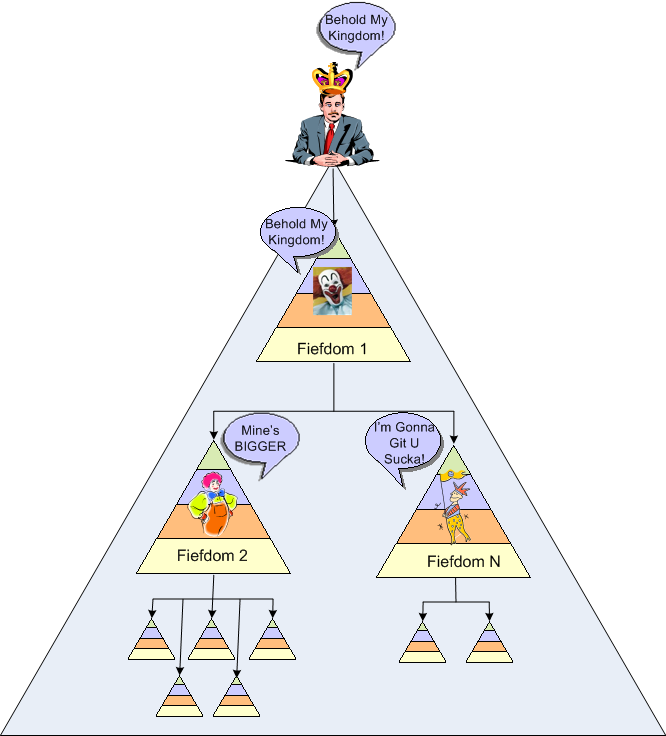
Once again, I’m verklempt, so tawk amongst yourselves. I’ll give you a topic: “nested monarchies”.
Accept And Continue, Or Accept And Change

If you’ve acquired a “bad rep” in a group, regardless of whether you think it’s deserved, it doesn’t matter how you present issues, problems, ideas, or solution options to anyone who perceives you as a “bad” person. Your ideas could have the potential to increase the group’s material or spiritual wealth, but……… fuggedabout getting any help from the “good” people. The “good” people are, by definition, those in positions of power who control the resources of production.
Once you understand the key principle of bad_rep == no_help, the first thing to do is get over any frustration and angst that you have from being “unfairly” adorned (how dare they!) with a scarlet letter. It’s out of your control, bozeltine. The next thing to do is to decide whether:
- to continue on being authentic, reinforcing your “bad rep” perception (if so-be-it) and knowing full well the consequences of your M.O.
- to attempt to force yourself into something you’re not. You know, morph into a “good” person so that the “bad rep” perception slowly dissolves in the minds of other “good” people.
I recommend continuing on and doing your thang as only you can do. You see, once your “bad rep” image gets burned into the UCB of one or more “good” people, it can never be erased. That’s because…… and here comes the usual acronym-laden rant that you may have been waiting for…… “good” BMs, CGH’s, SCOLs and BOOGLs are hoarders. They can add images and perceptions to their UCBs, but since they’re infallible, they are incapable of periodically re-assessing its truthiness and cleaning house. Like the Hotel California, “stuff can check in but it can never leave“.

I hate people who think in terms of “us and them”. You know, people like me. – Bulldozer00
Late Breaking News: After I wrote and queued up this vitriolic post, I discovered that one of my heroes, Scott Berkun, wrote a similar, but much more elegant, less offensive, and insightful one. Check it out here: “How To Keep Your Mouth Shut“, and be sure to watch the classic video snippet he points you to. It’s arguably the best caricature of a BM ever created.
Liked And Respected
Check out this snippet from “Proofiness: The Dark Arts Of Mathematical Deception“. It talks about people lying in the context of being asked questions by pollsters, but it also applies daily in corpricracies everywhere, dontcha think?

It’s an innocent, human-nature-driven, corpo lie-fest: DICs lie to BUTTs; DICs lie to fellow DICs; BUTTs lie to other BUTTs; BUTTs lie to DICs. Got all that?
When a corpo environment is stable, the lying is kept to a minimum. When org stress rises during times of misfortune and financial instability, the lying escalates. Some DICs and BUTTs lie regularly, regardless of org stability. Uh, wait a minute. Maybe it’s just me who lies regularly in my fruitless search for likeability, respectability, honorability, trustability, noblility, integrity, blah-blah-blah; but you don’t.
An arguable, hypothetical case of SCOL-to-SCOL lying is shown below. It’s “arguable” because the repeated, measured shortfalls between planned and actual results could be totally innocent due to market conditions. What do you think the example represents? Lying? Innocent mistakes? Innocent, but culturally forced lying?

How about the example below? What do you think about these results? Can one make a judgment on “data” alone?

A Life Changing Experience?
The article “Undercover Boss’ role opens Republic Airways CEO’s eyes” describes what Republic Airways CEO Bryan Bedford learned while participating on the show “Undercover Boss“. In the show, CEOs go undercover and work on the front lines as a DORK in disguise.

Here’s one thing Mr. Bedford said of his experience:
“What was eye-opening, the most noticeable thing was just the disconnect and (poor) communication between the management team and front-line employees,” Bedford said.
I don’t know what was so eye opening about it. As usual, I just don’t get it. Do you? Do you now understand the meaning of one of the profanely endearing acronyms, CGH, that I often use in this boisterous blog?
Moving on, here’s some more unsurprising (at least to me) commentary :
While working in different roles for the company — including cleaning aircraft, checking baggage, dumping aircraft toilets and standing at the ticket counter — he asked fellow employees why they didn’t take their complaints to management to implore change. The same response came time and time again: “No, I’ve talked to management about this stuff, and they never listen,” Bedford said.
Wow. Huge surprise, no? Why won’t the BMs, BUTTs, and CCRATs in the fatty middle org layers listen to, and act on, DICforce inputs? Because it would require hard work and it could make them look bad. You know, their image of being infallibly in charge might suffer: “Damn the org, it’s all about me and my success“.
“Are you here to build a career or to build an organization?” – Peter Block
I’m almost done with this rant, so bear with me just a couple of more sentences. Summing up his experience, Mr. Bedford relates his epiphany:
When you are actually working side by side and hearing about their struggles, it’s very personal. It’s life-changing. You can never go back to thinking of them as anything other than family.
So, six months from now, after returning to the same-old, same-old business as usual (operating off spreadsheets and powerpoints, communicating solely with his hand picked yes-men junta, caving to pressure from Wall St. and shareholders) do you think Bryan will remember what he said? I hope so, but I doubt it. He’s human just like you and (maybe) me.
How about you? Even if he/she wanted to, would your CEO, or even your immediate manager, be capable of doing your job in order to experience your frustrations at the inefficiency, dysfunction, and red tape that engulfs you?

Why am I here?
WTF?
Meh!
D'oh!

My BTC Address



 Bulldozer00's Blog