Archive
Normal, Slave, Almost Dead, Wimp, Unstable
Mr. William T. Powers is the creator (discoverer?) of “Perceptual Control Theory” (PCT). In a nutshell, PCT asserts that “behavior controls perception“. His idea is the exact opposite of the stubborn, entrenched, behaviorist mindset which auto-assumes that “perception controls behavior“.
This (PCT) interpretation of behavior is not like any conventional one. Once understood, it seems to match the phenomena of behavior in an effortless way. Before the match can be seen, however, certain phenomena must be recognized. As is true for all theories, phenomena are shaped by theories as much as theories are shaped by phenomena. – Bill Powers
On the Living Control Systems III web page, you can download software that contains 13 interactive demos of PCT in action:

The other day, I spent several hours experimenting with the “LiveBlock” demo in an attempt to understand PCT more deeply. When the demo is launched, the majority of the window is occupied by a fundamental, building-block feedback control system:
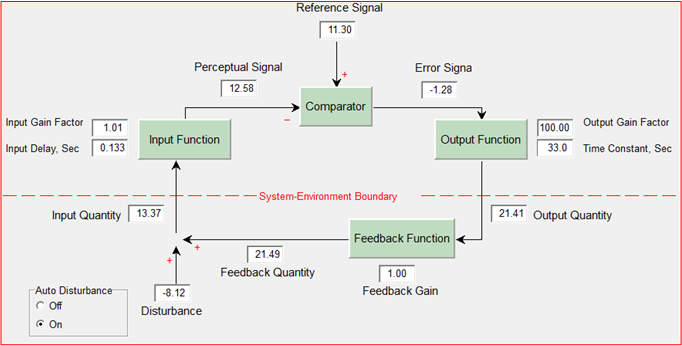
When the “Auto-Disturbance” radio option in the lower left corner is clicked to “on“, a multi-signal time trace below the model springs to life:

As you can see, while operating under stable, steady-state circumstances, the system does what it was designed to do. It purposefully and continuously changes its “observable” output behavior such that its internal (and thus, externally unobservable) perceptual signal tracks its internal reference signal (also externally unobservable) pretty closely – in spite of being continuously disturbed by “something on the outside“. When the external disturbance is turned off, the real-time trace goes flat; as expected. The perceptual signal starts tracking the reference signal dead nutz on the money such that the difference between it and the reference is negligible:

The Sliders
Turning the disturbance signal “on/off” is not the only thing you can experiment with. When enabled via the control panel to the left of the model (not shown in the clip below), six parameter sliders are displayed:
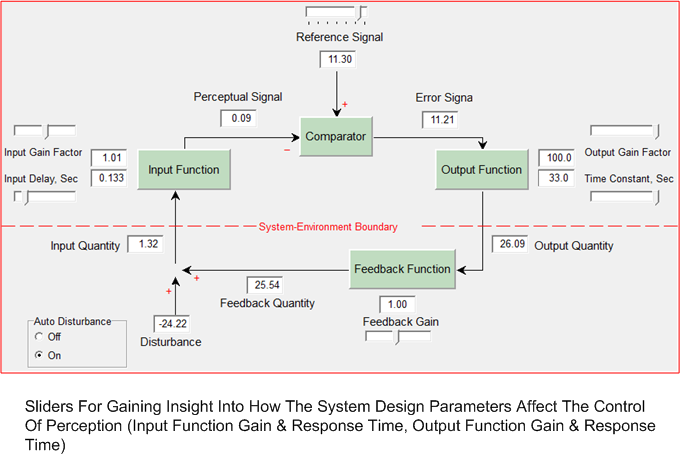
So, let’s move some of those sliders to see how they affect the system’s operation.
The Slave
First, we’ll break the feedback loop by decreasing the “Feedback Gain” setting to zero:

Almost Dead
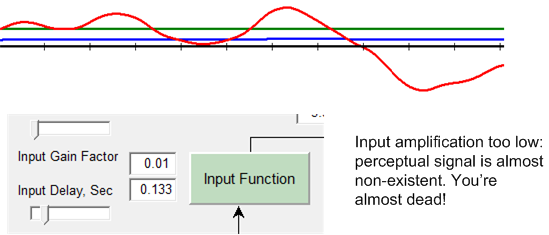
Next, let’s disable the input to the system by moving the “Input Gain” slider as far to the left as we can:
The Wimp
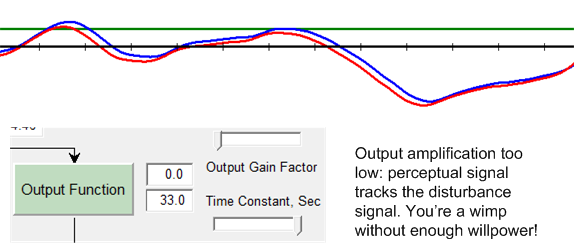
Next, let’s cripple the system’s output behavior by moving the “Output Gain” slider as far to the left as we can:
Let’s Go Unstable!
Finally, let’s first move the “Input Delay” slider to the right to decrease the response time and then subsequently move the “Output Time Constant” slider to the left to increase the reaction time:
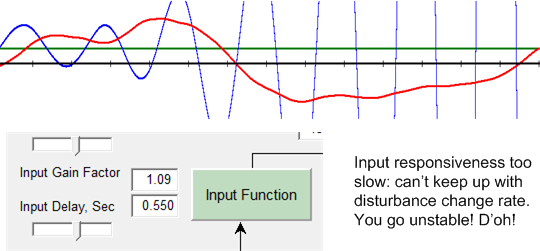
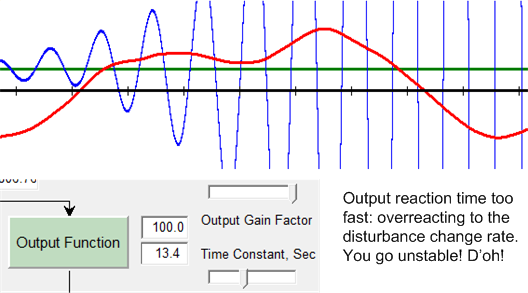
So, what are you? Normal, a slave, almost dead, a wimp, or an unstable wacko (like BD00)?
I’ve always been pretty much a blue-collar type, by training and by preference. – Bill Powers
Related articles
- Nine Plus Levels (bulldozer00.com)
- Extrapolation, Abstraction, Modeling (bulldozer00.com)
OMITTED ACTIVITIES!
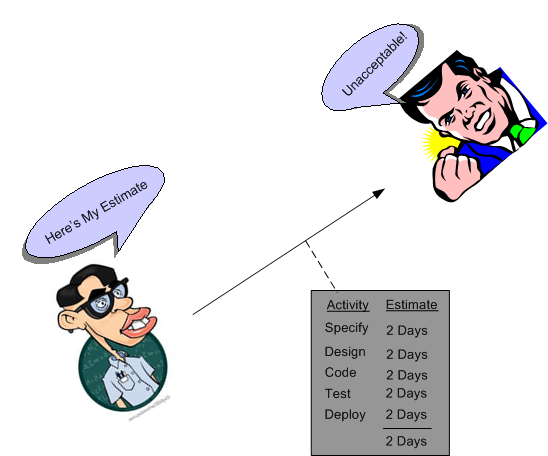
The best book I’ve read (so far) on software estimation is Steve McConnell’s “Software Estimation: Demystifying the Black Art“. Steve is one of the most pragmatic technical authors I know. His whole portfolio of books is worth delving into.
Prior to describing many practical and “doable” estimation practices, Steve presents a dauntingly depressive list of estimation error sources:
- Unstable requirements
- Unfounded optimism
- Subjectivity and bias
- Unfamiliar application domain area
- Unfamiliar technology area
- Incorrect conversion from estimated time to project time (for example, assuming the project team will focus on the project eight hours per day, five days per week)
- Misunderstanding of statistical concepts (especially adding together a set of “best case” estimates or a set of “worst case” estimates)
- Budgeting processes that undermine effective estimation (especially those that require final budget approval in the wide part of the Cone of Uncertainty)
- Having an accurate size estimate, but introducing errors when converting the size estimate to an effort estimate
- Having accurate size and effort estimates, but introducing errors when converting those to a schedule estimate
- Overstated savings from new development tools or methods
- Simplification of the estimate as it’s reported up layers of management, fed into the budgeting process, and so on
- OMITTED ACTIVITIES!
But wait! We’re not done. That last screaming bullet, OMITTED ACTIVITIES!, needs some elaboration:
- Glue code needed to use third-party or open-source software
- Ramp-up time for new team members
- Mentoring of new team members
- Management coordination/manager meetings
- Requirements clarifications
- Maintaining the scripts required to run the daily build
- Participation in technical reviews
- Integration work
- Processing change requests
- Attendance at change-control/triage meetings
- Maintenance work on previous systems during the project
- Performance tuning
- Administrative work related to defect tracking
- Learning new development tools
- Answering questions from testers
- Input to user documentation and review of user documentation
- Review of technical documentation
- Reviewing plans, estimates, architecture, detailed designs, stage plans, code, test cases
- Vacations
- Company meetings
- Holidays
- Sick days
- Weekends
- Troubleshooting hardware and software problems
It’s no freakin’ wonder that the vast majority of software-intensive projects are underestimated, no? To add insult to injury, the unspoken pressure from the “upper layers” to underestimate the activities that ARE actually included in a project plan seals the deal for “perceived” future failure, no? It’s also no wonder that after a few years, good technical people who feel that hands-on creative work is their true calling start agonizing over whether to get the hell out of such a failure-inducing system and make the move on up into the world of politics, one-upsmanship, feigned collaboration, dubious accomplishment, and strategic self-censorship. Bummer for those people and the orgs they dwell in. Bummer for “the whole“.
Killers Or Motivators?
It’s ironic that many of the words and phrases in “100 words that kill your proposal” are used by management and public relations spin doctors to project a false illusion of infallibility:
- Uniquely qualified, very unique, ensure, guarantee
- Premier, world-class, world-renowned, well-seasoned managers
- Leading company, leading edge, leading provider, industry leader, pioneers, cutting edge
- Committed, quality focused, dedicated, trustworthy, customer-first
How can these subjective and tacky words sink a business proposal on the one hand, but (supposedly) inspire and motivate on the other hand?

Extrapolation, Abstraction, Modeling
In the beginning of his book, “Behavior: The Control Of Perception“, Bill Powers asserts that there are three ways of formulating a predictive theory of behavior: extrapolation, abstraction, and modeling.
Extrapolation and abstraction are premised on accumulating a collection observations of behaviors and ferreting out recurring patterns applicable under many contexts and input situations. Modeling goes one level deeper and is based on formulating an organizational structure of the internal mechanisms that cause the observed behaviors.

For 30 years prior to the discovery/development/refinement of control theory (and continuing on today because of entrenched mindsets), psychologists and sociologists formulated theories of behavior based on extrapolation and abstraction. Because the human nervous system and brain were (and still are) unfathomably complex, they didn’t even try to model any underlying mechanisms. They treated organisms as dumb-ass, purposeless, “black box” responders to stimuli.
Bill Powers didn’t accept the superficial approaches and black box conclusions of the social “sciences” crowd. He went deeper and turned opaque-black into transparent-white with the relentless modeling and testing of his control system hypothesis of behavior:
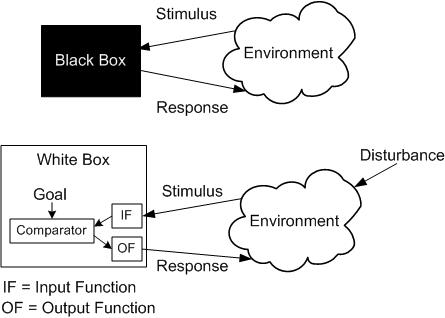
Note that in Bill’s model, there is an internal goal that determines the response to a given “disturbance“. Thus, given the same disturbance at two different points in time, the white box model can generate different responses whereas the black box model would always generate the same response.
For example, the white box model explains anomalies like why, on the 100th test run, a mouse won’t press a button to get a food pellet as it did on the 99 previous runs. In this case, the internal goal may be to “eat until satiated“. When the internal goal is achieved, the externally observed behavior changes because the stimulus is no longer important to the mouse.
Theories based on extrapolation and abstraction are useful for predicting short term actions and trends within a certain probability, but when a physical model of the underlying mechanisms of a phenomenon is discovered, it explains a lot of anomalies unaccounted for by extrapolation/abstraction.
For a taste of Mr. Powers’ control system-based theory of behavior, download and experiment with the software provided here: Living Control Systems III.
Best Of…

The fans have spoken! After reviewing over 1900 dorky images in the BD00 wordpress.com media library, the top 5 were chosen. Here they are:
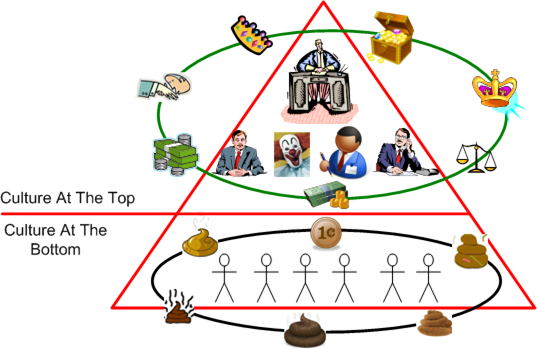
Culture Divide
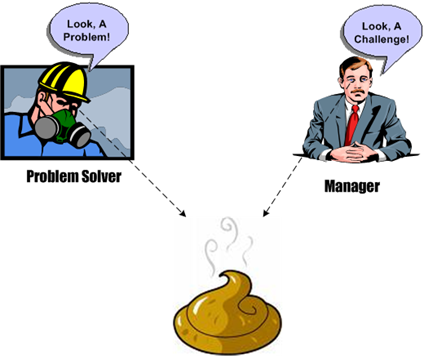
Prallenge
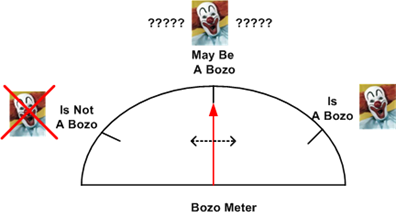
Bozometer
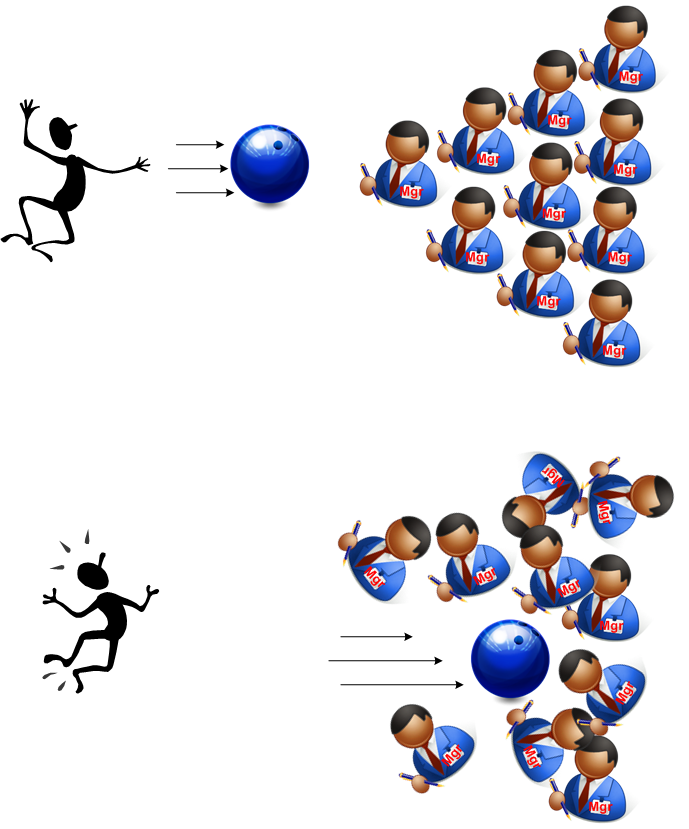
Bowling For Managers
Christmas Message

Even though the polls are closed, you can still tell me what your fave is – or the worst.
The History Of Man
The particulars of each discontinuity may be different, but regardless of which “ism” rules the roost at any given time, the sawtooth pattern is the same at the macroscopic level:

When the ratio of “have-nots” to “haves” in a stable society exceeds an unknown threshold, instability and revolution are sure to follow; it’s just a matter of when. The old order is jettisoned, and the new order, sincerely but falsely promising equity for all, is lovingly embraced by the “have-nots“. The ratio then abruptly decreases because the “haves” are forcefully transformed into the new “have-nots” (usually violently) by the previous crop of “have-nots“…. whose leaders instantly become the new “haves“. And then….. the ratio starts increasing…. yet again.
I guess this is why many people assert that history repeats itself, and lessons, if ever learned, are eventually and conveniently forgotten.

And hey, you’re welcome for the depressing post. But wait… here’s an upbeat closer that (hopefully) makes up for the downer:

Jokes are often offensive. If you get offended, the problem is solidly at your end. – Linus Torvalds
Espoused Vs. In-Use
Although we say we value openness, honesty, integrity, respect, and caring, we act in ways that undercut these values. For example, rather than being open and honest, we say one thing in public and another in private—and pretend that this is the rational thing to do. We then deny we are doing this and cover up our denial. – Chris Argyris
Guys like Chris Argyris, Russell Ackoff, and W. E. Deming have been virtually ignored over the years by the guild of professional management because of their in your face style. The potentates in the head shed don’t want to hear that they and their hand picked superstars are the main forces holding their borgs in the dark ages while the 2nd law of thermodynamics relentlessly chips away at the cozy environment that envelopes their (not-so) firm.
Chris Argyris’s theory of behavior in an organizational setting is based on two conflicting mental models of action:
- Model I: The objectives of this theory of action are to: (1) be in unilateral control; (2) win and do not lose; (3) suppress negative feelings; and (4) behave rationally.
- Model II: The objectives of this theory of action are to: (1) seek valid (testable) information; (2) create informed choice; and (3) monitor vigilantly to detect and correct error.
The purpose of Model I is to protect and defend the fabricated “self” against fundamental, disruptive change. The patterns of behavior invoked by model I are used by people to protect themselves against threats to their self-esteem and confidence and to protect groups, intergroups, and organizations to which they belong against fundamental, disruptive change. D’oh!
From over 10,000 empirical cases collected over decades of study, Mr. Argyris has discovered that most people (at all levels in an org) espouse Model II guidance while their daily theory in-use is driven by Model I. The tool he uses to expose this espoused vs. in-use model discrepancy is the left-hand-column/right-hand-column method, which goes something like this:
- In a sentence or two identify a problem that you believe is crucial and that you would like to solve in more productive ways than you have hitherto been able to produce.
- Assume that you are free to interact with the individuals involved in the problem in ways that you believe are necessary if progress is to be made. What would you say or do with the individuals involved in ways that you believe would begin to lead to progress. In the right hand column write what you said (or would say if the session is in the future). Write the conversation in the form of a play.
- In the left-hand column write whatever feelings and thoughts you had while you were speaking that you did not express. You do not have to explain why you did not make the feelings and thoughts public.
What follows is an example case titled “Submerging The Primary Issue” from Chris’s book, “Organizational Traps:Leadership, Culture, Organizational Design“. A superior (S) wrote it in regard to his relationship with a subordinate (O) regarding O’s performance.
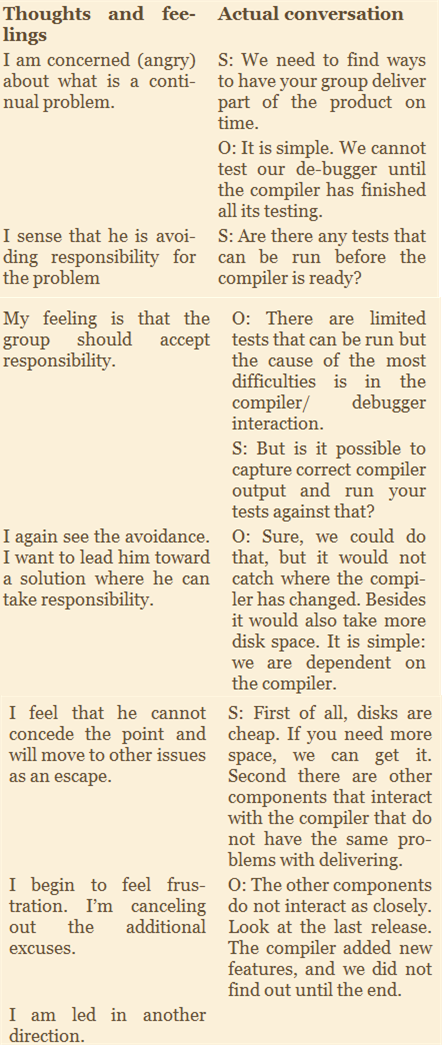
The primary issue in the superior’s mind, never directly spoken in the dialog, is his perception that the subordinate lacks a sense of responsibility. The issue that *did* end up being discussed was a technical one. (I’d love to see the same case as written by the subordinate. I’d also like to see the case re-written by the superior in a non-supervised environment.)
When Mr. Argyris pointed out the discrepancy between the left and right side themes to the case writer and 1000s of other study participants, they said they didn’t speak their true thoughts out of a concern for others. They did not want to embarrass or make others defensive. Their intention was to show respect and caring.
So, are the reasons given for speaking one way while thinking a different way legitimately altruistic, or are they simply camouflage for the desire to maintain unilateral control and “win“? The evidence Chris Argyris has amassed over the years indicates the latter. But hey, those are traits that lead to the upper echelons in corpoland, no?
Ego Battles


And yes, I don my armor daily. It’s war out thar!
Nine Plus Levels
In William T. Powers’ classic and ground-breaking book “Behavior: The Control Of Perception“, Mr. Powers derives a theoretical model of the human nervous system as a stacked, nine-level hierarchical control system that collides with the standard behaviorist stimulus-response model of behavior. As the book title conveys, his ultimate heretical conclusion is that behavior controls perception; not vice-versa.
The figure below shows a model of a control system building block. The controller’s job is to minimize the error between a “reference signal” (that originates from “somewhere” outside of the controller) and some feature in the external environment that can be “disturbed” from the status quo by other, unknown forces in the environment.
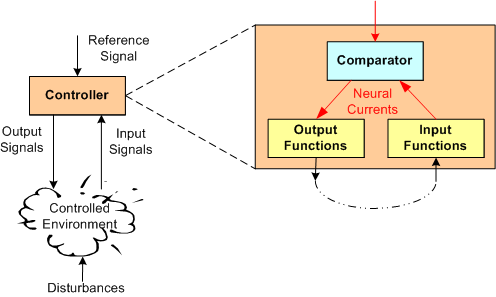
Notice that the comparator is one level removed from physical reality via the transformational input and output functions. An input function converts a physical effect into a simplified neural current representation and an output function does the opposite. Afterall, everything we sense and every action we perform is ultimately due to neural currents circulating through us and being interpreted as something important to us.
So, what are the nine levels in Mr. Powers’ hierarchy, and what is the controlled quantity modeled by the reference signal at each level? BD00 is glad you asked:

Starting at the bottom level, the controlled variables get more and more abstract as we move upward in the hierarchy. Mr. Powers’ hierarchy ends at 9 levels only because he doesn’t know where to go after “concepts“.
So, who/what provides the “reference signal” at the highest level in the hierarchy? God? What quantity is it intended to control? Self-esteem? Survival? Is there a “top” at all, or does the hierarchy extend on to infinity; driven by evolutionary forces? The ultimate question is “who’s controlling the controller?“.
This post doesn’t come close to serving justice to Mr. Powers’ work. His logical, compelling, and novel derivation of the model from the ground up is fascinating to follow. Of course, I’m a layman but it’s hard to find any holes/faults in his treatise, especially in the lower, more concrete levels of the hierarchy.
Note: Thanks once again to William L. Livingston for steering me toward William T. Powers. His uncanny ability to discover and integrate the work of obscure, “ignored”, intellectual powerhouses like Mr. Powers into his own work is amazing.
Dispersion Of Ownership
Much as God was replaced by professional clergy who claim to “know” the will of God, the dispersion of ownership in a company (via the birth of the stock market) birthed the professional institution of management who claim to know the will of the owners.
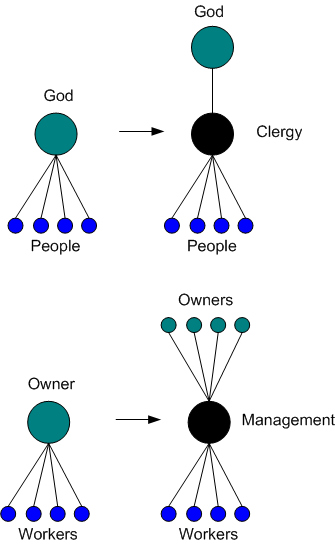
If the will of absentee owners is solely to extract maximal profit from the org, then management indeed knows the will of the owners. And since the workery can no longer communicate directly with the diluted and fragmented owner heap, their concerns and ideas are conveniently out of sight and out of mind; reinforcing the “maximal profit extraction” mindset.
Relying on the fairness of managers to balance profit with worker well-being is not much different than relying on the same behavior from a heap of unconnected, faceless owners because neither group is the original creator of the org.
Note: This post is the result of contemplation and reflection on the Russell Ackoff paper titled: “A SYSTEMIC VIEW OF TRANSFORMATIONAL LEADERSHIP“. It’s yet another unoriginal BD00 meta-post. As usual, I sketched up a picture and pasted some bogus words around it. You can probably come up with a better supporting story yourself. Give it a try.

Why am I here?
WTF?
Meh!
D'oh!

My BTC Address



 Bulldozer00's Blog