Archive
Peer Relationships
As you move up into the Bozone layers in a DYSCO, in addition to honing your Kiss-Up-Kick-Down skills, your horizontal relationships with your peers mysteriously start to change…..

Of course, the diagram is totally wrong and it lacks credible scientific evidence to back it up, no? Hey, what do you expect from a L’artiste?
Temporary Reprieve
Since I‘m an egomaniac and I often feel guilty about being one, I bash the “I, ME, MY” thought source all the time. However, since eliminating absolute black and white binary thinking is a major blow to my ego, I feel compelled to give credit where credit is due.
Being too lazy to concoct my own tribute to the ego’s sunny side, I’ll steal and regurgitate Steve Taylor‘s eloquent words to pay homage to “me“:

So there. Now that I‘ve said nice things about the “enemy“, the temporary reprieve is over and it’s time to get back to ego bashing. Stay tuned for more hipocritical ego bashing in the future.
Don’t Stop There
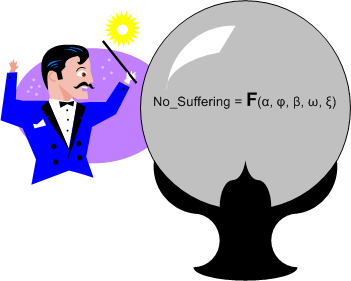
Buddha said that “life is suffering“. Many people, especially those stuck inside their head like me, stop there and say “no shit sherlock“. However, what if one continues on with “and if, by an act of grace, you come to realize this profound truth in your bones, your suffering will start to fade“?.
For the legions of skeptics out there, I do have a rigorous and irrefutable mathematical proof of this truth, but my sale price hasn’t been met yet.
Ripple Effect
During a peek-a-boo visit many years ago, it was revealed to me that everything a person does has a ripple effect:
 What type of encoded signals modulate your ripples?
Scott Meyers On C++0x
From what I know (which is very little), it looks like the C++0x programming standard will finally be released to the world as C++0B this spring. As part of preparing for this release, I recently listened to an interview with “Effective” Scott Meyers on Software Engineering Radio.
In case you find yourself bored, and with an hour of free time on your hands, check out my audio + notes pencast recording of the interview on the Livescribe smart pen site: here. (Clicking on the pic below won’t start the pencast in-situ. I haven’t figured out how to embed pencasts into this blog yet).
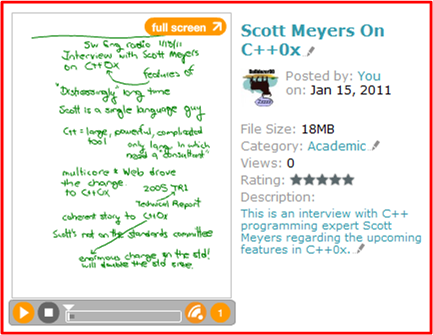
The interview was an interesting mix of good technical information from Scott, triggered by great questions from the interviewer. Nevertheless, at several points during the interview, the interviewer seemed to interject sarcastic commentary that showed his disdain for the language. He obviously wasn’t/isn’t a C++ language fan, but he still did a great job with his questions. The interview never veered off into a “your language sux and my language rules” religious war and the interviewer’s snarky remarks kept the interview refreshing:
“Why doesn’t C++ have garbage collection? …… Because then there would be nothing left.”
In summary, Scott used his considerable teaching talent to clearly and concisely explain these key features of the “C++0B” standard:
- concurrency
- the “auto” keyword
- move semantics using rvalue references
- variadic templates
- lambda functions
- uniform initialization syntax
- tuples (or as the interviewer pronounced, “two-pulls” 🙂 )
If C++ is your programming language of choice and you haven’t followed the development of the new standard, now may be the time to start wading in? The Meyers interview, this excellent Wikipedia C++0x starter page, and Bjarne Stroustrup’s C++0x FAQ page may help.

Related Articles
- An Interview with C++ Creator Bjarne Stroustrup (codeguru.com)
- Type Inference vs. Static/Dynamic Typing (herbsutter.com)
Trustworthiness Metrics
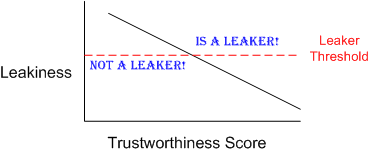
Check out this hilarious blarticle from “Federal Computer Week“: Measuring federal employees’ moods to determine trustworthiness. If you don’t want to go there, I’ll cherry pick the parts that reinforce my UCB:
In the memo, national security officials ask agencies what metrics they use to measure trustworthiness without alienating employees. They also ask agencies if they use psychiatrists or sociologists to measure relative happiness or “despondence and grumpiness” as means to gauge an employee’s trustworthiness.
My question is: Do these rule-making, memo-writing “national security officials” eat their own dog food; practice what they preach? Do they “objectively” measure their own trustworthiness and “leakability“? I’d love to see an enumerated list of these officially sanctioned metrics.
Moving on, let’s see what the article says about the latest fading management buzzword, “engaged“:
…because now there’s more understanding about the importance of an engaged workforce.
WTF? Just now, and not waaay before now?
I’m sure that our government is going down the right path with the strategies they’re proposing for stopping future Wikileaks type fiascos. Our government SCOLs need to declare “a war on leaks” and appoint a “Leak Czar“. Wars and czars are sure-fire solutions that have worked before on terrorism, drugs, crime, and obesity, right? Maybe businesses should employ the “war” and “czar” metaphors too. Oops, they already do, but without publicly espousing it.
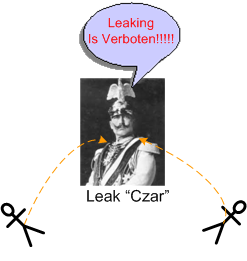
Does writing this post decrease my trustworthiness score? By how much? What’s your trustworthiness score?
Berkun Myths
Steven Johnson‘s book, “Where Good Ideas Come From“, seems to have garnered more accolades and publicity, but Scott Berkun‘s “The Myths Of Innovation” is also an insightful, well crafted, and surprising read on much-the-same topic. I haven’t read Steven’s book yet (it’s on my list), but I’ve read and enjoyed both editions of Scott’s book.
Here is Scott’s list of the 10 myths of innovation:

My faves are numbers 4, 6, and 7. Regarding number 4, one of my favorite quotes fits the bill:
Don’t worry about people stealing your ideas. If your ideas are any good, you’ll have to ram them down people’s throats. – Howard Aiken
What are your faves? Are there any myths missing from the list? What do you think are the “truths” of innovation? Are they just the inverses of the list?
Caught Chetan Again!
It’s sad, so sad. It’s a sad, sad situation. And it’s gettin’ more absurd. – Elton John
Sometimes, actually, a lot of times, I like to commiserate with like-minded people (isn’t that what community is all uh-boot?). Thus, when I recently hooked up with new e-friend and author of “Why Your Boss Is Programmed To Be A DICtator“, Chetan Dhruve, we commiserated about the current stagnant state of leadership in the business world. In one of our exchanges, Mr. Dhruve asked:
May I request a favor. Could you please post your review of my book on Amazon.com? This is because many readers email me their comments directly after reading the book – with the result that the number of reviews is low (only 3 reviews currently). In many cases, readers are afraid to put up reviews for fear of being being found out and victimized at their workplaces, and hence don’t want to take any chances. In fact, many people have told me that they are afraid to even place the book on their workplace desks in full view, simply because of the book’s title. – Chetan Dhruve
Of course, that statement sent a shiver down my spine, but I did what he asked because – a man’s gotta do what he’s gotta do (for me, replace the word “man” with “child“). Upon further dialog, Chetan continued on with a couple of other scary vignettes:
A friend of mine (in the US) who loved the book bought 10 copies to give to clients. He then had the thought: “What if my clients feel that I’m implying they are bad bosses? Maybe I will lose their contracts.” So instead of giving the books to clients, he gave the books to relatives. He told me all this saying, “The book’s title will scare people, and it’s going to be a problem for you.” Indeed, he has proven to be correct.
A similar thing happened with another friend of mine. She gave a copy of my book as a gift to a friend of hers, whereupon the friend was instantly offended and got defensive saying, “I promise I will try hard to be a good boss.” This was even before reading the back cover of the book!
The irony is that the book doesn’t blame individuals but the system. And these gut-reaction behaviors only prove the point that we have dictatorship systems at our workplaces. It’s terrible, absolutely terrible, to know that people are frightened to simply have such a book on their table! I didn’t anticipate that the fear levels would be so high, that too in a free country.
I hate to sound like a know-it-all (well, maybe not), but I coulda told Chetan of the reality of his last sentence before he shockingly discovered it for himself. No matter how much one abstracts an anti-hierarchy message and directs it away from specific people, people above level 0 in a hierarchy are going to get offended at the slightest hint that you resonate with Chetan’s blasphemous message. After all, hierarchy has a sacred origin and religion has always been at the top of the heap when it comes to instilling fear into people, no?.

The statements that make people mad are the ones they worry might be believed. I suspect the statements that make people maddest are those they worry might be true. – Paul Graham
Related Articles
Nice And Competent
It’s prolly just me, but I can’t seem to fully accept that most people equate niceness with competence – especially in the guild of layered management. Oh sure, there are lots of cases where people are both nice and competent, but there may be more cases where people are both nice and incompetent. What does your experience indicate?
One reason why there may be a lot of people who are both nice and incompetent is because niceness can camouflage incompetence – at least temporarily, and at most, till retirement. If you’re nice, your boss won’t scrutinize your work output (if he can understand it and isn’t incompetent himself) as closely than if you’re not nice. Thus, it’s better to be nice and incompetent than to be mean and incompetent – duh. Hell, niceness counts so much at top tier DYSCOs that it’s better to be nice and incompetent than not-nice and competent. Niceness trumps competence at these back asswards citadels.
If you’re a DICster, where it’s easier to “measure” competence by the material results you either do or don’t create, the cover up of incompetence by niceness doesn’t work nearly as well than if you’re a BM, SCOL, CGH, or BOOGL in a CCH org. Why? Because it’s much harder to measure middle management output. Most managers don’t create much of anything (except for angst and turmoil), so how can their performance be meaningfully measured? Plus, the senior managers who are supposed to do the “objective” measuring of their appointees don’t want to look bad by admitting that they knighted incompetent subordinate managers and incompetent, elite staff members.
So, what about me? I’m not nice and I’m incompetent, so this blarticle doesn’t apply to me. What about you?

Note: One way for a senior manager to measure a “junior manager’s performance is to ask junior’s people how he/she is helping them to grow and do a better job. Do you think this is done often in the corpo world? Even when this skip-level technique is miraculously performed, do you think honest feedback is obtained? Why or why not?
Meritocracy Hippocracy
Thanks to software guru Ron Jeffries, I just discovered this article from “Sociation Today“: The Meritocracy Myth. In their piece, authors McNamee and Miller restate the oft espoused American dream as:
Getting ahead is ostensibly based on individual merit, which is generally viewed as a combination of factors including innate abilities, working hard, having the right attitude, and having high moral character and integrity.
They then attempt to prove that it’s a myth:
“..the really big money in America comes not from working at all but from owning, which requires no expenditure of effort, either physical or mental. In short, working hard is not in and of itself directly related to the amount of income and wealth that individuals have.”
Of course, being academics, McNamee and Miller are required to present income and wealth distribution statistics to bolster their case:

OK, so assume that they convinced “us” that the American dream has morphed into a ruse. What actions do McNamee and Miller propose to transform the myth into reality? They present these well-worn yawners:
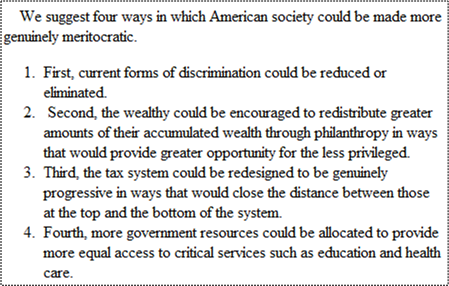
But wait. Maybe we don’t want an ideally meritocratic society. As McNamee and Miller imply: Isn’t there a chance that the meritorious who’ve risen to the top of the income and wealth charts would develop a sense of righteous entitlement? Wouldn’t they “look down” upon those who haven’t advanced in life based on merit?
Well, yeah – ego dominated humans will be humans. But wouldn’t a system based on merit be fairer than one that keeps privileged and meritless aristocrats entrenched in power and “looking down“? Don’t you think meritorious leaders would have a greater sense of humility and compassion than aristocratic, silver-spoon-fed leaders? At least the American dream would be alive and kicking. The hope of personally creating a better life would become a reality, and not remain just a mythical pipe dream.
All ideologies end up killing people. – Jean Goss

Why am I here?
WTF?
Meh!
D'oh!

My BTC Address



 Bulldozer00's Blog