Archive
Us And Them
Poor org leaders, or SCOLs, either maintain a stratified “Us And Them” (UAT) line in their orgs or worse – they purposefully create one. By hiring clones of themselves, multiple UAT lines of demarcation appear; choking off open, honest, inter-layer communication and breeding mistrust and disrespect.

Great leaders, or PHORs, skillfully obliterate UAT lines where they exist, or they heroically prevent UAT lines from arising in the first place. Of course, that’s what makes them great leaders.


Compensation Compression
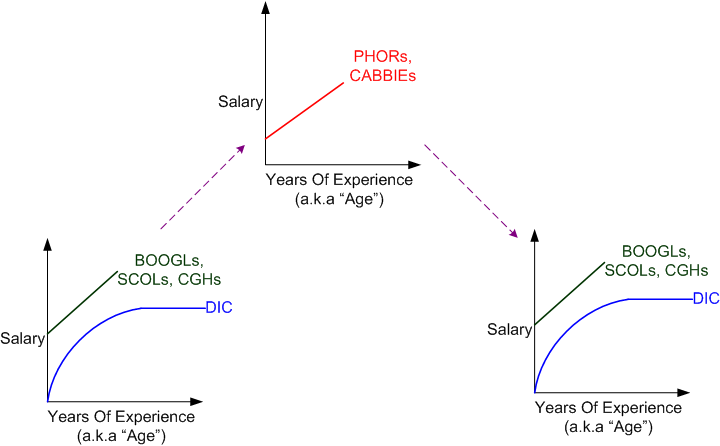
The figure below shows the salary trends for a typical corpricracy comprised of DICs, BOOGLs, SCOLs, and CGHs. Notice that the sky’s the limit for manager types and compression occurs for the DICforce. Is that the way it should be? In theory, probably yes. In practice, most likely no.
 The most frequent reason given by the mainstream management guild for rationalizing the curve is that managers have more responsibility and greater impact on an org than any “induhvidual contributor” DIC. That is true, but are they fulfilling their responsibility? Is their impact positive or negative? Oh sure, every viable org has at least a handful of PHOR managers that fulfill their responsibilities and positively impact the org, but all mediocracies are filled with BOOGLs, SCOLs, and CGHs who don’t fulfill their responsibility and negatively impact the corpricracy.
When the inequity in compensation becomes blatantly obvious and intolerable, a handful of underappreciated DICs usually break off and form their own startup where everyone starts out as either a CABBIE or PHOR. Ironically, as the startup grows and allegedly matures:
- The majority of PHORs transform into BOOGLs, SCOLs, and CGHs while retaining the mindset that they’re still PHORs.
- The BOOGLs, SCOLs, and CGHs start perceiving the CABBIEs as DICs; a cost to be minimized.
A Key Ingredient
As Tony Hsieh states in “Delivering Happiness“,
A key ingredient in strong (business) relationships is to develop emotional connections. – Tony Hsieh
In my fantasy world, I find this extremely ironic because, in “business”, most corpricracies only anoint those who can cleverly camouflage their emotions to exalted and coveted leadership positions. And yet, here is Mr. Chez, the CEO of a profitable billion dollar company in the cutthroat shoe retail industry, “nicely” flipping the finger at mainstream American business and the esteemed B-school advice they rode in on.
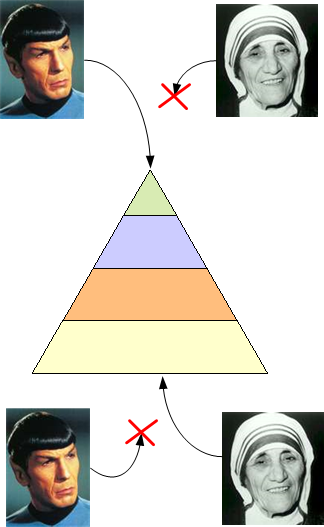
It’s funny how “passion”, which can be defined as a “strong emotion“, is demanded of the DICforce, but Spock-like emotional control is required by SCOLs and BOOGLs for ascension to the throne.
Why Do You Guys Suck?
In this Gary Hamel post, Extreme Management Makeover, Mr. Hamel tells the story of HCL Technologies CEO Vineet Nayar’s passionate effort to turn his company’s culture upside down. Read the article to discover the slew of wildly unorthodox actions that Vineet executed to achieve his goal. As a sampling of Mr. Nayer’s courage and determination to buck the status quo, check this one out:
HCLT employees are able to rate the performance of any manager whose decisions impact their work lives, and to do so anonymously. These ratings are published online and can be viewed by anyone who has submitted a review. This visibility challenges managers to be more responsive and exercise their authority judiciously. The number and organizational scope of the reviews a manager receives are also a good indicator of an individual’s zone of influence—is he or she adding value across a wide swath of the company, or only within a narrow sphere? Importantly, this “feedforward” process isn’t connected to compensation and promotion decisions. It is purely developmental. Nevertheless, there aren’t many hiding places left at HCLT for mediocre managers.
Want another zinger?
Early on, Vineet and his leadership team set up an online forum and encouraged employees to ask tough questions and offer honest feedback. Nothing was censored on the “U&I” site; every post, however virulent, was displayed for the entire company to see. Vineet recalls that in the beginning, “virtually 100% of the questions were dirty questions. ‘Why do you guys suck?’ ‘Why does your strategy suck?’ ‘Why aren’t you living up to your values?’’ While some managers bemoaned the fact that all of the company’s soiled laundry was now online, employees lauded the forum as a symbol of HCLT’s commitment to transparency and as another way to hold top management accountable. The U&I portal had another value: it was also an early warning system for critical issues facing the company.
Does your company even have a DICforce-to-management U&I portal? If you’re lucky enough to have one, is it anonymous and uncensored so that the submitted questions are more than just cream puffs?
 If Vineet was in any position other than the CEO, do you think his idea of “employees first, customers second” would have any chance at all of being heard, let alone being placed into execution? Do you think managers in general explore the landscape for innovative management practices and weird, heretical companies like HCLT, Zappos.com, SAS Institute, SEMCO, et al?
Much To Like
There’s much to like in Zappos.com CEO Tony Hsieh’s new book: “Delivering Happiness“. In addition to detailing the inspiring rags-to-riches Zappos.com story, Mr. “Chez” shares many nuggets of wisdom that he discovered along the way:
Don’t play games that you don’t understand, even if you see lots of other people making money from them.
It doesn’t matter how flawlessly a business is executed if it’s in the wrong business or if it’s in too small of a market.
Without conscious and deliberate effort, inertia always wins.
The presentation of the truth is as important as the truth.
Never outsource your core competency. If we were trying to be about customer service, we knew that we shouldn’t be outsourcing that (call center).
Without a separation of work and life, it’s remarkable how values can be exactly the same.
Don’t measure call times, don’t force employees to upsell, and don’t use scripts.
A key ingredient in strong relationships is to develop emotional connections.
It’s not what you say or do, but how you make people feel that matters the most.
For individuals, character is destiny. For organizations, culture is destiny.
As it turns out, many of the best ideas came about while having drinks at a local bar.

A Blessing And A Curse
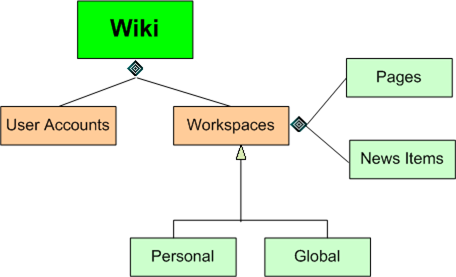
The figure below depicts a UML class diagram model of the static structure of a typical Wiki system. A Wiki may be comprised of many personally controlled and/or global workspaces. Each logical workspace is composed of user created work pages and news items (a.k.a. blog posts). Lastly, a Wiki contains many user accounts that are either created by the users themselves or, in a more controlled environment, created by a gatekeeper system administrator. Without an account, a user cannot contribute content to the Wiki database.
Org Wikis are both a blessing and a curse. They’re a blessing for the DICforce in that they allow for close collaboration and rapid, real-time information exchange between and across teams. They also serve as an easily searchable and publicly visible record of org history.
In malevolent and stovepiped CCHs where SCOLs and BOOGLs rarely communicate horizontally and, even more rarely, downward to the DICforce, Wikis are a curse because….
Networks make organizational culture and politics explicit. – Michael Schrage
BOOGLs and SCOLs that preside over malevolent CCHs don’t like having their day-to-day operational behavior exposed to the light of day. If a malevolent CCH org is liberal enough to “approve” of Wiki usage, chances are that none of the BOOGLs or SCOLs will contribute to its content. In the worse case, a Wiki police force may be established to enforce posting rules designed to keep politics and positioning behavior secret. Hell, without censorship, the DICforce might form the opinion that they are being led by a gang of thugs who are out for themselves instead of the lasting well being of the org.
Are you here to build a career or to build an organization? – Peter Block
A Change In Funding Source
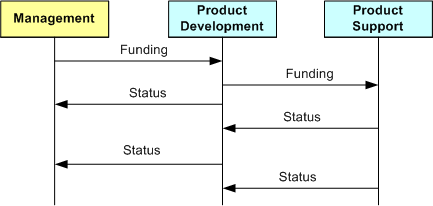
The figure below shows a dorkily simplistic UML sequence diagram example of the provision of service from a support group (e.g. purchasing, quality assurance, configuration management) to a product development group within a CCH patriarchy. During product development, the team aperiodically requires and requests help from one or more corpo groups who’s raison d’etre is to provide timely support to those who need it. 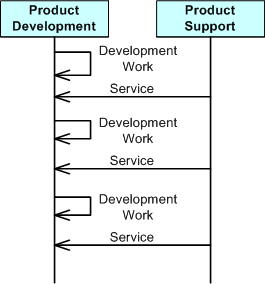 Depending on who’s leading the support group, the service it provides can be highly responsive and of high quality. However, since the standard “system” setup in all CCH corpocracies is as shown in the sequence diagram below, the likelihood of that being true is low. That’s because in centralized patriarchies, all budgets, salaries, and token rewards are doled out by the sugar daddys perched at the top of the pyramid. On the way down, the middlemen in the path take a cut out of the booty for, uh, the added-value “leadership” they provide to those on the next lower rung in the ladder.

In exchange for their yearly/quarterly investments in the lower layers of the caste system, the dudes in the penthouse require periodic status reports (which they can’t understand and which are usually cleverly disguised camouflage) that show progress toward wealth creation from the DICs below.
Since their bread is buttered from the top and not their direct customers, the natural tendency of support groups is to blow off their customers’ needs and concentrate on maximizing their compensation from the top. They do this, either consciously or unconsciously, by adding complexity to the system in the form of Byzantinian procedural labyrinths for customers to follow to show how indispensable they are to the b’ness. As a result, their responsiveness decreases and their customers experience an increase in frustration from shoddily late service.
So how does one fix the standard, dysfunctional, centralized, CCH setup? Check out and ponder the sequence diagram below for a possible attempt at undoing the dysfunctional mess. Can it work? Why, or why not?
By definition, if everyone is doing industry best practice, it’s not best practice. It’s average practice.
Bureaucracy Reinforcement
In the “Bureaucracy Formation” post, I hypothesized about how orgs can undetectably transform from vibrant and flexible citizens into rigid and slovenly slow, bullies. As a refresher, the figure below carries over the pre- and post-transformation “system” states from that post. Sadly, after the t=Bureaucracy time threshold is passed, the situation gets worse than the picture implies.
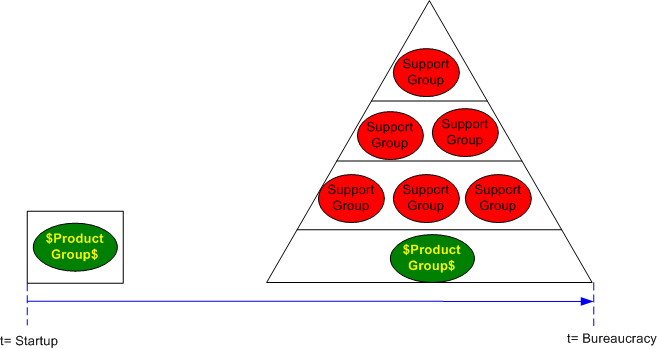
In order to survive, thrive, and indisputably “show” their importance to the well being of the whole, each support group continuously adds more and more time sucking and money hogging work of questionable added-value to the system. However, the work they add is not for them to do. Incredulously, it’s red tape work they impose on their clients (a.k.a. customers), which are the product group and “other” support groups that are forced to use their service.
Early on in the stages of org development, it’s relatively easy to get support. You ask a person for help and you get it in a timely fashion. If you have to supply input along with your request, like a piece of software, or hardware, or a document, you don’t have to meet any arcane content, formatting, or packaging requirements. Over time, however, everything changes. First, a simple form is required. Then, a more detailed form. Then, more than one form. Then multiple forms and multiple signatures are required. Then you are required to follow a detailed step by step procedure that is so arcane and unmemorable that you have to look it up every time you need service. Then, if you do something wrong, you’re scolded for not knowing the process. On and on it goes. You get the picture, no?
Where You Stand
In “Making It Big In Software“, author Sam Lightstone quotes former GE CEO Jack Welch:
You want to make sure everyone knows where they stand in the organization. It’s a leader’s obligation. In most companies, the leaders stand back, and people don’t know where they stand. – Jack Welch
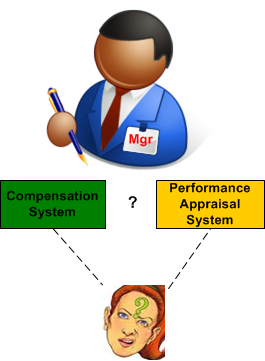
Do your performance appraisal and compensation systems allow you to clearly determine where you stand? If not, do you know what’s missing (hint: a clear and unconfusing connection between the two)? If you do know what’s missing, have you raised your concern to management? If you haven’t raised your concern to management, why not (hint: fear)?
Bureaucracy Formation
Since I’m not a big fan of bureaucracies, let’s have some fun and see how these resource sucking and dehumanizing orgs are naturally formed right under the noses of the high paid corpo dudes who are ironically “responsible” for keeping costs down. As you’ll see, it may even be worse than you think. The infallible, know-it-all, multi-titled CGHs in charge not only allow their bureaucracy to flourish, they feed and water it as a result of the unconscious and self-centered need for ego expansion.
Check the figure below out for a hypothetical example of the formation of a bureaucracy over time. As usual, I’ve made the example up (cuz I’m a L’artiste) and I’ve simplistically decomposed a complex org into two group archetypes; product and support. In my obviously wrong dream-world, the otherwise highly esteemed management class is a support group sub-type, of course.
At t=Start, when a vibrant and competent startup org is initialized, there are no “support” groups: nada, zilch. There’s only a product development (or service provider) group that does everything needed to sustain and grow a business around the wealth-creating product (or service).

As time tics by and the fledgling enterprise grows, one support group after another is added as another ring of fat around the product development group core. At the beginning, the support groups are few, and they’re subordinate both in stature and compensation to the wealth creation group because everyone knows that the product and/or service brings home the bacon.
As the org matures, an incredulous flip in the stature structure snaps into place (t=T3 in the example above) because, well, because that’s the way it is. The first of many subsequent support groups to rise in stature is the executive level management cadre. As even more corpo maturation accrues, all emotional enthusiasm and passion is expelled from the org because the same-old, same-old, mechanistic, B-school and Wall Street psychology usurps the childlike and immature “let’s change the world” mindset which birthed the org in the first place. The so-called management leadership cabal catalyzes and accelerates the move to bureaucracy by; treating wealth creators as easily replaceable DICs, punishing any publicly expressed passion and enthusiasm, cloning themselves in newly added middle management layers, and growing their personal empires in order to inflate their pocketbooks and sense of importance at the expense of the org as a whole. Bummer.
“Are you here to build a career or to build an organization?” – Peter Block

Why am I here?
WTF?
Meh!
D'oh!

My BTC Address



 Bulldozer00's Blog