Archive
Measuring Clock Resolution
The Boost.Date_Time C++ library provides an excellent, platform-independent set of interrelated classes for measuring and tracking times and dates during program operation. It is much more capable and, more importantly, accurate than the standard C++ <ctime> library inherited from C. Since we need to benchmark the average and peak latency for our growing distributed, real-time, system infrastructure running on Linux, Solaris and (maybe) Win32 platforms, I decided to use the Boost.Date_Time functionality to measure the clock resolution on a representative of each platform.
The UML activity diagram below shows the simple algorithm that I used to write a small program that estimates the clock resolution of any compiler-CPU-OS platform combo that Boost.Date_Time is available for. The assumption underlying the design is that the program instructions inside the loop execute an order of magnitude faster than a clock tick increments. At CPU speeds on the order of GHz ( nanoseconds) and clock periods of microseconds, this is a pretty decent assumption, no? The algorithm simply spins around in a tight, high speed loop waiting for the clock to change value relative to an initial reference sample. Note that measuring hardware clock accuracy is another story (Does anyone know if clock hardware accuracy can even be estimated in software?).

The function below shows the super secret, proprietary, source code that uses the Boost.Date_Time facilities to implement the clock resolution estimation algorithm. Note that the boost microseconds clock, as opposed to the nanoseconds or seconds clock, is used to grab time samples. The seconds clock is too coarse grained for our needs and typical off-the-shelf servers do not provide hardware clocks with nanosecond resolutions without add on circuitry. The box below the code shows the results that I obtained for three platforms on which I ran the program. Of course, the results aren’t perfect (are any results ever perfect?), but since the Solaris and Linux results provide sub-millisecond resolution and we expect end-to-end system latencies on the order of hundreds of milliseconds, the clocks will satisfy our latency measurement needs. Of course, the Win32 result is crappy. Got any thoughts?

Status Seekers And Superheroes
Some people don’t like the dude, but I love Richard Branson. Why? Because he breaks the mold of CEOs who steadfastly cling to their self-image of infallibility and hide within their enclaves for fear of ruining said image and appearing human. Check out this paragraph from “It’s all About the People“.
Try to avoid hiring status seekers, as they tend to distance themselves from their employees. Look for people who care passionately about the company and not simply their status within it. In my experience, they must want to build a business that all its employees can all be proud of – one that will look after its staffers and customers alike. Of course, you can’t get it right every time. When you do make the wrong management decision, it’s vital to act decisively. As the saying goes, “Rot starts at the top”. – Richard Branson
The trick, of course, is knowing how to separate the wheat from the chaff; the bozos from the non-bozos. Mr. Branson goes on to talk about the importance of ferreting out problems before they mushroom into full blown crises:
How will you know when things are going wrong? In the early days at Virgin, I would give out my phone number to all our music company staffers and tell them to call me whenever they felt we were doing something really wrong. This was key to our development as a business, both because it helped me to identify problems early on and, more importantly, because it let the employees know that management was ready to listen to them. Fostering this kind of dialogue is essential if you want to build a company that will grow and thrive. Your staff will feel more valued and committed if they really believe you are listening to them, and you will benefit from hearing a lot of great ideas from the people on the front lines. – Richard Branson
I think the two points that Richard illuminates go hand in hand. When a SASS (who shouldn’t have been hired in the first place) is the primary cause of a problem, he/she will cleverly camouflage and redirect the blame. Having successfully moved him/her self out of harm’s way, our SASS will next offer to step up, don his/her superhero suit, and dissolve the crisis. Of course, the SASSholes situated above our superhero in the CCH will happily guzzle the full glass of koolaid.

Read, Read, Read
To put it mildly, I’m not too fond of software project and “functional” software managers that don’t read code. Even worse, wanna-be-manager tweeners and lofty software “architects” who don’t read code are the pits. Note that I’m not demanding that these exalted ones write code, just actually RTFC (Read The F#@^&*! Code). Why? I thought you’d never ask…..
You see, I’m a believer in the “trust but verify” motto popularized by Ronald Reagan during the cold war. The only pseudo-objective way to truly assess progress, consistency, and quality on a software project is to sample the product – you know, the code. If you know of a better way, then I’m all ears.
It’s not that I don’t trust people to try their best, it’s just that most hierarchical cultures are toxic by unintentional design and that forces people to innocently cover up or camouflage a lack of progress when they fill out their “weekly status sheets” or verbally report progress at useless CYA (Cover Your Arse) meetings. Sadly, once DICs get appointed into elite manager and architect titles, they tend to leave their code reading and (especially) writing days behind. Of course, they’ve arrived (Halleluja!) and they no longer have to do any “janitorial” work that can be done by fungible DORKs.
How about you? Do you think people in the roles of software project manager, software functional manager, and software architect should actively read code as part of their jobs?

In many companies, enterprise architects sit in an ivory tower without doing anything useful. – Ivar Jacobson
The Sociopaths, The Clueless, And The Losers
So, you’ve never heard of the “gaping void”? Hugh MacLeod? “Ignore Everybody“? Here’s a taste of Hugh’s work:

Of course, I fall into Hugh’s “Losers” category, but considering the alternatives I feel pretty good.
For you fellow software weenies, here’s what Grady Booch (in Masterminds Of Programming) has to say:
There’s a delightful site called Gaping Void. He’s basically a PR-type person and his claim to fame is he does art on the back of business cards. But he has this riff which has been very popular about how to be creative. You might point your readers to that one.
Uh, what are you waiting for? Scurry on over to Hugh’s site and sign up for his daily cartoon. You won’t be disappointed and you’ll feed your famished mind with some tasty food. Yum yum!
An Epic Heavyweight Battle
In this corner, we have Bjarne “No Yarn” Stroustrup, the father of C++. In the other corner, we have James “The Goose” Gosling, the father of Java. Ding, ding…… let’s get ready to ruuuumble!
“No Yarn” comes outs swinging and throws the first haymaker:
Well, the Java designers—and probably the Java marketers even more so—emphasized OO to the point where it became absurd. When Java first appeared, claiming purity and simplicity, I predicted that if it succeeded Java would grow significantly in size and complexity. It did. For example, using casts to convert from Object when getting a value out of a container (e.g., (Apple)c.get(i)) is an absurd consequence of not being able to state what type the objects in the container is supposed have. It’s verbose and inefficient. Now Java has generics, so it’s just a bit slow. Other examples of increased language complexity (helping the programmer) are enumerations, reflection, and inner classes. The simple fact is that complexity will emerge somewhere, if not in the language definition, then in thousands of applications and libraries. Similarly, Java’s obsession with putting every algorithm (operation) into a class leads to absurdities like classes with no data consisting exclusively of static functions. There are reasons why math uses f(x) and f(x,y) rather than x.f(), x.f(y), and (x,y).f()—the latter is an attempt to express the idea of a “truly object-oriented method” of two arguments and to avoid the inherent asymmetry of x.f(y).
In an agile counter move, “The Goose” launches a monstrous left hook:
These days we’re beating the really good C and C++ compilers pretty much always. When you go to the dynamic compiler, you get two advantages when the compiler’s running right at the last moment. One is you know exactly what chipset you’re running on. So many times when people are compiling a piece of C code, they have to compile it to run on kind of the generic x86 architecture. Almost none of the binaries you get are particularly well tuned for any of them. When HotSpot runs, it knows exactly what chipset you’re running on. It knows exactly how the cache works. It knows exactly how the memory hierarchy works. It knows exactly how all the pipeline interlocks work in the CPU. It knows what instruction set extensions this chip has got. It optimizes for precisely what machine you’re on. Then the other half of it is that it actually sees the application as it’s running. It’s able to have statistics that know which things are important. It’s able to inline things that a C compiler could never do. The kind of stuff that gets inlined in the Java world is pretty amazing. Then you tack onto that the way the storage management works with the modern garbage collectors. With a modern garbage collector, storage allocation is extremely fast.
On the age old debate about naked pointers, “The Goose” unleashes a crippling blow to the left kidney:
Pointers in C++ are a disaster. They are just an invitation to errors. It’s not so much the implementation of pointers directly, but it’s the fact that you have to manually take care of garbage, and most importantly that you can cast between pointers and integers—and the way many APIs are set up, you have to!
Enraged, “No Yarn” returns the favor with a rapid jab, jab, jab, uppercut combo:
Well, of course Java has pointers. In fact, just about everything in Java is implicitly a pointer. They just call them references. There are advantages to having pointers implicit as well as disadvantages. Separately, there are advantages to having true local objects (as in C++) as well as disadvantages. C++’s choice to support stack-allocated local variables and true member variables of every type gives nice uniform semantics, supports the notion of value semantics well, gives compact layout and minimal access costs, and is the basis for C++’s support for general resource management. That’s major, and Java’s pervasive and implicit use of pointers (aka references) closes the door to all that.
The “dark side” of having pointers (and C-style arrays) is of course the potential for misuse: buffer overruns, pointers into deleted memory, uninitialized pointers, etc. However, in well-written C++ that is not a major problem. You simply don’t get those problems with pointers and arrays used within abstractions (such as vector, string, map, etc.). Scoped resource management takes care of most needs; smart pointers and specialized handles can be used to deal with most of the rest. People whose experience is primarily C or old-style C++ find this hard to believe, but scope-based resource management is an immensely powerful tool and user-defined types with suitable operations can address classical problems with less code than the old insecure hacks.
Stunned silly, “The Goose” steps back, regroups, and charges back into the fray:
One of the most problematic (situations) over the years in C++ has been multithreading. Multithreading is very tightly designed into the code of Java and the consequence is that Java can deal with multicore machines very, very well.
“The Yarn” stands his ground and attempts to weather the ferocious onslaught:
The very first C++ library (really the very first C with classes) library, provided a lightweight form of concurrency and over the years, hundreds of libraries and frameworks for concurrent, parallel, and distributed computing have been built in C++. C++0x will provide a set of facilities and guarantees that saves programmers from the lowest-level details by providing a “contract” between machine architects and compiler writers—a “machine model.” It will also provide a threads library providing a basic mapping of code to processors. On this basis, other models can be provided by libraries. I would have liked to see some simpler-to-use, higher-level concurrency models supported in the C++0x standard library, but that now appears unlikely. Later—hopefully, soon after C++0x—we will get more libraries specified in a technical report: thread pools and futures, and a library for I/O streams over wide area networks (e.g., TCP/IP). These libraries exist, but not everyone considers them well enough specified for the standard.
And the winner is………?
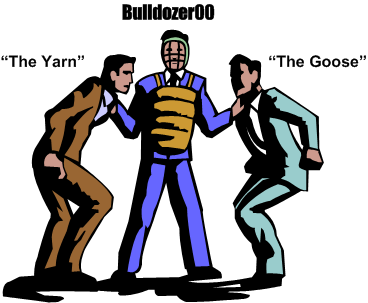
So, do you think that I’ve served well as an impartial referee for this epic heavyweight battle? Hell, I hope not. I’m strongly biased toward C++ because it’s taken me years of study and diligent practice to become an intermediate-to-advanced C++ programmer (but still well below the skill level of the masters). I think that most Java programmer’s who religiously trash C++ do so out of fear of: its breadth+depth, its suitability for application at all layers of the stack, and the option to “get dangerously close to the machine“. On the other hand, C++ programmers who trash Java do so out of a sense of elitism and a disdain for object oriented purity.
Note: The snippets in this blarticle were copied and pasted from the delightful and engrossing “Masterminds Of Programming“. The book’s author, Federico Biancuzzi, not only picked the best possible people to interview, his questions were insightful and deeply thought provoking.
Spreading Ideas
In the list below, Seth Godin hits the nail on the head when he exposes the top 20 reasons why one person spreads another person’s idea. As I scanned the list, I looked for, and circled the reasons why I try to propagate my own crappy ideas. After all, being a self-centered narcissist, it’s all about me.

Notice that I didn’t circle any of the altruistic ones like the me-version of number 1: “I spread my idea because it makes me feel generous“. How about you? Why do you spread your own ideas?

Personal Fulfillment Needs

What type of org do you work for? A DEPAM like Org A, a stinkpot CCH like Org D, or somewhere in between in a mediocre hierarchy that works to some extent?
If you run an Org, reflect on which type you think you preside over. Then, after making your decision, ask your people what they think – and not in some big public forum where they have no choice but to say what you want to hear. In other words, don’t forget to make it “safe” for them to really express what their true feelings are. On second thought, fuggedaboutit and keep your infallible tiara firmly in place. You can’t risk the chance of getting hurt and externally showing that you’re only a human being – cuz that would be terrible for the org. Or would it?
OMG! Design By Committee
In Federico Biancuzzi’s terrific “Masterminds Of Programming“, Federico interviews the three Amigo co-creators of UML. In discussing the “advancement” of the UML after the Amigos freely donated their work to the OMG for further development, Jim Rumbaugh had this to say:
The OMG (Object Management Group) is a case study in how political meddling can damage any good idea. The first version of UML was simple enough, because people didn’t have time to add a lot of clutter. Its main fault was an inconsistent viewpoint—some things were pretty high-level and others were closely aligned to particular programming languages. That’s what the second version should have cleared up. Unfortunately, a lot of people who were jealous of our initial success got involved in the second version. – Jim Rumbaugh
LOL! Following up, Jim landed a second blow:
The OMG process allowed all kinds of special interests to stuff things into UML 2.0, and since the process is mainly based on consensus, it is almost impossible to kill bad ideas. So UML 2.0 became a bloated monstrosity, with far too much dubious content, and still no consistent viewpoint and no way to define one. – Jim Rumbaugh
Double LOL!
Another UML co-creator, Grady Booch, says essentially the same thing but without specifically mentioning the OMG cabal:
UML 2.0 to some degree, and I’ll say this a little bit harshly, suffered a bit of a second system effect in that there were great opportunities and special interest groups, if you will, clamoring for certain specific features which added to the bloat of UML 2.0. – Grady Booch
Triple LOL!
Mitchi Henning, a key player during the CORBA era, rants about the OMG in this controversial “The Rise And Fall Of CORBA” article. Mitchi enraged the corbaholic community by lambasting both CORBA and the dysfunctional OMG politburo that maintains it:
Over the span of a few years, CORBA moved from being a successful middleware that was hailed as the Internet’s next-generation e-commerce infrastructure to being an obscure niche technology that is all but forgotten. This rapid decline is surprising. How can a technology that was produced by the world’s largest software consortium fall from grace so quickly? Many of the reasons are technical: poor architecture, complex APIs, and lack of essential features all contributed to CORBA’s downfall. However, such technical shortcomings are a symptom rather than a cause. Ultimately, CORBA failed because its standardization process virtually guarantees poor technical quality. Seeing that other standards consortia use a process that is very similar, this does not bode well for the viability of other technologies produced in this fashion. – Mitchi Henning
Maybe the kings and queens of the OMG should add an exclamation point to the end of their acronym: OMG!
The reason the OMG! junta interests me is because I’ve been working hands-on with RTI‘s implementation of the OMG Data Distribution Service (DDS) standard to design and build the infrastructure for a distributed sensor data processing server that will be embedded in a safety-critical supersystem. At this point in time, since DDS was co-designed, tested, and fielded by two commercial companies and it wasn’t designed from scratch by a big OMG committee, I think it’s a terrific standard. Particularly, I think RTI’s version is spectacular relative to the other two implementations that I know about. I hope the OMG! doesn’t transform DDS into an abomination………

Imperatively Dysfunctional
I’ve been programming in the C and C++ imperative languages forever. However, it seems that functional languages like Lisp, F#, Erlang, Scheme, Haskell, etc, are generating a lot of buzz these days. Curious as to what all the fuss is about, I tuned into Rebecca Parsons’ “Functional Languages 101” InfoQ video to learn more about these formerly “academic” languages.
OMG! It felt like getting a root canal without novocaine. Since I’m imperatively dysfunctional, I found her lecture to be really tough to follow. The fact that all of Rebecca’s viewgraphs were black and white text-only throwbacks to the 70’s didn’t help – not one conceptual diagram was presented.
One of Rebecca’s opening foils is shown below. As opposed to a statement, which is the fundamental unit of design in imperative languages, the pure “function” is ground zero in the functional language world. Recursion and statelessness are fundamental tenets of functional languages. Problems, even those that are naturally stateful (most real-world problems?), must be morphed into the vocabulary and semantics of functional language land.

The viewgraph below shows one of several Scheme language listings that Rebecca presented. Even after listening to her explanation of how it works, the only thing about the parentheses encoded gibberish that I grasped is that it defines the logic of three recursive functions that do something. D’oh!
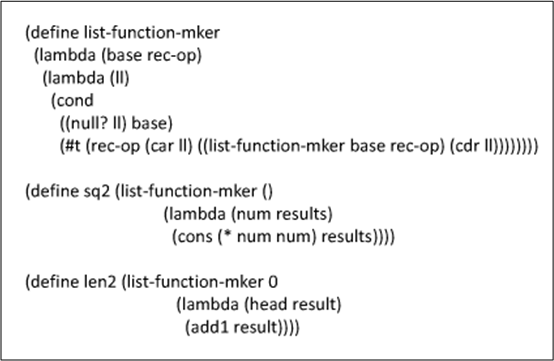
In one of her last viewgraphs (see below), Ms. Parsons addressed the main reason for the rise of functional programming languages. Being a specifier/designer/developer of distributed real-time sensor systems, I’m really keen on her first bullet.
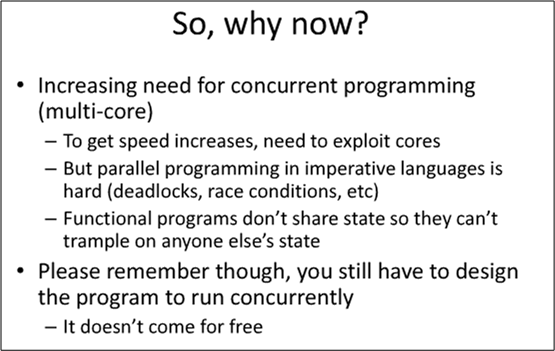
Even though watching Rebecca’s lecture didn’t enlighten me and it made my head spin, I’m going to crack open an Erlang programming book and try to learn more about the subject. Eventually, I just may “get it” and experience the “ah-ha” moment that many others seem to have experienced.

Bowling For BMs
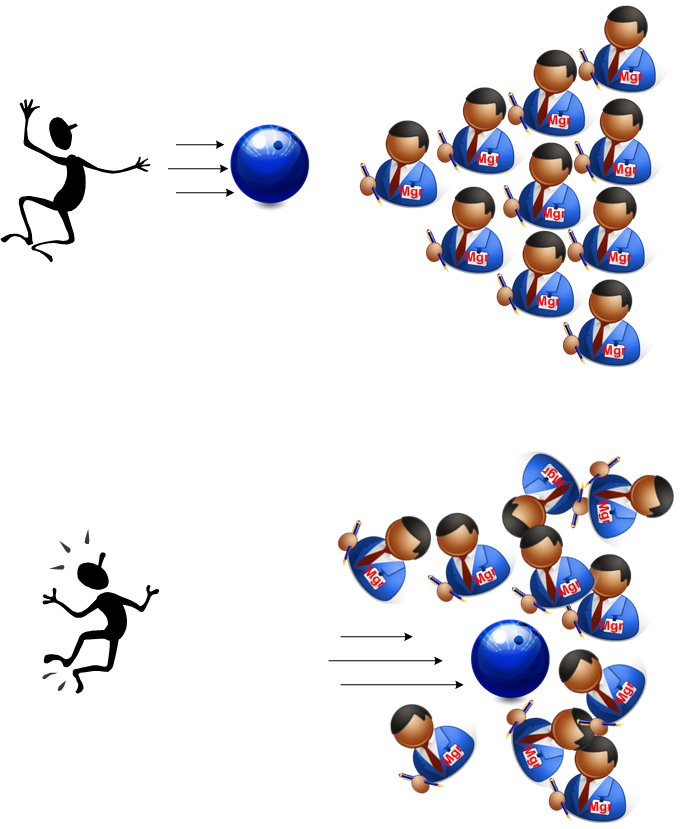 Don’t know what BM means? Check out readme.txt.

Why am I here?
WTF?
Meh!
D'oh!

My BTC Address



 Bulldozer00's Blog