Archive
Temporary Enlightenment
Dependence Over Autonomy
Matthew Gill’s “Accountant’s Truth” provides a fascinating analysis and expose of the attitudes and culture of the accounting industry through a series of in-depth interviews with practicing accountants. As I’m reading the book, I’m using the Kindle’s marvelous “share” feature to tweet snippets like this one out into the ether:
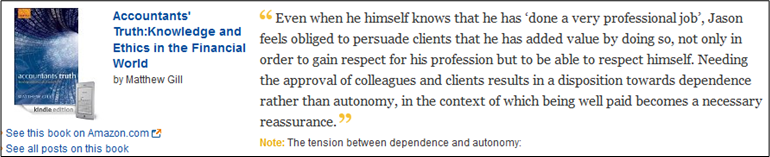
Now, compare this excerpt with the following pair of tweets from one of my fave spiritual teachers, Byron Katie:
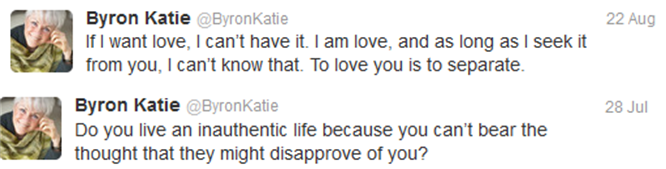
Interesting, don’t you think?
Prune Me, Please
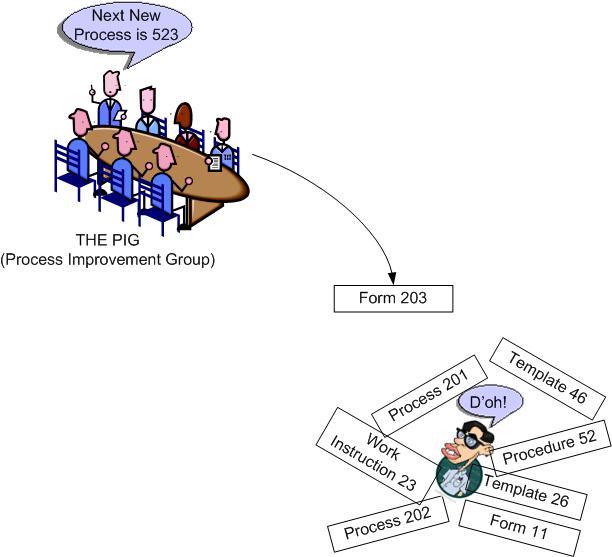
In “Integrating CMMI and Agile Development“, Paul E. McMahon asserts that even though they’d like to, many orgs don’t “prune” their fatty, inefficient, and costly processes because:
..it requires a commitment of the time of key people in the organization who really use the processes. Usually these people are just too busy with direct contract work and the priority doesn’t allow this to happen.
One of BD00’s heroes, the Oracle of Omaha, has a different take on it:
There seems to be some perverse human characteristic that likes to make easy things difficult. – Warren Buffet
Of course, both reasons could apply.
1, 2, X, Y
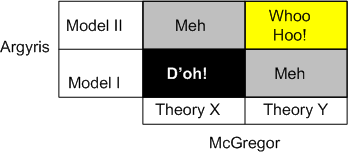
Chris Argyris has his Model 1 and Model 2 theories of action:
- Model I: The objectives of this theory of action are to: (1) be in unilateral control; (2) win and do not lose; (3) suppress negative feelings; and (4) behave rationally.
- Model II: The objectives of this theory of action are to: (1) seek valid (testable) information; (2) create informed choice; and (3) monitor vigilantly to detect and correct error.
Douglas McGregor has his X and Y theories of motivation:
- Theory X: Employees are inherently lazy and will avoid work if they can and that they inherently dislike work.
- Theory Y: Employees may be ambitious and self-motivated and exercise self-control; they enjoy their mental and physical work duties.
Let’s do an Argyris-McGregor mashup and see what types of enterprises emerge:
Ego Battles


And yes, I don my armor daily. It’s war out thar!
Quid Pro Quo
Forget about the superficial, ceremonial, “empoyee survey” that is often ignored and quickly forgotten. Wouldn’t it be a great quid-pro-quo move to “allow” each employee in an org to formally judge his/her organization’s behavior, I mean performance, once a year? The content of the review form could be similar to the one in which the employee him/herself is evaluated. After filling out a set of multiple choice questions and allowing for free-form input to justify the selections, an overall behavioral rating could close the review. The rating could be selected from an enumerated list similar to this:
- Exceeds Expectations
- Meets Expectations
- Needs Improvement
- Unacceptable
Based on the final rating, instead of giving the org a merit increase, the employee would communicate the level of commitment that he/she will really provide in the coming year:
- Total Commitment
- Half-assed Commitment
- Feigned Total Commitment
Of course, much like parents and teachers are expected by “the entrenched social system” to evaluate their children, but not vice-versa, this idea doesn’t have a chance of making it into the mainstream. Nevertheless, BD00 speculates that the practice is done somewhere as part of a continuous improvement initiative?
Skepticism, Cynicism, Transparency, Openness
Much as reassurance is the antidote to insecurity, transparency and openness are the antidotes to skepticism and cynicism. Surgical strikes on cynics and skeptics only exacerbate the problem by creating a new batch of more deeply embedded bretheren who fly below the corpo radar. Because of their formless and distributive natures, ya can’t just “shout it out” or spray WD-40 on the stifling rust that keeps skepticism and cynicism firmly in place.
The best large scale example I can cite for the trumping of skepticism/cynicism by courageous transparency/openness is the HCL Technologies transformation as told by CEO Vineet Nayar in his book “Employees First, Customers Second“. The HCL story is amazing because once unbridled skepticism and cynicism seep into the fabric of an org, it takes an act of god to clean the laundry. Mr. Nayar and crew must have consulted with god because they pulled it off at a huge company filled with the most hard core skeptics and cynics known to man – freakin’ engineers.
The fastest ways to bankruptcy are wine, women, gambling, and (cynical and skeptical) engineers. – Unknown

Quality Living
It’s one thing to have a high falutin’ written quality policy (and it’s standard fare for all commercial enterprises to have one enshrined in magnets, buttons, key chains, and strategically placed posters), but it’s another thing to live it. If DICsters joke about the “quality” policy frequently and managers never utter the word “quality” during the real-time execution of projects, then neither side is living it, no?
How could you know whether your company is living up to your quality policy? Do your customers and users frequently tell you – unsolicited? Do your earned value metrics tell you? Are your people unabashedly and vocally proud of what they build?
Thank god that at most companies, the management group is a true champion of quality and those “few” trench dwellers who cynically joke about it are simply deemed as a handful of miserable and disgruntled blokes who must be marginalized or ex-communicated.

Mistake Recognition
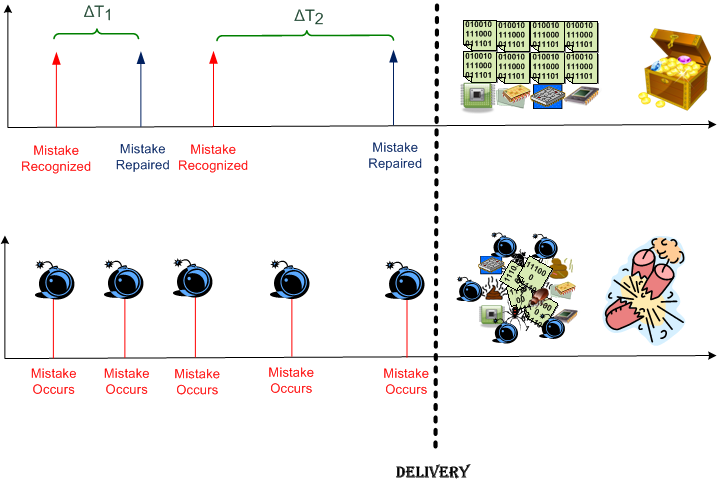
First question: Is “mistake recognition” allowed in your organization? Second question, if, and only if, the answer to the first question is “yes“: How many different “enabler” groups are required by your process to “have a say” in the path from “recognized” to “repaired”
If the answer to the first question is a cultural “no“, then as the lower trace in the dorky diagram shows, out the door your cannonballs go!
More Bureaucratic Than A Bureau
Tsukasa Makino is one of the Harvard Business Review/McKinsey “Beyond Bureaucracy Challenge” winners. In “From bureaucratic, divided, passive, and exhausted to productive, creative, autonomous, and happy company”, Tsukasa tells the transformational story of Tokio Marine Nichido Systems (TMNS) from a classic, robotic, unhealthy borg into a vibrant community.
In 2005, Hideki Iwai, a system engineer, proposed a corporate culture assessment by an outside consulting firm. Management “approved” of the idea and here was the bottom line:

D’oh!
Taking the bull by the horns, Hideki formed the “Work Style Reform committee” to change the culture. Despite being a “committee” the communist-sounding group worked! It spawned, and followed through on, a slew of blockbuster initiatives:

The challenge presented by bullet number 4 seems daunting. How did they vanquish it? They just said “NO!”
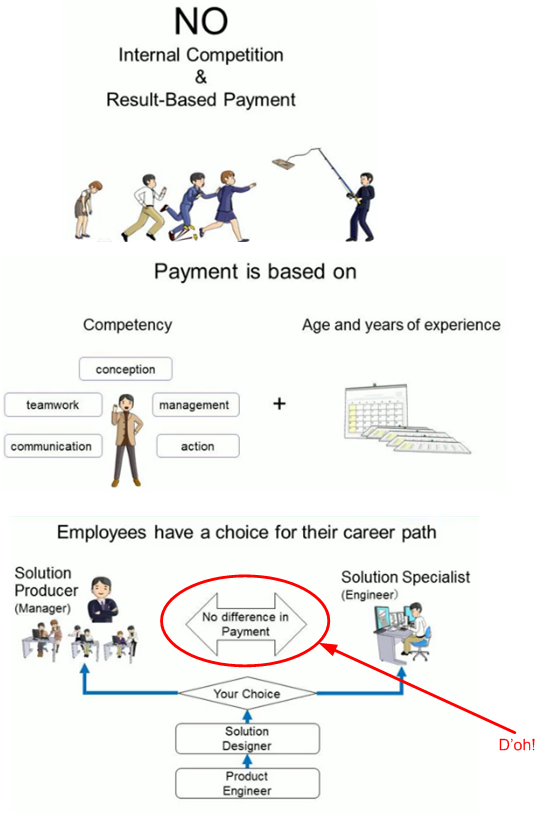
I love finding heartwarming stories like this. They’re hard to find, but thanks to web sites like Gary Hamels’ MIX, it’s getting easier.

Why am I here?
WTF?
Meh!
D'oh!

My BTC Address



 Bulldozer00's Blog