Archive
What Is It?
Ok dear reader, it’s quiz time! How does an enduring album come into the world? How does a revered painting emerge into being? How does a beloved novel spring forth? Please describe the “Process” in your own words….

Should, Or Could?
There’s quite a difference between thinking and behaving as if “the world should be better aligned with my wishes!” and “the world could be better aligned with my wishes“. If your psychic disposition is toward the former, you’ll most likely be walking around frustrated and bitchy most of the time. If it’s toward the latter, you’ll most likely be more accepting and graceful.
BD00 seems to think that he’s been experiencing a slow shift over the years from thinking in terms of “should!” to thinking in terms of “could“. But of course, it may be just another one of those self-delusions that are packed wall to wall inside of his crippled mind.

The Evolution Of Thinking
Nassim Taleb nails it with this simple but profound sentence:
Our minds are not quite designed to understand how the world works, but, rather, to get out of trouble rapidly and have progeny. – Nassim Taleb (Fooled By Randomness)
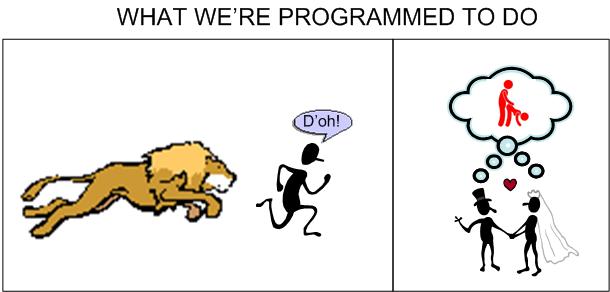
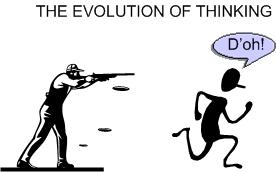
We human beings are so full of ourselves. With much hubris, we auto-assume that we are above all other life forms just because we can “think“. We concoct immortal and all-powerful gods in our minds who we “think” are watching over our well-being (but not the well being of those we don’t like). Then, when something terrible happens, we wonder “why” our gods could allow such a tragedy. Instead, maybe we should contemplate “why not?“.
The ability to “think” has unquestioningly made life more comfortable locally for the human race over time. However, it’s questionable whether “thinking” has made human life more comfortable globally. Unlike a “mindless” swarm of locusts that ravish the environment with a vengeance, we “mindful” humans seem to be ravishing our environment and other fellow humans at an increasingly alarming rate as our “thinking” supposedly evolves.
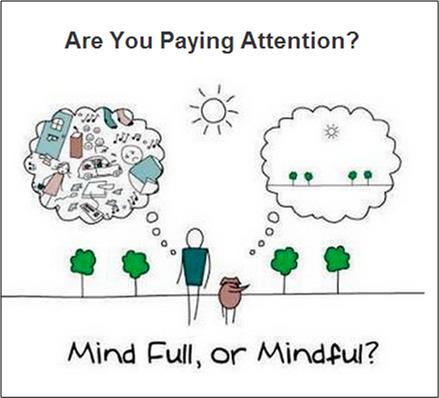
Mind Full, or Mindful?
Years ago, I watched a televised debate between Deepak Chopra and atheist Sam Harris. Since Deepak came across at times as defensive, I’ve never felt the need to delve into any of Deepak’s books. Nevertheless, since I instantaneously fell in love with this telling picture from the Chopra LinkedIn post “The Conscious Lifestyle: Awareness Skills“, I just had to copy and paste it here:
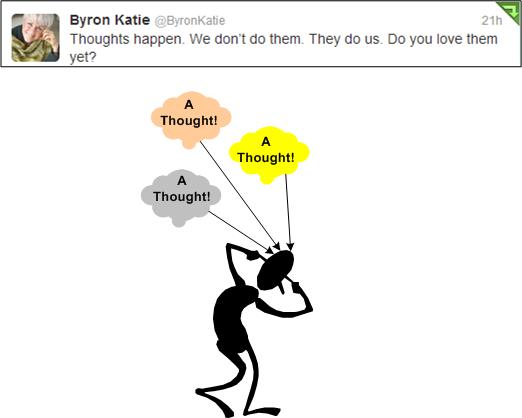
They Do Us!
Survival Machines
In “The Selfish Gene“, proud atheist Richard Dawkins theorizes that we are just temporary “survival machines” doing the bidding of the selfish genes within us. These little buggers program us such that we live long enough to propagate “them” onward (via sexual reproduction, of course) from generation to generation – forever. Selfish genes don’t give a damn about the individual survival machines they temporarily use for transport. WTF!, and very depressing if you believe in his logically sound, equation-backed “derivation“, no?

Science without religion is lame, religion without science is blind – Albert Einstein
Armies Of The Preposterous

Similar to many of BD00’s posts, this one is most likely to offend some people who stumble upon it. Why? Because BD00 felt the need to hoist these eloquently concise snippets from Richard Dawkins’ “The God Delusion“:
Faith is an evil precisely because it requires no justification and brooks no argument. Teaching children that unquestioned faith is a virtue primes them—given certain other ingredients that are not hard to come by—to grow up into potentially lethal weapons for future jihads or crusades.
Because each new generation of children is taught that religious propositions need not be justified in the way that all others must, civilization is still besieged by the armies of the preposterous. We are, even now, killing ourselves over ancient literature. Who would have thought something so tragically absurd could be possible?
To be fair, much of the Bible is not systematically evil but just plain weird, as you would expect of a chaotically cobbled-together anthology of disjointed documents, composed, revised, translated, distorted and ‘improved’ by hundreds of anonymous authors, editors and copyists, unknown to us and mostly unknown to each other, spanning nine centuries.
OK, so now it’s time to open myself up to a counterattack. I believe, but not unquestioningly, that we are all unique, individual manifestations of a universally distributed life force that permeates all things. We are like waves in the ocean of life. We rise up, we create, and then we return home again.
Actually, we never leave home. We just “think” we do.
It’s What We Do
Error correction is what we are doing every instant of our lives – John Gall (The Systems Bible, P84)
OMG! Mr. Gall’s wisdom is spot on with William T. Powers‘ PCT, which in effect states that:
We are a mysterious stacked aggregate of thousands of little control systems acting continuously on our environment in a manner which corrects errors between what we desire and what is. (BD00 via William Powers)
Need some dorky picture to visualize the undecipherable message? For context, try this one first:
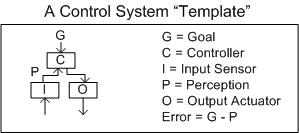
Next try this model of “us” (actually, anything that’s alive):
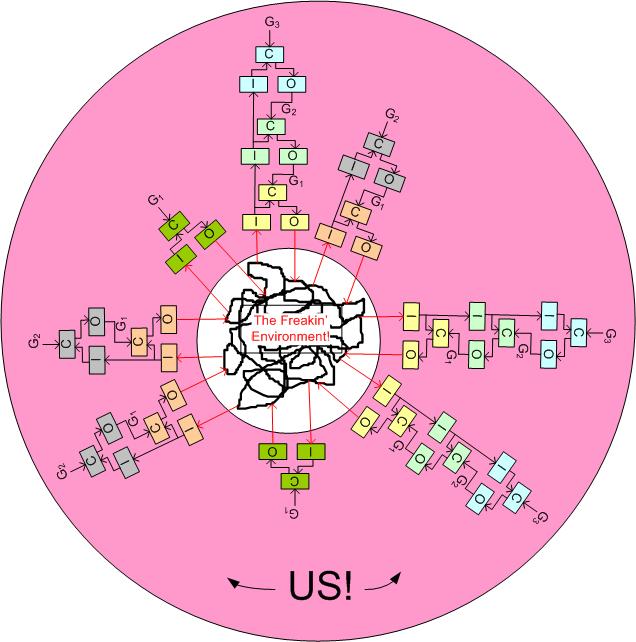
When we go to sleep, our conscious mental control system building blocks temporarily go dormant. However, those at the periphery of the stack which directly penetrate the physical “us/environment” boundary never sleep – because the environment never sleeps. These unsung workhorse heroes at the bottom of the hierarchy symphonically collaborate to keep our blood pressure, temperature, breathing, heart beat, etc, within some preset genetic limits so that we can wake up the next morning! And the little buggers do this by…. continuously correcting for errors between what the bazillion “controlled variables” are and what they should be. Error correction is what we do.
Note that without nature’s loving cooperation in keeping the variations in the environment within the controllable limits of our little friends, we wouldn’t be here now – we wouldn’t have even “begun“. What a joyous and miraculous dance of life, no?
So, the next time someone asks you what you do for a living, tell them that you correct errors.
Related articles
- Command Vs. Control (bulldozer00.com)
- Bankrupt Models (bulldozer00.com)
- From The Ground Up (bulldozer00.com)
- Cross-Disciplinary Pariahs (bulldozer00.com)
- Normal, Slave, Almost Dead, Wimp, Unstable (bulldozer00.com)
- Extrapolation, Abstraction, Modeling (bulldozer00.com)
- Nine Plus Levels (bulldozer00.com)
The Three Principles
William James, who is regarded as the father of modern psychology, once wrote that the field of psychology had no true principles. He said if such principles were ever realized on a large scale, it would make the importance of every human advancement since fire pale in comparison.

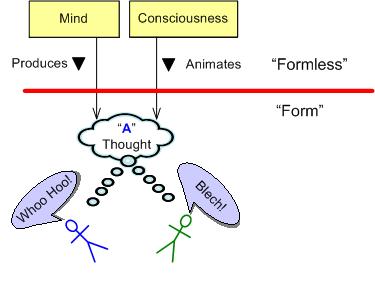
As always, it’s our choice to decide what’s true for ourselves, but the three principles behind psychological life are: Mind, Consciousness, and Thought (MCAT). From formlessness, Mind produces a formed Thought and Consciousness brings this thought form to life via our senses. It’s as simple (simplistic?) as: Mind->Thought->Consciousness.

As long as we are alive, the MCAT trinity is in continuous operation. Whether we’re aware that this irreducible, equation-less, metaphysical system is operating silently in the background of our psyche or not, that’s how we experience psychological life moment-to-moment.
Of the three principles, “thought” is what we are intimately familiar with. Unlike formless “mind” and formless “consciousness“, we can directly “see and feel” our thought forms in real-time. Thus, from the instant we wake up in the morning until we go to sleep at night, we act on them as they spontaneously emerge during the day.

Note that the universal MCAT trio is impersonal. It doesn’t say anything… nada… zilch… about quality of “thought“. That’s where the “personal” you and I come in.
As soon as we become aware of an impersonally created thought, we instantaneously attach a level of personal “I-ness” and judgmental quality to the thought. Thus, hypothetically given the same thought, you can experience its associated feeling as joy and I can experience it as sorrow. Ergo, quality of thought is personal.
Related articles
- RIP, Dear Syd (Bulldozer00.com)
Disengaging
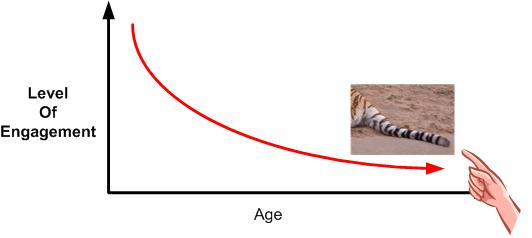
In “We Learn Nothing“, uber-essayist Tim Kreider said something like “it’s sad to see people disengage from life as they get older.” OMG! When I read that, I felt like Timbo had just articulated one of my greatest fears.
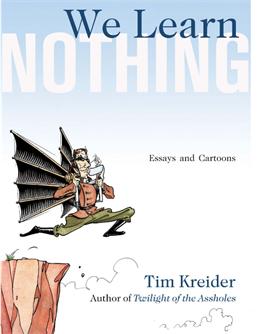
Except for a handful of painful but relatively short times when I’ve totally disengaged from participating in life, I’ve been committed to desperately holding on to the tiger’s tail and racing through the jungle of life with (almost) reckless abandon.
How about you? Do you feel yourself sloooowly disengaging from life as the years tick by? If not, then good for you. If so, then do you think you should wake up and start searching for that tiger tail?

Why am I here?
WTF?
Meh!
D'oh!

My BTC Address



 Bulldozer00's Blog