Archive
What’s REALLY Required
An understanding and application of “Systems Thinking” are pre-requisites to effective leadership in any large socio-technical group endeavor. Since business schools and pundits teach so-called business skills in disconnected, specialized, fragmented chunks and the primary component of systems thinking is the opposite of this classically entrenched Descartesian way of thinking, effective large scale leadership is nowhere to be found except in rare, small pockets of brilliance.
Systems thinking employs analytical thinking as a subordinate to its opposite – synthetic thinking. Since most (the vast majority of?) elite execs intentionally fragment their time to match their thinking style and they don’t know how to synthesize anything but an inflated and infallible image of themselves, they’re eternally stuck in the quagmire of one dimensional analytical thinking without a clue. But hey, ya gotta give them credit for knowing how to stuff their pockets with greenbacks.

A $1.6M Mistake – And No One Was Fired
The other day, I discovered that a human mistake made on Zappos.com’s sister web site, 6pm.com, emptied the company’s coffers of $1.6 million dollars. Being the class act that he is, here’s what CEO Tony Hsieh had to say regarding the FUBAR:
To those of you asking if anybody was fired, the answer is no, nobody was fired – this was a learning experience for all of us. Even though our terms and conditions state that we do not need to fulfill orders that are placed due to pricing mistakes, and even though this mistake cost us over $1.6 million, we felt that the right thing to do for our customers was to eat the loss and fulfill all the orders that had been placed before we discovered the problem. – Tony Hsieh, CEO, Zappos.com
If this happened at your company, what would your management do? Do ya think they’d look at it as a learning experience?
Besides Zappos.com, here are the other companies that I love. What are yours, and is the company you work for one of them?

DICbox Be Gone!
Check out the “DIC in the box” below. The DICbox is drawn around the DICster because that’s the way BMs dehumanize the person behind the DIC label. They do this, of course, in order to make their so-called job easier and to preclude getting their hands dirty with unimportant people. In a BM’s mechanistic mind, all DICs are the same and they’re interchangeable.
In a corpricracy, DICs are given work to do and, if they’re competent and self-motivated, they create high quality work products that increase the wealth of the corpricracy – in spite of the management chicanery that takes place.
 The figure below shows an expanded DICbox model with a BM integrated into the system. Since the dude is part Bozo, he doesn’t:
- have a clue (or care) what the work is,
- know (or care) what it takes to do the work,
- know (or care) what the work products are, or how to evaluate them.
That’s why there are no connections in the picture traversing from the work products or work definition flows to the BM. Of course, the BM feigns it as best he can and knows some generic technical buzzwords like “requirements”, “analysis”, “design”, etc. To a BM, all technical projects, from web site development to space shuttle development, are the same – a linear, sequential, unchangeable schedule of requirements, design, coding, testing, and delivery.
 Since the BM is in over his head, he must justify his highly compensated existence. He does this via the only option available: behavior watching. Thus, all he essentially does is intently watch for non-conformance of DIC behavior to a set of unwritten and arbitrarily made up corpo rules. He really shines when he detects a transgression and issues the boiler plate “get with the program” speech (a.k.a peek a boo visit) to coerce the DIC back into the box. If that fails, he calls in the big guns – his fellow overhead management dudes in the HR silo. But that’s another story.
OK, OK. So you want to arse me on my own turf and say: “It’s easy to whine and complain about bad management. I’m as good as you are at it.” You follow that up with “How should it be, smarty pants?“. Well here’s one model:
 I don’t think the above model needs to be accompanied with much explanation. However, I do think these caveats should be pointed out:
- The DICbox is gone.
- The “BM” label has been replaced by “Leader”.
- The work is co-defined by the leader and the doer.
- The leader knows what the work products should be (work products = “expected outcomes” in management lingo).
- The leader still watches behavior, not as an end in itself, but as a means to help the doer grow, develop, and succeed.
- The leader does what some people (like me) may consider – real work.
What A Deal!
Do you know those dorky self-promotional license plate holders that car dealers attach to your sparkling new vehicle before you drive it off the lot? Well, the Gold’s gym that I religiously go to has had a stack of them publicly available for sale over the past couple of months. When I first saw them next to the other items for sale, I said to myself:
“WTF? Do the clueless BMs in charge of this place really expect to sell any of those stupid, self-serving contraptions? Hell, even if they offered to pay gym members to take them, they’d still gather dust and waste shelf space until someone in the corpo chain of elites finally took responsibility and owned up to the grumpy they pinched in public.”
About a week ago, management placed the stack of crap right on the check-in counter with a sign that proudly displayed a massive reduction in price from $5 to 1$. What a deal, no?
I finally couldn’t take it anymore and I asked my fellow DIC manning the counter if her management really thought they’d be able to sell those abominations. She said she didn’t know and that she personally hadn’t sold a single one over the time they’d been placed on the market. Surprise!
I left the gym that day suggesting that she tell her bosses that a customer said that they should concentrate more on continuously satisfying their customers instead of thinking of them as moronic walking wallets. As an example of customer satisfaction, I told her to ask “them” if they could refill the woefully deflated balance balls every once in awhile. I even suggested (and it wasn’t the first time) that if they put a pump near the ball rack, I’d fill them occasionally and maybe other users would too. Knowing the typical BM mindset, they probably auto-rejected the idea because they’d be afraid that their “customers” would steal the pump.
How much would you pay for my license plate holder?
Ackoff On Systems Thinking
Russell Ackoff, bless his soul, was a rare, top echelon systems thinker who successfully avoided being assimilated by the borg. Checkout the master’s intro to systems thinking in the short series of videos below.
What do you think?
Armed And Ready
How much technical acumen does a project manager need to have in order to effectively manage a software-intensive product development effort? Are Spreadsheet, Gannt chart, PERT chart, EVM, Microsoft Project skills, and a golden certificate from schools like the vaunted PMI the only tools needed to lead a multi-disciplined, technical crew of engineers to so-called victory? I think not, but you may think differently – especially (and understandably) if you’re a project/program manager.
I think effective technical project managers are rare and they sprout from the trenches of one or more of the technical disciplines: software, hardware, test, and systems engineering. Wrestling with technical problems in the mud while under schedule pressure from multiple managers to keep costs down and to deliver quality promptly is the hazing experience needed to appreciate both the financial and technical aspects of a project or program. It may seem that project and program managers are under pressure themselves from executives above them in the command and control hierarchy, but unlike the dudes at the bottom of the food chain, they can easily pass the buck when financial and technical goals aren’t met. Who do ineffective BMs pass the buck to when the execs in the heavens demand accountability for poor project performance (usually way downstream after project execution has been supposedly progressing splendidly)? Why, the dweebs in the cellar of course.
“You have to know a lot to be of help. It’s slow and tedious. You don’t have to know much to cause harm. It’s fast and instinctive.” – Rudolph Starkermann
Cranking fat heads off the project management education assembly line and arming them with the necessary but insufficient skills to lead technically smart people into the raging battle against complexity is like arming firefighters with squirt guns to put out a 5 alarm fire. All it does is perpetuate the illusion of control and prep the graduates for moving higher up on the Plan-Watch-Control-Evaluate ladder – even though they don’t have a clue as to what they’ll be planning-watching-controlling-evaluating. But hey, I like to make things up and I’m not fit to lead anything, so don’t listen to a word I say 🙂

Pick And Own
No, the title of this blost (short for blog-post and pronounced “blow-ssst”) is not “pick your nose“. It’s “pick and own“. My friend Bill Livingston uses the following catchy and true phrase throughout his book “Design For Prevention“:
He who picks the parts owns the behavior. – Unknown
This is certainly true in the world of software development for new projects. For maintenance projects, which comprise the vast majority of software work, this dictum also holds:
He who touched the code last owns the stank. – Unknown
Bill also truly but sadly states that when something goes awry, the dude who “picks the parts” or “owns the stank” is immediately sought out for punishment. When everything goes smoothly, the identity of the designer/maintainer magically disappears.
Punishment but no praise. Such is the life of a DIC. BMs, CGHs and CCRATS on the other hand, clever as they are, flip everything upside down. Since they don’t pick or maintain anything, they never get blamed for anything that goes wrong. Going one step further, they constantly praise themselves and their brethren while giddily playing the role of DIC-punisher and blamer.
WTF you say? If you fellow DICsters didn’t know this already, then accept it and get used to it because it’ll sting less when it happens over and over again. Tis the way the ancient system of patriarchical CCH institutions is structured to work. It doesn’t matter who the particular cast of characters in the upper echelons are. They could individually be great guys/gals, but their collective behavior is ubiquitously the same.

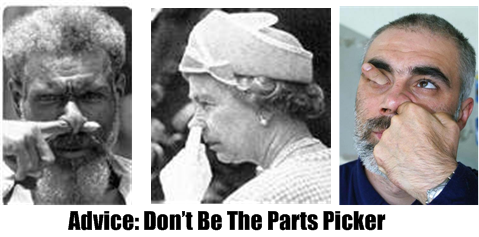
Don’t Keep It A Secret
When I was younger and working at my first real job as a sonar “system engineer”, I was tasked with designing a set of digital filters to process a multiplexed stream of audio signals from a sonar microphone array. During a weekly status meeting, the best manager I ever worked for asked me if I’d written up the design and had it peer reviewed. I told him that I hadn’t and then he hit me with the first of many wise zingers over several years. He told me “Don’t keep it a secret. Write it up, communicate it, share it.” Being the dumbass and naive engineer that I was (and still am?) back then, I hadn’t thought of doing that. I was just gonna slip the resulting design into the system specification, let the software and hardware and test dudes deal with any mistakes/errors downstream, and move onto my next joyful assignment.
When my mentor said “don’t keep it a secret” to me, a terrible fear gripped me: “What if I screwed up and someone points out a major flaw in the work? What would people think? People might laugh at me.” Instead of thinking about adding value to the company and helping others do their jobs better, I was dwelling on self-important thoughts about ME – poor ME. Alas, such is the conditioning that is innocently but surely foist upon us from the moment we start disassociating ourselves from our true being and we start welding ourselves to the “I” thought. This freedom-squelching conditioning process starts with our parents and continues relentlessly throughout school and throughout our working lives.
From what I remember, the writeup and review process went much better than I anticipated. However, even after that first jolt, it still took me a long, long time to overcome the fear of exposing my work to others. Even today, many years later, I sometimes relapse and must fight the fear instinct associated with exposing work to others for scrutiny – especially managers.

How about you? Have you ever experienced a similar feeling? Do you still experience it? Is your goal to jump into management as quickly as possible so that you can escape the fear and transition from scrutinizee to scrutinizer? Have you already successfully done this? Dudes and dudettes, don’t be shy and please gimme some blowback. 🙂
Plan, Plan, Plan…. Blah, Blah, Blah.
Preface
People followed Martin Luther King of their own free will because he had a dream, not a plan. – Simon Sinek
On the other hand, know-it-all business school trained weenies will profess (in a patriachical and condescending tone):
Failing to plan is planning to fail – Unknown
Irrelevant Intro
When I started this relatively loooong blarticle, I had no freakin’ idea where it would go but I followed where it led me. Led by the unknown into the unknown – it was the keystone cops leading the three (nyuk nyuk nyuk) stooges (whoo, whoo, whoo, boink, plunk, pssst!).
As usual, I didn’t have a meticulously well formed plan for this time-waster ( <- for you, heh, heh) in my fallible cranium and I made many mid-course corrections as I crab-walked like a drunken sailor toward the finish line. Hell, I didn’t even know where the freakin’ finish line was. I stopped iteratively writing/drawing when I subjectively concluded that….. tada, “I’ve arrived!”. Such is the nature of exploration, discovery, and exposition, no? If you disagree, why?
Pristine Profile – Full Steam Ahead!
The figure below shows the shape of a pristine, planned, cost vs time profile at “project start” for a long term, resource-intensive, project to do something “big and grand for the world”. Some one or some group has consulted their crystal ball and concocted a cost vs schedule curve based on vague, subjective criteria, and bolstered by a set of ridiculously optimistic assumptions and a bogus risk register “required for signoff“. To coverup the impending calamity, the schedule has been enunciated to the troops as “aggressive“. BTW, have you ever heard of a non-aggressively scheduled big project?

It’s interesting to note that the dudes/dudettes who “craft” cost profiles for big quagmire projects are never the ones who’ll roll up their sleeves, get dirty, and actually do the downstream work. Even if the esteemed planners are smart enough to actually humbly ask for estimates from those who will do the work, they automatically chop them down to size based on whim, fancy, and political correctness. <- LOL!
Typical Profile – Bummer
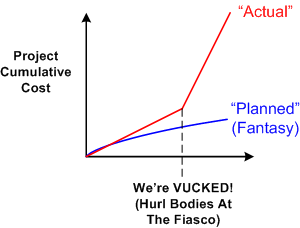
The figure below shows (in hindsight) the actual vs planned cost curve for a hypothetical “bummer” project. The project started out overestimated (yes, I actually said overestimated), and then, as the cost encroached into uncomfortable territory, the plan became, uh, optimistic. Since it was underestimated for “political reasons” (what other reason is there?), but no one had a clue as to whether the plan was sane, no acknowledgement of the mistake was made during the entire execution and no replanning was done. The loss accumulated and accumulated until end game – whatever that means.

Crisis Profile – We’re Vucked!
The figure below shows (in hindsight) the actual vs planned cost curve for a hypothetical “vucked” project. Cost-wise, the project started out OK, but because it was discovered that technical progress wasn’t really, uh, technical progress, bodies were thrown onto the bonfire. Again, the financial loss accumulated and accumulated until end game – whatever that means.
Replan Profile – Fantasy Revisited
The figure below shows (in hindsight) the actual vs planned cost curve for a hypothetical “fantasy revisited” project. Cost-wise, the project started out OK (snore, snore, Zzzzz), but because it was discovered that technical progress wasn’t really, uh, technical progress, bodies were thrown on the bonfire. But his time, someone with a conscience actually fessed up (yeah, some people are like that, believe it or not) and the project was replanned in real-time, during execution. Alas, this is not Hollywood and the financial loss accumulated and accumulated until end game – whatever that means.

Iterative, Incremental Profile – No Freakin’ Way
Alright, alright. As everyone knows, and this especially includes you, it’s easy to rag about everyone and everything – “everything sux and everyone’s an a-hole; blah, blah, blah…. aargh!”. What about an alternative, Mr. Smarty Pants? Even though I have no idea if it’ll work, try this one on for size (and it’s definitely not original).
The figure below shows (in hindsight) the actual vs planned cost curve for a hypothetical “no freakin’ way” project. But wait a minute, you cry. There’s only one curve! Shouldn’t there be two curves you freakin’ bozeltine? There’s only one because the actual IS the planned. This can be the case because if the planning increments are small enough, they can almost equate to the actual expenditures. At each release and re-evaluation point, the real thing, which is the product or service that is being provided (product and service are unknown concepts to bureaucrats and executive fatheads), is both objectively and subjectively evaluated by the people who will be using the damn thing in the future. If they say “This thing sux!”, its fini, kaput, end game before scheduled end game. If they say “Good job so far! I can envision this thing helping me do my job better with a few tweaks and these added features”, then it’s onward. The chances are high that with this type of rapid and dynamic learning SCRBF system in place, projects that should be killed will be killed, and projects that should continue will continue. Agree, or disagree? What say you?

This hypothetical project is called “No Freakin’ Way” because there is “no freakin’ way” that the system of co-dependent failure designed and kept in place by hierarchs in both contractor and contractee institutions will ever embrace it. What do you think?
Viable, Vulnerable, Doomed II
As the title indicates, this blow-sst is an extension of yesterday’s inane blabberfest. While yesterday’s lesson (<— lol!) dealt with the static structure of Viable, Vulnerable, and Doomed (VVD) orgs, today’s BS-fest talks about the dynamic behavior of VVD social groups. Behold that if you’re conscious and you concentrate on observing the world around you, the structure plus behavior of an org will clearly and unambiguously reveal over time what it does. Forget what its so-called leaders say it does, observe for yourself how the stratified monolith is structured, how it behaves, and what it actually produces. If you’re diligent and astute, you’ll discover the principle of POSIWID: the Purpose Of a System Is What It Does (not what it’s leadership says it does).
The UML diagram below shows a state machine model of: the mutually exclusive states of a VVV system, the transitions between the states, and the events that trigger the transitions. But wait…… VVV? What happened to VVD? Well, in a dumbass attempt to inject levity and fruitlessly retain your interest, I changed the name of the “Doomed” state to “”Vucked” so that all states start with the letter “V”. Stupid, no?
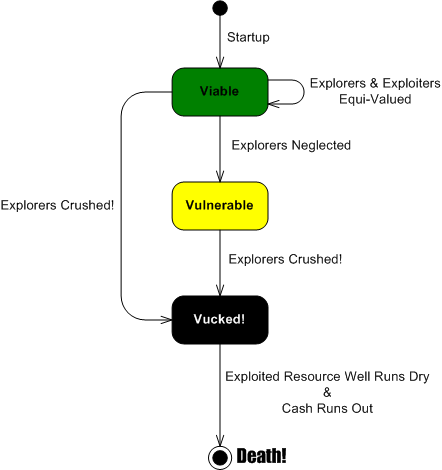
Virtually all startup companies initialize into the viable state. After all, if they didn’t have a product or service that a market didn’t want to consume, they wouldn’t be born as a viable entity, right? Over time, if they neglect their explorers and single mindedly, greedily, milk their product/service to death, eventually they’d become vulnerable to competitors. If the leadership becomes drunk with success and their heads expand too far, they start resenting and rejecting their explorers – they become vucked!
Unless, as the figure below shows, an epiphany in the head shed occurs (and the chances of that occurring in fat headed executives rolling in dough are incredibly slim) it’s death to the org and all its membership – including the innocents who had no hand in the implosion. This ain’t a hollywood story so there’s no happy ending.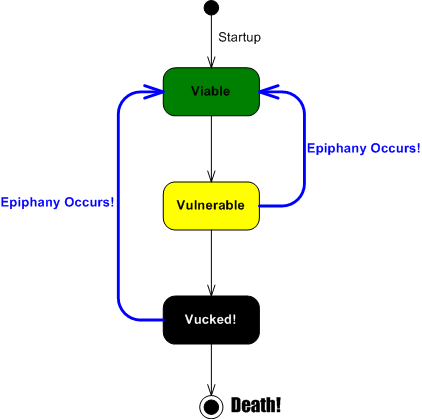

Why am I here?
WTF?
Meh!
D'oh!

My BTC Address



 Bulldozer00's Blog