Archive
Viable, Vulnerable, Doomed
Unless an org is subsidized without regard to its performance (e.g. a government agency, a pure corpocracy overhead unit like HR), it must both explore and exploit to retain its existence. Leaders explore the unknown and managers exploit the known, so competence in both these areas is required for sustained viability.
Exploitation is characterized by linear thinking (projecting future trajectory solely based on past trajectory) and exploration is characterized by loop thinking. Since these two types of thinking are radically different and prestigious schools teach linear thinking exclusively, all unenlightened orgs have a dearth of loop thinkers. Sadly, the number of linear thinkers (knowers) increases and the number of loop thinkers (unknowers) decreases as the management chain is traversed upward. This is the case because linear thinkers and loop thinkers aren’t fond of one another and the linear thinkers usually run the show.
The figure below hypothesizes three types of org systems: vulnerable, doomed, and viable. The vulnerable org has a loop thinking exploration group but most new product/service ideas are “rejected” by the linear thinkers in charge because of the lack of ironclad business cases. Those new product/service ideas that do run the gauntlet and are successful in the marketplace inch the org forward and keep it from imploding. The doomed org has an exploration group, but it’s just for show. These orgs parade around their credentialed rocket scientists for the world to see and hear but nothing of exploitable substance ever comes out of the money sucking rathole. The viable org not only has a productive explorer group, but the top leadership group is comprised of loop thinkers too – D’oh! These extraordinary orgs (e.g. Apple, Netflix, Zappos, SAS) are perpetually ahead of their linear thinking peers and they continually (and unsurprisingly) kick ass in the marketplace.
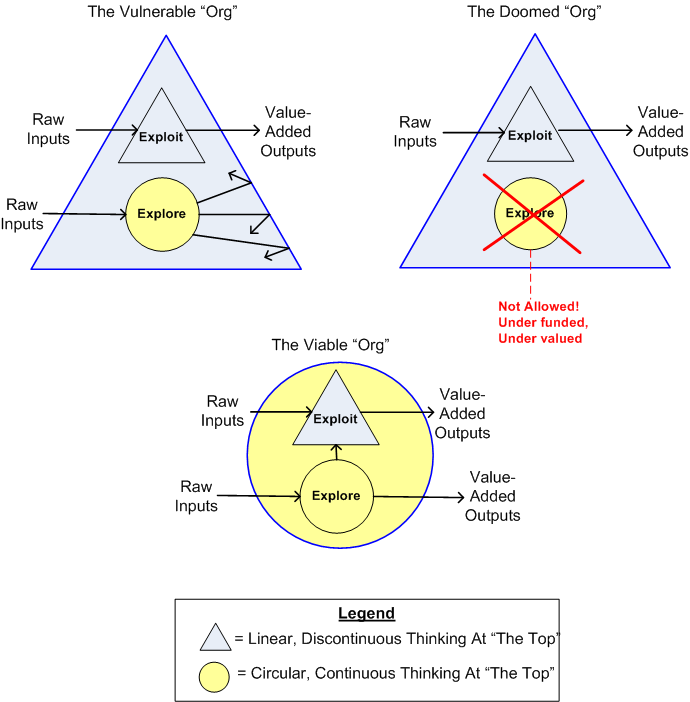
What type of org are you a member of?
Preserving The Problem
Because I’m a shirker, I love Clay Shirky. Not only does he have a kool name, the guy is an innovative thinker:
“Institutions will try to preserve the problem to which they are the solution.” — Clay Shirky
Like many rich and insightful quotes that I stumble upon, I didn’t quite get this one at first. But after thinking about it, I conjured this one up:
While espousing that they want unity of purpose, collaboration, esprit de corps, teamwork, and yada-yada-yada, the juntas in head sheds everywhere unwittingly (wittingly?) preserve the very same problem they supposedly want solved. In this example, the problem is poor corpo performance caused by fragmentation, isolation, stratification, disengagement, and mis-communication. CCRATS not only preserve the performance problem, I’ll go one better than the Clayster. I’ll assert that CGHs amplify the stank by nurturing and perpetuating their hand made caste system of divisive titles, arbitrary reward systems, and socially disconnected working units/departments/groups. It’s silo city – by design.
So why do head sheds everywhere perpetuate this Alice In Wonderland behavior in spite of the ominously growing evidence that it doesn’t work in an increasingly flat and globally connected world? Because changing the entrenched system they collectively built to take care of themselves would flatten the hierarchy and cause them to come tumbling down from the heavens. Do you think many of the “honorable and infallible” talking heads of our institutions want, or have the will, to give up their elevated personal standing for the greater good of the whole? I suspect not many, but those who can and do will prosper in this age of rapid change.

Rules, Exceptions, Guidelines
Unlike natural laws (on the macroscopic level) which unremorsefully allow no exceptions, I think all human concocted rules should be flexible to exceptions, no? If you believe that, then maybe the word “rule” should be replaced with “guideline”. Doing this can be interpreted as splitting hairs, but I think it may positively affect those who are required to operate by the “rules”. It shows respect and implies that some freedom is allowed to continuously improve things. Since the yearning for freedom is built into the fiber of every human being, those in positions of authority who conjure up the “rules” should take heed.
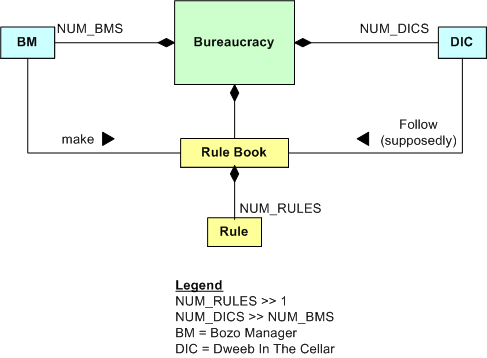
Note: The model above is a UML “class diagram”, which is used to depict the static structure of a system. Other UML diagrams can be used to model the behaviors of a system. The diagram can be interpreted as follows:
- A bureaucracy has NUM_BMS BMs and NUM_DICS DICs and a Rule Book.
- The BMs make the rule book, which has NUM_RULES (usually a boatload) rules.
- The DICs are obliged to follow the rules, written or unwritten (but understood) – or else.
Making A Living
In “Stewardship: Choosing Service Over Self-Interest“, Peter Block comically states:
No one should be able to make a living simply planning, watching, controlling, or evaluating the actions of others.
If corpo granite heads everywhere took that statement to heart (which they can’t, and thus won’t), they’d eliminate themselves and all the layers below them in an instant – poof! Alas, that ain’t gonna happen cuz someone’s gotta look pretty, run the show, and suck up the dough. Seriously, someone really does have to run the show to keep the CCF viable.
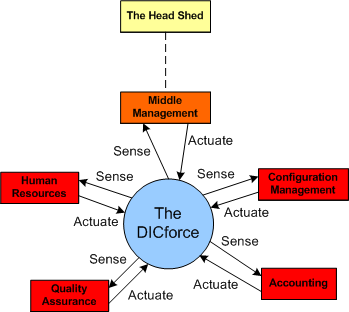
Actually, the dudes in the penthouse have others do the PWCE dirty work for them. The thugs in middle management and the pure overhead departments like Human Resources, Quality Assurance, Configuration Management, and Accounting serve nicely as the lower level sensors, alarm detectors, and actuators in the system. Because of this sleight of hand, the DICforce often targets their ire at those “support” functions and not where it rightfully ought to be targeted – the high priests living it up in the self-congratulatory head shed.
Spreading Happiness
Just like last year, as soon as I heard that Zappos.com’s 2009 culture book was available, I e-mailed the company to get one. Just like last year, I received my free, postage paid copy in the mail three days later. What a great way to spread happiness, no?
Right on page number 1, Zappos CEO Tony Hsieh states:
People may not remember exactly what you did or what you said, but they will always remember how you made them feel.
Who says there is no room in business for emotions? Ninety-nine percent of business schools and business executives do, that’s who: “It’s not personal, it’s business.” Over the years I’ve learned to question the assumptions that institutional bozeltines, oops, leaders operate under. Sadly, I’ve discovered that most of those taken-for-granted, 100 year old assumptions like “the separation of feeling from work” don’t hold true anymore. How about you?

Leverage Points
In Places to Intervene in a System, systems thinker Donella Meadows lists the following 9 leverage points for keeping a system “on the rails” and in continuous pursuit of its goals.
9. Numbers (subsidies, taxes, standards).
8. Material stocks and flows.
7. Regulating negative feedback loops.
6. Driving positive feedback loops.
5. Information flows.
4. The rules of the system (incentives, punishment, constraints).
3. The power of self-organization.
2. The goals of the system.
1. The mindset or paradigm out of which the goals, rules, feedback structure arise.
The items are listed in increasing order of difficulty. Of particular interest is number 1, the “mindset” of the system controller(s). In so-called “modern” corpricracies, the patriarchical mindset of “we’re in charge and we know what’s best, so STFU and do what you’re told“, has ruled the day since the Henry Ford era. In that day, since the typical workforce was under-educated and managers actually knew how to perform and teach the work that kept a company viable, patriarchy worked well. These days, since the situation has changed (and continues to change) immensely, patriarchy can drive a company into the ground.
When managers don’t have a clue how to do the work, they ignore problems, issues, and ideas floated up from the bottom by the DICforce. This crucial feedback loop for sustained viability gets severed and the org suffers greatly for it. BMs collectively, and often unconsciously, behave this way in order not to look stupid and preserve their aura of infallible superiority. Ideas that can save six or seven figures in costs and product enhancements that may increase competitiveness go un-investigated or are killed via “it’s not in the budget”.
Maybe surprisingly to some, the vast majority of the DICforce actually buys into the patriarchical mindset because that’s the way it’s been for eons. DICs that initially don’t buy into patriarchy fall in line as soon as they are ignored or are slapped down a couple of times. Those that continue to buck the patriarchy after being “warned” are shackled or expelled for “insubordination” – another great term that reinforces the patriarchical mindset.

Closed Systems
In “Entropy Demystified“, Arieh Ben-Naim states an often forgotten fact about entropy:
The entropy of a system can decrease when that system is coupled with another system (e.g. a heating system connected with a thermostat). The law of ever increasing entropy is only valid in an isolated system.
In the figure below, the system on the left is coupled with the external environment and its members can use the coupling to learn how to adapt, dynamically self-organize, and arrest the growth in entropy that can destroy systems. In the isolated system on the right, which models a typical corpo mediocracy run by fat headed and infallible BMs who ignore everything outside their cathedral walls, there is no possibility of learning – and entropy marches forward.

Morally Irresponsible Stooges
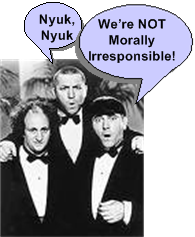
In the first place, it is clear that the degradation of the position of the scientist as an independent worker and thinker to that of a morally irresponsible stooge in a science factory has proceeded even more rapidly and devastatingly than I had expected. The subordination of those who ought to think to those who have the administrative power is ruinous to the morale of the scientist, and quite to the same extent, the objective scientific output of the nation. – Norbert Wiener.
By stealing Norby’s quote and replacing a few words, we can make up this nasty, vitriolic, equivalent passage (cuz I like to make stuff up):
In the first place, it is clear that the degradation of the position of the product creator/developer as an independent worker and thinker to that of a morally irresponsible stooge in a corpocracy has proceeded even more rapidly and devastatingly than I had expected. The subordination of those who ought to think to those who have the bureaucratic power is ruinous to the morale of the wealth creator, and quite to the same extent, the productive output of the CCF. – Bulldozer00.
These days, exploiters are more valued than explorers and makers. In the good ole days (boo hoo!) and in most present day startup companies, the exploiters were/are also the explorers and makers, but because of a lack of respect and support for the species, the multi-disciplined systems thinker and doer has gone the way of the dinosaur. It’s only getting worse because as complexity grows, the need for renaissance men and women to harness the increase in complexity’s dark twin, entropy, is accelerating.
A Newly Discovered Universal Constant
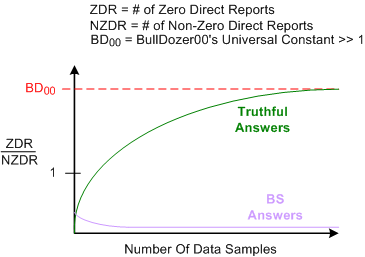
The next time you meet someone with a title of “manager of xxx” or “director of yyy”, ask the dude how many subordinates (a.k.a. DICs) directly report to him/her to be “managed” or “directed”. As you acquire data samples, keep a running tally over time of the ratio of the number of people who truthfully retort with an answer of Zero Direct Reports (ZDR) to the number of people who truthfully reply with an answer of Non-Zero Direct Reports (NZDR). My theory is that, as the number of collected “samples” grows, a truthful ZDR-to-NZDR ratio will increase and then level off to some yet undiscovered universal constant (like the speed of light in a vacuum, Avogadro’s number, or Boltzmann’s constant). Also, the ratio will settle out to a value much greater than one.
My bogus theory is based on the hypothesis that most people covet the esteemed title of “manager” and “director” because it’ll (at least temporarily) jack up their social standing compared to other “non-manager” low lifes and get them higher starting salaries and bonuses if they decide to jump ship. I also hypothesize that most self-proclaimed and artificially-anointed managers/directors who have zero direct reports will fib about it – especially if they’re highly confident that you won’t be able to verify their response as truthful. My advice is to flip the bozo bit from MBAB to IAB whenever you uncover a manager/director with zero direct reports who proclaims he/she has one or more direct reports under his/her control.
Since there seems to be a boatload of managers and directors aggregated there, LinkedIn.com is a fertile experimental lab for collecting data points. So, if you’re interested in exploring this cock-a-mamy, made up theory founded on no basis whatsoever, you can start there – especially if you’re a recruiter of managers and directors for your clients or your company.
So, why don’t I do my own data collecting and number crunching? Because: 1) I have no interest in doing it, 2) I project that I’d become depressed at my findings, and 3) I’m a lazy ass who likes to sit back and make stuff up that pisses some people off and ignites a chuckle in other downtrodden and incorrigible people like me. Of course, this assumes that there actually are others like me. D’oh!
A conscience is what feels bad when everything else feels so good. – Steven Wright
The Best Defense
In “The Design Of Design“, Fred Brooks states:
The best defense against requirements creep is schedule urgency.
Unfortunately, “schedule urgency” is also the best defense against building a high quality and enduring system. Corners get cut, algorithm vetting is skipped, in-situ documentation is eschewed, alternative designs aren’t investigated, and mistakes get conveniently overlooked.
Yes, “schedule urgency” is indeed a powerful weapon. Wield it carefully, lest you impale yourself.


Why am I here?
WTF?
Meh!
D'oh!

My BTC Address



 Bulldozer00's Blog