Archive
Stewardship
In “Stewardship: Choosing Service Over Self-Interest“, Peter Block logically and unemotionally exposes the warts of patriarchical management and promotes the concept of stewardship as a much needed replacement for it. Check out these gems:
The antidote to self-interest is to commit and to find cause. To commit to something outside of ourselves. To be part of creating something we care about so we can endure the sacrifice, risk, and adventure that commitment entails. This is the deeper meaning of service.
When patriarchy asks its own organization to be more entrepreneurial and empowered, it is asking people to break the rules that patriarchy itself created and enforces.
Stewardship is the willingness to hold power, without using reward and punishment and directive authority, to get things done.
Many managers open the door to their employees, and no one walks through it. (BMs love when no one from below confronts them).
At the heart of entitlement is the belief that my needs are more important than the business and that the business exists for my own sake. (BMs always think this way).
At some point each of us has to discover that our self-interest is better served by doing good work than getting good things.
“Are you here to build a career or to build an organization?” has to be clear and without hesitation…we are here first to build the organization.
“You are teaching revolution to the ruling class.” The phrase stayed with me. There is something both unsettling and very true about it. The truth is that we are, in fact, talking about a revolution. Revolution means a turning. Changing direction. The act of revolving. It means the change required is significant, obvious even to the casual observer. Obvious, for example, even to customers. It is more comforting to talk about evolutionary change. Evolutionary change means that everything is planned, under control, and reasonably predictable.
Getting better at patriarchy is self-defeating. Having one group manage and one group execute is the death knell of the entrepreneurial spirit. (BMs ignore this).
The notion of management prerogatives disappears. There is no privileged class of people. Everyone does work that brings value to the marketplace. And everyone should do some of the core work of the organization part of the time. (BMs have no idea how to perform core work).
Measure business results and real outcomes, stop measuring people’s behavior and style in getting there.
The trick here is to be accountable without being controlling. Patriarchy has always justified control on the basis of accountability.
Overhead costs are an interesting one. We are very verbal about the costs of direct labor. There is much less information on the cost of field overhead or, especially, home office overhead charges and what they consist of. (BMs think they are worth every overhead penny that they consume).
We have been swinging between centralization and decentralization for decades, with our patriarchal method of governance remaining unscathed.
Systems are usually designed to control people, not to give those close to the customer information to make good decisions for the business.
Groups that invent, design, produce, market, sell, and deliver the product or service are the line functions. The line functions are what are referred to in this book as the core work teams or core workers. (These are the DICs).
The main limitation of a functional structure is that it does not react well to the customer’s need for quick and whole-system oriented solutions.
If you insist on having an appraisal process, let people be appraised by their customers. This means bosses will be appraised by their subordinates. (BMs think subordinates have no right to appraise them).
Everyone likes the idea of pay for performance, but most of us have rarely experienced it. We most often get paid on the basis of how our boss evaluates us. This is more accurately called “pay for compliance.”
A demand for measurement is an expression of doubt and lack of faith.
Middle managers who made a living planning, organizing, and controlling are no longer needed and, in fact, get in the way. If they cannot now answer the question of what real value they add to their unit, then perhaps they are no longer needed. (LOL!)
Victims are strong believers in patriarchy, they are just angry that they are not the patriarchs. (Victims = DICs like you and me).
We replace coercion and persuasion with invitation.
At nights and on weekends we cry out for human rights and freedom of speech, and then we go to work and become strategic and cautious about our every word for fear we will be seen as disloyal or uncommitted.
Of course, since Block’s views align closely with my own, reading the book got me all juiced up. I found myself rooting for him and constantly saying to myself: “Wow, I wish I’d thought of that!”.

Executive Misnomer
I don’t know why the dudes at the top of the corpo food chain are called “executives”. They don’t execute anything except non-conformers. They coerce and patronize others into bidding their will – which is to make themselves rich regardless of the performance of their orgs.
- CEO = Chief Evisceration Officer
- COO = Chief Oppression Officer.
- CTO = Chief Torture Officer
Sycophant compensation committees reinforce the ubiquitous make-me-rich executive process by striving to pay execs as much as they can (to retain top “talent”) while striving to pay the DICforce as little as possible (to keep fixed costs down).

Cucumbers, Pickles, Brine
It’s been a while since I read Gerry Weinberg’s “Secrets Of Consulting“, but the cucumber-pickle-brine story has been frequently appearing (uninvited, of course) in my mind. It goes something like this:
No matter how vehemently a cucumber says he/she will not turn into a pickle if dropped into a barrel of pickles filled with brine, he/she will get pickled. No exceptions.
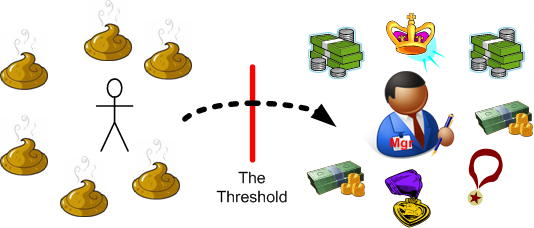
When a DIC crosses the magical threshold into the land of privilege, the guild of management, the cucumber-to-pickle transformation is inevitable. From lowly wealth creator to status taker, schedule jockey, planner, watcher, controller, evaluator. Trouble is, most cucumbers want to get pickled.
Ornament And Substance
When you’re forced to be simple, you’re forced to face the real problem. When you can’t deliver ornament, you have to deliver substance. – Paul Graham (Hackers And Painters)
Mr. Graham’s quote explains why the higher one goes up in the corpo chain of command, the more jargon-filled and superficial the communications bestowed upon the adoring DICforce below. This ornament/substance conundrum is also true for DIC to DIC communication when one DIC is a highly credentialed complexifier and obfuscator. You see, when people don’t know what they’re freakin’ talkin about and they feel the egoic need to appear infallible and all-knowing, they’re compelled to cover it up by attempting to make others feel inferior and dumb.
Alas, don’t lose your faith in humanity because it’s not the individual ornament-deliverers that are “bad”. It’s the ancient pyramidal class system that they’re an integral cog in that weaves that behavior into the fabric of their being. Because the ornament/substance dichotomy is a blind spot to them and the system automatically provides them with power and riches (at the expense of the whole), the system’s designers and maintainers have no incentive to blow up and redesign the system for optimal performance of the whole. Plus, virtually every other corpricracy is structured as a CCH, so it must be right, no?

High Level Doers
Jim Goodnight, (CEO of the SAS Institute, Inc), writes code on the side: “His first love is programming, which he likens to solving puzzles“. Marissa Meyer (Vice President, Search Products & User Experience, Google, Inc.) writes code on the side:
I still like to write some programs every year. I do some programming on the weekends. Lately it’s been more web-centric, using PHP and MySQL. The next thing I’ll try to tackle is the Google App Engine. I’m looking to do a little more programming with Python and Ruby on Rails. But I think it’s just an element of keeping my skills fresh by exploring some of these new trends and keeping my hand in coding, even if it’s on the side of core Google work. – From the book “Making It Big In Software“
Gee, do you think this low level behavior by high level employees has anything to do with why these two companies are considered insanely great by boatloads of experts and laymen? How about your company? Forget about those in the stratosphere like Jim and Marissa, do any of your front line managers do any grunge work “on the side” to keep themselves grounded in reality? Probably not, because when they made the leap into the guild of management they became too self-important for such mundane activity. Plus, because they’re expected to be infallible, they can’t be “seen” making any mistakes by the DICforce.

Approver To Approvee Ratio
Every non-trivially sized profit-making organization has a number of approvers and approvees. For approvees to be enabled to do anything of significance like, uh, create products and respond to customers, they need the blessing of one or more approvers. As the graph below implies, it’s the “or more” word duo in the previous sentence that has an ominous connotation.
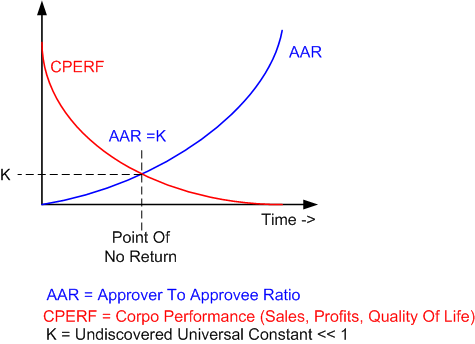
As the AAR in a group of people organized for a purpose increases, the org’s CPERF will start declining at some point in time. At a mystical value of “K”, the point of no return is reached and it’s all down hill from there. As the K threshold is exceeded, the maze of approver signatures that an approvee needs to navigate becomes untenable and the responsiveness of the “system” goes down the crapper. Even worse, the lower class approvee subgroup soon jettisons its sense of initiative and only assaults the approver fortress when a high ranking approver him/herself forces the action.
In clueless corpricracies, no one diligently watches over the AAR and prevents it from exceeding K. Quite the contrary, approvers love to hire more approvers because they have much in common with them and they love to have other approvers report to them – so they can approve the underling approver’s future requests for approval.
Approve, approve, approve your request, gently up the chain.
Sourly, sourly, sourly, sourly, work is but a drain.
Survive And Prosper
The purpose of a living system is to survive and prosper. There are different levels of systems. For example, there’s the organization, the organizational unit, the organizational group, and the organizational worker. Each of these human-composed entities can be considered a System Of Interest (SOI) unto itself and, as the figure below shows, SOIs are nested and connected.

If you believe my BS assertion that the purpose of a SOI is to survive and prosper, then each SOI may (and almost always does) choose to do whatever it can to survive, regardless of the cost to other internally nested and externally coupled systems. Of course, since everything is connected, the actions chosen by one “subsystem” to optimize its survival can (and almost always does) degrade the survival chances of those subsystems nested within it and those systems in which it is nested. For example, if a Bureaucratic Overhead Org Group (BOOG) like “purchasing” puts a boatload of Draconian procedures and forms and approval barriers in place to show how “important” they are, they degrade corpo performance by hindering timely acquisition of external equipment and services needed to get the job done. Schedules slip, which means customers aren’t delighted, and the people in other SOIs think twice about ordering tools that could make them more efficient and happy.
The dysfunction is even worse than you think. When a member of another SOI tries to point out the inefficiency of a BOOG to the so-called BOOG Leader (BOOGL), the auto-defense instinct kicks into high gear. Clever BOOGLs (and they must be clever because they got themselves appointed as a BOOGL in the first place) twist the situation out of whack. The instigator and his/her native SOI are made out to be the cause of inefficiency in the BOOG. This is done, of course, so that the BOOGL and his/her BOOG can survive and prosper. It’s so sad that ya gotta laugh…… LOL!
In Defense Of Incompetence.
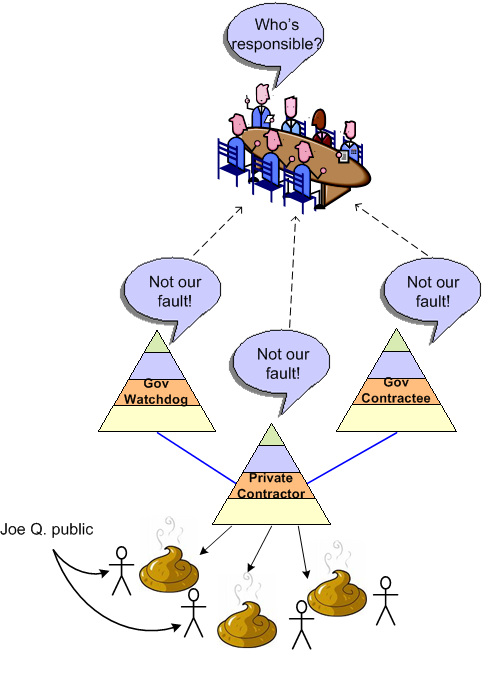
When a government contractor is exposed as incompetent by an external observer (e.g. the press or a civilian group), the government agency that hired them almost always comes to its defense. That shouldn’t be surprising to you because those bureaucratic, and thus, mindless agencies:
- Will do anything to avoid looking incompetent in front of congress for hiring the nin-cum-poops
- Spend other people’s money (yours and mine) instead of their own – and we’re not talkin pocket change here
In addition, the “esteemed” government watchdog agencies (e.g. SEC and FDA and EPA) responsible for ensuring that contractors don’t perpetuate gargantuan disasters make up all kinds of excuses for not detecting the incompetence before massive stakeholder damage has been manifest (lost money, lost lives, lost livelihoods). They do this, of course, because these dudes don’t want to look incompetently asleep at the wheel either.
The system sux and the exhibited behavior is encrusted in its hierarchical, silo+caste system structure that crushes individual conscience. Expect this behavior to go on and on since complexity and the intertwining of interests and agendas will no doubt keep increasing as the world’s population increases. After all, if we can’t fix it, it ain’t broke.
How Do You Like It?
Stunningly, I was once (and only once) asked by a manager how I liked my raise. It was stunning because I speculate that cosmic events like this rarely happen. Has it ever happened to you?
I told the manager that I was happy to get a raise at all. I also told him that since it was the same amount as the average company given raise, I perceived that he thought of me as an average employee. He, and no other manager has ever asked me for “raise feedback” again.
Of course, fairness and unfairness are in the eye of the beholder, or, in physicist-speak, the “observer”.

All My Children
When rearranging the chairs within their stratified and siloed command and control hierarchies fails (and it almost always fails) to improve performance, mechanistically thinking patriarchs often resort to the ubiquitous centralize/decentralize cycle. However, the c/d cycle is also a stone cold loser for improving performance because all it does is spawn mini command and control patriarchies – just like daddy’s. The mindsets of daddy and his sons don’t change, so neither does performance – duh! But hey, at least there’s a lot of action taking place and it looks impressive to outsiders – til the duplication of work and resources is realized and the move back to centralization takes place.


Why am I here?
WTF?
Meh!
D'oh!

My BTC Address



 Bulldozer00's Blog