Archive
Approval Barriers
All business advice is founded on the core principle of “delighting the customer“. However, not all customers are created equal. Most mainstream business advice seems to “assume” that the “customer” is an individual point source payer and user of the product/service.

However, the really big bux business deals occur between social systems of orgs where it’s hard to discern the payer(s) from the actual product end user(s). The seller has to navigate through the customer’s org to influence the right payers and users.

When the end user is some struggling group deeply nested within a behemoth command and control structure (like the US government or a Fortune 500 company), the system is setup for all kinds of mischief to occur. The gauntlet of approval barriers erected by bureaucrats and disinterested little Hitlers in the customer org often makes it impossible to get the right problem solving product into the hands of the problem holders. Tis what it is.
Quality Living
It’s one thing to have a high falutin’ written quality policy (and it’s standard fare for all commercial enterprises to have one enshrined in magnets, buttons, key chains, and strategically placed posters), but it’s another thing to live it. If DICsters joke about the “quality” policy frequently and managers never utter the word “quality” during the real-time execution of projects, then neither side is living it, no?
How could you know whether your company is living up to your quality policy? Do your customers and users frequently tell you – unsolicited? Do your earned value metrics tell you? Are your people unabashedly and vocally proud of what they build?
Thank god that at most companies, the management group is a true champion of quality and those “few” trench dwellers who cynically joke about it are simply deemed as a handful of miserable and disgruntled blokes who must be marginalized or ex-communicated.

Risk-Reward Curve
I’d like to thank my new found e-friend Bob Marshall for triggering the creation of this scientifically unassailable graph:

Profound Shift In Focus
The following quote comes from John Hagel via this Peter Vander Auwera blog post: “Corporate Rebels United” – the start of a corporate spring?”:
The key answer that defines the post-digital enterprise is to shift attention from the cost side to the value side. Rather than treating employees as cost items that need to be managed wherever possible, why not view them as assets capable of delivering ever-increasing value to the marketplace? This is a profound shift in focus. For one thing, it moves us from a game of diminishing returns to an opportunity for increasing returns. There is little, if any, limit to the additional value that people can deliver if given the appropriate tools and skill development. – John Hagel
For big, established companies who can’t even remember what it was like to focus on value, “profoundly shifting” from a cost mindset back to a value mindset is a tall order indeed.
As the state machine based figure below illustrates, successful startups are totally “value focused” in the sun-up phase of their life. But over time, as they obsessively grow and misguidedly try to become more efficient by adding layers upon layers of cost watchers, the vast majority of them (with few Apple-like exceptions) morph into “cost focused” borgs.

Once a formerly vibrant org has moved into the sundown phase of its life, the borgdom hardens. It’s cost-focus till death, with no memory of any prior, value-focused behavior.

Hameltonian Gems
Hameltonian == Hamiltonian, get it? I know, I know – that’s the worst free-association joke you’ve ever heard.
When it comes to eloquently cracking good jokes while talking about serious matters, Gary Hamel is right up there with fellow heretical management genius Russell Ackoff. Check out these gems from Mr. Hamel’s latest book, “What Matters Now“:
- Unfortunately, the groundwater of business is now heavily contaminated with the runoff from morally blinkered egomania.
- It was a perfect storm of human delinquency. Deceit, hubris, myopia, greed, and denial were all luridly displayed.
- “ninja” loans (no income, no job, no assets).
- Among the powerful, blame deflection is a core competence.
- As ethical truants, big business seems to rank alongside Charlie Sheen and Lindsay Lohan.
- If life had adhered to Six Sigma rules, we’d still be slime.
- …they seem to have come from another solar system—one where CFOs are servants rather than gods.
- …you’d have an easier time getting a date with a supermodel or George Clooney than turning your company into an innovation hottie.
- Unlike Apple, most companies are long on accountants and short on artists. They are run by executives who know everything about cost and next to nothing about value.
Dynamic Loop Of Demise
Uh Oh! Is Google going down the turd hole? First, in “Why I Left Google“, newly minted Microsoft employee James Whittaker says:
..my last three months working for Google was a whirlwind of desperation, trying in vain to get my passion back. The Google I was passionate about was a technology company that empowered its employees to innovate. In such an environment you don’t have to be part of some executive’s inner circle to succeed. The Google I left was an advertising company with a single corporate-mandated focus.
Then, in “Google’s Mounting Trash Pile“, Paul Whyte writes:
Google’s engineering culture has been an incredible asset. But the record shows that without some discipline, that asset can subtly but inevitably work against Google in its mission as a titan of Internet search and software.
On the one hand, Mr. Whittaker bailed because he felt the dense fog of bureaucracy and a narrowing focus descending upon the company. On the other hand, the (not unreasonable) pressure to jettison bogus research projects with no revenue stream in sight seems to be draining the passion and engagement out of the workforce. Can a vicious, self-reinforcing loop be in the making? Increase In Pressure For Profits -> Decrease In Reseach Funding -> Decrease In Employee Passion -> Decrease In Number And Quality Of Products -> Increase In Pressure For Profits.

I don’t think this dynamic loop of demise is one of Peter Senge‘s “Fifth Discipline” archetypes, but maybe it should be.
Fish On Fridays IV
Earlier this week, sometimes-guest-blogger fishypoo submitted some content for today’s entry to BD00 for “approval“.

Here it is, fishypoo’s b’fore and afta “process improvement” flowchart submittal:
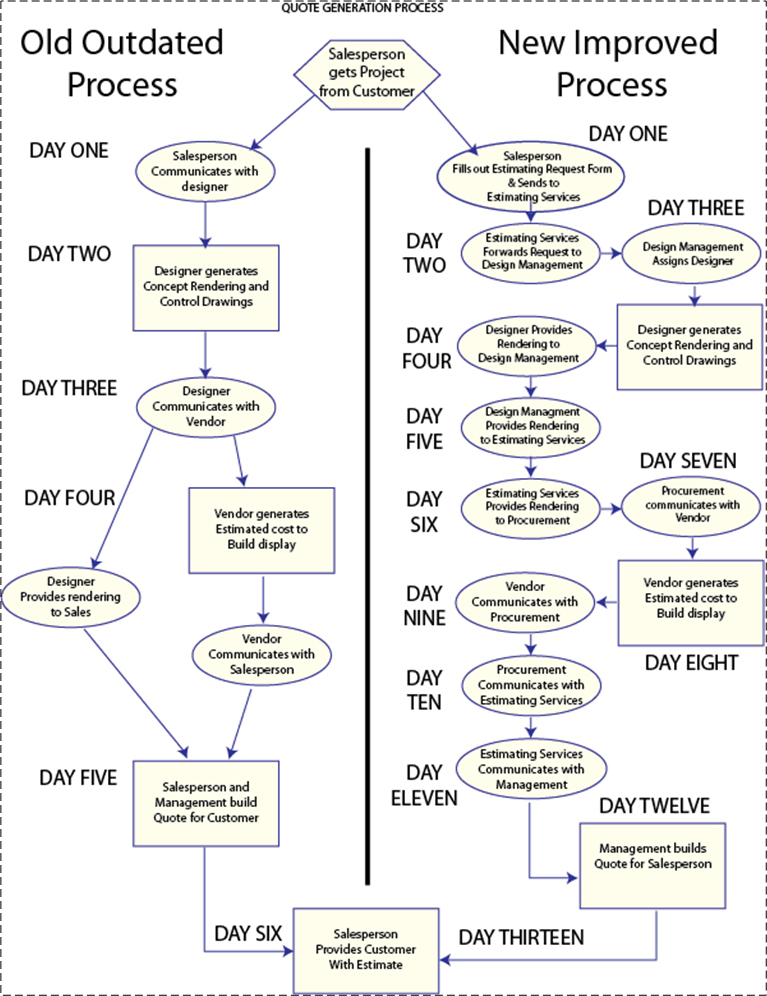
With a 2X increase in delay from input to output and the addition of three new “enabling” actors,
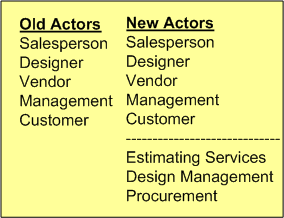
the new process is a slam dunk and a shining example of the value-added that can be achieved from doggedly performing continuous improvement.
Dramatic Difference
I’ve been an investor in Whole Foods Markets for about 10 years because I like CEO John Mackey‘s “Conscious Business” approach to capitalism. In this Fast Company post, “How Whole Foods Became The Luxury Brand Of Millennials”, Michael Pavone dramatically illustrates the difference between today’s winners and yesterday’s winners with this chart:

Maybe Eckhart Tolle is right when he says that a transformation to a “New Earth” is slowly but surely taking place. But then again, since Mackey-like approaches and businesses like Whole Foods Markets are still extreme outliers, maybe he’s wrong.
What do you think? Putting your company’s BS press clippings and self proclamations of greatness aside for a brief moment, how is your business really different from your moo-herd peers?

Filtered And Delayed
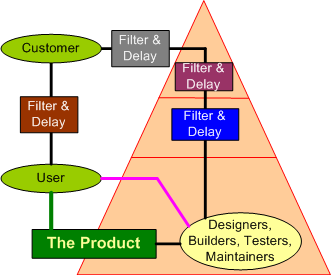
In the consumer products business, the customer and the user are one and the same – a “customoozer“. The figure below shows two system “designs” for a consumer products company. All other things equal, which one has the competitive advantage?

In industries like B2B and government contracting, where the customer and end user are separate entities with differing wants/needs/agendas, the typical institutional design structure is shown below:

It’s no wonder that most innovation occurs in the consumer products industry.
If it could be pulled off, do you think that the subversive system enhancement below could provide a competitive advantage?
Transparency, Meritocracy, and Collaboration
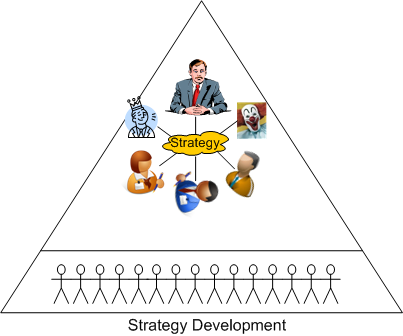
When Red Hat Inc. went public with much fanfare 12 years ago, I thought there was no way the company would make money on the Linux open source operating system. As usual, BD00 was outright wrong. This MIX article by Red Hat VP Jackie Yeaney, “Democratizing the Corporate Strategy Process at Red Hat”, may explain one reason why.
In her article, Ms. Yeaney shares all the details of the company’s strategic development process along with some performance metrics that demonstrate its effectiveness. Here are some snippets that I found refreshingly interesting.
“When I first started working with Red Hat at the beginning of 2008, it was readily apparent that the traditional corporate strategy development process would simply not work in an open source company where transparency, meritocracy, and collaboration were prized elements of the culture.”
“While many might view it is as a disadvantage or a time sink to systematically gather feedback from across the company, at Red Hat it’s a core part of our competitive advantage.”
“We built an internal wiki that leaders of each exploration team used to organize their thoughts and ideas out in the open where any employee could make comments or suggestions. Anyone who was particularly interested could read about the progress, and add their ideas or volunteer to help (and many did).”
“This information-gathering dialog lasted about 5 months. We communicated our progress along the way through regular updates at company meetings, through email, and on the Intranet. The strategy team leaders posted status updates to the wiki and replied to comments on their team’s internal blog. Jim hosted a company-wide online chat session where associates could ask him any question they wanted to about the strategy process (or anything else that was on their minds), and team leads communicated key updates through company-wide announcements and discussions.”
The likelihood that you have any clue of how business strategy is created in your org is low. The likelihood that you’re given the chance to actively participate in the process is even lower, dontcha think? Instead of being “engaged with” you’re simply “communicated to“, no?

Why am I here?
WTF?
Meh!
D'oh!

My BTC Address



 Bulldozer00's Blog