Archive
Courageous Journey
Here’s a dare fer ya:
If your org has a long, illustrious history of product development and you’re just getting started on a new, grand effort that will conquer the world and catapult you and your clan to fame and fortune, ask around for the post-mortem artifacts documenting those past successes.
If by some divine intervention, you actually do discover a stash of post-mortems stored on the 360 KB, 3.5 inch floppy disk that comprises your org’s persistent memory, your next death-defying task is to secure access to the booty.
If by a second act of gawd you’re allowed to access the “data“, then pour through the gobbledygook and look for any non-bogus recommendations for future improvement that may be useful to your impending disaster, err, I mean, project. Finally, ask around to discover if any vaunted org processes/procedures/practices were changed as a result of the “lessons learned” from innocently made bad decisions, mistakes, and errors.

But wait, you’re not 100% done! If you do survive the suicide mission with your bowels in place and title intact, you must report your findings back here. To celebrate your courageous journey through Jurassic Park, there may be a free BD00 T-shirt in the offing. Making stuff up is unacceptable – BD00 requires verifiable data and three confirmatory references. Only BD00 is “approved” to concoct crap, both literally and visually, on this dumbass and reputation-busting blawg.
Behind One’s Back
Most reasonable people think that “talking behind one’s back” is a dishonorable and disrespectful thing to do. But aren’t many corpo performance evaluation systems designed, perhaps inadvertently, to do just that?
In some so-called performance evaluation systems, an “authorized” evaluator (manager) talks to an evaluatee’s peers to get the “real scoop” on the behavior, oops, I mean the “performance” of the evaluatee. But can’t that be interpreted (by unreasonable people, of course) as a sanctioned form of talking behind one’s back?
In these ubiquitously pervasive and taken-for-granted performance evaluation systems, when the covert, behind-the-back, intelligence gathering is complete and an “objective” judgment is concocted, it’s bestowed upon the evaluatee at the yearly, formal, face-to-face get together.
Wouldn’t it be more open, transparent, and noble to require face-to-face, peer-to-peer reviews before the dreaded “sitdown” with Don Corleone? Even better, wouldn’t it be cool if the evaluatee was authorized by the head shed to evaluate the evaluator?
“Mr. Corleone, just about every action you took last year slowed me down, dampened my intrinsic motivation, and delayed my progess. Hence, you sucked and you need to improve your performance over the next year.“

But alas, hierarchies aren’t designed for equity. Besides, quid pro quo collaboration takes too much time and we all know time is money. Chop, chop, get back to work!
To make the situation more inequitable and more “undiscussable“, some orgs institute two performance evaluation systems: the formal one described above for the brain dead DICsters down in the bilge room; and the undocumented, unpublicized, and supposedly unknown one for elite insiders.
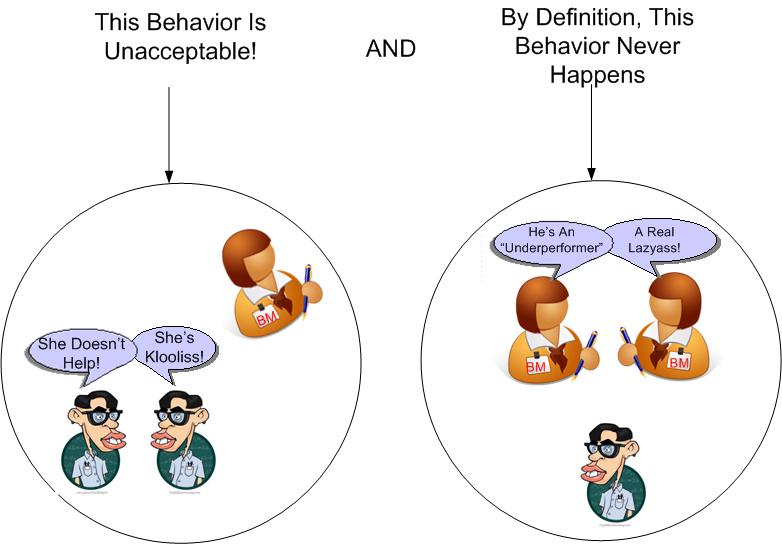
If you work in an org that has a patronizing, behind-your-back performance evaluation system, don’t even think of broaching the subject to those who have the power to change the system. As Chris Argyris has stated many times, discussing undiscussables is undiscussable.
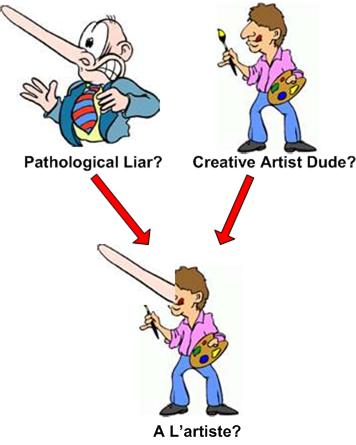
But wait! Snap out of that psychedelic funk you may have found yourself drifting into after reading the above blasphemy. Remember whose freakin’ blog you’re reading. It’s BD00’s blog – the self-proclaimed, mad, l’artiste.
Four Reasons
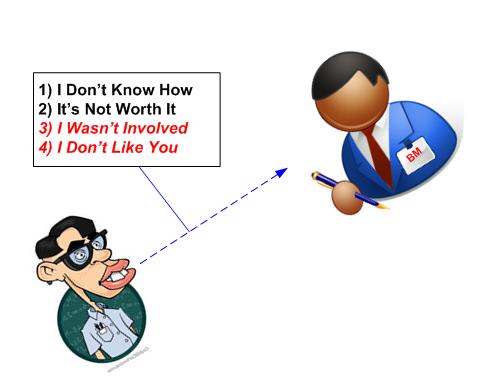
When I don’t do something that I’m “supposed” to do, it comes down to one of two reasons:
- I don’t know how to do it because of a lack of expertise/experience (ability).
- I don’t believe it adds any, or enough, value (motivation).
But wait, I lied! There are also two more potential, but publicly undiscussable reasons. They’re elegantly put into words by Mr. Alexander Hamilton:
Men often oppose a thing merely because they have had no agency in planning it, or because it may have been planned by those whom they dislike. – Alexander Hamilton
How about you? When you don’t do something expected of you, why don’t you do it?
Humbled And Overjoyed
I’m humbled and overjoyed that some people actually appreciate and want to hear what BD00 has to say:

If you don’t overcome the fear of publicly expressing yourself somehow, then how else can you experience the same warm feelings – outside of your small, bounded, circle of family and friends? Why, daily, at work, of course.
Brain-Bustingly Hard
Unsettlingly, I admire the cross-disciplinary work of William L. Livingston because:
- It’s difficult to place into a nice and tidy category (systems thinking? social science? philosophy?).
- It resonates with “something” inside me but it’s brain-bustingly hard to absorb, understand, and re-communicate.
- The breadth of his vocabulary is astonishing.
- He doesn’t give a shit about becoming rich and famous.
- He digs up quotes/paragraphs from obscure, but insightful “mentors” from the past.
As the boxes below (plucked from the D4P4D) show, Gustave Le Bon is one of those insightful mentors, no?
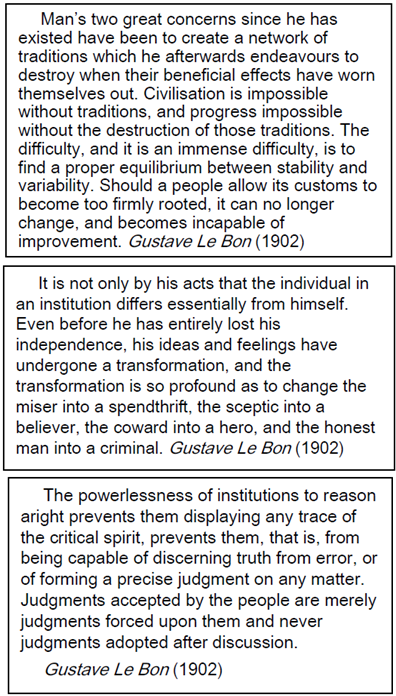
A lot of Mr. Le Bon’s work is available for free online at project Gutenberg.
Human_Being:preserveSelf
As the UML sequence diagram below shows, an “unnamed” Nature object with an infinite lifeline asynchronously creates and, uh, kills Human_Being objects at will. Sorry about that.

So, what’s this preserveSelf routine that we loop on until nature kicks our bucket? I’m glad you asked:

Have a nice day! 🙂
Performance Per Watt
Recently, I concocted a blog post on Herb Sutter‘s assertion that native languages are making a comeback due to power costs usurping programming labor costs as the dominant financial drain in software development. It seems that the writer of this InforWorld post seems to agree:
But now that Intel has decided to focus on performance per watt, as opposed to pure computational performance, it’s a very different ball game. – Bill Snyder
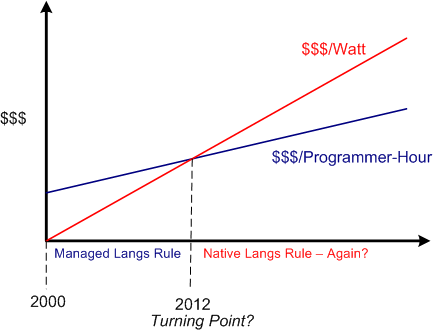
Since hardware developers like Intel have shifted their development focus towards performance per watt, do you think software development orgs will follow by shifting from managed languages (where the minimization of labor costs is king) to native languages (where the minimization of CPU and memory usage is king)?
Hell, I heard Facebook chief research scientist Andrei Alexandrescu (admittedly a native language advocate (C++ and D)) mention the never-used-before “users per watt” metric in a recent interview. So, maybe some companies are already onboard with this “paradigm shift“?
So-Called Reality


D4P4D Tweetfest

I’m in the process of reading William L. Livingston’s “Design For Prevention For Dummies” (D4P4D). I’m a pretty fast reader, but like my prior consumptions of all of Bill’s other dense and mind-absorbing writings, it’s a slow going affair that’s severely playin’ with my mind. I can only read about 10 fascinating pages per sitting before having to abandon ship and recoup my senses. After a martini, it’s 1 page and done. D’oh!
The book is full of masterful and tweet-worthy quotes like these:
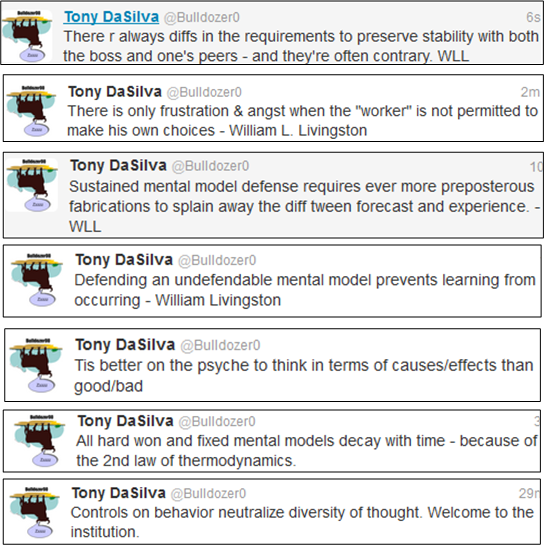
Bill, if you’re reading this bogus blog post, I apologize for the lack of attribution in some of the tweets. I think I know you well enough that you don’t give a chit, but since I twisted your words so much in some of the tweets, I didn’t know if I should attribute them to you. Cheers!

Why am I here?
WTF?
Meh!
D'oh!

My BTC Address



 Bulldozer00's Blog