Archive
Extrapolation, Abstraction, Modeling
In the beginning of his book, “Behavior: The Control Of Perception“, Bill Powers asserts that there are three ways of formulating a predictive theory of behavior: extrapolation, abstraction, and modeling.
Extrapolation and abstraction are premised on accumulating a collection observations of behaviors and ferreting out recurring patterns applicable under many contexts and input situations. Modeling goes one level deeper and is based on formulating an organizational structure of the internal mechanisms that cause the observed behaviors.

For 30 years prior to the discovery/development/refinement of control theory (and continuing on today because of entrenched mindsets), psychologists and sociologists formulated theories of behavior based on extrapolation and abstraction. Because the human nervous system and brain were (and still are) unfathomably complex, they didn’t even try to model any underlying mechanisms. They treated organisms as dumb-ass, purposeless, “black box” responders to stimuli.
Bill Powers didn’t accept the superficial approaches and black box conclusions of the social “sciences” crowd. He went deeper and turned opaque-black into transparent-white with the relentless modeling and testing of his control system hypothesis of behavior:
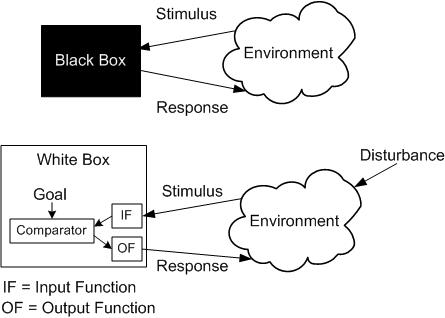
Note that in Bill’s model, there is an internal goal that determines the response to a given “disturbance“. Thus, given the same disturbance at two different points in time, the white box model can generate different responses whereas the black box model would always generate the same response.
For example, the white box model explains anomalies like why, on the 100th test run, a mouse won’t press a button to get a food pellet as it did on the 99 previous runs. In this case, the internal goal may be to “eat until satiated“. When the internal goal is achieved, the externally observed behavior changes because the stimulus is no longer important to the mouse.
Theories based on extrapolation and abstraction are useful for predicting short term actions and trends within a certain probability, but when a physical model of the underlying mechanisms of a phenomenon is discovered, it explains a lot of anomalies unaccounted for by extrapolation/abstraction.
For a taste of Mr. Powers’ control system-based theory of behavior, download and experiment with the software provided here: Living Control Systems III.
The History Of Man
The particulars of each discontinuity may be different, but regardless of which “ism” rules the roost at any given time, the sawtooth pattern is the same at the macroscopic level:

When the ratio of “have-nots” to “haves” in a stable society exceeds an unknown threshold, instability and revolution are sure to follow; it’s just a matter of when. The old order is jettisoned, and the new order, sincerely but falsely promising equity for all, is lovingly embraced by the “have-nots“. The ratio then abruptly decreases because the “haves” are forcefully transformed into the new “have-nots” (usually violently) by the previous crop of “have-nots“…. whose leaders instantly become the new “haves“. And then….. the ratio starts increasing…. yet again.
I guess this is why many people assert that history repeats itself, and lessons, if ever learned, are eventually and conveniently forgotten.

And hey, you’re welcome for the depressing post. But wait… here’s an upbeat closer that (hopefully) makes up for the downer:

Jokes are often offensive. If you get offended, the problem is solidly at your end. – Linus Torvalds
Espoused Vs. In-Use
Although we say we value openness, honesty, integrity, respect, and caring, we act in ways that undercut these values. For example, rather than being open and honest, we say one thing in public and another in private—and pretend that this is the rational thing to do. We then deny we are doing this and cover up our denial. – Chris Argyris
Guys like Chris Argyris, Russell Ackoff, and W. E. Deming have been virtually ignored over the years by the guild of professional management because of their in your face style. The potentates in the head shed don’t want to hear that they and their hand picked superstars are the main forces holding their borgs in the dark ages while the 2nd law of thermodynamics relentlessly chips away at the cozy environment that envelopes their (not-so) firm.
Chris Argyris’s theory of behavior in an organizational setting is based on two conflicting mental models of action:
- Model I: The objectives of this theory of action are to: (1) be in unilateral control; (2) win and do not lose; (3) suppress negative feelings; and (4) behave rationally.
- Model II: The objectives of this theory of action are to: (1) seek valid (testable) information; (2) create informed choice; and (3) monitor vigilantly to detect and correct error.
The purpose of Model I is to protect and defend the fabricated “self” against fundamental, disruptive change. The patterns of behavior invoked by model I are used by people to protect themselves against threats to their self-esteem and confidence and to protect groups, intergroups, and organizations to which they belong against fundamental, disruptive change. D’oh!
From over 10,000 empirical cases collected over decades of study, Mr. Argyris has discovered that most people (at all levels in an org) espouse Model II guidance while their daily theory in-use is driven by Model I. The tool he uses to expose this espoused vs. in-use model discrepancy is the left-hand-column/right-hand-column method, which goes something like this:
- In a sentence or two identify a problem that you believe is crucial and that you would like to solve in more productive ways than you have hitherto been able to produce.
- Assume that you are free to interact with the individuals involved in the problem in ways that you believe are necessary if progress is to be made. What would you say or do with the individuals involved in ways that you believe would begin to lead to progress. In the right hand column write what you said (or would say if the session is in the future). Write the conversation in the form of a play.
- In the left-hand column write whatever feelings and thoughts you had while you were speaking that you did not express. You do not have to explain why you did not make the feelings and thoughts public.
What follows is an example case titled “Submerging The Primary Issue” from Chris’s book, “Organizational Traps:Leadership, Culture, Organizational Design“. A superior (S) wrote it in regard to his relationship with a subordinate (O) regarding O’s performance.
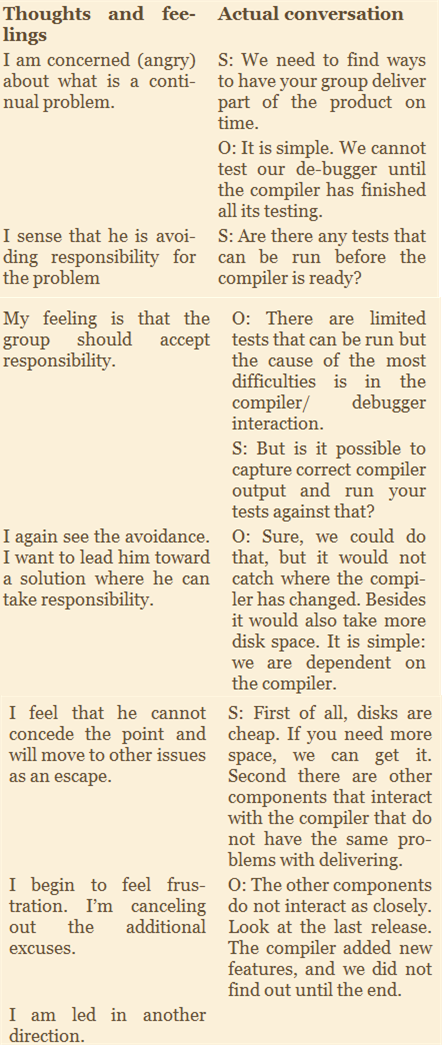
The primary issue in the superior’s mind, never directly spoken in the dialog, is his perception that the subordinate lacks a sense of responsibility. The issue that *did* end up being discussed was a technical one. (I’d love to see the same case as written by the subordinate. I’d also like to see the case re-written by the superior in a non-supervised environment.)
When Mr. Argyris pointed out the discrepancy between the left and right side themes to the case writer and 1000s of other study participants, they said they didn’t speak their true thoughts out of a concern for others. They did not want to embarrass or make others defensive. Their intention was to show respect and caring.
So, are the reasons given for speaking one way while thinking a different way legitimately altruistic, or are they simply camouflage for the desire to maintain unilateral control and “win“? The evidence Chris Argyris has amassed over the years indicates the latter. But hey, those are traits that lead to the upper echelons in corpoland, no?
Ego Battles


And yes, I don my armor daily. It’s war out thar!
Nine Plus Levels
In William T. Powers’ classic and ground-breaking book “Behavior: The Control Of Perception“, Mr. Powers derives a theoretical model of the human nervous system as a stacked, nine-level hierarchical control system that collides with the standard behaviorist stimulus-response model of behavior. As the book title conveys, his ultimate heretical conclusion is that behavior controls perception; not vice-versa.
The figure below shows a model of a control system building block. The controller’s job is to minimize the error between a “reference signal” (that originates from “somewhere” outside of the controller) and some feature in the external environment that can be “disturbed” from the status quo by other, unknown forces in the environment.
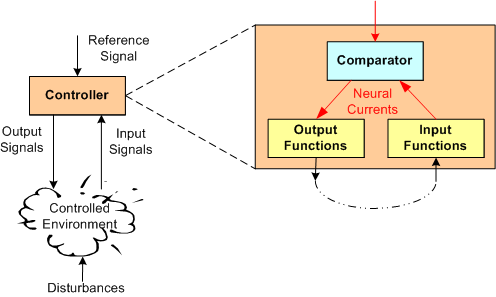
Notice that the comparator is one level removed from physical reality via the transformational input and output functions. An input function converts a physical effect into a simplified neural current representation and an output function does the opposite. Afterall, everything we sense and every action we perform is ultimately due to neural currents circulating through us and being interpreted as something important to us.
So, what are the nine levels in Mr. Powers’ hierarchy, and what is the controlled quantity modeled by the reference signal at each level? BD00 is glad you asked:

Starting at the bottom level, the controlled variables get more and more abstract as we move upward in the hierarchy. Mr. Powers’ hierarchy ends at 9 levels only because he doesn’t know where to go after “concepts“.
So, who/what provides the “reference signal” at the highest level in the hierarchy? God? What quantity is it intended to control? Self-esteem? Survival? Is there a “top” at all, or does the hierarchy extend on to infinity; driven by evolutionary forces? The ultimate question is “who’s controlling the controller?“.
This post doesn’t come close to serving justice to Mr. Powers’ work. His logical, compelling, and novel derivation of the model from the ground up is fascinating to follow. Of course, I’m a layman but it’s hard to find any holes/faults in his treatise, especially in the lower, more concrete levels of the hierarchy.
Note: Thanks once again to William L. Livingston for steering me toward William T. Powers. His uncanny ability to discover and integrate the work of obscure, “ignored”, intellectual powerhouses like Mr. Powers into his own work is amazing.
Dispersion Of Ownership
Much as God was replaced by professional clergy who claim to “know” the will of God, the dispersion of ownership in a company (via the birth of the stock market) birthed the professional institution of management who claim to know the will of the owners.
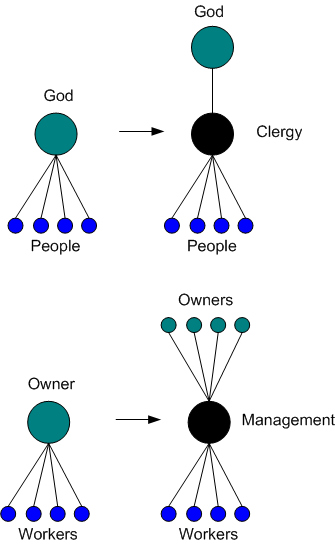
If the will of absentee owners is solely to extract maximal profit from the org, then management indeed knows the will of the owners. And since the workery can no longer communicate directly with the diluted and fragmented owner heap, their concerns and ideas are conveniently out of sight and out of mind; reinforcing the “maximal profit extraction” mindset.
Relying on the fairness of managers to balance profit with worker well-being is not much different than relying on the same behavior from a heap of unconnected, faceless owners because neither group is the original creator of the org.
Note: This post is the result of contemplation and reflection on the Russell Ackoff paper titled: “A SYSTEMIC VIEW OF TRANSFORMATIONAL LEADERSHIP“. It’s yet another unoriginal BD00 meta-post. As usual, I sketched up a picture and pasted some bogus words around it. You can probably come up with a better supporting story yourself. Give it a try.
Shall And Shall Not
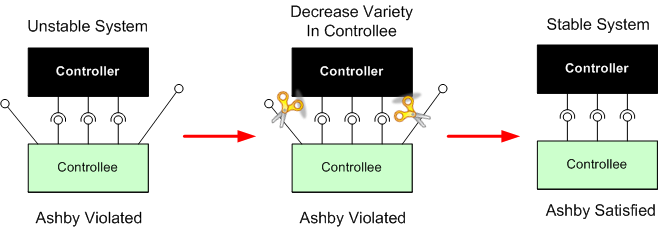
For a controlled system to remain viable and stable, Ashby’s law of requisite variety requires that the system controller(s) exhibit a wider variety of behavior than the system controllee(s). This can be accomplished by either the controller increasing its variety of responses to controllee disturbances, or by decreasing the variety of controllee disturbances relative to its own variety of control responses, or both.
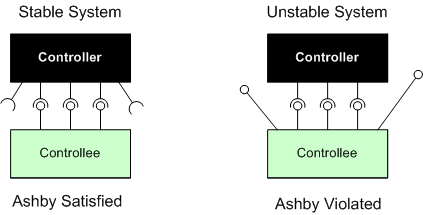
In order to comply with Ashby’s law (in conjunction with several other natural laws – 2nd law of thermo, control theory, Turing’s infallible/intelligence thesis, etc), Bill Livingston asserts that membership in any institution requires the internalization, either consciously or (more likely) unconsciously, of the following set of “shall” and “shall not” rules:
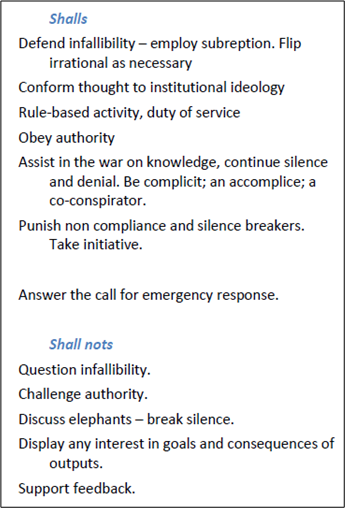
As you can see, suppressing variety in the controllee population is the preferred method of a controller aiming to satisfy Ashby’s law. The alternative, increasing its own variety of response relative to controllee variety of disturbance, requires learning and development. By definition, infallible controllers don’t need to learn and develop. They stopped learning when they achieved the status of “infallible” – either by force or by illusion.
So, what do you think? Did Mr. Livingston hit the bullseye? Miss by a mile?
Out Of One, Many
A Software Product Line (SPL) can be defined as “a set of software-intensive systems that share a common, managed set of features satisfying the specific needs of a particular market segment or mission and that are developed from a common set of core assets in a prescribed way“.
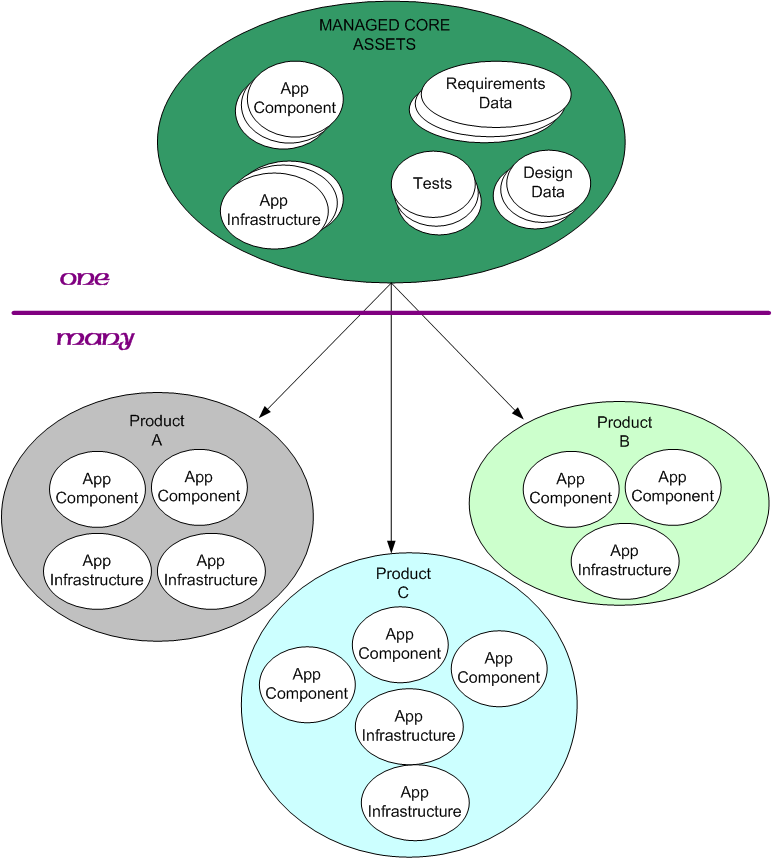
The keys to developing and exploiting the value of an SPL are
- specifying the interfaces and protocols between app components and infrastructure components
- the granularity of the software components: 10-20K lines of code,
- the product instantiation and test process,
- the disciplined management of changes to the app and infrastructure components.
- managing obsolescence of open source components/libs used in the architecture
- keeping the requirements and design data in synch with the code base
Any others?
Your Operational Configuration
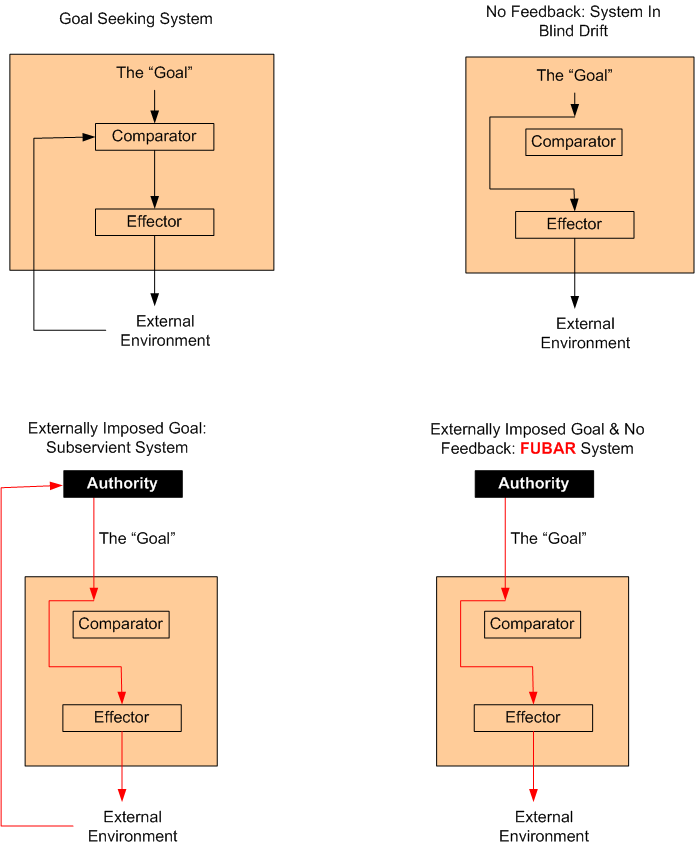
Which system configuration do you prefer? Which system configuration is most prevalent in nature? In the “civilized” world? What’s your operating configuration, and do you have just one?
Idealized Design
Russell Ackoff describes the process of “Idealized Design” as follows:
In this process those who formulate the vision begin by assuming that the system being redesigned was completely destroyed last night, but its environment remains exactly as it was. Then they try to design that system with which they would replace the existing system right now if they were free to replace it with any system they wanted.
The basis for this process lies in the answer to two questions. First, if one does not know what one would do if one could do whatever one wanted without constraint, how can one possibly know what to do when there are constraints? Second, if one does not know what one wants right now how can one possibly know what they will want in the future?
An idealized redesign is subject to two constraints and one design principle: technological feasibility and operational viability, and it is required to be able to learn and adapt rapidly and effectively.
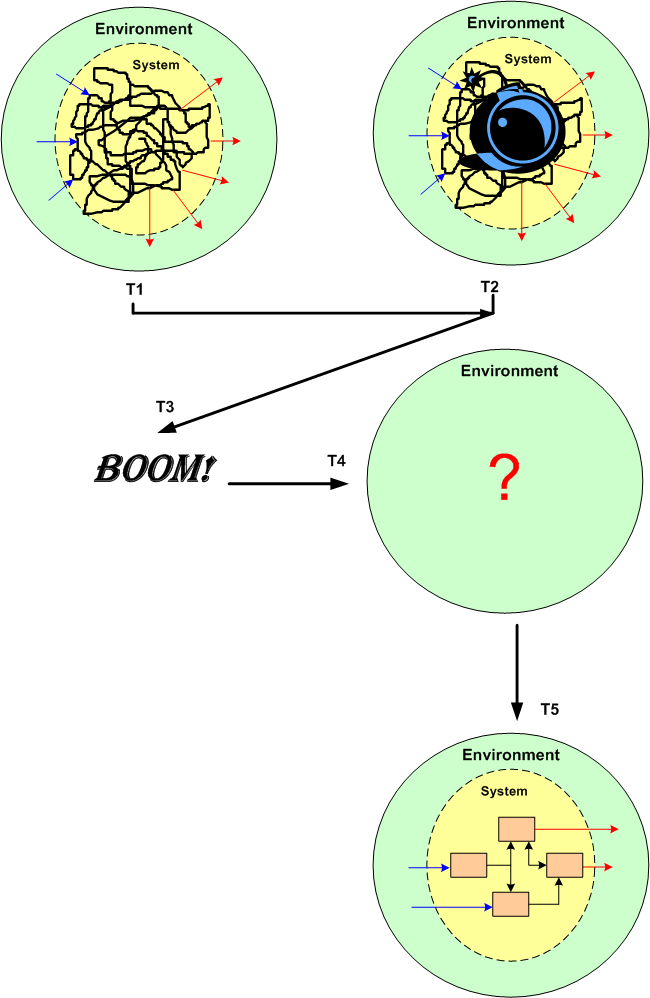
So, are you ready to blow up your system? Nah, tis better to keep the unfathomable, inefficient, ineffective beast (under continuous assault from the second law of thermo) alive and unwell. It’s easier and less risky and requires no work. And hey, we can still have fun complaining about it.

Why am I here?
WTF?
Meh!
D'oh!

My BTC Address



 Bulldozer00's Blog