Archive
Fierce Protection
Delicious, just delicious. Pitches from Fred Brooks, Scott Berkun, Tom DeMarco, Tim Lister, and Steve McConnell all in one place: the Construx (McConnell’s company) Software Executive Summit. You can download them from here: Summit Materials.
Here’s a snapshot of one of Fred Brooks’s slides that struck me as paradoxical:
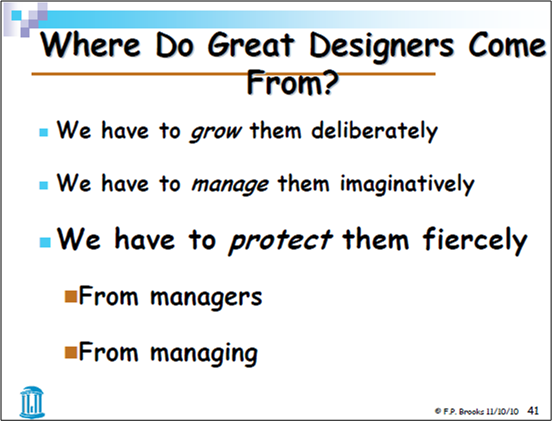
So…. who’s the “we” that Fred is addressing here and what’s the paradox? I’m pretty sure that Fred is addressing managers, right? The paradox is that he’s admonishing managers to protect great designers from…… managers. WTF?
But wait, I think I get it now. Fred is telling PHOR managers to “fiercely” protect designers from Bozo Managers (but in a non-offensive and politically correct way, of course). Alas, the fact that this slide appears at all in Fred’s deck implies that PHORs are rare and BMs are plentiful, no?
How do you interpret this slide?
Aggressive Substitution
One incredibly overused word heard repeatedly like a metronome across the vast corpo wasteland is “aggressive“. We will “aggressively pursue new opportunities“, “aggressively cut costs“, yada, yada, yada. It’s most commonly used by anointed BMs everywhere in long winded inspirational sentences that contain its most beloved twin: “schedule“. Here’s what my corpo jargon decoder ring tells me what it means:
Aggressive Schedule (AS) = Work your ass off at least 12 hours a day for months on end without receiving any overtime pay and expecting the same 1% yearly raise as the rest of the DICforce that smartly exits the psychic prison after five to seven hours of work per day. Oh, and I’ll get a bonus if you meet schedule.
The AS(s) phrase is always wielded by someone with no real skin in the game except for the possibility of fewer stock options if the “S” isn’t met. Since chronic overuse of any word takes the sting out of it, how about creatively mixing it up from time to time with a synonym replacement:
- Barbaric schedule
- Contentious schedule
- Destructive schedule
- Disruptive schedule
- Disturbing schedule
- Intrusive schedule
- Pugnacious schedule
- Rapacious schedule
I can’t decide on my favorite surrogate replacement. It’s either “pugnacious” or “rapacious”. What’s yours?

Disconnect And Distance
If professional social networks like LinkedIn.com were around in the 1980’s, it’s highly likely that you’d be branded as an unloyal traitor for joining one. Even today, didn’t you feel a slight twinge of exhilarating fear when you joined? Uh, not me (LOL!).
If the leaders (or should I say the “SCOL“s?) in your org are ostriches and they cling to outdated, mechanistic, FOSTMA ideas like the demand for one way loyalty without even a hint of self awareness that they need to change their mindsets, then head for the hills because your sugar daddy is most likely going downhill. If, for some reason beyond your control you think you’re stuck where you are, then simply disconnect and distance yourself from the daily shenanigans that take place in your environment.

Rabble-Rousing And Anarchy-Instigation
Because he’s passionate, energetic, and prolific, I like Tom Peters. Check out this twitter conversation I recently had with him:

What are your thoughts?
Infinitely Late
In deference to Fred Brooks‘s “adding more people to a late project makes it later“, I present you with the enhanced version: “adding more people to a late project makes it later, and at some critical size K, adding more people makes it infinitely late“.
 As more smart and competent people are added to an org or project, the capability of the group to accomplish great things increases. The really sad thing about poor management is that this increased capability is countered by increased fragmentation and growth in fatty middle corpo layers that slowly snuff out productivity. The lag time between the addition of people and degraded org productivity can be can be so great that the correlation is totally missed and the probability of recovery goes to zero.
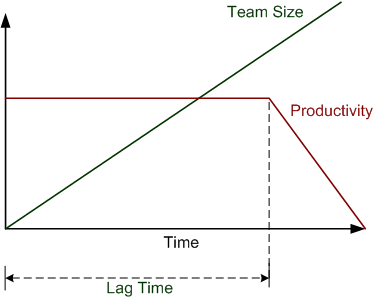
At a really dysfunctional institution, productivity plummets to zero and the immobilized institution withers away – unless some sugar daddy starts subsidizing the beast without regard to performance.
In the cases where the hapless institution is a government, it can become is its own sugar daddy. Since it has the bullying power to subsidize itself via taxation of its constituency, it can maintain its comatose state for essentially infinity. DYSCOs are not so lucky. They can, and often do, run out of money before they even know what hit them.
Love Before Fear First, And Fear Before Love Second
One of Niccolo Machiavelli‘s most famous dicta is:
It is better to be feared than loved.
But wait….. that’s not the whole story. It’s certifiably time-proven and unassailable advice after you’ve parked your svelt butt on the throne, but not before. As you rise through the power rankings on your way to becoming alpha dog, it’s better to be loved than to be feared so that you can be swept into power by the very same people that you’ll need to fear you after you’ve secured Fort Knox.
You get it, right? If you’re not loved on the way up, chances are that you won’t even make it “up”. Hence, you’ve got to cleverly morph into one of those “nice guys” at work. You know, one of those stereotypical Stepford dudes that everybody speaks fondly of, but whose contributions and accomplishments are mysteriously unknown.
Thus, I, Bulldozer00, illegitimate son of Bulldozer and 00, have successfully catapulted brother Machiavelli’s quote for success into 21st century:
“Before you acquire power, it is better to be loved than feared. After you’ve acquired power, it is better to be feared than loved” – Machiavelli and Bulldozer00
Moo, hah , hah, hah. MOO HAH HAH HAH!!!!

Self Inquiry
I used to follow a bunch of spiritual and motivational teachers on Twitter, but I’ve “unfollowed” most of them since I didn’t connect much with their tweets – meh. It reached the point where I equated their mostly-boring tweet floods with spam. However, “brite2briter“ hits the sweet spot because her tweets invite her tweetees to practice “self inquiry” like the more well known Byron Katie (Is it absolutely true?) and Ramana Maharshi (Who am I?).
Recently, brite2briter fired off a couple of tweets that hit home. Here they are, along with my replies:
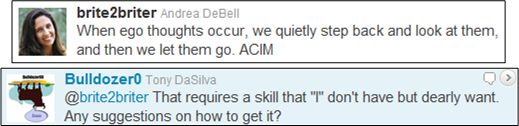

Do these examples do anything fer ya? Too far out and new agey? Meh?
Requisite Knowledge
In “Item 3. Design Patterns” of Stephen Dewhurst’s “C++ Common Knowledge: Essential Intermediate Programming“, he states the following:
Design patterns are often described as “micro-architectures” that can be composed with other patterns to produce a new architecture. Of course, selecting appropriate patterns and composing them effectively requires design expertise and native ability. However, even your manager will be able to understand the completed design if he or she has the requisite knowledge of patterns.
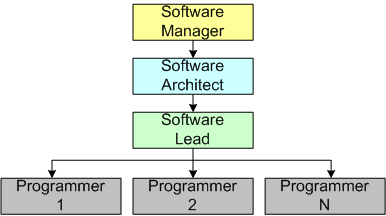
Uh, Stephen, you’re kidding, ain’t ya? In a project mini-corpricracy like the one below, you’ll be lucky if even the software lead knows what a pattern is, let alone the lofty manager. The software “Rocket-tect” will most likely know what a pattern is – but probably not how to apply it since he/she will be stuck in “lemme-show-u-how-smart-I-am” jargon-land. On the bright side, everybody in the power structure (which excludes the programmers, of course) will know what a Microsoft schedule, spreadsheet, and powerpoint deck are.
Fixed Vs Variable Sleep Times
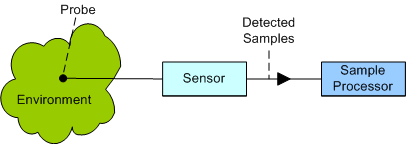
Consider the back end of a sensor system as shown below. Now, assume that you’re tasked with building the Sample Processor and you need some way of testing it. Thus, you need to simulate the continuous high speed sample stream that the Sensor will produce during operation in the real physical world.
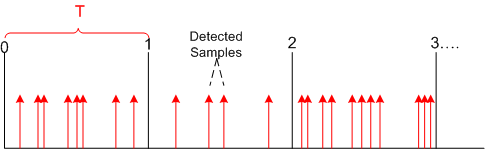
Since the analog real world is wonderfully messy and non-deterministic, the sensor/probe combo will produce data sample detections in bursty clumps as modeled below.
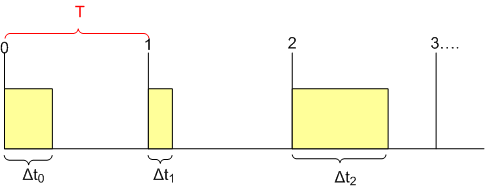
However, since you don’t need the high fidelity and fine grained controllability in your sensor simulator implied by the figure, you simplify your approach by modeling the sensor output as a deterministically time sliced (slice size = T) and “batched” device as shown by the yellow boxes in the diagram below.
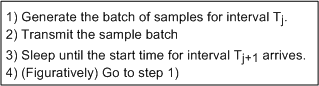
 After thinking about it, you sketch out a simple core sensor simulation algorithm as:
As the figure below shows, there are two options for determining how long to “sleep” after each yellow sample batch has been generated and transmitted: fixed and variable. In the simpler approach, the code sleeps for a fixed time duration “T” after every batch – regardless of how long it took to generate and transmit the batch of sensor samples. In the higher fidelity variable sleep approach, the time to sleep is calculated on the fly during runtime as the slice time “T” minus the time it took to generate and send the current batch. As the batch processing time approaches the time slice period T, the software sleeps less in order to maintain true real-time operation.
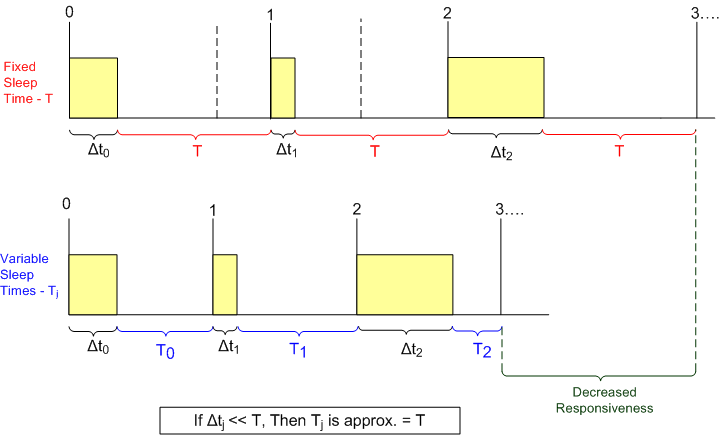
As the figure shows, implementing the sensor simulator with variable sleep time logic results in truer real-time behavior. In the fixed sleep design, the simulator starts lagging behind real-time immediately and the longer the sensor simulator runs, the further its behavior deviates from the real-time ideal. However, for short simulator runs and/or large relative time slice periods (see the box above), the simpler fixed sleep time approach tracks real-time just about as well.
For the project I’m currently working on, I’ve coded up a sensor simulator and sample processor pair that can be configured either way. I just thought I’d share the analysis/design thought process that I went through just in case it might interest or help anybody who’s working on something similar.
DYSCO Dancer
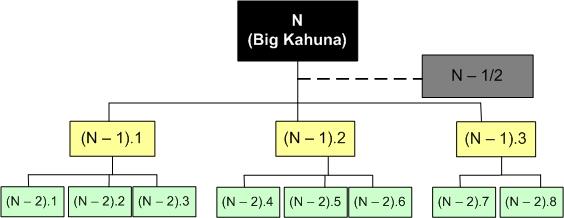
The figure below shows the top three levels of an N level textbook corparchy. Virtually all corpo monarchs present some visual camouflage like this to model their beloved corpricracy. The massive illusions that a diagram like this intends to project are:
- an orderly flow of timely, accurate status information upward;
- intelligent direction and guidance downward;
- cooperative collaboration both sideways and diagonally;
- a paragon of efficiency and excellence for all external and (especially) internal observers to embrace without inquiry.
Now, splash some cold water on your face and observe an example of a pseudo-realistic model of a typical DYSCO dance:
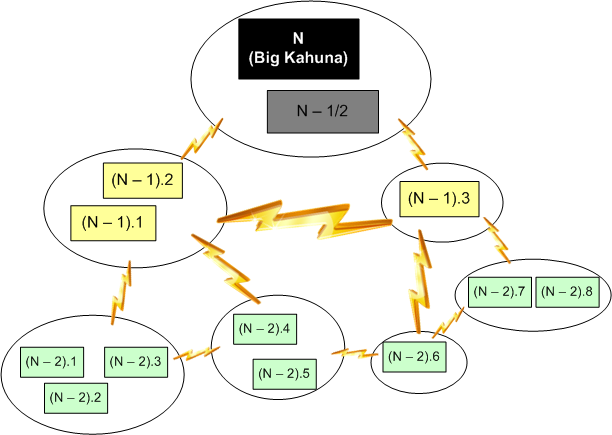 If you’ve inferred that the lightning bolt connections represent clever, but antagonistic and counterproductive relationships between rival DYSCO dancing factions, then you’d be right.
Some of my friends(?) have told me that I’m an elite DYSCO dancer. Are you?


Why am I here?
WTF?
Meh!
D'oh!

My BTC Address



 Bulldozer00's Blog