Archive
A Real Renaissance
For quite some time now, I’ve been hearing that C++ has been undergoing a resurgence of interest; a renaissance. However, until recently, I couldn’t tell if the claim was real, or just some hype coming out of the C++ community to fruitlessly combat the rise of a plethora of new languages.
Well, I’m convinced that the renaissance is legit. The slides below, pilfered from Herb Sutter‘s “The Future Of C++” talk at Microsoft Build 2012, introduced the formation of a new C++ trade group, the “Standard C++ Foundation“.

Note that there are some big guns with deep pockets backing the foundation along with a cadre of brilliant and dedicated directors at the helm.
It’s a good time to be a C++ programmer, so join the renaissance and start learning the new features and libraries offered up in C++11. Of course, if your technical management is not forward looking and it’s tight with training dollars, you’ll have to do it on your own time, covertly, behind the scenes. But it will not only be fun, it will enhance your marketability.
The C++ Product Roadmap
Fresh from the ISO C++ chairman himself, Herb Sutter, I present you with the C++ product roadmap:

If all goes according to plan, a minor release of the ISO standard will be hatched in 2014. By minor, Herb means that it will be mostly bug fixes to C++11, plus a filesystem library based on Boost.org‘s brilliant work. The networking library, which is big and being developed by a large group of smart people, will be hatched incrementally in a series of Technical Specifications (TS).
The main point that Herb stressed when he hoisted the slide was that “the past is not a good predictor of the future“. If all goes according to plan, the time between major releases of the standard will have been cut from 13 years to 6.
Two Plus Months
Race conditions are one of the worst plagues of concurrent code: They can cause disastrous effects all the way up to undefined behavior and random code execution, yet they’re hard to discover reliably during testing, hard to reproduce when they do occur, and the icing on the cake is that we have immature and inadequate race detection and prevention tool support available today. – Herb Sutter (DrDobbs.com)
With this opening paragraph in mind, observe the figure below. If you don’t lock-protect a stateful object that’s accessed by more than one thread, you’re guaranteed to fall into the dastardly trap that Herb describes. D’oh!

Now, look at the two object figure below. Unless you protect each of the two objects in the execution path with a lock, you’re hosed!

To improve performance at the expense of higher risk, you can use one lock for the two object example like on the left side of this graphic:
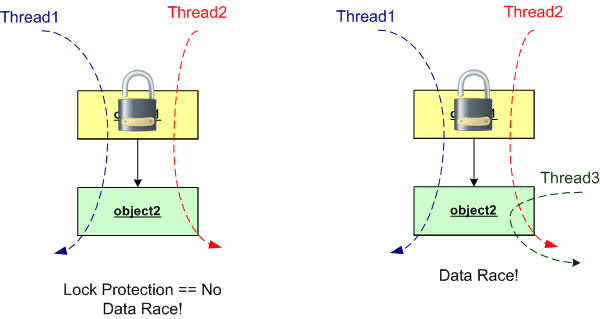
Alas, if you do choose to use one lock in a two object configuration like the example above, you better be sure that you don’t come in through the side with another thread to use the thread-unsafe object2. You also better be sure that a future maintainer of your code doesn’t do the same. But wait… How can you ensure that a maintainer won’t do that? You can’t. So stick with the more conservative, lower performance, one-lock-per-object approach.
Don’t ask me why I wrote this post cuz I ain’t answering. Well, Ok, ask. I wrote this post because I was burned by the left-hand side of the second graphic in this post. It took quite awhile, actually two plus months, to finally localize and squash the bugger in production code. As usual, Herb was right.
And please, don’t tell me that lock-free programming is the answer:
…replacing locks wholesale by writing your own lock-free code is not the answer. Lock-free code has two major drawbacks. First, it’s not broadly useful for solving typical problems—lots of basic data structures, even doubly linked lists, still have no known lock-free implementations. Second, it’s hard even for experts. It’s easy to write lock-free code that appears to work, but it’s very difficult to write lock-free code that is correct and performs well. Even good magazines and refereed journals have published a substantial amount of lock-free code that was actually broken in subtle ways and needed correction. – Herb Sutter (Dr. Dobbs).
Performance Per Watt
Recently, I concocted a blog post on Herb Sutter‘s assertion that native languages are making a comeback due to power costs usurping programming labor costs as the dominant financial drain in software development. It seems that the writer of this InforWorld post seems to agree:
But now that Intel has decided to focus on performance per watt, as opposed to pure computational performance, it’s a very different ball game. – Bill Snyder
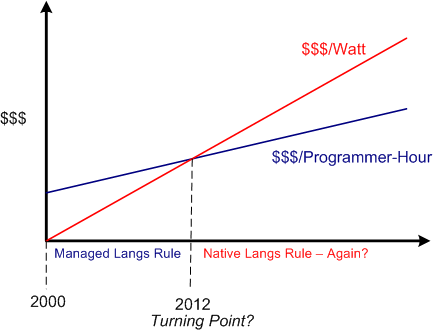
Since hardware developers like Intel have shifted their development focus towards performance per watt, do you think software development orgs will follow by shifting from managed languages (where the minimization of labor costs is king) to native languages (where the minimization of CPU and memory usage is king)?
Hell, I heard Facebook chief research scientist Andrei Alexandrescu (admittedly a native language advocate (C++ and D)) mention the never-used-before “users per watt” metric in a recent interview. So, maybe some companies are already onboard with this “paradigm shift“?
Relentless Assault
Microsoft’s Herb Sutter is a whirling dervish. Since the ISO approval of the C++11 standard last fall, he’s been on a crusade to promote C++ via several comparative assaults on Java and Microsoft’s own C#.
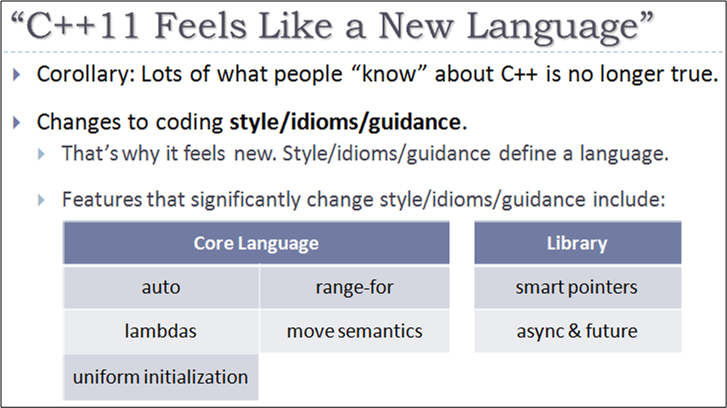
Herb’s latest blitzkrieg occurred at the lang.next 2012 conference (video link, slides link). In this slide, Herb summarizes some of the C++11 features that close the productivity and safety gap relative to C# and Java.
In this next slide, Herb contrasts C++11’s adherence to its more open “trust the programmer” philosophy against the more closed “we know what’s good for you” C#/Java philosophy.

Unless the large movement of business applications to the cloud is the latest fad du jour, the following two slides show that the largest software development and maintenance costs will shift from labor to compute efficiency. Thus, it doesn’t matter how programmer friendly your language is and how low the salaries you pay are, you might find that your costs are going up because of power drain in massive data centers and time spent frantically optimizing VM-based code that’s relatively slower and bigger.

In closing, Herb, the nice guy that he is, backs off a bit with this “the right tool for the right job” slide:
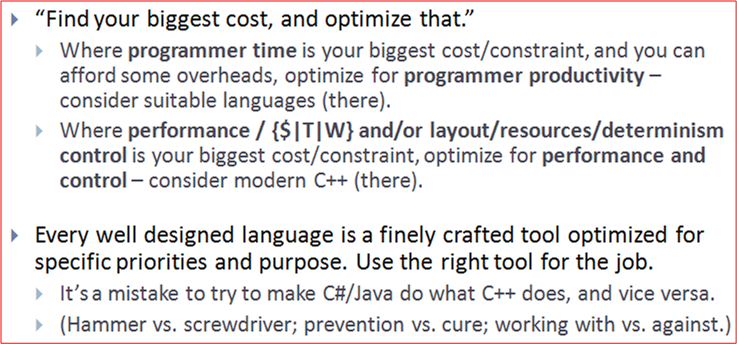
Is Herb stretching the truth and exaggerating the improvements offered up by C++11? The fact that I wrote this post obviously means that I don’t. What about you, dear reader? What say you?
Metadata Code Bloat
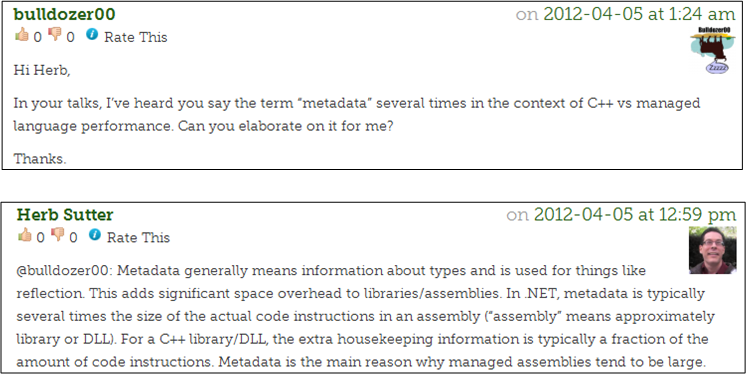
In many of his (terrific) talks and lectures, Herb Sutter often says that “always on garbage collection“, “default virtual dispatch“, and “metadata” are valid reasons as to why managed language programs written in C# and Java are typically slower and bigger than native languages like C++ and C. I understand the first two issues, but not the “metadata” argument. Thus, I asked Herb to “splain dis to me Lucy“.
Here’s my question and Herb’s gracious answer:
The Lost Decade?
I think you’ll be hard pressed to find many knowledgeable C++ programmers who won’t admit that managed languages provide higher per-programmer productivity than native languages (because they’re easier to learn, have bigger libraries, and are not as “picky“). Likewise, I think you won’t find many “reasonable” managed language advocates who won’t admit that native language programs are more efficient (smaller and faster for a given solution) than their managed language counterparts. Having said that, take a look at this chart:

According to Herb Sutter, efficiency has(will) usurped(usurp) productivity as the dominating cost factor for software-intensive products in this decade (battery life in mobile devices, power consumption in the data center). Agree?
If you’re interested in watching the video and/or downloading Herb’s slides, here’s the link: “C++ and Beyond 2011: Herb Sutter – Why C++?“.
A Dearth Of Libraries
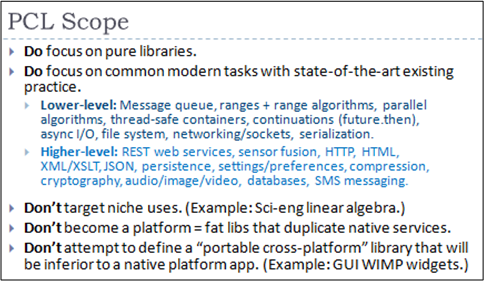
In Herb Sutter’s talk at GoingNative 2012, he opined that the biggest weakness of C++11 is its dearth of libraries; which causes programmers to waste lots of time ($$$) writing their own code to implement mundane functionality like XML parsing, cryptography, networking/sockets, thread-safe containers (<- I’ve had to spend quite a bit of time doing this!), serialization, etc.
Using language and library specification page counts, Herb started out by showing the progressive growth of C and C++ over time:
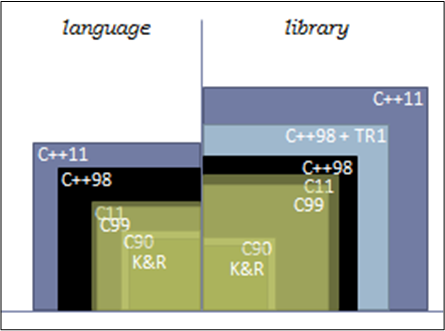
Next, Herb presented this eye-popping chart of relative library size for C++11, .NET, and Java:

Yes, that’s C++11 down in those tiny blue boxes. WTF! Note that the core language specifications on the left side of the chart are roughly the same size.
To address the issue, Herb proposed the formation of a an open-source Portable C++ Libraries (PCL) organization with the following guiding principles:
Herb also addressed the issue of how the PCL would interact with the C++ standards committee with this chart:

Basically, the PCL would serve as a front end vetter and integrator of library submittals in order to unburden the committee from the responsibility and allow it to concentrate more on tricky core language features (concepts, modules, static if, etc). The C++ committee would serve as the final fine-grained scrutinizer and approver of library additions to the language. In practice, libraries like poco and Qt could be shipped with every standards-compliant C++ compiler in the future.
I think Herb’s idea is a good one and I hope it blossoms into the real deal. How about you? What do you think?
Broken Books
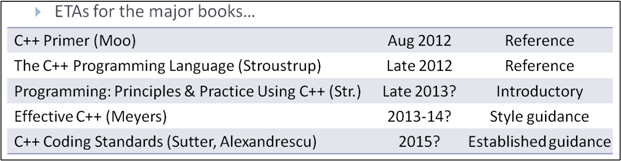
With the addition of features like auto, initializer lists, lambdas, and smart pointers, a lot of C++98 programming idioms and guidance have become obsolete now that C++11 is here. Thus, as Herb Sutter said at GoingNative 2012, a boatload of code examples in the best C++ books are now “broken“.
As a result, new and revamped versions of the books will take awhile to become available. Here’s Herb’s “estimated time of arrival” for several stalwart books:
In the meantime, you can feast your eyes on, and feed the left side of your brain with, these links:
- Bjarne Stroustrup’s C++11 FAQ page
- Wikipedia C++11
- Scott Meyers Overview Of C++11
- C++11 Features To GCC Compiler Map
- C++ Standards Committee Home Page
- GoingNative 2012
- C++11 Features in Visual C++ 11
- Clang Compiler C++11 Support
- Writing Modern C++ Code (Herb Sutter)
Do you know of any other good links to add to this post?
One Chart Summary
While flipping through Herb Sutter’s “C++ And Beyond” keynote speech charts, I stumbled upon this fabulous one chart summary of all (almost all?) the new features available in C++11.
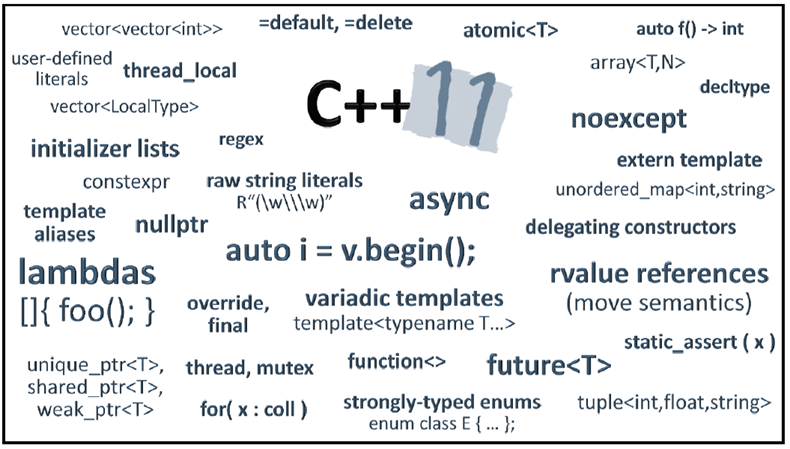
Pretty intimidating, but cool, eh?

Why am I here?
WTF?
Meh!
D'oh!

My BTC Address



 Bulldozer00's Blog