Archive
Management Idiots And Programming Idioms
In TC++PL, Bjarne Stroustrup introduces the concept of a class hierarchy with this simple business world example:
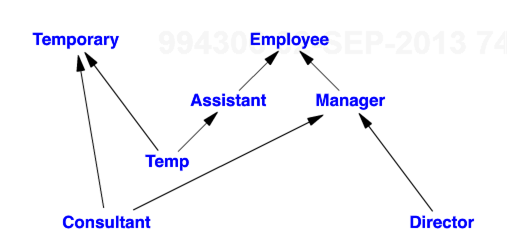
Temporary and Employee base class “objects” get paid by the company to do work that directly creates value. Manager objects inherit an Employee’s responsibilities and encapsulate new, manager-specific, behaviors; like monitoring/commanding/reprimanding non-manager Employees, Temps, and Assistants. Proceeding down the inheritance tree on the right, a Director object inherits the behaviors of both the Manager and Employee classes while adding new “directorial” behaviors.
When BD00 saw Bjarne’s inheritance tree example, he said to himself “Dude, you got it wrong. If you wanted to model the real world, here’s what you shoulda presented“:
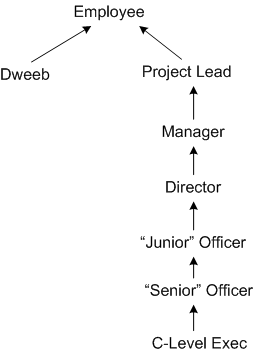
It woulda added a touch of edgy humor to the book, dontcha think?
When I write my first programming book, I’m gonna have diagrams like that and code fragments like this in it:
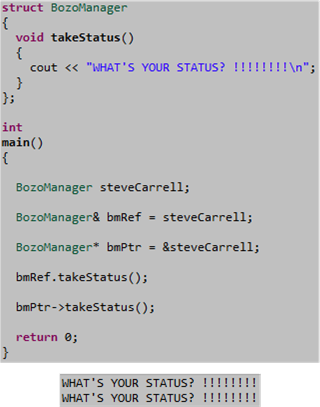
I’m thinking of hatching a kickstarter.com project and titling the hybrid book something like “Management Idiots And Programming Idioms“. What would you name it, and would you buy it?

No Runtime Overhead
Since I have the privilege of using C++11/14 on my current project, I’ve been using the new language idioms as fast as I can discover and learn them. For example, instead of writing risky, exception-unsafe, naked “new“, code like this:
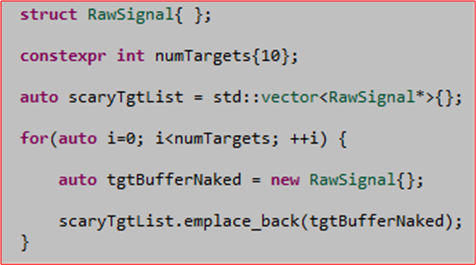
I’ve been writing code like this instead:
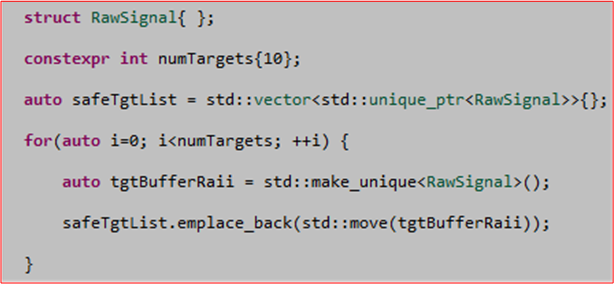
By using std::unique_ptr instead of a naked pointer, I don’t have to veer away from the local code I’m writing to write matching delete statements in destructors or in catch() exception clauses to prevent inadvertent memory leaks.
I could’ve used a std::shared_ptr (which can be copied instead of “moved“) in place of the std::unique_ptr, but std::shared_ptr is required to maintain a fatter internal state in the form of strong and weak owner counters. Unless I really need shared ownership of a dynamically allocated object, which I haven’t so far, I stick to the slimmer and more performant std::unique_ptr.
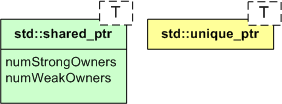
When I first wrote the std::unique_ptr code above, I was concerned that using the std::move() function to transfer encapsulated memory ownership into the safeTgtList vector would add some runtime overhead to the code (relative to the C++98/03 style of simply copying the naked pointer into the scaryTgtList vector). It is, after all, a function, so I thought it must insert some code into my own code.
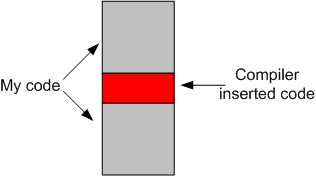
However, after digging a little deeper into my concern, I discovered (via Stroustrup, Sutter, and Meyers) that std::move() adds zero runtime overhead to the code. Its use is equivalent to performing a static_cast on its argument – which is evaluated at compile time.
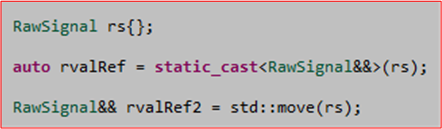
As Scott Meyers stated at GoingNative13, std::move() doesn’t really move anything. It simply prepares for a subsequent real move by casting its argument from an lvalue to an rvalue – which is required for movement of an object’s innards. In the previous code, the move is actually performed within the std::vector::emplace_back() function.
Quoting Scott Meyers: “think of std::move() as an rvalue_cast“. I’m not sure why the ISO C++ committee didn’t define a new rvalue_cast keyword instead of std::move() to drive home the point that no runtime overhead is imposed, but I’d speculate that the issue was debated. Perhaps they thought rvalue_cast was too technical a term for most users?
Update 10/25/13
As I said early in the post, the code example is “like” the code I’ve been writing. The real code that triggered this post is as shown here:
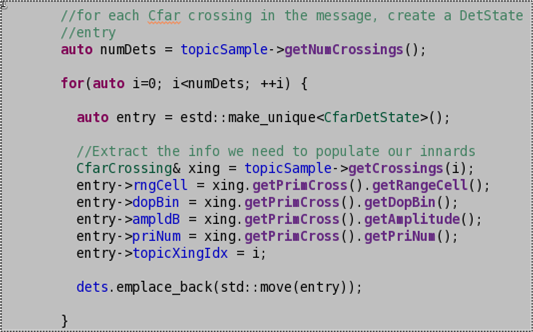
Since each “entry” CfarDetState object must be uniquely intialized form it’s associated CfarCrossing object, I can’t simply insert estd::make_unique<CfarDetState>() into the emplace_back() function. All of the members of each “entry” must be initialized first. Regardless of whether I use emplace_back() or push_back(), std::move(entry) must be used as the argument of the chosen function.
Two Opposing Ideas
If you didn’t already know it, I’m a fan of the C++ programming language. Of course, not everybody feels the same way. There are many smart people who are among the “haters“.
C++ is a horrible language. It’s made more horrible by the fact that a lot of substandard programmers use it, to the point where it’s much much easier to generate total and utter crap with it. – Linus Torvalds
When I read anti-C++ tirades like Linus Torvalds’ emotionally charged attack, it always stings a little at first. But then I eventually step back from the “emotional-me” and remember (thanks to the teachings of Byron Katie and Eckart Tolle) that the world will never be the way I “demand!” it to be. The length of time it takes me to disengage from abstract thought-storms like these and return to earth is proportional to how deeply I’m attached to one side of the debate stomping around in my head.
“The test of a first-rate intelligence is the ability to hold two opposing ideas in mind at the same time and still retain the ability to function.” – F. Scott Fitzgerald
Java creator James Gosling, Haskell‘s Bartosz Milewski, and Go creator Rob Pike are three of the more prominent people in the anti-C++ camp. As expected, they have agendas to promote: advocating their own favorite programming languages at the expense of C++.
- Milewski’s rant: “Edward C++Hands“
- Pike’s rant: “Less Is Exponentially More“
- Gosling’s rant: “The Java Language Environment“
Ironically, these rants by smart and well known people can be construed as tributes to C++. That’s probably why this is one of my favorite Bjarne Stroustrup quotes:
There are just two kinds of languages: the ones everybody complains about and the ones nobody use.
The Biggest Cheerleader
Herb Sutter is by far the biggest cheerleader for the C++ programming language – even more so than the language’s soft spoken creator, Bjarne Stroustrup. Herb speaks with such enthusiasm and optimism that it’s infectious.

In his talk at the recently concluded GoingNative2013 C++ conference, Herb presented this slide to convey the structure of the ISO C++ Working Group 21 (WG21):
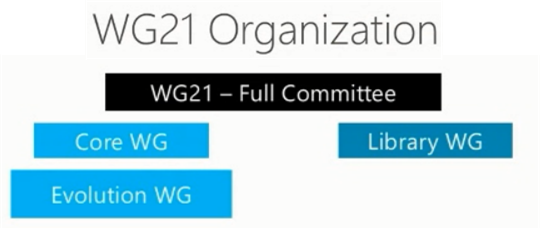
On the left, we have the language core and language evolution working groups. On the right, we have the standard library working group.
But wait! That was the organizational structure as of 18 months ago. As of now, we have this decomposition:
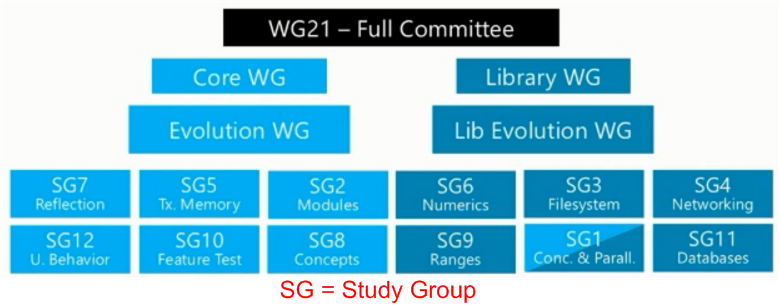
As you can see, there’s a lot of volunteer effort being applied to the evolution of the language – especially in the domain of libraries. In fact, most of the core language features on the left side exist to support the development of the upcoming libraries on the right.
In addition to the forthcoming minor 2014 release of C++, which adds a handful of new features and fixes some bugs/omissions from C++11, the next major release is slated for 2017. Of course, we won’t get all of the features and libraries enumerated on the slide, but the future looks bright for C++.
The biggest challenge for Herb et al will be to ensure the conceptual integrity of the language as a whole remains intact in spite of the ambitious growth plan. The faster the growth, the higher the chance of the wheels falling off the bus.
“The entire system also must have conceptual integrity, and that requires a system architect to design it all, from the top down.” – Fred Brooks
“Who advocates … for the product itself—its conceptual integrity, its efficiency, its economy, its robustness? Often, no one.” – Fred Brooks
I’m not a fan of committees in general, but in this specific case I’m confident that Herb, Bjarne, and their fellow WG21 friends can pull it off. I think they did a great job on C++11 and I think they’ll perform just as admirably in hatching future C++ releases.
Don’t Panic!
The fourth edition of “The C++ Programming Language” weighs in at 1346 pages and 44 chapters allocated over four partitions. The end of each chapter provides a list of advisory items – yielding a grand total of 699 nuggets of general programming and C++ specific wisdom for the reader to ponder.

The figure below shows a breakdown of the behemoth book’s table of contents. The number of advisories provided in each chapter and each partition are shown on the right side.

As a temporary excursion from reading and studying and writing exploratory snippets of C++11 code, I went through all 699 items and plucked out a subset of the tidbits I found most useful. Of course, your personal list would no doubt turn out differently.
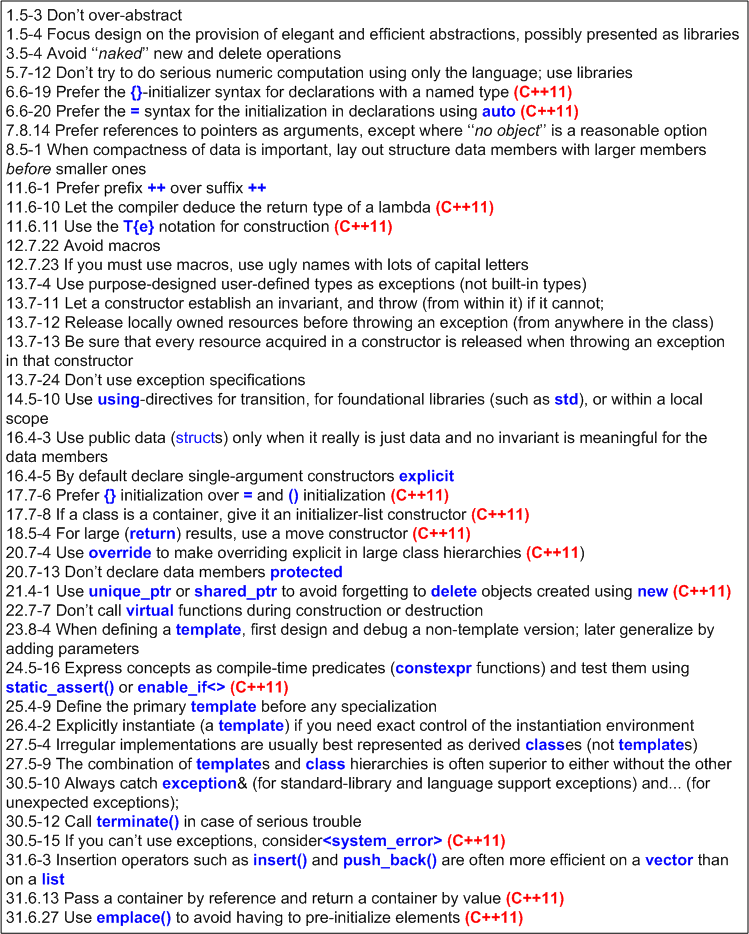
Even though it’s not on my list, my absolute favorite item of advice is the first one presented at the end of chapter 2:

D’oh! Wanna guess at how much time is needed for all to become clear? Maybe Malcolm Gladwell‘s famous “10,000 hours” isn’t enough? But that’s why I love C++. It provides an endlessly rich and deep opportunity for learning.
My C++11 “Move” Notes
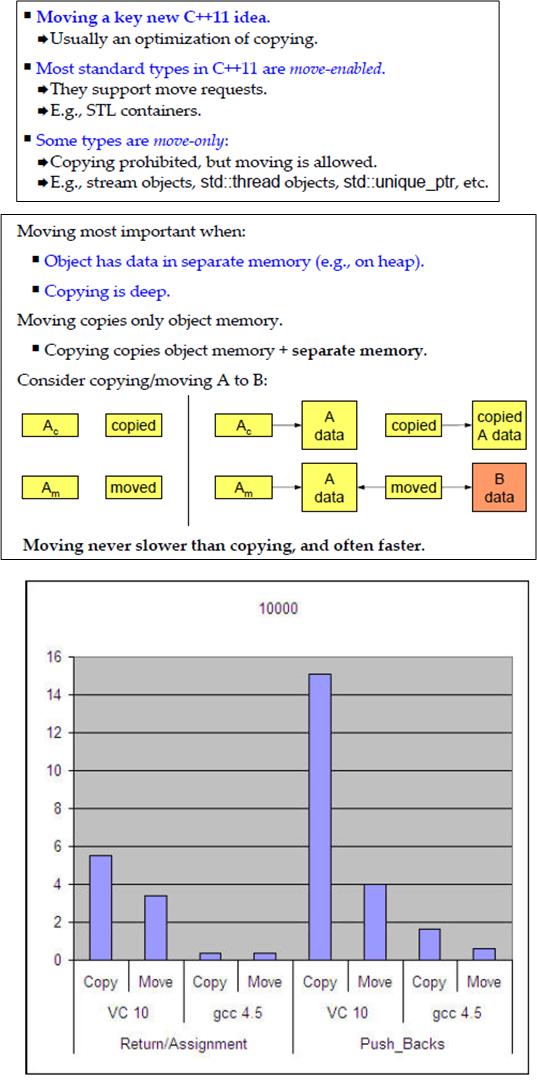
Being a slow learner, BD00 finds it easier to learn a new topic by researching the writings from multiple sources of authority. BD00 then integrates his findings into his bug-riddled brain as “the truth as he sees it” (not the absolute truth – which is unknowable). The different viewpoints offered up by several experts on a subject tend to fill in holes of understanding that would otherwise go unaddressed. Thus, since BD00 wanted to learn more about how C++11’s new “move” and “rvalue reference” features work, he gathered several snippets on the subject and hoisted them here.
Why Move?
The motivation for adding “rvalue” references and “move” semantics to C++11 to complement its native “copy” semantics was to dramatically improve performance when large amounts of heap-based data need to be transferred from one class object to another AND it is known that preserving the “from” class object’s data is unnecessary (e.g. returning a non-static local object from a function). Rather than laboriously copying each of a million objects from one object to another, one can now simply “move” them.
Unlike its state after a “copy“, a moved-from object’s data is no longer present for further use downstream in the program. It’s like when I give you my phone. I don’t make a copy of it and hand it over to you. After I “move” it to you, I’m sh*t outta luck if I want to call my shrink – until I get a new phone.
Chapter 13 – C++ Primary, Fifth Edition, Lippman, Lajoie, Moo

Chapter 3 – The C++ Programming Language, 4th Edition, Bjarne Stroustrup
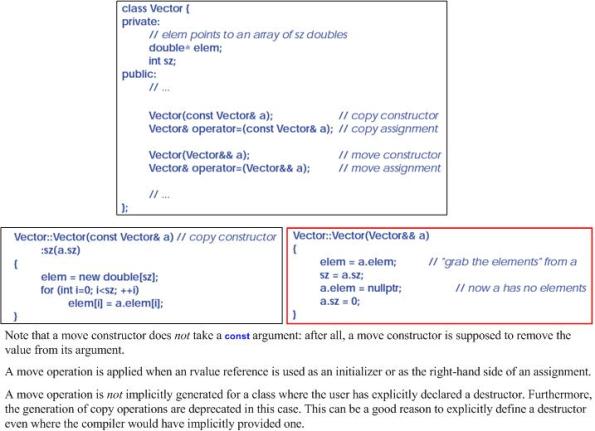
Chapter 3 – The C++ Standard Library, 2nd Edition, Nicolai M. Josuttis

Overview Of The New C++ (C++11), Scott Meyers
C++ Predictability
Did you know that…

I clipped this snippet from the slides that accompanied this interview: “David Intersimone of Embarcadero interviews Bjarne Stroustrup to to kick off their CodeRage 7 conference.”
A Glimpse Into C++11PL4
At Microsoft’s Build 2012 conference, ISO C++ chairman Herb Sutter introduced the new isocpp.org web site. On the site, you can download a draft version of Chapter 2 from Bjarne Stroustrup‘s upcoming “The C++ Programming Language, 4th Edition“. As I read the chapter and took “the tour“, I noted the new C++11 features that Bjarne used in his graceful narrative. Here they are:
auto, intializer lists, range-for loops, constexpr, enum class, nullptr, static_assert.
Since I’m a big Stroustrup and C++ fan, I just wanted to pass along this tidbit of info to the C++ programmers that happen to stumble upon this blog.
Patience Grasshoppa, Patience
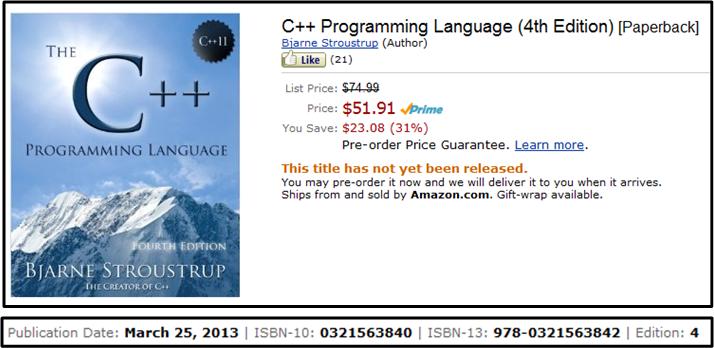
It won’t arrive for awhile, but it’s on its way: the C++11 rendition of Bjarne Stroustrup‘s “The C++ Programming Language“.
In case you didn’t already know, the C++11 editions of these tomes are already available for your consumption:
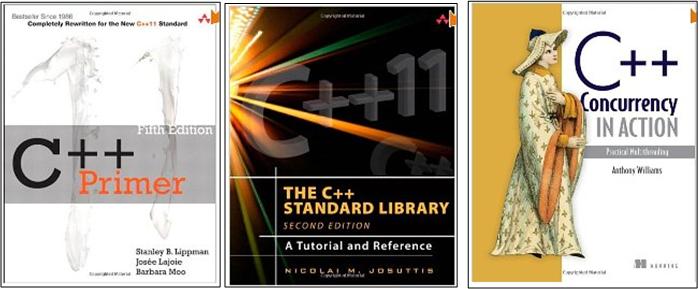
But of course, you did already did know this. There are gifted copies of each of these references on your and your colleague’s desks because your company cares about you, your productivity growth, and continuously enhancing the quality of its revenue-generating product portfolio. That’s why it obsesses over little, but simultaneously huge, things like this for you, its products, and its future well being. It’s a quiet, low-key, low-cost, win-win-win situation that makes you feel warm and fuzzy each day you walk in the door to joyfully add your contribution to the whole.
And puh-leeze, no comments from the hip and cool Ruby, Python, Java, Go, Scala, C#, etc, peanut galleries. On this bogus blawg, only pope BD00 is approved to promote or trash other programming languages, ideas, groups, concepts, institutions, traditions. Well, you get the idea.

Note: I created the above image at says-it.com. It’s a wonderful site, so hop on over there and give it a whirl.
Misapplication Of Partially Mastered Ideas
Because the time investment required to become proficient with a new, complex, and powerful technology tool can be quite large, the decision to design C++ as a superset of C was not only a boon to the language’s uptake, but a boon to commercial companies too – most of whom developed their product software in C at the time of C++’s introduction. Bjarne Stroustrup‘s decision killed those two birds with one stone because C++ allowed a gradual transition from the well known C procedural style of programming to three new, up-and-coming mainstream styles at the time: object-oriented, generic, and abstract data types. As Mr. Stroustrup says in D&E:
Companies simply can’t afford to have significant numbers of programmers unproductive while they are learning a new language. Nor can they afford projects that fail because programmers over enthusiastically misapply partially mastered new ideas.
That last sentence in Bjarne’s quote doesn’t just apply to programming languages, but to big and powerful libraries of functionality available for a language too. It’s one challenge to understand and master a language’s technical details and idioms, but another to learn network programming APIs (CORBA, DDS, JMS, etc), XML APIs, SQL APIs, GUI APIs, concurrency APIs, security APIs, etc. Thus, the investment dilemma continues:
I can’t afford to continuously train my programming workforce, but if I don’t, they’ll unwittingly implement features as mini booby traps in half-learned technologies that will cause my maintenance costs to skyrocket.
BD00 maintains that most companies aren’t even aware of this ongoing dilemma – which gets worse as the complexity and diversity of their product portfolio rises. Because of this innocent, but real, ignorance:
- they don’t design and implement continuous training plans for targeted technologies,
- they don’t actively control which technologies get introduced “through the back door” and get baked into their products’ infrastructure; receiving in return a cacophony of duplicated ways of implementing the same feature in different code bases.
- their software maintenance costs keep rising and they have no idea why; or they attribute the rise to insignificant causes and “fix” the wrong problems.
I hate when that happens. Don’t you?


Why am I here?
WTF?
Meh!
D'oh!

My BTC Address



 Bulldozer00's Blog