The What Before The How
While paging through my portfolio of dorky sketches and e-doodles, I stumbled upon one that I whipped up a long time ago when I was learning about Linux shells:

Unless I’m forced to rush, I always bootstrap my learning experience for new subjects by drawing simplistic, abstract pictures like the above as I study the subject matter. Sometimes I’ll spend several hours drawing contextual pix from the lightweight intro chapter(s) of a skill-acquisition book before diving into the nitty gritty details. It works for me because I’m not smart enough to learn by skimming over the “what” and immediately diving into the “how“.
Whenever I feel forced to bypass the “what” and bellyflop into the “how” (via pressure to produce “Twice The Software In Half The Time“), I make way more mistakes. Not only does it degrade the quality of my work, it propagates downstream and degrades the quality of the receivers/users of that work.
And Then A Miracle Occurs
It’s a great story. A nine page white-paper hatched by a mysterious author that elegantly integrates peer-to-peer networking, cryptography, and economics to create a new form of money the world has never seen. Brilliant, simply brilliant.


Checklist Of Maladies
Since I can’t remember where I poached this “checklist of maladies” from, I can’t give any attribution to its creator(s). I’m sorry for that, but I wanted to share it anyway:
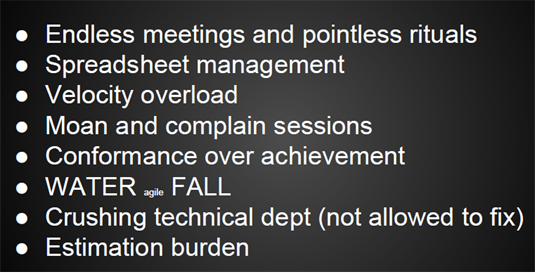
I do, however, remember that the presenter was talking about agile processes gone awry.
It’s funny how these maladies have been around forever: pre-agile and post-agile. Resilient little cockroaches, no?
A Croc O’ Crap
As a software developer, the idea of #noestimates was really appealing to me. I sooo wanted to be convinced of its applicability across the whole landscape. Thus, I originally was on board with, and rooting for, the fledgling movement. However, it’s hard for me to take the #noestimates community seriously when one of its top advocates slams a croc o’ crap like this down on the dinner table.
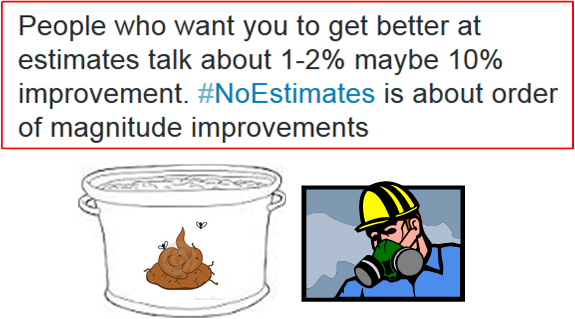
From what I’ve seen and heard over 2+ years of heated Twitter debates, the case for jettisoning the practice of estimation from the software development life cycle is still so intellectually weak that I consider it a waste of energy whenever I find myself getting sucked into the fray. Now when I scroll through my twitter feed and stumble across yet another vitriolic exchange on the subject, I cross my fingers and pray that I make it past the spew without adding my own crap to the gobbledygook.
Better
Consider a classic, straight-line, hierarchical organization:

Because of the structure of the vertical communication links that tie the org together into a system, the dudes at the top are guaranteed to have a distorted understanding of what the dudes at the bottom are doing – and vice versa. With no direct lines of communication between non-adjacent layers, how could it be otherwise?
Of course, everyone who has ever toiled in the lower layers of such a “classic” hierarchy has railed against what they perceive as the unfairness and inhumanity of participating in such a system.
So then, if the classic, straight-line, vertical hierarchy is so bad for those grinding it out in the lower layers, which is a better system structure:

If you’re expecting BD00 to definitively choose sides, extolling the virtues of “the good one” while denigrating the vices of “the bad one“, fuggedaboudit. There is no universally applicable “good one“. Or is there?
Bypassing The Riskiest Link
On the left, we have the traditional method of investment. An investor buys stock in a company that makes a product or service. The investor trusts that both the company’s executives and the company’s product offerings will generate increasing wealth over time.
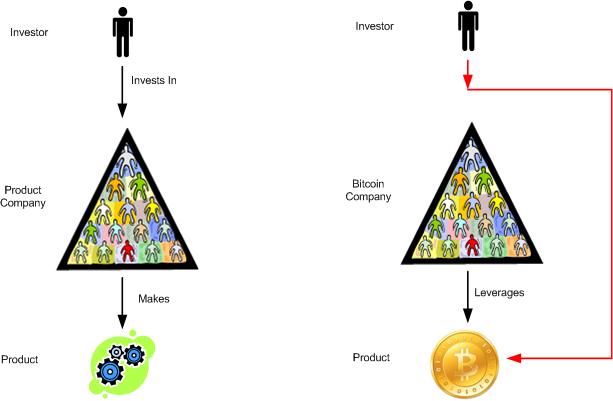
As the right hand side of the diagram shows, a Bitcoin investor can bypass the riskiest link in the investment chain – a Bitcoin company’s management. Rather than being concerned about executive incompetence (like Mt. Gox and all the other Bitcoin companies that have gone bust), a Bitcoin investor can buy and hold bitcoins directly – just like he/she can buy gold. Indeed, I have been slowly buying up some Bitcoins over the last 6 months as a speculative investment – just in case we have another 2008-like financial meltdown in the future.
Even if Bitcoin doesn’t succeed as a widespread currency of exchange or unit of account, it can succeed as a store of “perceived value” – just like gold. Like gold and unlike fiat currency, Bitcoin is guaranteed to be scarce. But unlike gold, Bitcoin is easily and quickly transportable, cheap to store, and highly divisible.
The Real Problem
People’s knickers are all bunched up over which operational state the US will transition into in November:
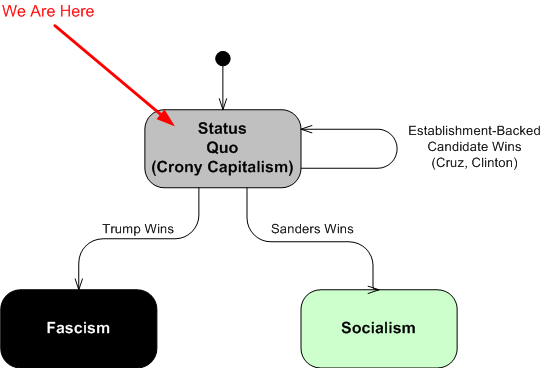
Well, screw that. Here is what people should really be fussing about.

Scaling Up Agile
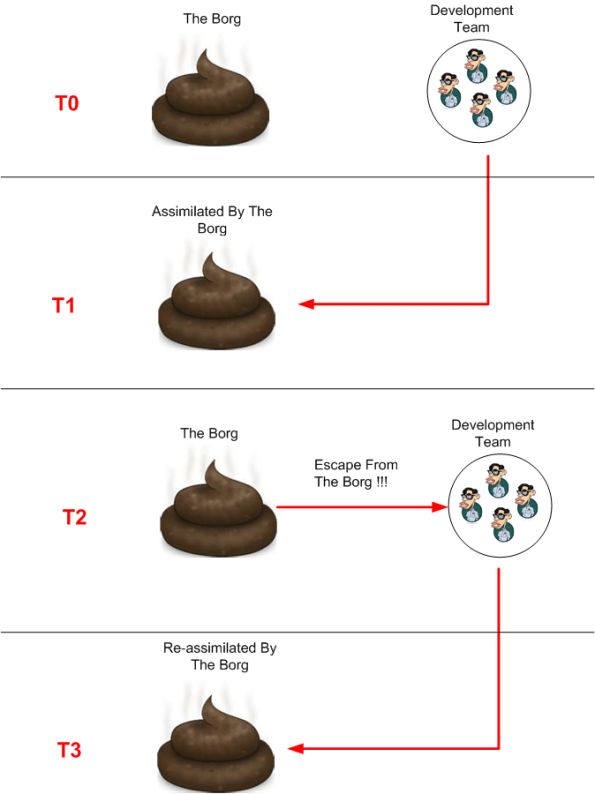
Lo and behold, the four phases of scaling up agile:

So, what are you waiting for? Whip out your checkbook and hire that LeSS or SAFe expert that’s been ringing your phone of the hook. It’ll turn out just fine.
The Real And The FAKE

Why am I here?
WTF?
Meh!
D'oh!

My BTC Address



 Bulldozer00's Blog