The Asshole Detection Feature
Before my cancer diagnosis, I tended to take my physical health pretty much for granted. Even though I exercised regularly for over 30 years and went to the doctor regularly for blood sugar, pressure, and cholesterol testing, I didn’t pay much attention to details. For example, whenever I caught a cold or cut myself or had back/muscle/joint pains I would just power through them without taking any meds other than ibuprofen. It’s amazing how robust and resilient the human body is despite the onslaught of constant attacks it repels every waking minute. Miraculously, all the hard work needed to keep us healthy happens silently and autonomously in the background. We have the equivalent of a builtin operating system which performs all the low level functions required to allow the applications that run on top of it to have fun and wreak havoc in the world!
I bought a fitbit step tracker right away when it was unveiled waaaay back when. I religiously tacked on over 10,000 steps per day for several years. When I first got sick and my feet/leg started going hot and numb, my daily step count plunged. I was barely registering 500 steps a day. When the power charging contacts started rusting and I had trouble charging the device reliably, I said fuck it and threw it in the trash. I decided I didn’t need one anymore because my health was going to go down the shitter real fast (which thankfully, it didn’t!).
When Amazon announced their screenless Halo health tracker ($64), I was very intrigued by an innovative feature called “Tone“. After learning about what it does, I renamed it the “Assshole Detection” feature. I knew it was a perfect match for me!

The Halo has tiny microphones in it. It “learns” your voice patterns and then tracks the “tone” of your conversations with others. Tone is mapped into 4 categories as follows:
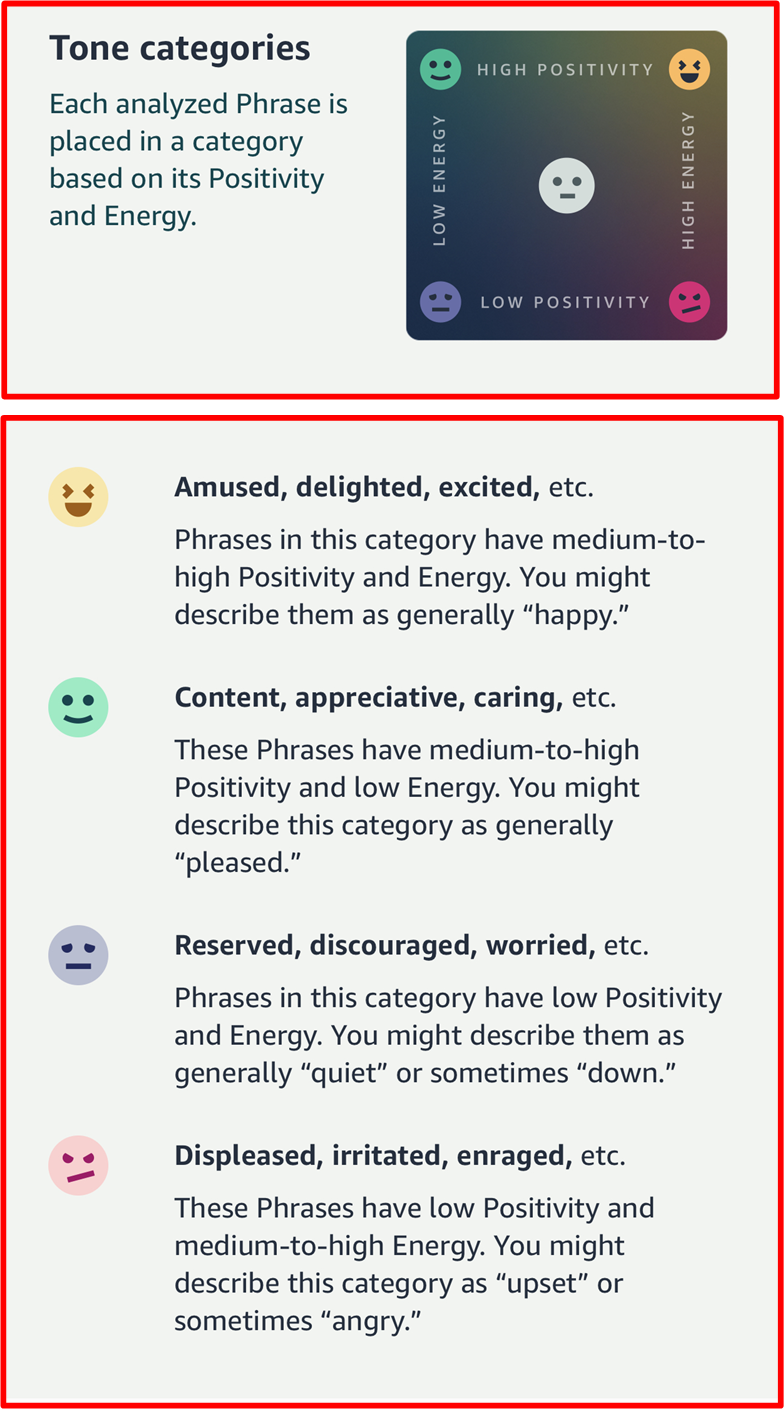
Now, if BD00 was director of Amazon Halo product development, his “tone” categories would be as follows:
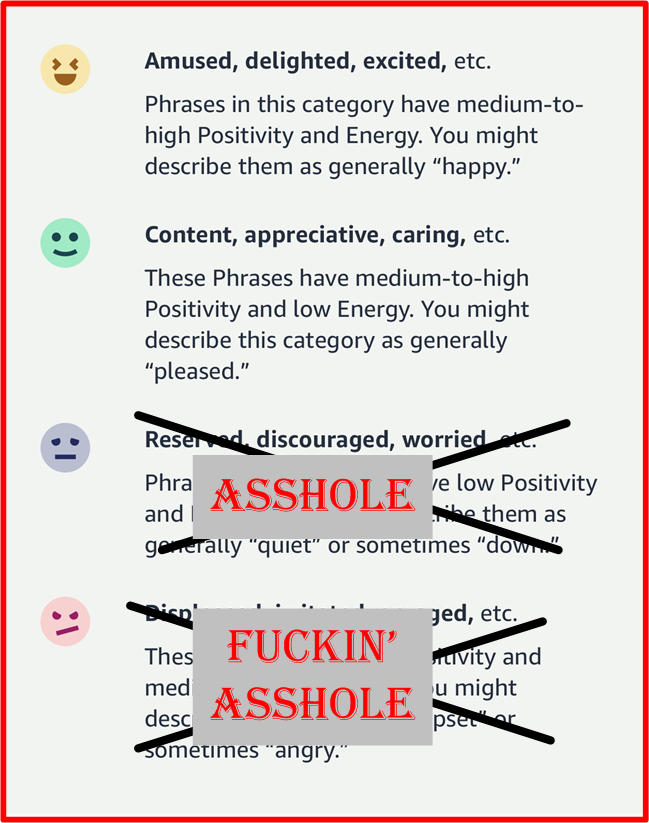
The Halo app dashboard has a tidy little “tone” widget that let’s the user know how often and, more importantly, WHEN he/she has been an asshole throughout the day. Here’s an example of my performance:

I’m just glad no pink “Fuckin’ Asshole” moments were detected by the Halo police that day. Sadly, I’m not surprised by my embarrassing purple “Asshole” performance. I just hope it doesn’t go pink on me. I’ll have to make up an asshole card to go with my cancer card if it does.
But wait! It gets even more intimate. Halo decides WHAT IS, and then records, “notable moments“. No raw conversations are recorded. Here are a couple of examples:

As an added bonus, users can also save notable moments in asshole (.ass) files on hard disk.
If you think Halo’s “tone” feature is creepy, you might find its “body” feature really funky. But that’s for perhaps another post. I will tell you though that Halo wants to take your naked pictures and measure your body fat from the multi-angle pictures.
Good, Bad, Death, No More
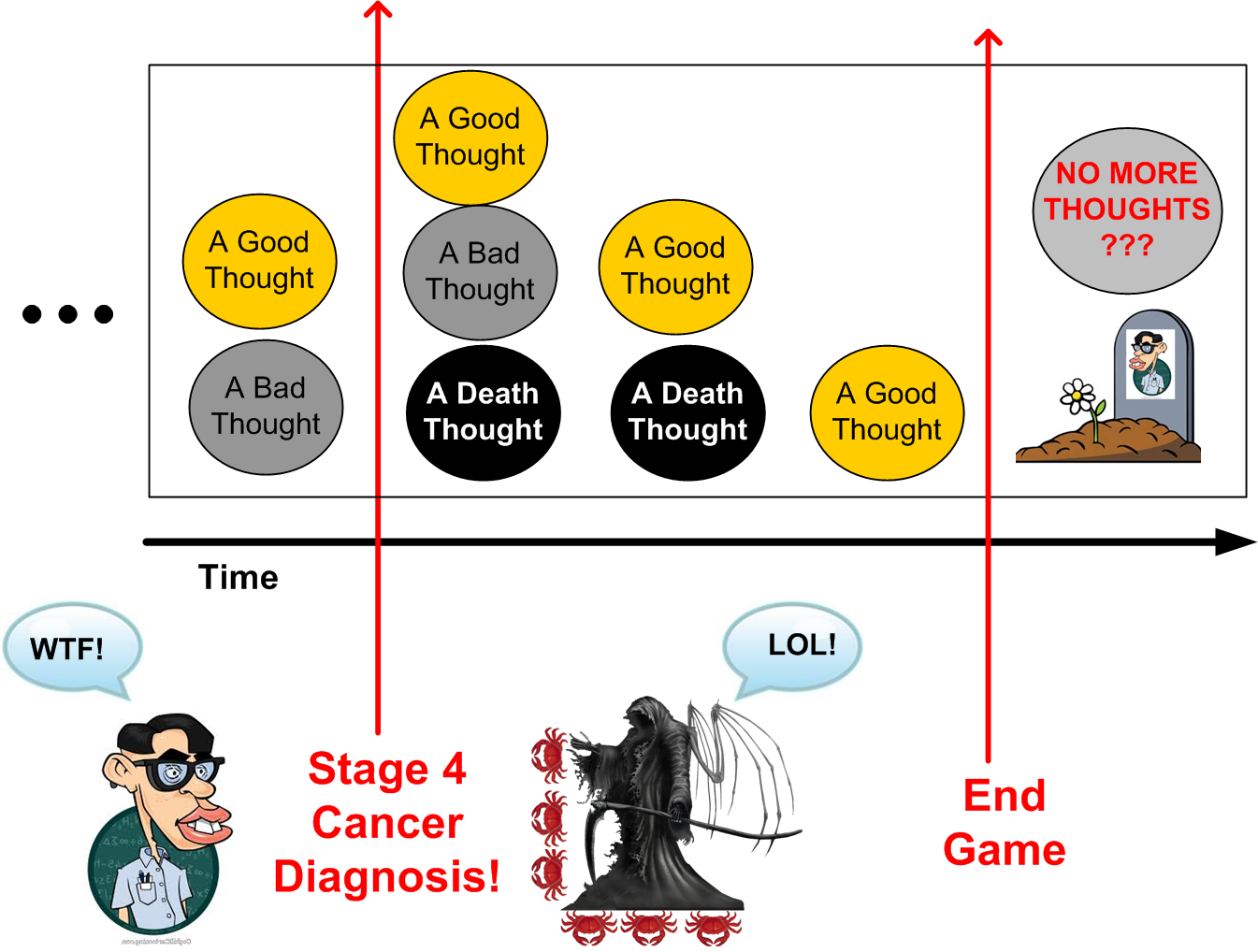
Some unknown force is always playing ping-pong inside our heads. During normal times, we continuously bounce back and forth between having good thoughts and bad thoughts. Unless something is really wrong in our life, “death” thoughts rarely appear in our consciousness.
When super lucky people like me are diagnosed with stage 4, metastatic cancer, death thoughts begin popping up as peers to the good and bad thoughts. As the disease progresses to the point of no return, the good thoughts start getting crowded out of mind. Consciousness becomes fully occupied with the bad thoughts and death thoughts. Next in the progression, the bad thoughts start getting pushed out of the cranium by the death thoughts. As time continues its relentless march forward, the big, badass, death thoughts start monopolizing the mind until, well, you know the rest of the story….

Of course, long time blog followers know that Bulldozer00 likes to make shit up.
Thus, here’s an alternative, uplifting view of what happens during the journey into no-more-thoughts land…
States Of Care
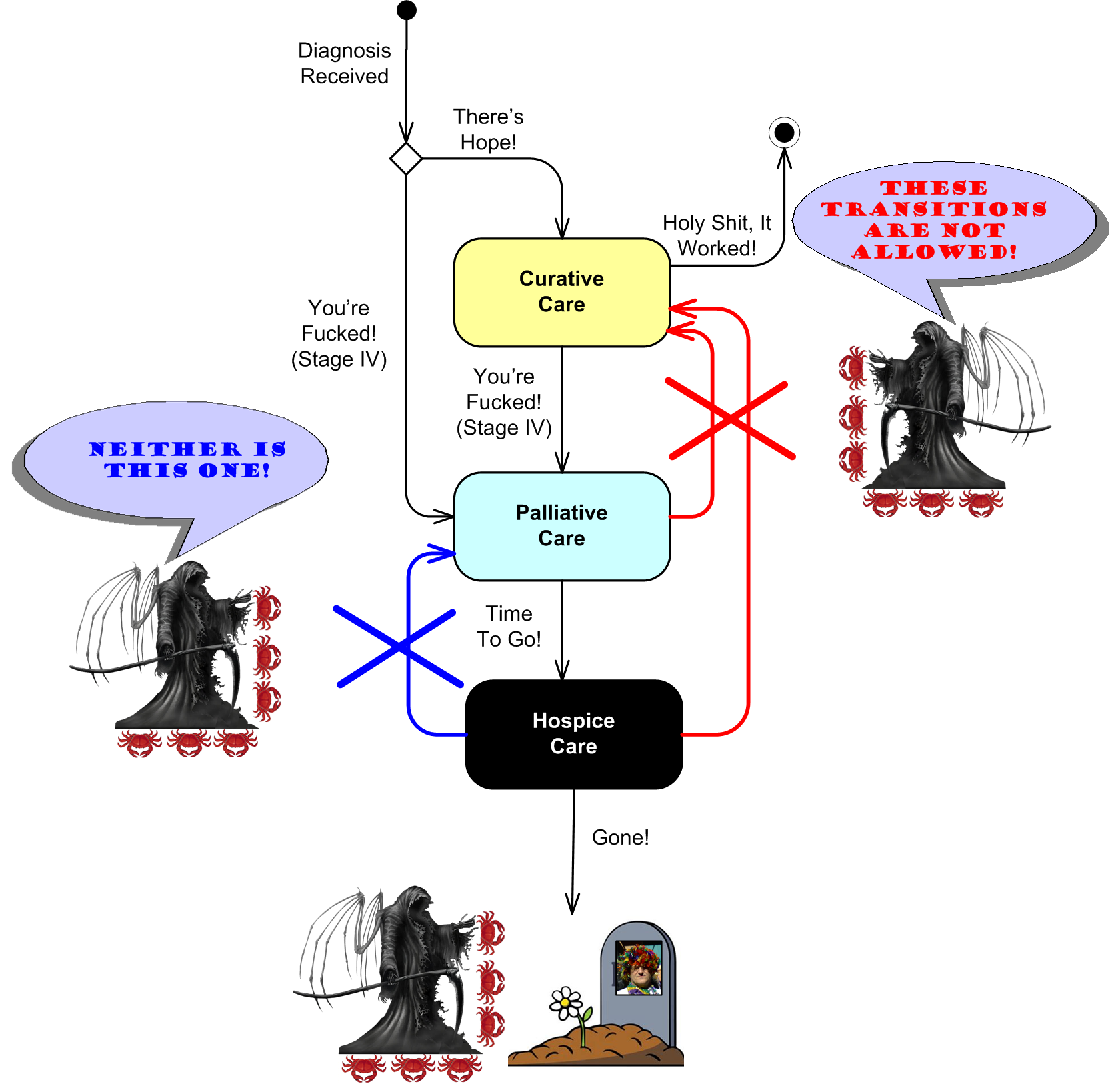
Oooh look, another state transition diagram…

The diagram defines: three states of cancer care, the transitions between them, and the events that trigger those transitions.
Let’s start at the top of the diagram. An unfortunate soul receives a cancer diagnosis, D’oh! If it’s stage IV, it’s not curable and the patient starts receiving palliative care treatments. Surgery, radiation, and chemo are deployed against the Emperor-Of-All-Maladies (EOAM) as the disease progresses. At some unknown time later, the emperor’s legions (aka lesions) overwhelm the patient’s defenses and the transition to hospice care is triggered. Everyone knows what state transition occurs after hospice care has run its course….. Yikes!
If the diagnosis is not stage IV, the cancer may be curable. The cure is most likely surgery that excises the emperor’s growing, but still highly localized, forces. The patient escapes the cancer care death star and all becomes well. If the emperor’s army is victorious over the curative assault waves, then the palliative care state is entered and hospice care looms down the road.
As far as I know (which isn’t very far), once the patient is inside the cancer care death star, and the curative care turns out to be unsuccessful, he is on a one way trip to the dirt suit tailor shop. There are no reverse transitions from the hospice care state back to the palliative or curative states of care. The emperor forbids them!
P.S. Thank you Craig for the “dirt suit” tip. I couldn’t wait to write it into a post, and I can’t wait to use it again. Ahhh, the smell of fresh soil in the morning. 🙂
Today’s Dashboard
In remembrance of the infamous, tri-state, bozo-meter that I concocted from my dark, angst-filled, past…
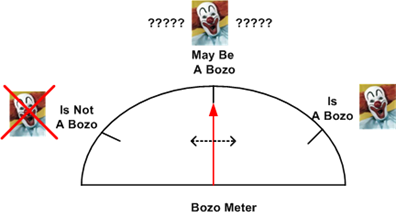
….I present to you two brand new analog metering devices (patent pending) to employ in my anxiety-filled present and for my terror-filled future: the Pain-ometer and the Numb-ometer.
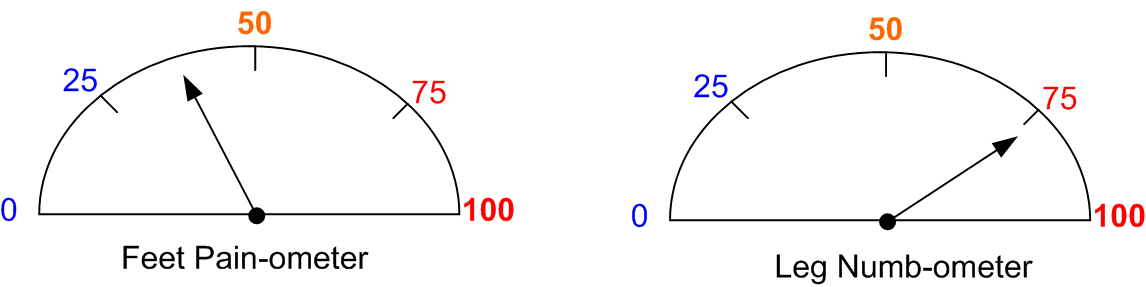
The readings correctly registered the status of my feet and right leg as I wrote this inane post.
I reserve the right to design, patent, and implement more “ometer” sensors in the future as the need arises. Licensing requests are welcome and I’ll be taking pre-orders on Amazon in the near future. Mugs, hats, and T-shirt orders will be available on Etsy as soon as I can get my Shopify e-store up and running.
Another Toothpick
A while back, I mustered up enough courage to ask my oncologist how a typical cancer patient of his dies. After a compassionate pause, he thoughtfully answered my question in terms of an input/output problem. Basically, he said that when a patient’s caloric input becomes insufficient (for whatever deadly reason) to produce enough (output) nourishment for the bones, tissues, muscles, and organs that manifest the functionality of all our bodily functions, the end is not too far off. 😦
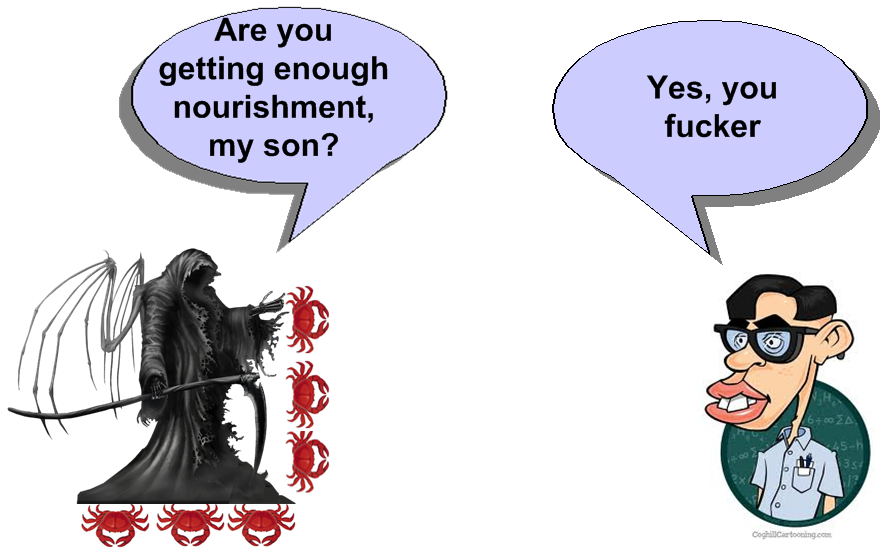
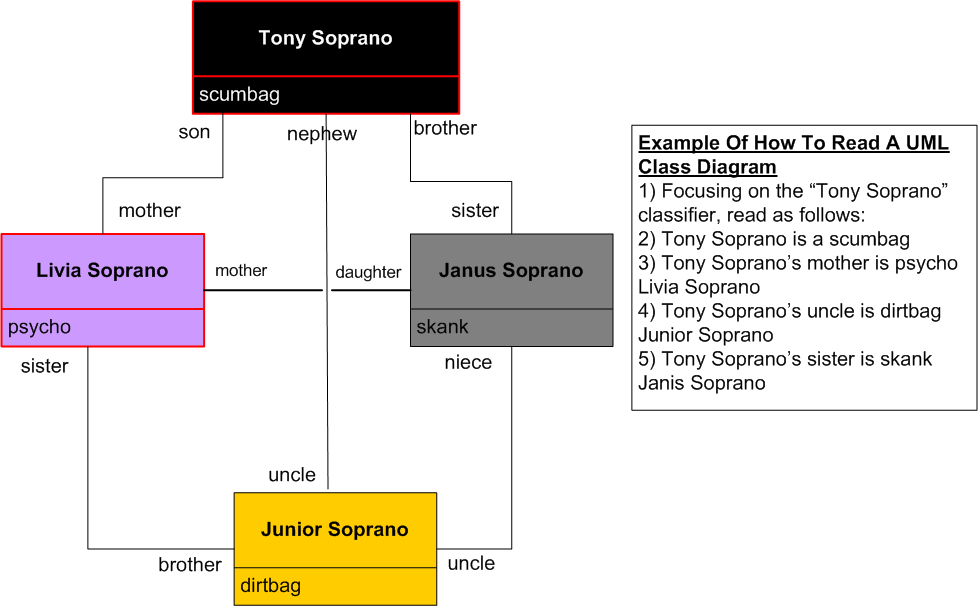
My onc’s response instantly reminded me of the Soprano’s season 3 episode titled “Another Toothpick“. In that episode, after scumbag Tony Soprano’s dirtbag uncle Junior was freshly diagnosed with stomach cancer, Janus, Tony’s skank sister, commented that Livia, Tony’s deceased, psychotic mother, often described a person who was dying from cancer as just “another toothpick.” Phew, did I get all the dysfunctional familial relationships right?
Currently, I weigh about 210 pounds. My pre-cancer baseline weight was a steady, 220 pounds of sculpted beefcake. Due to treatments, I’ve bounced around between 225 and 200 pounds. So, what would I look like if I morphed into just another toothpick? Hmm…
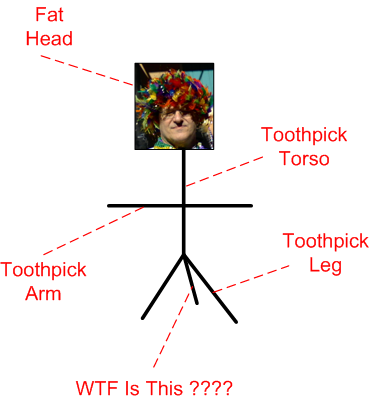
I need to think of another scary question to ask my onc. Maybe the answer he gives can serve as fodder for another blog post like this. Got any ideas?
The Scanxiety Cycle
I’ve used the beloved word several times before, but this is the first time I put it in the title of a post:
Scanxiety
Every stage 4 cancer patient gets to experience the infamous scanxiety cycle. It’s also known among the elites as the “periodic parabolic fever“, with the periodicity nominally being 3 months between CT scans. Rather than try to explain this natural phenomena in a bumbling word salad, I’m going to present my understanding of the meaning of scanxiety in the form of one of my dorky, 20th century, graphics:
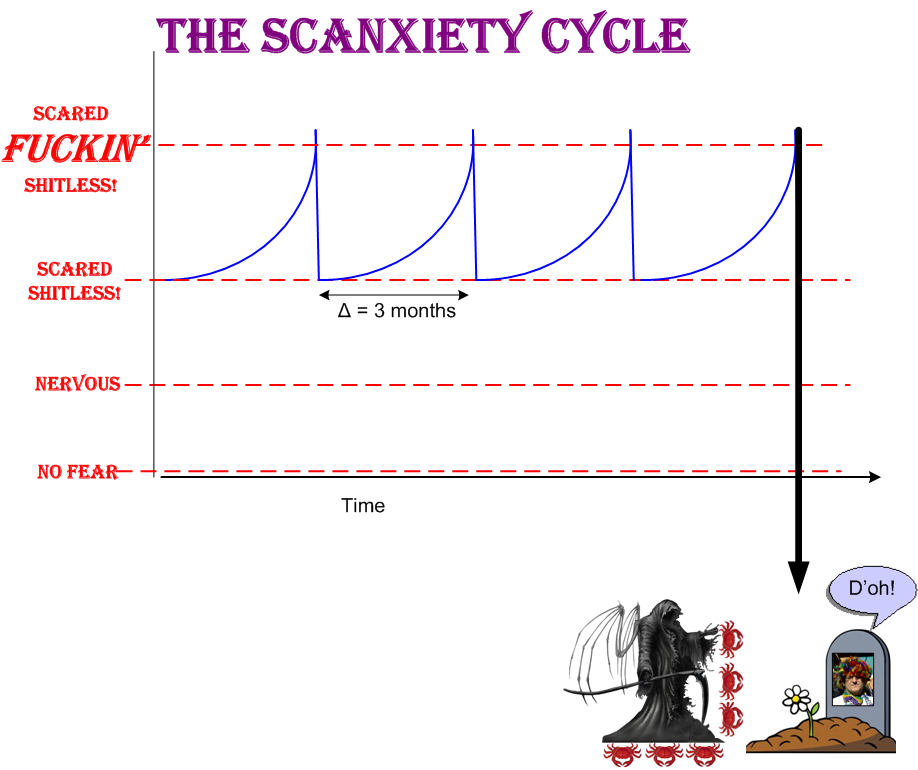
Before the terminal diagnosis, the baseline anxiety level of a cancer patient is somewhere between the “No Fear” level and the “Nervous” level. Somewhat shortly (sometimes as short as a picosecond) after the devilish diagnosis is bequeathed upon the poor soul, this baseline anxiety level instantaneously leaps up to the “Scared Shitless!” level. The scanxiety cycle rollercoaster then jerks into action and the fun begins, until it ends, which it will.
Randy Pausch
Many people have asked me why I’m documenting my terminal cancer “adventure” in public. Actually, no one has asked me that because no one reads this blasphemous blawg. 🙂
Besides the innate propensity to keep my potty mouth spewing verbal diarrhea, the top reason I’m writing about my walk down the proverbial plank is Randy Pausch. Randy was a computer science professor at a well known engineering school, Carnegie Mellon University. He was a victim of pancreatic cancer who succumbed to the EOAM‘s evil forces in 2008 at the age of 47.
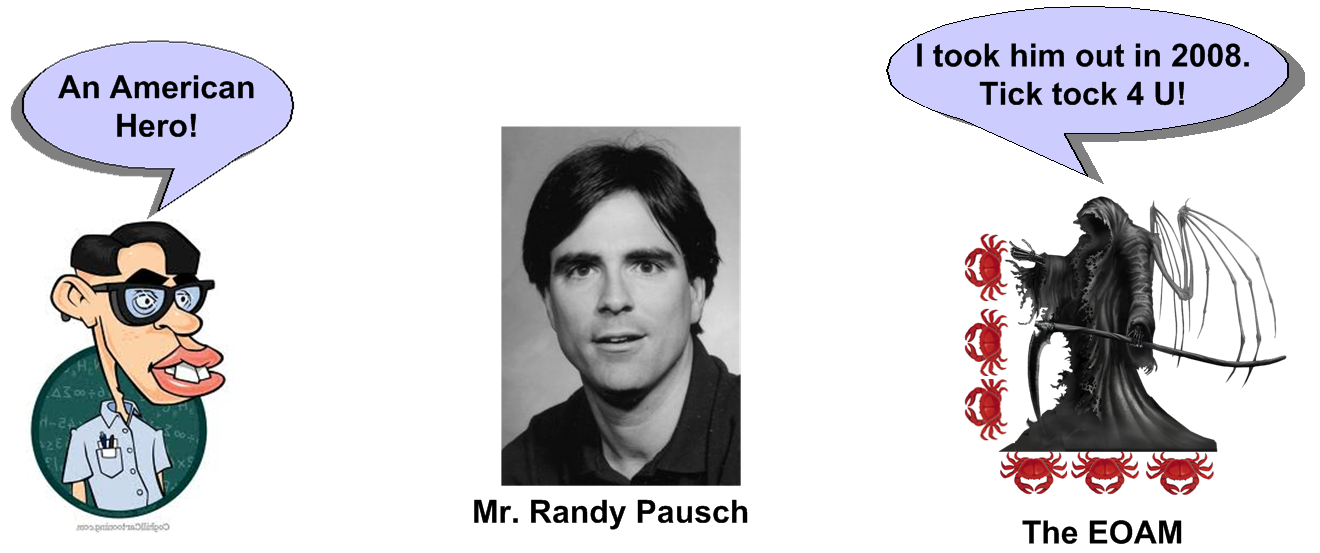
Before he died, Randy gave a truly inspirational lecture and wrote an equally inspiring NYT best-selling book titled “The Last Lecture“. I didn’t have my cancer diagnosis back then, but I clearly remember watching his lecture (20 million views) and reading his profound, uplifting book. I can recall it so easily because I remember the hair on my neck (I have no hair on my head, and it’s not because of chemo) standing straight up and my spine tingling as I listened to, and read, his heartwarming words of wisdom.

Since Randy Pausch is one of my greatest heroes that I’ve never met, please consider exploring his work to make the world a brighter place by clicking on one of the links in this post. I guarantee you that his words, in spite of the serious subject matter, will bring you multiple tiny moments of joy as they infiltrate your being.
Pssst! Ya Wanna Buy Some Dex?
It’s been widely reported in recent medical studies that dexamethasone is effective in the treatment of COVID-19. “Dex”, as I fondly call it in honor of my fave TV serial killer, Dexter Morgan, is a common, low-cost, steroid that suppresses inflammation in the body.
Having said that, do you wanna buy some black market dex? If so, then I’m your drug man. Ya see, I’ve been on and off dex ever since they found 3 metastatic brain tumors in my dirty brain over 3 years ago. I use dex to fight “flareups” in my brain where I get lightheaded and my off-kilter balance makes me feel like an unstable tower swaying in the wind. Strangely, when I’m feeling dizzy, it’s easier to walk than to stand still.
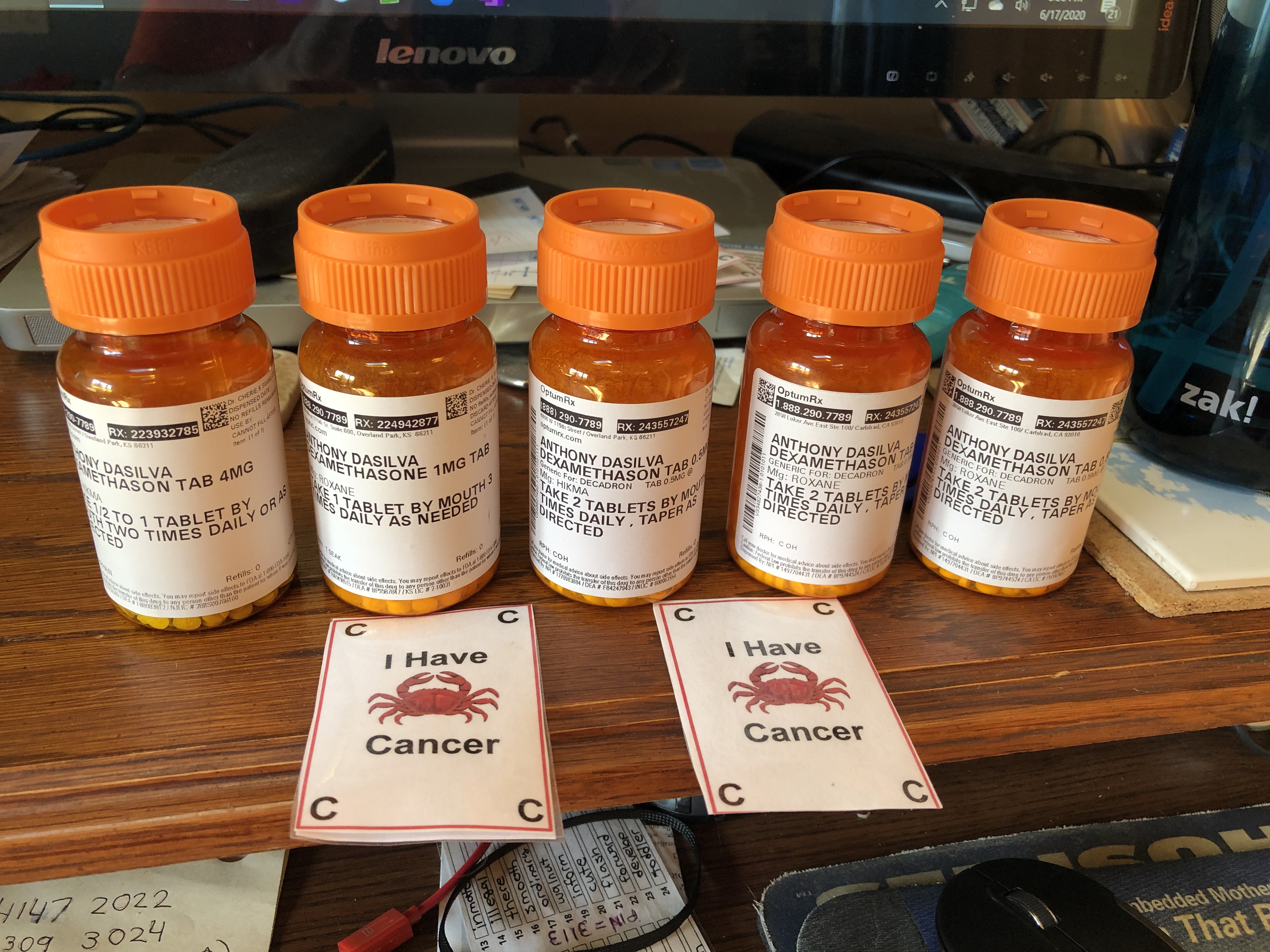
I’ve got dex in 4, 1, and .5 mg dosages for you. If you order before midnight tonight, I’ll give you a 10% discount and 5% off of future orders. I’ll even barter with you in exchange for cannabis edibles or bitcoin if you’re low on cash. 😜😂
Toxic Dispose Of As Biohazard
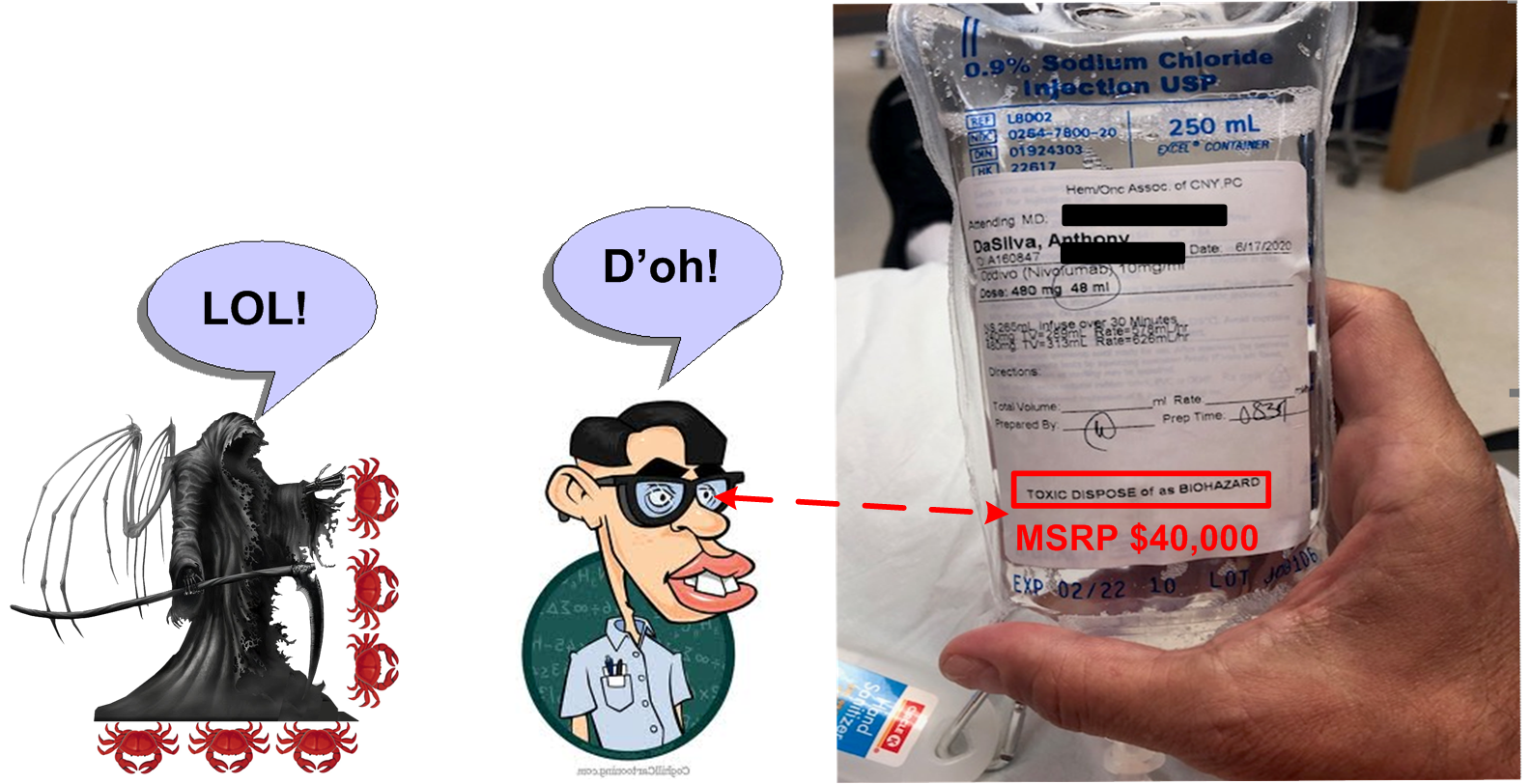
Does this mean my pee and poop and other miscellaneous bodily fluids are toxic? I wonder what the radioactive half-life of Opdivo is?
I shouldn’t complain. I’m very grateful to my toxic friend for keeping me alive for three more years than my original diagnosis predicted.
The Final Transition
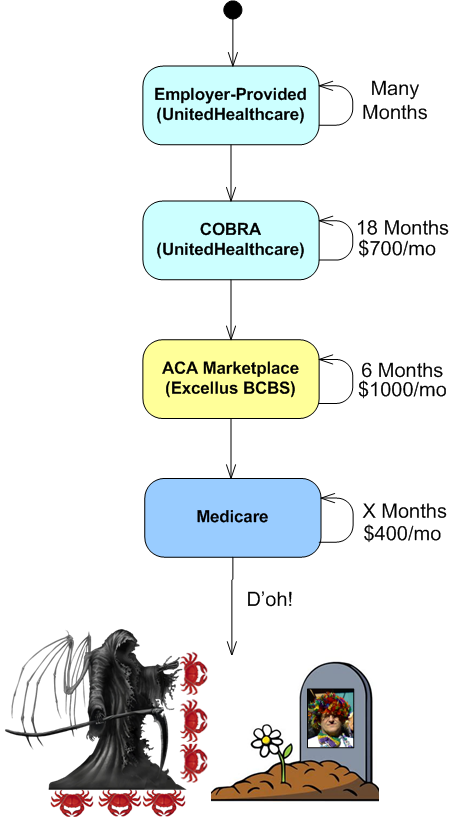
I’m about to make my final transition… No silly, I know what you are thinking and it’s not that. It’s not my transition from life to death. Not just yet! It’s the transition to the final state of health insurance on my dizzying, brain frying, leg numbing, foot burning, ear ringing, byzantine, journey through the health care jungle.
The trigger event for this final transition was the reception today of everybody’s medical holy grail: the medicare card!
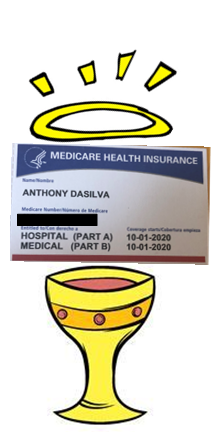
Before I can drink from the blessed medi-grail, I’ve got to withstand the pain of three more months of $1000/month premiums and many unknown co-pays for treatments and specialist appointments.
For completeness, I present to you my health insurance history in the form of an STD. No silly, I know what you are thinking and it’s not that (That’s twice I caught you thinking nasty thoughts). It’s a State Transition Diagram. A handy, but simple, tool I used for many years to understand the dynamic behavior of systems.

Why am I here?
WTF?
Meh!
D'oh!

My BTC Address



 Bulldozer00's Blog