Archive
Weakly Status Ritual
Everyone knows about the “weakly” status reporting ritual. It’s where the DICs (Dweebs In The Cellar) fill out and submit written status reports to the manager in charge (sic).

Did you ever wonder why status reporting is a one way street and it’s unquestioningly accepted as the norm in corpocracies everywhere? Whatever happened to “lead by example”? Why don’t managers fill out their very own weakly status reports and distribute them to their captive DICS? It’s because they don’t contribute or accomplish anything other than stapling the DIC reports together and kicking the result upstairs to the NLM (Next Level Manager) – who promptly ignores the POP (Package Of Poop) too. Side note: that’s where the term “POP server” originated.
If managers were required to submit weakly status reports to the DIC-force, what would they look like?

Working Software, Working Documents
Documentation is a love letter that you write to your future self – Damian Conway
The agile software development community rightly says that the best measure of progress is demonstrate-able working software that is delivered incrementally and frequently to customers for their viewing and using pleasure. For the most part, and for good reasons based on historical evidence, agile proponents eschew documentation. Nevertheless, big bureaucratic customers like national and state governments often, very often, require and expect comprehensive documentation from their vendors. Thus, zealot agilist juntas essentially ignore the requirements of a large and deep-pocketed customer base.
It’s software development, not documentation development – Scott Ambler
What if we can bring big, stodgy, conservative, and sometimes-paranoid customers halfway? Why not try to convince them of the merits of delivering frequent and incrementally improving requirements, design, construction, and user documents along with the working software builds? If we pay as we go, incrementally doing a little documentation, doing a little software coding, and doing a little testing instead of piling on the documentation up front or frantically kludging the documents together after the fact, wouldn’t the end result would turn out better?
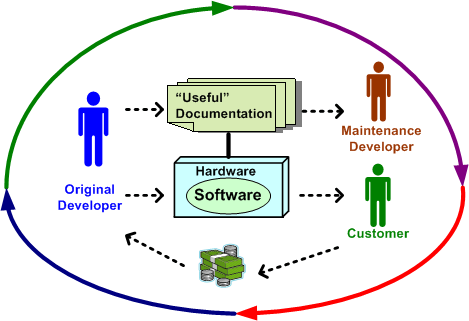
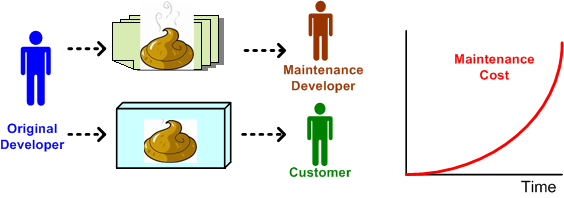
A consequence of generating crappy documentation for big, long-lived systems is the high cost of downstream maintenance. Dumping hundreds of thousands of lines of code onto the maintenance team without handing them synchronized blueprints is an irresponsible act of disrespect to both the team and the company. Without being able to see the forest for the trees, maintenance teams, which are usually comprised of young and impressionable developers, get frustrated and inject kludged up implementations of new features and bug fixes into the product. Bad habits are formed, new product versions get delivered later and later, and maintenance costs grow higher and higher. Bummer.
Structure And Work
Under the inescapable second law of thermodynamics, fragmentation and dis-integration are natural consequence of organizational growth over time. Real leaders respect and arrest the destructive power of the second law by conscientiously applying structure and work to keep the org intact and aligned toward a higher purpose. All cookie cutter managers know how to design and impose structure. Hell, that’s the easy part because you could look one up in the standard hierarchical patterns handbook (which has only one page and one pattern – the command and control hierarchy where the kahunas at the top rule over the kingdom and ignore input from everyone else).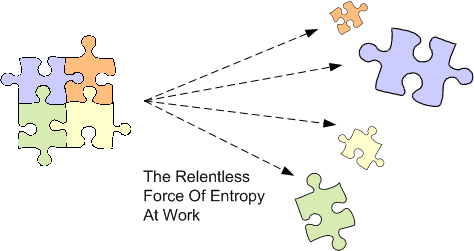
The “work” is the hard part. Unlike leaders, managers hate work and they’ll do anything, no matter how harmful it is to the org, to avoid it while feigning that they’re bustin’ their butt to “get things done”. Thus, after unveiling his/her latest masterpiece corpo structure, which is always an insignificant hierarchical tweak, he/she “abdicates” the day-to-day work of keeping the fragments in harmony to…….. “others”.
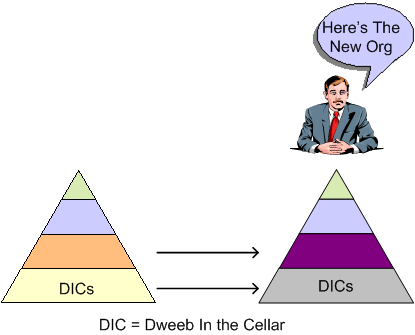
So, what is the “work” part of the powerful, entropy-arresting, work+structure dynamic duo? It’s a continuous and active “sampling the value stream” and a continuous monitoring of the interfaces and interactions between the org fragments to sense signals of disintegration. Without doing the work part, performance will not improve, and of course, it will deteriorate further; triggering yet another round of restructuring to “meet the changing needs of our customers”. Bummer.

Initiative Initiation
Assume that the graph below describes the rise and fall of a hypothetical CCH (Command and Control Hierarchical) business. During the party time phase of increasing profits (whoo hoo!), the CCH corpocrats in charge pat themselves on the back, stuff their pockets, and slowly inflate their heads with bravado and delusions of infallibility.
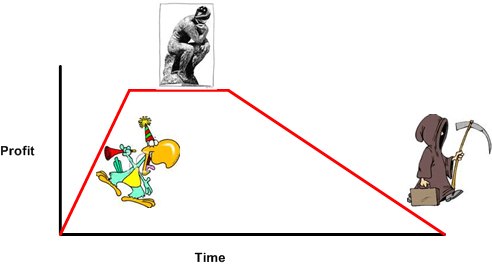
In order to extend the increasing profit trajectory, an undetectable status quo preserving mindset slowly but surely kicks in. Hell, if it ain’t broke, don’t touch the damn thang. Since what the CCH (so-called) leadership is doing is working, any individual or group from within or without the cathedral walls who tries to deviate significantly from the norm is swiftly “dealt with” by the corpocrats in charge. Everthing needs to get approved by a gauntlet of “important” people. However, while the shackles are being tightened and the ability to scale for success is being snuffed, the external environment keeps changing relentlessly in accordance with the second law of thermodynamics. Profit starts eroding and tension starts ratcheting upwards. Out of fear of annihilation, the cuffs are tightened further and the death dive has begun. Bummer.
During the free fall to obscurity, the now brain-dead and immobile corpocrats in charge start “taking aggressive action” to stem the flow of red ink. Platitudes and Matt Foley-like motivational speeches are foisted upon the DICs (Dweebs In the Cellar) in frantic attempts to self-medicate away the pain of stasis and failure. Initiatives with cute and inspiring names are started but never finished (because it takes real hands-on leadership, sweat, and work to follow through). As corposclerosis accelerates, silver-bullet-bearing consultants are brought in and the frequency of initiative initiation increases. Calls for accountability of “them” pervade the corpocracy from the top down and vice versa.
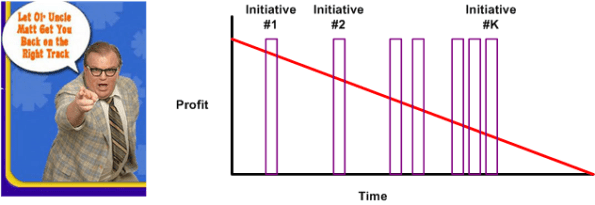
After being hammered by pleas to “improve performance” and being pounded by the endless tsunamis of hollow initiatives, the DICs disconnect and distance themselves from the lunacy being doled out by the omnipotent dudes in the politboro. Since the DICs expect the corpocrats to effect the “turnaround” and the corpocrats expect the DICs to strap on their Nikes and “just do it”, no one takes ownership and nothing of substance changes. As you might surmise, it’s a Shakespearian tragedy with no happy ending. Bummer squared.
Leaderless CCHs deserve what they get; a fearful, disconnected workforce and a roller coaster ride to oblivion.

Scaleability
The other day, a friend suggested plotting “functionality versus size” as a potentially meaningful and actionable measure of software development process prowess. The figure below is an unscientific attempt to generically expand on his idea.

Assume that the graph represents the efficiency of three different and unknown companies (note: since I don’t know squat and I am known for “making stuff up”, take the implications of the graph with a grain of salt). Because it’s well known by industry experts that the complexity of a software-intensive product increases at a much faster rate than size, one would expect the “law of diminishing returns” to kick in at some point. Now, assume that the inflection point where the law snaps into action is represented by the intersection of the three traces in the graph. The red company’s performance clearly shows the deterioration in efficiency due to the law kicking in. However, the other two companies seem to be defying the law.
How can a supposedly natural law, which is unsentimental and totally indifferent to those under its influence, be violated? In a word, it’s “scaleability“. The purple and green companies have developed the practices, skills, and abilities to continuously improve their software development processes in order to keep up with the difficulty of creating larger and more complex products. Unlike the red company, their processes are minimal and flexible so that they can be easily changed as bigger and bigger products are built.
Either quantitatively or qualitatively, all growing companies that employ unscaleable development processes eventually detect that they’ve crossed the inflection point – after the fact. Most of these post-crossing discoverers panic and do the exact opposite of what they need to do to make their processes scaleable. They pile on more practices, procedures, forms-for-approval, status meetings, and oversight (a.k.a. managers) in a misguided attempt to reverse deteriorating performance. These ironic “process improvement” actions solidify and instill rigidity into the process. They handcuff and demoralize development teams at best, and trigger a second inflection point at worst:
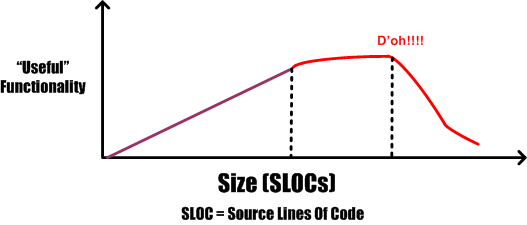
More meetings plus more documentation plus more management does not equal more success. – NASA SEL
Is your process scaleable? If so, what specific attributes make it scaleable? If not, are the results that you’re getting crying out for scaleability?
Percent Complete
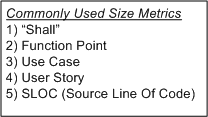
In order to communicate progress to someone who requires a quantitative number attached to it, some sort of consistent metric of accomplishment is needed. The table below lists some of the commonly used size metrics in the software development world.
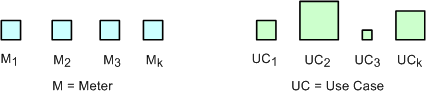
All of these metrics suffer to some extent from a “consistency” problem. The problem (as exemplified in the figure below) is that, unlike a standard metric such as the “meter”, the size and meaning of each unit is different from unit to unit within an application, and across applications. Out of all the metrics in the list, the definition of what comprises a “Function Point” unit seems to be the most rigorous, but it still suffers from a second, “translation” problem. The translation problem manifests when an analyst attempts to convert messy and ambiguous verbal/written user needs into neat and tidy requirement metrics using one of the units in the list.
Nevertheless, numerically-trained MBA and PMI certified managers and their higher up executive bosses still obsessively cling to progress reports based on these illusory metrics. These STSJs (Status Takers and Schedule Jockeys) love to waste corpo time passing around status reports built on quicksand like the “percent done” example below.

The problems with using graphs like this to “direct” a project are legion. First, it is assumed that the TNFP is known with high accuracy at t=0 and, more erroneously, that its value stays constant throughout the duration. A second problem with this “best practice” is that lots, if not all, non-trivial software development projects do not progress linearly with the passage of time. The green trace in the graph is an example of a non-linearly progressing project.
Since most managers are sequential, mechanistic, left-brain-trained thinkers, they falsely conclude that all projects progress linearly. These bozelteens also operate under the meta-assumption that no initial assumptions are violated during project execution (regardless of what items they initially deposited in their “risk register” at t=0). They mistakenly arrive at conclusions like: ” if it took you two weeks to get to 50% done, you will be expected to be done in two more weeks”. Bummer.
Even after trashing the “percent complete” earned-value-management method in the previous paragraphs, I think there is a chance to acquire a long term benefit by tracking progress this way. The benefit can accrue IF AND ONLY IF the method is not taken too seriously and it’s not used to impose undue stress upon the software creators and builders who are trying their best to balance time-cost and quality. Performing the “percent complete” method over a bunch of projects and averaging the results can yield decent, but never 100% accurate, metrics that can be used to more effectively estimate future project performance. What do you think?
Pay As You Go
An age old and recurring source of contention in software-intensive system development is the issue of deciding how much time to spend coding and how much time to spend writing documentation artifacts. The figure below shows three patterns of development: BDUF, CADOB, and PAYGO.
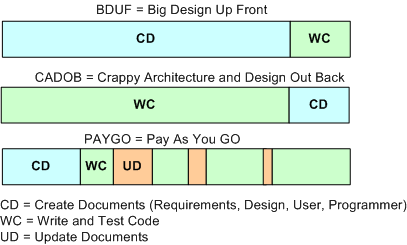
Prior to the agile “revolution“, most orgs spent a lot of time generating software documentation during the front end of a project. The thinking was that if you diligently mapped out and physically recorded your design beforehand, the subsequent coding, integration, and test phases would proceed smoothly and without a hitch. Bzzzt! BDUF (bee-duff) didn’t work out so well. Religiously following the BDUF method (a.k.a. the waterfall method) often led to massive schedule and cost overruns along with crappy and bug infested software. Bummer.

In search of higher quality and lower cost results, a well meaning group of experts conceived of the idea of “agile” software development. These agile proponents, and the legions of programmers soon to follow, pointed to the publicly visible crappy BDUF results and started evangelizing minimal documentation up front. However, since the vast majority of programmers aren’t good at writing anything but code, these legions of programmers internalized the agile advice to the extreme; turning the dials to “10”, as Kent Beck would say. Citing the agile luminaries, massive numbers of programmers recoiled at any request for up front documentation. They happily started coding away, often leading to an unmaintainable shish-CADOB (Crappy Architecture and Design Out Back). Bozo managers, exclusively measured on schedule and cost performance by equally unenlightened corpocratic executives, jumped on this new silver bullet train. Bzzzt! Extreme agility hasn’t worked very well either. The extremist wing of the agilista party has in effect regressed back to the dark ages of hack and fix programming, hatching impressive disasters on par with the BDUF crews. In extreme agile projects where documentation is still required by customers, a set of hastily prepared, incorrect, and unusable design/user/maintenance artifacts (a.k.a. camouflage) is often produced at the tail end of the project. Boo hoo, and WAAAAGH!
As the previously presented figure illustrates, a third, hybrid pattern of software-intensive system development can be called PAYGO. In the PAYGO method, the coding/test and artifact-creation activities are interlaced and closely coupled throughout the development process. If done correctly, progressively less project time is spent “updating” the document set and more time is spent coding, integrating, and testing. More importantly, the code and documentation are diligently kept in synch with each other.
An important key to success in the PAYGO method is to keep the content of the document artifact set at a high enough level of abstraction “above” the source code so that it doesn’t need to be annoyingly changed with every little code change. A second key enabler to PAYGO success is the ability and (more importantly) the will to write usable technical documentation. Sadly, because the barriers to adoption are so high, I can’t imagine the PAYGO method being embraced now or in the future. Personally, I try to do it covertly, under the radar. But hey, don’t listen to me because I don’t have any credentials, I like to make stuff up, and I’ve been told by infallible and important people that I’m not fit to lead 🙂
The only way to learn how to write is by wrote.
Structure And The “ilities”
In nature, structure is an enabler or disabler of functional behavior. No hands – no grasping, no legs – no walking, no lungs – no living. Adding new functional components to a system enables new behavior and subtracting components disables behavior. Changing the arrangement of an existing system’s components and how they interconnect can also trade-off qualities of behavior, affectionately called the “ilities“. Thus, changes in structure effect changes in behavior.
The figure below shows a few examples of a change to an “ility” due to a change in structure. Given the structure on the left, the refactored structure on the right leads to an increase in the “ility” listed under the new structure. However, in moving from left to right, a trade-off has been made for the gain in the desired “ility”. For the monolithic->modular case, a decrease in end-to-end response-ability due to added box-to-box delay has been traded off. For the monolithic->redundant case, a decrease in buyability due to the added purchase cost of the duplicate component has been introduced. For the no feedback->feedback case, an increase in complexity has been effected due to the added interfaces. For the bowl->bottle example, a decrease in fill-ability has occurred because of the decreased diameter of the fill interface port.
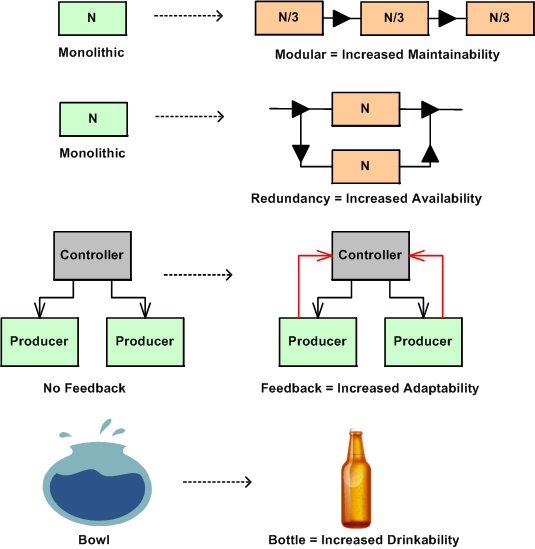
The plea of this story is: “to increase your aware-ability of the law of unintended consequences”. What you don’t know CAN hurt you. When you are bound and determined to institute what you think is a “can’t lose” change to a system that you own and/or control, make an effort to discover and uncover the ilities that will be sacrificed for those that you are attempting to instill in the system. This is especially true for socio-technical systems (do you know of any system that isn’t a socio-technical system?) where the influence on system behavior by the technical components is always dwarfed by the influence of the components that are comprised of groups of diverse individuals.
Islands Of Sanity
Via InformIT: Safari Books Online – 0201700735 – The C++ Programming Language, Special Edition, I snipped this quote from Bjarne Stroustrup, the creator of the C++ programming language:
“AT&T Bell Laboratories made a major contribution to this by allowing me to share drafts of revised versions of the C++ reference manual with implementers and users. Because many of these people work for companies that could be seen as competing with AT&T, the significance of this contribution should not be underestimated. A less enlightened company could have caused major problems of language fragmentation simply by doing nothing.”
There are always islands of sanity in the massive sea of corpocratic insanity. AT&T’s behavior at that time during the historical development of C++ showed that they were one of those islands. Is AT&T still one of those rare anomalies today? I don’t have a clue.

Another Bjarne quote from the book is no less intriguing:
“In the early years, there was no C++ paper design; design, documentation, and implementation went on simultaneously. There was no “C++ project” either, or a “C++ design committee.” Throughout, C++ evolved to cope with problems encountered by users and as a result of discussions between my friends, my colleagues, and me.”
WTF? Direct communication with users? And how can it be possible that no PMI trained generic project manager or big cheese executive was involved to lead Mr. Stroustrup to success? Bjarne should’ve been fired for not following the infallible, proven, repeatable, and continuously improving, corpo product development process. No?

Stacks And Icebergs
The picture below attempts to communicate the explosive growth in software infrastructure complexity that has taken place over the past few decades. The growth in the “stack” has been driven by the need for bigger, more capable, and more complex software-intensive systems required to solve commensurately growing complex social problems.

In the beginning there was relatively simple, “fixed” function hardware circuitry. Then, along came the programmable CPU (Central Processing Unit). Next, the need to program these CPUs to do “good things” led to the creation of “application software”. Moving forward, “operating system software” entered the picture to separate the arcane details and complexity of controlling the hardware from the application-specific problem solving software. Next, in order to keep up with the pace of growing application software size , the capability for application designers to spawn application tasks (same address space) and processes (separate address spaces) was designed into the operating system software. As the need to support geographically disperse, distributed, and heterogeneous systems appeared, “communication middleware software” was developed. On and on we go as the arrow of time lurches forward.
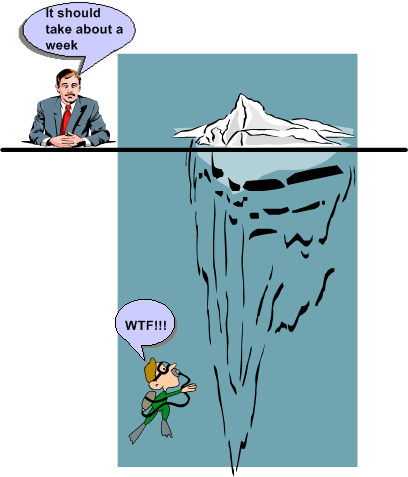
As hardware complexity and capability continues to grow rapidly, the complexity and size of the software stack also grows rapidly in an attempt to keep pace. The ability of the human mind (which takes eons to evolve compared to the rate of technology change) to comprehend and manage this complexity has been overwhelmed by the pace of advancement in hardware and software infrastructure technology growth.
Thus, in order to appear “infallibly in control” and to avoid the hard work of “understanding” (which requires diligent study and knowledge acquisition), bozo managers tend to trivialize the development of software-intensive systems. To self-medicate against the pain of personal growth and development, these jokers tend to think of computer systems as simple black boxes. They camouflage their incompetence by pretending to have a “high level” of understanding. Because of this aversion to real work, these dudes have no problem committing their corpocracies to ridiculous and unattainable schedules in order to win “the business”. Have you ever heard the phrase “aggressive schedule”?
“You have to know a lot to be of help. It’s slow and tedious. You don’t have to know much to cause harm. It’s fast and instinctive.” – Rudolph Starkermann

Why am I here?
WTF?
Meh!
D'oh!

My BTC Address



 Bulldozer00's Blog