Archive
Gift Wrap
In dysfunctional corpocracies, it’s not only acceptable, but it’s expected that STSJs (Status Takers and Schedule Jockeys) will routinely drop turd-bombs on DICs (Dweebs In the Cellar) when schedules, no matter how far off the mark they are, are not met.
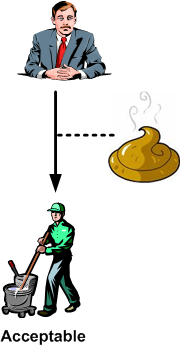
However, it’s socially unacceptable for a DIC to hurl a turd-coil skyward toward an STSJ. Nevertheless, if a DIC has been trained to “communicate effectively” and is clever and skillful enough, a gift-wrapped turd-ball may be accepted “temporarily” by an STSJ – until he/she opens the box. Thus, the best course of action for DICS “privileged” enough to work in a one way command and control hierarchy is to flush turd-bombs down the toilet when they are discovered. Whoosh!

Endless Loop
Are you a player in an endless loop like this:
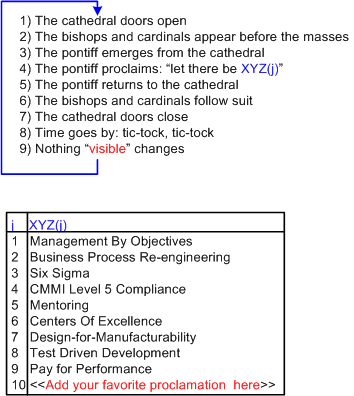
If so, are you the pontiff? A cardinal? A bishop? A “mass”? If you ARE a player in this endless loop, do you aspire to play a different role, and why? Do you want to be the selector and promulgator of the next “j” proclamation? Do you fancy the bling that the cardinals, bishops, and pontiff adorn themselves in? Do you want to change the content of one or more of the loop steps, especially number 9?
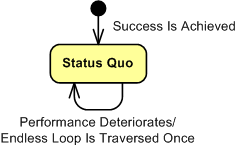
Motivility
In one of the Vital Smarts crew’s books (I forget which one, and I’m too lazy-ass to look it up) they mention motivation and ability as two important metrics that leaders can leverage to help people improve performance. To make things simple, but hopefully not simplistic, I’ve constructed a “Leader’s Action Table” (LAT) below using a binary “Present” or “Absent” value for each of the motivility attributes.
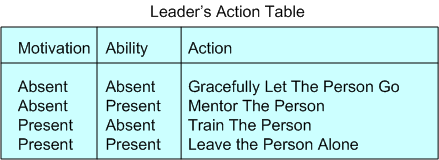
Since, by definition, a leader is pro-active and he/she cares about people and performance (both), he/she will take the time and effort to get to know his/her people well. The leader can then use the simple, two attribute , four action LAT to help his/her people grow and develop.
With bozo managers, the story is much different. Even if they stopped thinking about themselves and their careers long enough to consider the individual needs of their people in terms of the two motivility attributes, those bozeltines would get it back-asswards and hose everything up – of course. Instead of a LAT, they’d wield the BAT shown below. BATter up!

Do you think the LAT could be useful? What would your LAT look like? Are there any important attributes that you think are missing from the table? Should one or either of the motivility attributes be multi-valued instead of binary? Meh?
“Half of the harm that is done in this world is due to people who want to feel important. They do not mean to do harm… They are absorbed in the endless struggle to think well of themselves.” – T. S. Eliot
Problems And Challenges
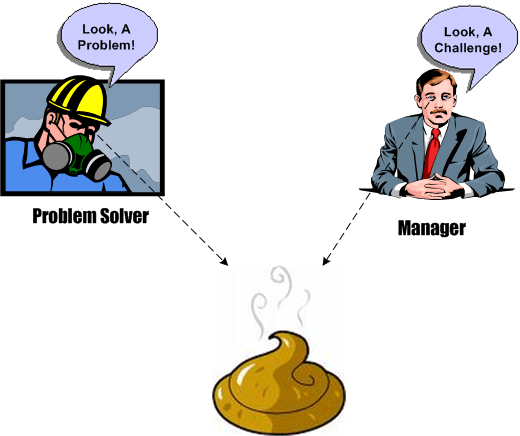
It’s easy to view a situation that requires action as a “challenge” instead of a “problem” if you don’t personally have to effect the change yourself. That’s why managers talk about challenges and workers talk about problems. Since hierarchical command and control corpocracies are inherently stratified caste systems, managers and workers don’t have a chance of seeing the same thing – a prallenge.
Best Of The Best
The breadth of variety of companies, markets, customers, industries, products, and services in the world is so wide and diverse that it can be daunting to develop objectively measurable criteria for “best in class” that cuts across all of the variability.
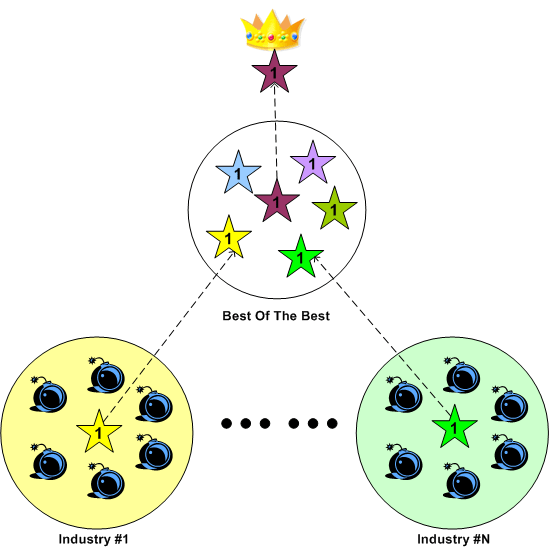
Being a simpleton, my pseudo-measurable criteria for a “best in class” company is:
- Everybody (except for the inevitable handful of malcontents (like me?) found in all organizations) who works in the company sincerely feels good about themselves, their co-workers, the products they build, their customers, and the company leadership.
That’s it. That’s my sole criterion (I told you I was a simpleton). Of course, the classical financial measures like year-over-year revenue growth, profitability, yada, yada, yada, matter too, but in my uncredentialed and unscholarly mind, those metrics are secondary. They’re secondary because good numbers are unsustainable unless the touchy-feely criterion is continuously satisfied.
The dilemma with any kind of “feel good” criteria is that there aren’t many good ways of measuring them. Nevertheless, one of my favorite companies, zappos.com, has conjured up a great way of doing it. Every year, CEO Tony Hsieh sends an e-mail out to all of his employees and solicits their thoughts on the Zappos culture. All the responses are then integrated and published, unedited, in a hard copy “Zappos Culture Book”.
The Zappos culture book is available free of charge to anyone who emails Tony (tony@zappos.com). Earlier this year, I e-mailed Tony and asked for a copy of the book. Lo and behold, I received the 400+ page tome, free-of-charge, four days later. I poured through the 100’s of employee, executive, and partner testimonials regarding Zappos’s actual performance against their espoused cultural values. I found no negative entries in the entire book. There were two, just two, lukewarm assessments of the company’s cultural performance. Of course, skeptics will say that the book entries were censored, and maybe they were, but I doubt it.
How would your company fare if it compiled a yearly culture book similar to Zappos’s? Would your company even entertain the idea? Would anyone feel comfortable proposing the idea? Is the concept of a culture book only applicable to consumer products companies like Zappos.com, or could its value be industry-independent?
Note: Zappos.com was recently bought out by Amazon.com. It should be interesting to see if the yearly Zappos culture book gets squashed by Jeff Bezos et al.
Man, These Guys Are Good
In general, I think that management consultants are way overpaid and full of themselves. These bozos with fat heads come waltzing in to a company in trouble and:
- analyze the “situation” from afar without getting their hands dirty,
- dispense all kinds of “proprietary” voodoo advice,
- collect their fee,
- and then bolt – leaving the ineffective corpocrats (who caused the mess in the first place) to clean up their own dung.
Notwithstanding the vitriolic diatribe in the previous paragraph, I think the following consulting dudes are the real deal: Vital Smarts. They’re people-oriented instead of mechanistically process-oriented. Collectively, they’ve talked with tens of thousands of workers; from the dweebs in the cellar to the exalted royalty in the corner of the building. They’ve also analyzed a ton of academic research to derive some down to earth, pragmatic, and potentially actionable direction for everyone – not just the patriarchs who direct the horror show. I’ve read all of their terrific bestselling books:
I’ve actually tried to employ their teachings in an attempt to be more effective in the workplace, but Ive failed miserably. Of course, it’s not their fault. It’s me and my “Unshakeable Cognitive Burden” of negativity toward all man-made command and control hierarchies.
A Professional Failure
I’m a professional failure. Why? Because I’m pretty sure that I’ve never satisfied any unreasonable schedule that I was ever “given” to meet. Since almost all schedules are unreasonable, then, by definition, I’m a professional failure. Hell, it didn’t even matter if I was the one who created the unreasonable schedule in the first place, I’ve failed. Bummer.

Looking back, I think that I’ve figured out why I underperformed (<– that’s management-speak for “failed”). It’s simply that the problem solving projects that I’ve worked on have been grossly underestimated. Why is that? Because they all required learning something new and acquiring new knowledge in the problem area of pecuniary interest.
So, how can you know if a given schedule is unreasonable, and does it matter if you conclude that meeting the schedule is a lost cause? You most likely can’t, and no, it doesn’t matter. Assume that, based on personal experience and a deep “knowing” of what’s involved in a project, you actually can determine that the schedule is a laughable, but innocent, lie. There’s nothing you can do about it. If you speak up, at best, you’ll be ignored. At worst, you’ll receive multiple peek-a-boo visits from one or more STSJs (Status Taker and Schedule Jockey) who don’t have to do any of the project work themselves.
How about you, have you been a perpetual failure like me? Of course not. Your resume says here that you have been 100% successful on every project you’ve worked on; and that implies that you’ve met every schedule. But wait, every other resume in my stack says the same thing. Damn! How am I gonna decide among all of these perfect people who gets the job?
Particular Individuals Don’t Matter
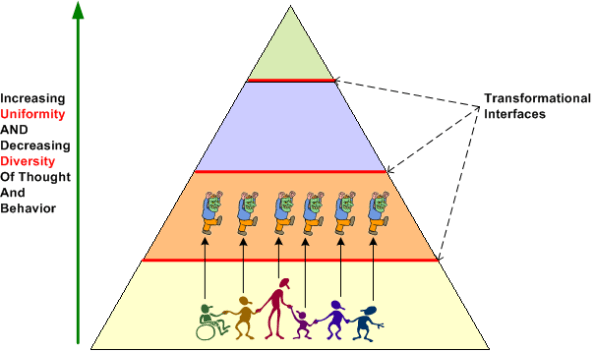
It doesn’t matter who the particular individuals in a corpocracy are. No matter how smart and well meaning they are, the awesome power of the pyramidal structure of woe to suppress their individuality and transform them into zombie clones tasked to guard the status-quo will prevail. How many of you have seen and experienced the ascension of smart, and formerly-effective, people into the ranks of the elite, only to be instantaneously transformed into ineffective druids?
Must Be An Outsider
One must be an outsider to escape being scalded for pointing out problems within a corpocracy. Unlike insiders (except for the obligatory, once a year, watered down employee survey), outsider opinions are actually solicited by the infallible hierarchs (who confidently and assuredly think they run the show). In addition, outsider pundits with “impeccable credentials” actually get paid for their analysis and recommendations! That’s why Weinberg’s “Secrets of Consulting” is in my reading queue.

Sadly, even if the situation on the left in the above diagram never happens in your org, DICs won’t stand up and expose turds that threaten the well being of the corpocracy because the image is dogmatically burned into their mind. There’s a reason why the story of the “emperor’s new clothes” is so funny and well known. The boy who pointed out his “highny”-ness’ s wardrobe malfunction was outside of the emperor’s kiss-ass court. Had he been an insider, it would have been “off with his head”.
Galileo And Kepler
To reinforce my anti-corpocracy UCB (Unshakeable Cognitive Burden), I just finished reading “The Age Of Heretics: A History Of The Radical Thinkers Who Reinvented Corporate Management“. It’s the second time in the last few months that I stumbled across the Galileo-Pope Urban story. The first time was in W. L. Livingston’s forthcoming “Design For Prevention”. Here’s a snippet from “Heretics”:
Why does Galileo Galilei have the reputation of a heretic, while his seventeenth-century fellow scientist Johannes Kepler does not? Because Kepler evaded the Church. Galileo sought to change it. The professor from Pisa spent the last third of his life arguing, with increasing fervor, that the Christian doctrines and even Bibles should be rewritten to conform to the realities he had seen through his telescope. Many of the cardinals and Church officials who censured and imprisoned him recognized the validity of the new cosmology and physics that Galileo championed, but they didn’t want to shake up their system too quickly. Too many monks and village priests clung to Ptolemy and Aristotle. The “people” would rebel at any sudden revision of the “truth.” Galileo didn’t care. Like many other heretics, past and present, he thought at first that the truth would set the institution free. He only had to show people what he had seen, and they would naturally adapt. When people doubted observations that to him were obvious, he lost his tact. He made enemies (some said needlessly) of the Jesuits, who fought bitterly to see him condemned, and he closed one of his notorious tracts, the Dialogue on the Great World Systems, with a snide lampoon of the views of Pope Urban VIII. Until then Urban had been his patron and champion. Ten months after publication in 1633, Galileo was on trial in Rome.

Here’s a snippet that is written further along in the book:
Even the Roman Catholic church eventually admitted that Galileo’s cosmology was correct—after 359 years.

Bummer. Behind the illusory cloak of modern civility, irrational and insane institutional behavior hasn’t changed much over the years. Heretics are still reviled by the bozos in power who will do whatever it takes to retain that power, and more importantly, the personal riches that automatically go along with it. Today’s well meaning but unconscious corpocrats are simply much more clever at veiling the methods that they use to annihilate heretics, even when individual heretics arise from their own ranks. Kepler rules!

Why am I here?
WTF?
Meh!
D'oh!

My BTC Address



 Bulldozer00's Blog