Archive
Short Cycle, Long Cycle
Since my memory isn’t that great, I think (but am not sure) that I wrote about short and long cycle run-break-fix before. Nevertheless, I’m gonna do it again because repetition can drive a message home.
In a nutshell, short cycle run-break-fix (SCRBF) and LCRBF are ways of enhancing product quality. High frequency SCRBF iteration jacks up quality by removing errors and fixing design disasters before a product gets shipped to customers. LCRBF is (hopefully) a low frequency technique of error removal after a product has made it into the customer’s hands. In that sense, SCRBF is good and LCRBF is bad. In a perfect world, LCRBF is never needed because the customer gets exactly what he/she wants right out of the shoot.
The figure below depicts side-by-side models of two different company’s day to day operating systems. Which one do you think is more successful? Why do you think the company on the right doesn’t do any SCRBF? Could it be that internal mistakes aren’t tolerated and hence covered up? Do you think it’s innocent ignorance? Do you think it’s because management puts schedule first and quality second – while publicly espousing the opposite? Which model best represents your company’s ingrained way of doing things?
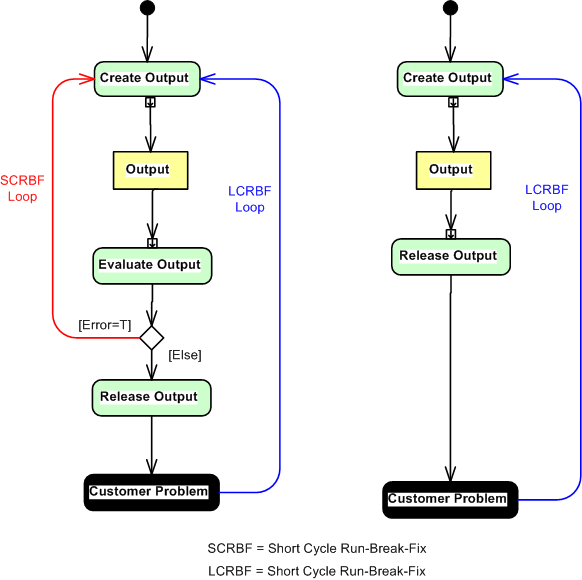
Note: The terms SCRBF and LCRBF were coined by William L. Livingston in his masterful second book, “Have fun at work“.
Trust
In “Design For Prevention” (there’s no link here because the book hasn’t been released yet), friend and mentor Bill Livingston elegantly states:
Trust substitutes for search, negotiation, monitoring, and enforcement; it substitutes for hierarchical control internally and for the legalisms of contracts externally. The core elements of trust include: reciprocity, reputation, and a common semantic.
Reciprocity and reputation align motives, and a common semantic aligns perceptions. People have an innate, passionate desire to contribute, called the instinct of workmanship. Opposing this urge to contribute is fear of rejection, failure, loss, retribution, or embarrassment. Earned trust tips the balance between the urge to contribute and fear. Working in an environment of trust reinforces, validates, and supports trust. – William L. Livingston
The truth in Bill’s words ring loud and clear to me. Trust flattens the hierarchy and nurtures the emergence of a collaborative, wealth creating community. Without trust, a herd-following and hardened mediocracy is guaranteed.
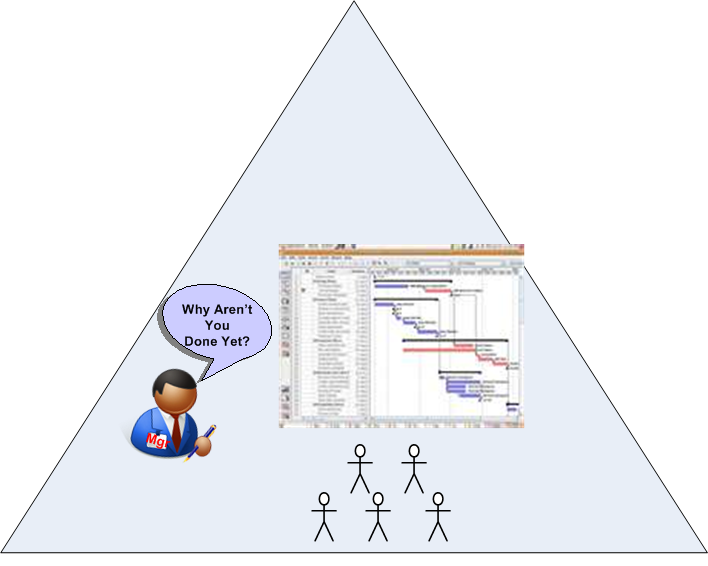
Sadly, because those in the top tiers of CCHs want nothing more than to stay in the penthouse, trust is not allowed within corpocracies. Fine grained, micro-detailed work schedules (that are hopelessly out of date as soon as the ink dries) coupled with useless daily status meetings continuously destroy trust and clearly show “who’s in charge” and who’s supposed to be more important.

A Contrast In Usability
I own two wildly different books dedicated to the topic of software estimation:
- Steve McConnell’s pragmatic and down to earth “Software Estimation: Demystifying the Black Art“
- Richard Stutzke’s massive, academic tome: “Estimating Software-Intensive Systems: Projects, Products, and Processes“
I have several of McConnell’s books and I think that he is a brilliant, understandable teacher of all things software. Steve’s concern for, and empathy towards, the layman software engineer shows. Stutzke, on the other hand, is an impressive equation-wielder and master complexity amplifier who seems more concerned with showing off his IQ to fellow elites than transmitting usable information to the dudes in the trenches. It could take more time to apply Stutzke’s work for estimating the size and effort to develop a large software-intensive system than to build the actual system itself.
Since McConnell’s book is half the price of Stutzke’s, buy two of them – one for yourself and one for your manager. On the other hand, give the second one to a colleague since most managers, BM or otherwise, don’t read technical stuff. They also don’t believe in estimation. They delusionally believe in certainty so they can populate their massive and useless Microsoft project files with exact numbers and never revise them until the fit hits the shan and it’s time to apportion blame to the DICforce.
Failure, Failure, Failure
There are tons of experts, articles, books, and references on the ephemeral topic of “change”. Over the years, I’ve read my fair share of books on change and one of the best that I’ve stumbled upon (so far) is “It Starts with One: Changing Individuals Changes Organizations“. Authors Black and Gregersen assert that the 3 major brain barriers to organizational change are:
- The failure to see
- The failure to move
- The failure to finish
The book is targeted at leaders who’ve “seen” that major change is needed and who feel compelled to move their orgs into the future. It provides a boatload of examples and solid, pragmatic advice on how leaders can help the DICforce see, move, and follow through on cross cutting change initiatives.
Black and Gregersen should follow up their nice work with a book on a more pervasive problem; the failure of corpo leaders to “see” the need for change in themselves. The sequel would advise the boatloads of leaders in this category to get off their duffs and continuously probe, sense, and decide what changes are needed for their orgs to remain viable in a fast changing and hostile external business environment.
At a certain age institutional minds close up; they live on their intellectual fat. – William Lyon Phelps
Bad leaders fail to “see” the need for change until a crisis jolts them into reality. That’s because the dudes in the head shed get comfortable with past successes and feel no sense of urgency to change anything – regardless of what they say. To paraphrase Carolyn Wells; ” actions, or a lack thereof, lie louder than words“.

What Without How
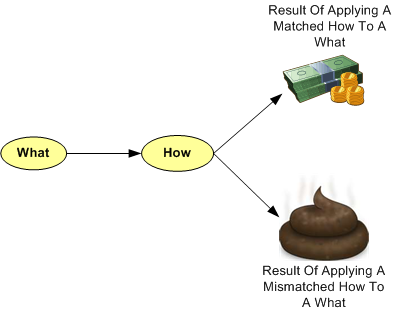
In “Hackers And Painters“, the great essayist Paul Graham states: “asking for what without knowing how is asking for trouble“. I’m on board with that because BMs do that all the time and I’ve seen the wreckage of that approach many times over the years. The higher up the BM, the less he/she knows about the “hows” but the more he/she demands the “whats“. The real damage comes from front line BMs who stop learning and let their “know how” skills atrophy because they’ve been promoted up from the cellar. Hell, they’ve “arrived” and there’s no need for keeping the sleeves rolled up and wrestling in the muck of challenging work that requires continuous learning and sustained immersion.
“The world is full of willing people, some willing to work, the rest willing to let them.” – Robert Frost
But what about when a group suddenly discovers that it needs to try something new to survive and thrive? In this case, everyone may know “what‘s” needed but nobody knows “how” to do the “what” – because it’s never been done by them before. Unless the group can hire outside expertise that has done “what” needs to be done before and therefore knows “how” to do it, the “how” must be learned on the fly in a typical high speed sense-act-reflect-correct feedback loop. Sadly, but expectantly, no time is ever “allocated” for training/learning “how” to do something new by institutional BMs; it costs money, consumes time, and it’s unspoken but expected that everybody knows “how” to do “what” at all times.
Managers And Leaders
Naturally, everyone has their own personal opinion regarding the difference between a leader and a manager. Of course, I have one too:
Manager = Status Taker and Schedule Jockey (STSJ)
Leader = People Helper and Obstacle Remover (PHOR) first, and STSJ second
Of course, the STSJ function is necessary (but not sufficient) to stay in business, but the PHOR function is required to increase profitability, instill trust, and build a joyful workplace. In order to grow into a PHOR, a candidate for leadership has got to communicate, and frequently. Hell, if a leadership candidate doesn’t communicate with his/her people, how’s he/she going to know what they need and what socio-technical obstacles must be removed for them to excel? All non-communicators are STSJs – which means the number of STSJs (a.k.a BMs) pervading corpo America is HUGE-UH.
If you have more managers than leaders in your organization, then you’re most likely not having any fun during your daily stint within the halls of your institution. If you have zero leaders in your organization, then your work life is probably horrific. If you have all leaders in your organization then you’re most likely in heaven.
If any organism fails to fulfill its potentialities, it becomes sick. – William James
What’s the Manager-To-Leader ratio (MTL) in your organization? If you’re “in charge” of a group of people, are you a manager or a leader according to my unscientific, concocted (I like to make stuff up) criteria ?

Unlike In Love
Unlike in love, in business “absence does not make the heart grow fonder“. When there are long stretches of silence between supervisor-to-supervisee, vendor-to-customer, and/or supplier-to-vendor communications, the receiving party in each case will sooner or later start thinking that the transmitting party doesn’t care about them. Worse, if communication solely occurs when the transmitter “wants something” from the receiver, the relationship deteriorates further. Trust and respect, difficult to acquire but ridiculously easy to lose, go right down the tubes and mutually beneficial collaboration comes to a stand still.
So, is all lost when the transmit-receive communication channel is intact but the transmitter stops transmitting? Hell no, but it takes awareness, sincerity, persistence, initiative and, most importantly, willingness on the transmitter’s part to repair the damage. Why should the transmitter be the lead in re-establishing communication? Because the transmitter is the source of information that the receiver needs to perform its function. No transmission, no information. No information, no mutually beneficial results.

Don’t Say It!
One of Paul Graham’s brilliant essays in “Hackers and Painters” is titled “What You Can’t Say“. In it, he analyzes the question: “How do people in power determine what you can’t say in a given historical time period?” He goes back to the Galileo era and cites the fact that what was taboo to say in one generation became trivially “OK” to say in subsequent generations. It’s sad because over the ages many people were persecuted, tortured, and killed because of what they said in one generation, only to have their deaths become senseless in the subsequent generation(s).
I think Paul’s answer to the “what you can’t say” question is pretty much right on:
“The statements that make people mad are the ones they worry might be believed. I suspect the statements that make people maddest are those they worry might be true.” – Paul Graham
How do I know that Paul is close to ground zero? Because when I get mad those are the reasons that trigger the madness. Mr. Graham’s conclusion aligns closely with the following GBS assessment.
“All great truths begin as blasphemies.” – George Bernard Shaw
If I was GBS, I would have stated it as: “All great truths begin as blasphemies that, when stated before it’s appropriate to do so, will get you censured, fired, tortured, killed, or all of the above.”

Line, Dot, Cone
My friend and mentor from afar (if you’ve looked around your local environment, there’s an incredible dearth of mentors from a-near), William L. Livingston, is about to hatch his fourth book: “Design For Prevention“. I’m happy to say that I’ve served as a reviewer and a source of feedback for D4P. I’m sad to say that it won’t become a New York Times bestseller because it’s one of those blasphemous books that goes against the grain and will be rejected/ignored by those it could help the most – institutional leaders.
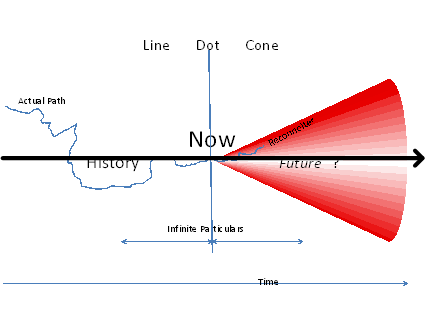
One of the graphics in DfP that I’ve fixated on is the “Line Dot Cone” drawing. As shown below, the path to “now” is not smooth and deterministic. It’s non-linear and quite haphazard. Likewise, the future holds an infinite cone of possibilities. The only way to narrow the cone of future uncertainty is to perform continuous reconnaissance via sensing/probing/simulating and then intelligently acting upon the knowledge gained from the effort, where intelligence = appropriate selection (W. Ross Ashby) and not academic knowlege.
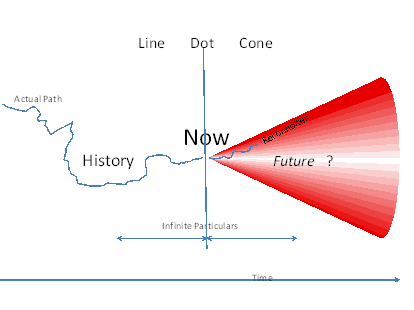
CCH corpocracies don’t acknowledge the existence of the Line-Dot-Cone reality. It would undermine the carefully crafted illusion that the dudes in the penthouse have projected about their ability to make the future happen. In their fat heads, as the overlay below shows, progress always occurs linearly in accordance with their infallible control actions. Thus, no reconnaissance is needed and all will be well for as long as they rule the roost.
The Bad Person
At my company, unlike the legions of others who are afraid of what they might discover, we have a web-based portal that enables anyone to post questions to management. Fittingly, the answers to most of the questions get publicly posted along with the questions themselves from someone in the management group. Again, unlike the legions of companies littering the landscape who’s upper management layers don’t “get involved” with such trivia from the DICforce, my company’s questions are often answered by our CEO.
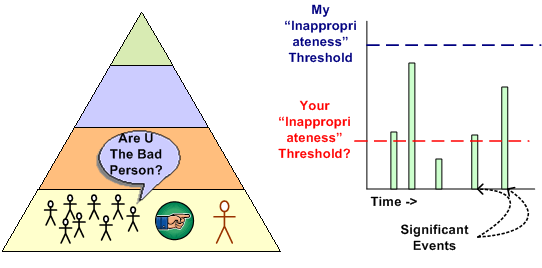
As you might surmise, some of the submitted questions could be judged as hurtful and hostile by many, if not the majority, of people in the organization. Nevertheless, everyone has a different threshold of “inappropriateness“, and as you might guess, mine is pretty high.
Because:
- of my high personal inappropriateness threshold,
- I like to continuously skirt the edge of inappropriateness to feel alive and perhaps influence other people’s thinking,
- I think (but am not sure) that quite a few people have at least judged me to be perpetually disrespectful,
I often get asked “Did you submit this question?” regarding some potentially controversial submittals. The interesting thing is, I’ve only been asked that by fellow DICs, and never by anyone in the management group. Is that both cool and weird, or what?
Every time I get asked the “Did you submit this question?” question by a fellow DICster, a slight twinge of guilt courses through my being even though I didn’t ask the question and even though I have judged it “appropriate” according to my subjective inappropriateness threshold setting. I suspect that I experience the discomfort because I feel like the asker is searching for “the bad person” who would ask such a thing. When that happens, the following quotes pop into my head to help me move past the icky and uncomfortable feeling associated with dancing on the edge of the abyss:
“It is only by risking our persons from one hour to another that we live at all.” – William James
“Do one thing everyday that scares you.” – Baz Luhrmann
How about you? Are you always on the hunt for “bad people“? Do you like to skirt the edge of inappropriateness? Do you like to sit in the lazy boy, munch on popcorn, watch the show, and remain on the sideline?

Why am I here?
WTF?
Meh!
D'oh!

My BTC Address



 Bulldozer00's Blog