Archive
Expected Forgetfulness
BMs and CCRATs in mediocracies always require that the DIC-force conveniently forget the parade of reorgs and resource draining initiatives that they have started but have never followed through on over the years. However, they’ll be the first to remind project contributors when they “haven’t met schedule” or when their project came in “over budget“.
DIC-sters, either consciously out of fear or unconsciously from years of mind-numbing indoctrination, comply dutifully with the “expected forgetfulness” rule in order to preserve the mediocre performance that gives a mediocracy is meaning. All attempts to point out the blatantly obvious but undiscussable hippocracy of CCRAT demands for schedule and cost compliance, while simultaneously underperforming in these areas themselves, is met with swift retribution. This happens even in the extremely rare cases when a hierarch himself loses his sanity for a nanosecond and tries to right the wrong.

Services And Outcomes
In an e-mail from friend and mentor Bill Livingston, he said:
If duty is focused on method and practices, there can be no responsibility either for meeting the objective or for any consequences of services. If goal attainment is chosen paramount, there can be no limitations on methodology. Duty for professional services is given by authority. Responsibility for outcomes must be willingly taken by the designer. – William L. Livingston
Think about how obsessed most companies (especially large ones run by fat heads) are with regard to following standard corpo policies, rules, methods, and practices. In other words, red freakin’ tape. In these abominations that have lost their way, if one is a good soldier and loyally follows the unchangeable rules inscribed in stone by the dudes in the head shed, there can be no repercussions for failure to achieve goals. After all, since the corpocrats created the operational rule set and they’re (of course) infallible, that means the rule set is perfect. Hence, if you follow the rules to the letter but cause a disaster, you’re absolved.

The Answer To A Burning Question
Ever since Fred Brooks hatched his legendary “The Mythical Man Month” over 20 years ago, he’s been on my hero/mentor list. His latest insightful work, “The Design Of Design“, is just as good as TMMM. Of course, since my views on software engineering (if it can be called engineering) are heavily influenced by his experiences as shared through his writing, I’m totally biased and unobjective (but….. aren’t we all to some extent?).
I pre-ordered TDOD as soon as I heard about its impending release and I received it from Amazon last week. Unlike most books, which I mildly speed read, I’ve been savoring this one slowly. As expected, I’ve been discovering and extracting a treasure trove of personally valuable fieldstones from TDOD at a feverish pace.
Fred opens up one of his chapters with this brilliant quote:
“A meeting is a refuge from the dreariness of labor and the loneliness of thought.” – Bernard Baruch
I think it’s brilliant because it answers a burning question that I haven’t been able to self-answer for a long time in one short sentence:
Why do managers spend the vast majority of their time in meetings?
Thanks to Fred and Bernie, I now know why 🙂

Underbid And Overpromise
As usual, I don’t get it. I don’t get the underbid-overpromise epidemic that’s been left untreated for ages. Proposal teams, under persistent pressure from executives to win contracts from customers, and isolated from hearing negative feedback by unintegrated program execution and product development teams, perpetually underbid on price/delivery and over-promise on product features and performance. This unquestioned underbid-overpromise industry worst practice has been entrenched in mediocracies since the dawn of the cover-your-ass, ironclad contract. The undiscussable but real tendency to, uh, “exaggerate” an org’s potential to deliver is baked into the system. That’s because competitors and customers are willing co-conspirators in this cycle of woe. The stalemate ensures that there’s no incentive for changing the busted system. As the saying goes; “if we can’t fix it, it ain’t broke!“. D’oh!

If a company actually could take the high road and submit more realistic proposals to customers, they’d go out of business because non-individual customers (i.e. dysfunctional org bureaucracies where no one takes responsibility for outcomes) choose the lowest bidder 99.99999% of the time. I said “actually could” in the previous sentence because most companies “can’t“. That’s because most are so poorly managed that they don’t know what or where their real costs are. Unrecorded overtime, vague and generic work breakdown structures, inscrutable processes, and wrongly charged time all guarantee that the corpo head sheds don’t have a clue where their major cost sinks are. Bummer.
A New Title Should Do It
“To solve our decreasing revenue and rising cost problems, we’ll just create a new title and insert the position into the org (thereby adding another layer to the stratified corpo cake). Voila! The problem will be solved (so let’s give ourselves a special bonus for being so smart).”
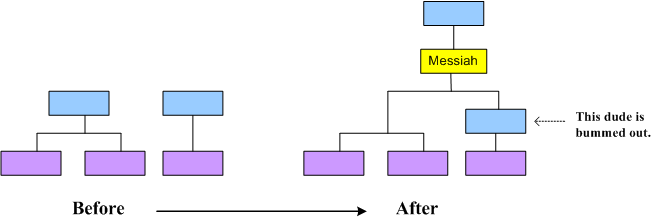
“But wait. What should the title be? Supervisor, Manager, Deputy Manager, Director, Deputy Director, General Manager? Should we bump it up by attaching a “Chief” and/or VP to the label? “We must be careful because the loftier the title, the more we’ll have to pay our new colleague (who will no doubt accomplish what we have failed to do).”

Such is the mindset of MBA trained corpo elites and their stooge press magazines like Business Week, Forbes, Fortune, et al. Do ya really think parachuting a messiah in to jumpstart an org with:
- an apathetic DICforce that is not as stupid as the head shed assumes and doesn’t appreciate management’s patronizing attitude
- an aging product development and manufacturing infrastructure (e.g. tools, processes, know how)
- an old and tired product portfolio that’s continually being usurped by competitor offerings
- a culture of undiscussable but obvious inter-group rivalry and disrespect
is realistic? Fragmented, hero-worshipping mindsets don’t clean up what Russell Ackoff calls, for lack of a better word, “messes”. Systemic thinking, along with the willingness to skinny dip, fully exposed, into the stinky mess is the only way to understand and clean up messes. Sadly, even if one or two dudes in the head shed junta are closet system thinkers and they try to speak out or take action, they’re promptly put back into their assigned slot….. and business resumes as usual…. while the mess grows ominously larger.
And now, for the bad news….. 🙂
Undiscussable Unfairness
Assume that two similar projects are underway at your company. Also, assume that one of the teams is encumbered by a heavyweight process and the other is given a blank check to do as they please – no processes or procedures to follow, no external reviewers, no forms to fill out, no design or maintenance documentation to be generated. Would you confront management about the inequity? If so, why would you do something so stupid? Don’t you think the dudes in charge know what they’re letting happen? Don’t you think they would be pissed at you for pointing out the obvious but undiscussable stank of unfairness in the air?
I think perfect objectivity is an unrealistic goal; fairness, however, is not. – Michael Pollan

Multividual Contributor
The most politically correct (a.k.a. least offensive) way to ensure that employees take note of the fact that they are a notch below them, managers love to use the term “individual contributor” to DICs. Managers use this term repeatedly during annual performance reviews to subtly pre-empt any discontent over the measly 2% raises almost all non-managers get every year. The unspoken but unambiguous top-down message is: “You shouldn’t expect more because you’re only an individual contributor. I, on the other hand, am a manager – a multi-vidual contributor.”

Say what? Aren’t managers individuals? Aren’t managers (well, at least the non-BMs amongst them) contributors? Individual + contributor = individual contributor, no? Is it time to come up with a new, creative, and clever replacement term that will continue to promote the false impression that all managers are more important than all DICs? How about “limited influencer” or “lesser contributor”? Nah, these are not politically correct enough. Got any suggestions?
Breakfast Interpretation
While e-conversing with a colleague the other day, I used the following quote that encapsulates the chicken and pig story:
In a bacon and eggs breakfast, the chicken is involved but the pig is committed – Ken Schwaber
Surprisingly (it’s surprising because my colleague isn’t a member of the management guild), my infallible and self-righteous peer castigated me with a retort of “that’s inappropriate!”.
Dude, gimme a break. You see, just because the quote was created by a semi-famous software dweeb to belittle BMs, it doesn’t have to be interpreted that way. It can be interpreted as the exact opposite:
“managers who decide to provide financial backing for a project have more skin in the game than the engineers who spend the money – because if the project fails, the pecuniary loss is pinned on the manager by his/her manager(s)“.
This interpretation certainly has as much validity as it’s polar opposite, no?
Nevertheless, when I did utter the quote, I was using it to convey Mr. Schwaber’s original intent. Bad dog – as my colleague was quick to point out. He seems to delight himself whenever he clearly points out how stupid I am – which is often. Gotta love pumping yourself up at the expense of others. I should know, cuz I do it all the time. Mooo hah hah hah! Bad dog!

Buy this poster at motivatedphotos.com. Post it on your cubie wall – if you dare.
Competitive Edge
Check out the figure below. Which model more closely maps to your company’s way of operating?
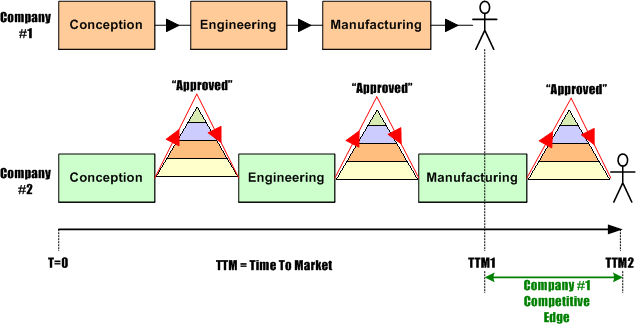
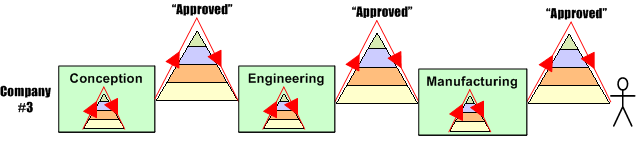
If you picked company #2, does the nested approval model below represent your company even more closely? Does every swingin’ dick (not DIC) in the house with one or more titles feel the need to be informed and bestow his/her approval before anything of substance can get done within the corpo citadel?
Make Me More Effective
In this blog post, 15 great leadership questions, executive and leadership coach John M. McKee asks leaders how often they ask their people:
What can I do to make you more effective?
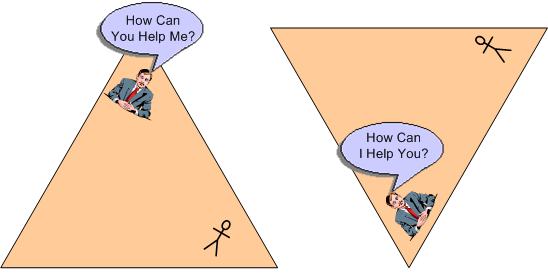
LOL. I’d wager that most leaders don’t ask this question at all. Managers cleverly ask and expect the opposite:
What can you do to make me more effective?
The higher one goes up in a corpo pyramid, the more this question gets asked either explicitly or (more likely) implicitly. You see, one unwritten rule (of many) in CCH bureaucracies is that lesser subordinates are required to make their bosses look good and expect nothing in return except the prevailing industry wage and benefits package. Expecting managers to actively facilitate high quality work and value creation is relegated to a distant second.
The problem with any unwritten law is that you don’t know where to go to erase it. – Glaser and Way
At the beginning of a project, an anointed leader once asked me: “What do you need?“. I was stunned, tongue-tied, and I didn’t know how to respond. Later, when I had some time to think about what I needed, I made my request. Sadly, I didn’t get what I needed but that didn’t really matter that much to me. Just the fact that he asked me the question was enough to instill a feeling of lasting trust and respect within me.

Why am I here?
WTF?
Meh!
D'oh!

My BTC Address



 Bulldozer00's Blog