Archive
Thinking Is Not Allowed
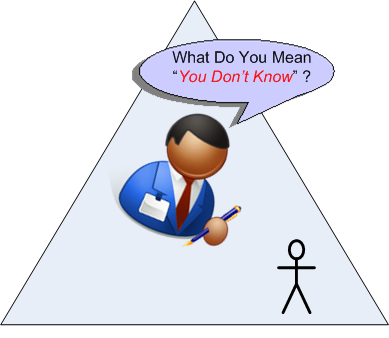
I’m not very good at flying by the seat of my pants during encounters with bozeltine managers who demand answers to complex questions on-the-spot, in real-time. When I spontaneously find myself in those situations, I tend to get flustered and make stuff up (more than I normally do (which is a lot)) to appease those in authority.
Rather than calmly saying “(please) let me think about it and get back to you“, I tend to cave and pull some stanky chit out of my arse. Maybe it’s because of the perception that “thinking” isn’t allowed? Maybe it’s because of the expectation that everyone should be perfectly all-knowing? If BMs were conscious of their irrational behavior when they ask for information, then they’d say “please think about it and get back to me“. But then, they wouldn’t be BMs. They’d be, heaven forbid, empathetic leaders.
Inappropriate
It seems that the word “inappropriate” is in fashion these days. It’s the modern and eloquent replacement for old and tired words like “disrespectful”, “disloyal”, “blasphemy”, “heresy”, and “sacrilege”. Infallible judgers are always on the lookout for impactful, fear-inducing words like these to silence conscientious objectors and concerned citizens. As you might surmise, the word “inappropriate” is directed at me quit frequently :).
Based on my personal experience, I can tell you that the fear effect works, but it’s success is person-specific. In my case, the fear effect usually wears off quickly and I’m back at being “inappropriate” yet again.
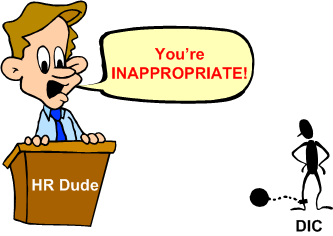
In dysfunctional CCHs, one of the primary functions of HR departments is to police the behavior of the DICforce. Thus, since they’ve been “approved” by the corpocracy to inject fear into non-conformers and rabble rousers, they’re the final arbiter of what’s deemed “inappropriate”. When someone “reports” (a.k.a rats out) someone to HR, the group happily kicks into action to assess the allegation. Unlike the drawn out investigation that occurs when a DIC rats out another DIC, the verdict of “inappropriate” is always certain when a manager rats on a DIC. You see, since HR is an integral member of the management guild and it gets paid by its brethren, it does whatever is best for management – which may not be best for the company as a whole.
Since (as I’ve said several times before) I like to make things up, don’t believe a word I say. If I could, I’d change the name of this blog to “Don’t Read This Blog Because I Like To Make Things Up“.
Ego Appeasement
It’s funny how dysfunctional orgs will demand unquestioned loyalty from the masses in order to help the org grow and develop, but at the same time thwart that goal by appeasing egos to the detriment of the org as a whole. In defiance to what’s best for the community that they lead, top echelon leaders will not merge or disassemble org units if middle managers will have their egos bruised.
For example, if it makes economic sense to tuck or merge an obsolete unit run by a senior VP under a “regular” VP for the betterment of the whole org, the top dogs won’t do it out of “respect” for the titular system of privilege. God forbid that a senior VP report to a regular VP. It’s verboten in CCH-land. Another corpo faux pas is forming an org that may increase profitability but has a VP reporting to a lowly Director. Ain’t gonna happen.
Such is the power of titular hierarchies to thwart their own development.

Equanimity
“Few people are capable of expressing with equanimity opinions which differ from the prejudices of their social environment. Most people are even incapable of forming such opinions.” – Albert Einstein
I love this quote because for a long, long time (half of my life to be more specific – and I’m not, uh, very young), I fit the “incapable of forming such opinions” part. However, for reasons that I don’t understand but am grateful for, I’ve done a total 180 degree turnaround. By design, I consciously choose to form and express opinions which differ from the prejudices of my social environment, both the local social environment and, more ominously, the global social environment. What I’ve yet to learn, and I may never learn it because I’m not intelligent(?) enough to suppress emotion over Spock-like logic, is the “equanimity” part (equanimity = evenness of temper even under stress). What keeps me going is this juicy gem from the father of psychology:
It is only by risking our persons from one hour to another that we live at all. – William James
Getting back to Mr. Einstein’s quote, it’s essence really comes alive in CCH organizations. It’s especially true between levels of membership in a caste-based hierarchy. Because of “the way things are“, an unwritten rule exists that is followed unconsciously by (almost) all. That rule is: “it’s a blasphemous act of disloyalty for those in the lower echelons of the corposphere to question any actions, decisions, and/or strategies effected by those in the upper echelons“. The rule implies that judgment is a one way street, with the judgers on top and the judgees on the bottom. The penalty of violation, of course, is excommunication or expulsion from the org so that the internal environment can snap back to the mind-numbing status quo. It doesn’t matter if the rule violator(s) contribute more to the well being of the whole org than they consume from it. It only matters if the infallible dudes in charge have their feelings hurt. But then, business isn’t personal, right?
Just because things are the way they are doesn’t mean they have to be that way.
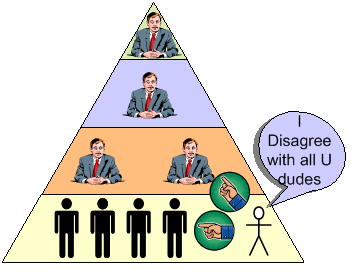 So, how about U? Are U capable of expressing, with or without equanimity, opinions that differ from your social environment? If not, why not? If U do, how do U feel when U take the plunge? Uncomfortable, insecure, isolated? Come on, gimme some feedback here.
Hey Nicky, Please Pass The Culture Sauce
This Inc. Magazine piece, Lessons From a Blue-Collar Millionaire, tells the story of CEO Nick Sarillo and Nick’s Pizza & Pub. Like Tony Hsieh of Zappos.com , Jim Goodnight of the SAS Institute, and Ricardo Semler of Semco, Nick knows that the real key to business success is building a people-centric culture and relentlessly husbanding it so that the second law of thermodynamics doesn’t slowly but surely destroy it.
Here are some snippets from the article followed by comments from the peanut gallery.
In an industry in which annual employee turnover of 200 percent is considered normal, Sarillo’s restaurants lose and replace just 20 percent of their staff members every year. Net operating profit in the industry averages 6.6 percent; Sarillo’s runs about 14 percent and has gone as high as 18 percent. Meanwhile, the 14-year-old company does more volume on a per-unit basis (an average of $3.5 million over the past three years) than nearly all independent pizza restaurants. And customers, it seems, adore the service: On three occasions, waitresses have received tips of $1,000.
The above results clearly show that what Nick’s doing works, no?
Sarillo has built his company’s culture by using a form of management best characterized as “trust and track.” It involves educating employees about what it takes for the company to be successful, then trusting them to act accordingly. The company’s training program is elaborate, rigorous, and ongoing. The alternative is command and control, wherein success is the boss’s responsibility and employees do what the boss says.”Managers trained in command and control think it’s their responsibility to tell people what to do,” Sarillo says. “They like having that power. It gives them their sense of self-worth. But when you manage that way, people see it, and they start waiting for you to tell them what to do. You wind up with too much on your plate, and things fall through the cracks. It’s not efficient or effective. We want all the team members to feel responsible for the company’s success.”
There’s not much to add to the above snippet. I, and countless others much smarter and more eloquent than me, have ranted about the toxicity of dysfunctional CCH corpocracies to no avail. CCHs litter the landscape anf they will continue to do so because of Nick’s quote: “They like having that power. It gives them their sense of self-worth.”
They had someone else put in the numbers, and when the numbers came out wrong, they didn’t dig deeper to discover why. Because they didn’t know the ‘why,’ they couldn’t share it with the team members. When you know the ‘why,’ it’s really easy to figure out what to do, but sharing that kind of information wasn’t how they’d been trained to manage.”
In the above snippet, Nick relates his experience when he mistakenly hired managers with the old “I’m the boss and I don’t do details – I’m better than that” 1920’s mindset.
People who inquire about a job receive a handout detailing the company’s purpose and values. Candidates need four yes votes from three managers to receive an offer. Just one of every 12 applicants to Nick’s gets hired. “I was really surprised by the process,” she says. “You get interviewed twice, and you take a personality test.”
Like other culture-obsessed companies, the interviewing process is key to separating the wheat from the chaff.
- 1 Feel your community’s pain; share its joy
- 2 Hire only A+ players
- 3 Learn, grow, compensate
- 4 Systems are for building trust
- 5 Coach in the moment, not after the fact
- 6 A consultant can be more helpful than you think
- 7 Turn negatives into positives by making talk safe
- 8 “Why” is more important than “what” or “how”
- 9 “Trust” without “track” is an invitation to trouble
- 10 Beware of growing before you — and the company — are ready
The above list represents the 10 key ingredients that Nick uses to drive his business. My faves are numbers 4, 7, 8, and 9. What are yours?

Central Planning
The most visibly confirming event that showcased the fact that “central planning” doesn’t work was the demise of the former Soviet Union. The 5 year plans foisted down on the populace by the politburo big-wigs stifled creativity, innovation, and motivation. In spite of the impeccable planning by those “who knew better“, the country imploded.
Likewise, in corpocracies that are incapable of learning from the past (no matter how compelling the evidence), the same fate awaits. By the time the perfectly infallible strategies and plans from the corpo junta get approved, poured in concrete, and trickled down to the DICforce at rock bottom, they’re mostly useless and obsolete.
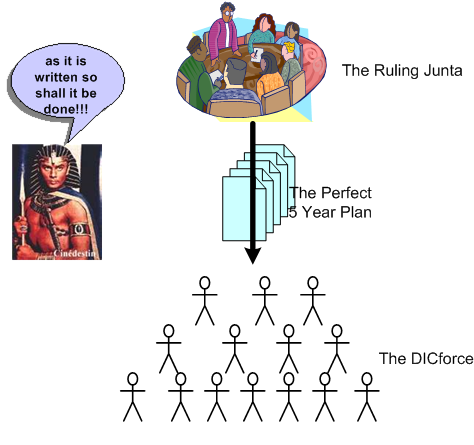
So, what’s a better way? How about generating flexible, multi-year rolling plans that are revisited often? Ricardo Semler uses that method at Semco. How about exposing the plans to the DICforce as they are being developed in real-time so that some insights from a larger pool of brains may be elicited? Got any other ideas?
Waiting
- “I’m waiting for the requirements specification”.
- “I’m waiting for management approval”.
- “I’m waiting for the customer’s answers to my questions”.
- “I’m waiting for QA appproval”.
- “I’m waiting for management to solidify our strategy.”
- “I’m waiting to get a software (or hardware or systems or test) engineer assigned to the project”.
- “I’m waiting for the finance department to open the charge number.”
Yada, yada, yada. On goes the list of pseudo-legitimate excuses for being late and inefficient in bureaucratic corpocracies. When a system is set up so that everything is tightly coupled and each element is highly dependent on everything else, productivity sinks, end-to-end delay increases, and it takes a miracle to get any value added work done. The funny thing is that the dudes in the bozone layer demand continuously increasing productivity while simultaneously allowing their system to deteriorate into an inflexible and intertwined mess of confusion.

Loyal, Or Disloyal?
In virtually every organization comprised of a large group of human beings, one individual or sub-group always holds absolute “power over” the members who hold the “power to” get things done. Because of the innate primal human desire to retain power and remain in control, there’s a dangerous fine line that every “power to” member should be acutely aware of.
On one side of the line is “loyalty”. On the other side is “disloyalty”. Those in charge, of course, are the ultimate arbiters of where you stand in relation to line. I like to straddle the line (see below), but it’s not within my power to judge where I stand.
Note: I borrowed the “power over” and “power to” concepts from Russell Ackoff, a true management genius – that everyone in the mainstream ignores, of course.

Troubleshooter
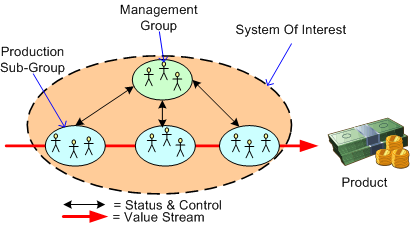
Assume that your company is cruising along and creating high quality products, happy customers, and making money. The drawing below shows this situational bliss – a well oiled machine.
Now assume that something in your previously flawless system has gone bad. Your product quality has tanked, your customers are angry, and your profitability has shrunk. The lightning bolts in the figure below show places of potential dysfunction that are causing and contributing to the mess.
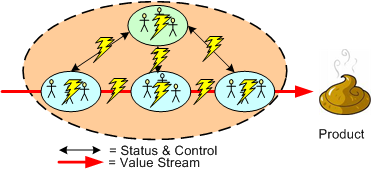
So, how do you figure out what’s gone wrong so that you can fix the stank? Of course, if you’re in the management group, you’ll automatically discard yourself and your brethren as a source of the problem(s). Since you have an agenda to look good and an unshakable self-image of infallibility, you’ll go poking around in all areas and cross-group interfaces except your own.
Since almost all corpo performance problems are the result of bozo management actions and a lack of leadership, one effective way of diagnosing and fixing what ails you is to bring in an objective outside troubleshooter who will tell you the unabashed truth. Alas, since you’ll be sourcing the income for any outside troubleshooter, he/she will most likely milk the job and tell you what you want to hear: you’re not the problem.

Oppose A Thing
“Men often oppose a thing merely because they have had no agency in planning it, or because it may have been planned by those whom they dislike.” – Alexander Hamilton
If you buy into Hamilton’s quote, then you’ll realize that it explains all kinds of irrational behavior at work by those in charge. Another ditty that explains counterproductive behavior and ludicrous decision-making in mediocracies is:
“It’s not what you say, it’s how you say it.”
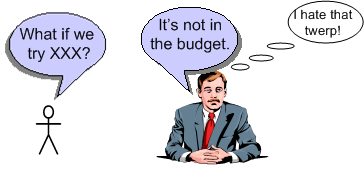
When someone is disliked by, or is brutally honest to those in power, even the best ideas offered up by the perceived villain will be rejected. It doesn’t matter if an idea could potentially save the corpocracy tons of money or bring in new business, the idea will be killed in the cradle. Of course, many kinds of clever camouflage and pseudo-rational reasons will be given for the rejection, but the underlying truth is what Mr. Hamilton stated hundreds of years ago.
Who says that business isn’t personal?

Why am I here?
WTF?
Meh!
D'oh!

My BTC Address



 Bulldozer00's Blog