Archive
Responsibilities And Compensation
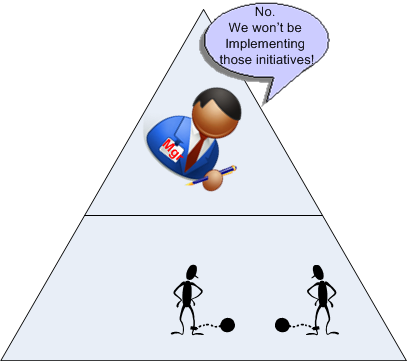
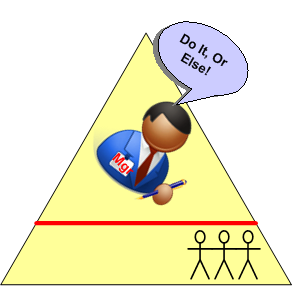
If you’re in the blue box, better shoot for the yellow box ASAP and start accumulating titles (to post on LinkedIn.com) before your compensation curve flattens. Since there are fewer multividual contributors in an org pyramid, by auto-assumption they must be more valuable and deserving, right? Of course, the graphic below is an extreme exaggeration, but how far off the mark do you really think it is?

From Concrete & Objective To Abstract & Subjective
Most companies, because of a UCB-anchored perception of a lack of viable alternatives, institute a digitized, leveled job description policy. Typically, as the level of importance increases up the corpo chain of command, the skills and behaviors and performance required of a candidate transition from concrete and semi-measurably objective, to abstract and unmeasurably-subjective. Even in those rare cases where performance expectations of managers/directors/executives are specified as measurable, it either isn’t measured, or poor performance is well camouflaged in order to keep the high level dudes in their ka-ching penthouse. Thus, at some mysterious and unknown threshold on the curve below, behavior starts trumping merit as one moves upward.

Empowerment Examples
Everyone’s heard of the worn and tired “employee empowerment” exhortation, but does anyone really walk the talk? Here are two specific and quantifiable empowerment examples from the same company. You be the judge.
Example 1 (via Gary Hamel: HCL’s Vineet Nayar on its ‘Management Makeover’ – Gary Hamel’s Management 2.0 – WSJ):
For example, our annual planning process for FY 2010 included a review of business plans for HCL customer accounts not only by top management but by 8,000 people throughout the organization. Under the program, dubbed My Blueprint, the plans were available on a portal where customer-facing employees, who would be charged with implementing those plans, could comment on them. This produced a flood of feedback and prompted the re-engineering of several plans.
Example 2 (via The world’s most modern management – In India):
Every employee rates their boss, their boss’ boss, and any three other company managers they choose, on 18 questions using a 1-5 scale. Such 360-degree evaluations are not uncommon, but at HCL all results are posted online for every employee to see.
Real-Time, Face-To-Face
Criticism is something we can avoid easily by saying nothing, doing nothing, and being nothing. – Aristotle
Ain’t that the truth? You can’t relate to it because you keep your trap shut out of fear of reprisal, no? Don’t worry, you’re not alone. Gracefully giving and (especially) receiving criticism in real-time, face-to-face is an art that I haven’t mastered. In those rare cases where I’m giving or receiving, either I’m meekly submissive or I blow a gasket; mostly the latter. Unlike when I’m blogging or e-mailing (a.k.a hiding behind the keyboard like a lot of engineers do), I’m too spontaneous to ponder, agonize over, and cunningly strategize over every word.
In corpricracies, criticism (real-time and face-to-face, or electronically) directed upward from the boys and girls down in the boiler room is verboten via one of the many rules written in invisible corpo ink, no? If not, then what purpose does the invention of anointed titles and structured CCH caste systems serve? What’s the purpose of the term “individual contributor” other than to divide and conquer? What’s the purpose of statements that start with “Effective immediately, management has decided…” other than to subtlely imply who’s allowed to criticize whom? How often do conquerees criticize conquerers, and when they miraculously do decide to profer some criticism, what’s the typical outcome? A subtle, unseen, but intensely felt top down psychological whuppin’?
On the bright side, at least civilization has “matured” from the time when the messenger who served up a pu pu platter was literally beheaded, no?

“The problem with any unwritten law is that you don’t know where to go to erase it.” – Glaser and Way
Stylistic Versatility
Except for his interviews with several famous people that were involved in the development of successful software systems, consuming Sam Lightstone’s “Making It Big In Software” didn’t do a whole lot for me. However, when he wasn’t writing like a know-it-all patriarch, Sam did provide several nuggets of wisdom to absorb. One of those nuggets was the disclosure of Hay & McBer’s 6 leadership styles as uncovered via a study of 3,871 executives. For your convenience (uh, actually my convenience), I’ve copied and pasted the leadership style table below.
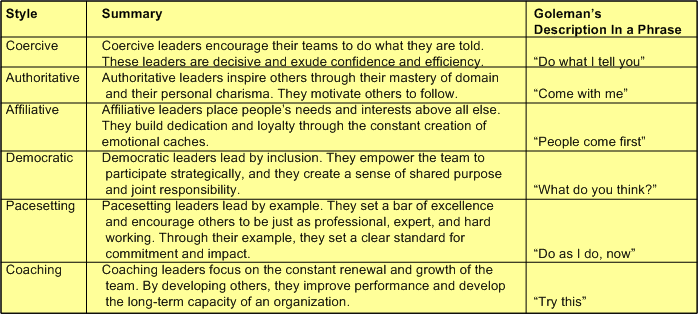
Lightstone rightly says that the versatile leader (and how many versatile, multidimensional leaders do you know?) applies the right style at the right time:
- Use coercion only in crises situations
- Use authority when charting a new course
- Use affiliation to heal a team
- Use democracy for collaboration
- Use pacesetting for sprints
- Use coaching for improvement
Regarding effectiveness of style, Lightstone writes:
Although each style has its pros and cons, (Daniel) Goleman’s article citing the Hay and McBer research found that the coercive and pacesetting styles have the most negative impact on an organizations. Nobody likes to be bullied, and the hallmark of a coercive style is a dictatorial approach. Pacesetting styles force employees to run at a pace that might not be comfortable or sustainable for them.
I think that BOOGLs, BUTTs, and CGHs, of which there are many, are one dimensional SCOLs who apply the only style they know, coercion, in all situations. These one-trick-pony dudes and dudettes either don’t believe the other five styles exist, or they don’t utilize the styles because they’re expected to be “in control” at all times by the toxic culture that pervades the corpricracy.
I’m not a leader, so I don’t/can’t practice applying any of the Hay & McBer styles. How about you? Are you a versatile leader, or are you a culturally conditioned control freak?
Priority List
In his brilliant and elegant essay, “Capitalism is Dead. Long Live Capitalism“, Gary Hamel laments about the deterioration of capitalism into those other bad, highly inequitable, anti-American “isms”. He says:
So why do fewer than four out of ten consumers in the developed world believe that large corporations make a “somewhat” or “generally” positive contribution to society? Why is it that only 19% of Americans tell pollsters they have “quite a lot” or a “great deal” of confidence in big business?
In Gary’s opinion, the reason is……
… the unwillingness of executives to confront the changing expectations of their stakeholders. In recent years, consumers and citizens have become increasingly disgruntled with the implicit contract that governs the rights and obligations of society’s most powerful economic actors—large corporations. To many, the bargain seems one-sided—it’s worked well for CEOs and shareholders, but not so well for everyone else.
This lead-in dovetails into the idea of a “CEO stakeholder priority list“. The UML class diagram below shows six types of corpo stakeholders. Of course, the six types were arbitrarily picked by me and there may be others on the same level of abstraction that you think are missing. Notice that the “earth” is a passive stakeholder that can’t directly and instantaneously exert pressure on the way corpricracies behave; unlike the other people-type stakeholders.

Now, check out some sample CEO stakeholder priority lists below. With 6 stakeholders types, the number of unique lists is quite a lot: 6! = 6 x 5 x 4 x 3 x 2 = 720. I just semi-randomly concocted these three specific sample lists so that I can continue babbling on while hoping that you’re still reading my drivel.
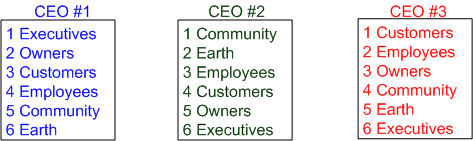
My own unscholarly opinion is that the vast majority of CEOs, their appointed-yes-men VP teams, and their hand picked boards of directors either consciously or unconsciously operate according to the blue list (or any other instance that prioritizes the “executives” stakeholder first). My opinion aligns with Mr. Hamel’s assertion that too many corpo captains are making decisions that materially favor themselves (first) and their shareholders while disproportionately harming the other stakeholder types.
But wait, hasn’t this always been the case with capitalism? If so, why has it suddenly become fashionable for dweebs like me to vilify corpricracies that operate in accordance with the blue list?
In closing, I feel the need to repeat the best quote in Hamel’s blarticle:
There are CEOs who still cling to the belief that a company is first and foremost an economic entity rather than a social one. – Gary Hamel
To those CEOs who still think that the word “social” equates to communism, get over it and move into this century.
The DORK Is Born
Unlike upstanding citizens, I’m both internally and externally verbally weird. For example, I think that when a proven, in-the-trenches, problem-solving, core worker jumps ship to another org it often hurts a corpricracy more than when a BM, CCRAT, BUTT, CGH or other non-DORK leaves. Because of anointed (not necessarily earned) positional power, non-DORK managerial workers are given the opportunity to positively influence an org’s social and economic performance. However, as all of us know, not all managers exert any positive influence at all. Au contraire, the really “bad ones” just flit from meeting to meeting conjuring up innovative procedural and financial obstacles to getting work done while simultaneously collecting super-sized paychecks. Who says managers aren’t innovative?
Because of this so-called distorted (and “bad”?) attitude, it makes me laugh when I hear of frantic counter offers being made when non-DORK managers leave, while nary a whisper is uttered when a highly productive, problem solving DORK rides off into the sunset. I laugh even more heartily when a non-DORK SCOL is presented with a going away cake or even better; an org-financed buh-bye party. Why laugh? Because the alternatives are much less palatable.
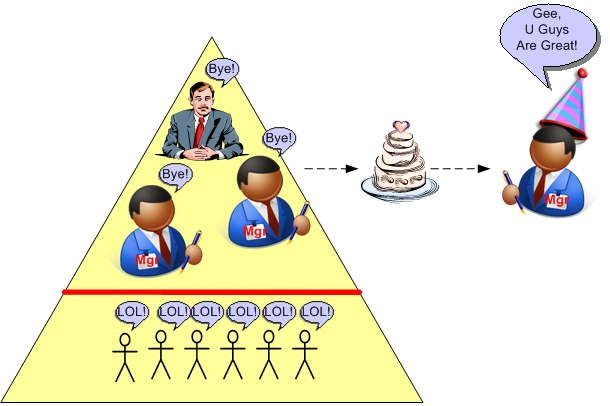
Breaking News: One of the byproducts of writing this stupidly RUU blarticle was the emergence of the “DORK” acronym from the bad-person corner of my psyche. I’m giddy with excitement cuz now I can interchange usage of the venerable “DIC” acronym with “DORK” in my future ramblings. Whoo Hoo, a landmark event!
Tribal Leadership
In “Tribal Leadership” (the audio version of the book is downloadable for free here), the authors summarize the results of their ten-year, 24,000 person research. Their tag line is: “Birds flock, fish school, and people tribe“. As a result of their experience, they’ve categorized organizational cultures into five “staged” types based on the general attitude of tribe participants.
The figure below and its accompanying annotations show my understanding of the TL authors’ message.

Notice that as one moves up the scale, the focus shifts from “me” to “we” and “all“. That’s why the authors assert that an epiphany is required to make the leap from stage 3 to stage 4. Successful people who are tired and frustrated at playing the dog-eat-dog game against other individuals at stage 3 shed their “it’s all about me” mindset and transform into sharers and effective catalysts for group advancement. Books and articles of techniques and tips for getting ahead, a multi-billion dollar industry targeted at the Donald Trump wannabes of the world, instantaneously become useless and irrelevant to stage 4 leaders. Those books and articles that concentrate on platitudes, community, and inspiration, formerly considered to be useless new age drivel, take on new meaning and serve as guidance for stage 4 leaders.
Reflecting on my behaviors and modus operandi over the years, I’m seemingly stuck in the isolationist world of stage 3 and impatiently waiting for the epiphany. How about you? Where are you, and are you at peace with your position?
Union Deterioration
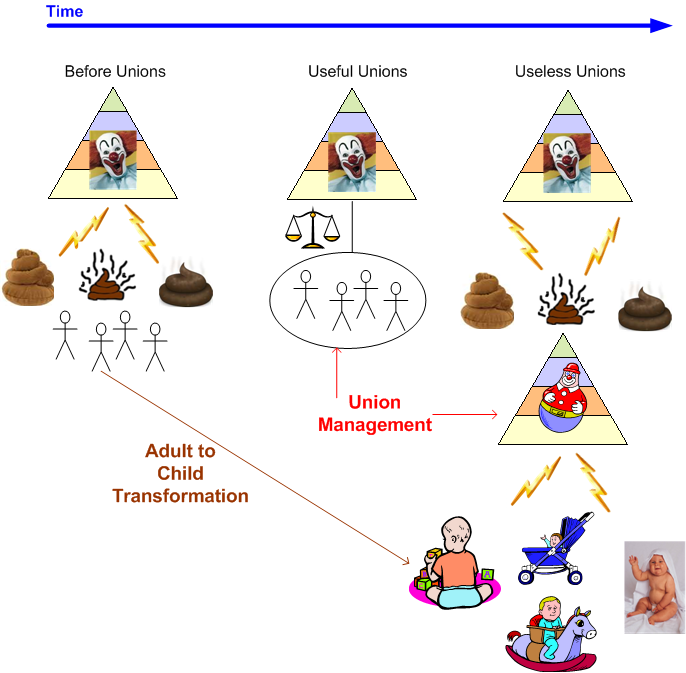
It took me forever to concoct this dorky picture, so I’m not gonna try to ‘splain it with any accompanying words. Hopefully, you’ll understand my message. If you need clarification on my interpretation, please ask.
Cows And Babies
From The End of Management – WSJ.com:
“Corporations, whose leaders portray themselves as champions of the free market, were in fact created to circumvent that market.”
“In the relatively simple world of 1776, when Adam Smith wrote his classic “Wealth of Nations,” the enlightened self-interest of individuals contracting separately with each other was sufficient to ensure economic progress. But 100 years later, the industrial revolution made Mr. Smith’s vision seem quaint.”
“In recent years, however, most of the greatest management stories have been not triumphs of the corporation, but triumphs over the corporation.”
“The best corporate managers have become, in a sense, enemies of the corporation.”
“Corporations are bureaucracies and managers are bureaucrats. Their fundamental tendency is toward self-perpetuation. They were designed and tasked, not with reinforcing market forces, but with supplanting and even resisting the market.”
“The thing that limits us,” he (Gary Hamel) admits, “is that we are extraordinarily familiar with the old model, but the new model, we haven’t even seen yet.”
Alas, many smart people have been predicting the demise of mechanistic, coercive, command and control hierarchies for decades. But like Tom Peters said in a semi-recent tweet:

Looking on the bright side, since the herd will be practicing self-serving hierarchy till kingdom come, if you split with the cows and truly install a decentralized participative meritocracy that leverages all of the creative brains in your org instead of treating them like children, then you’ll kick ass. But, uh, how do you do that? Hah, the devil’s in the delicious details. I certainly don’t know how – I’m just a standard, run ‘o the mill RUU DIC.


Why am I here?
WTF?
Meh!
D'oh!

My BTC Address



 Bulldozer00's Blog