Archive
Bowling For BMs
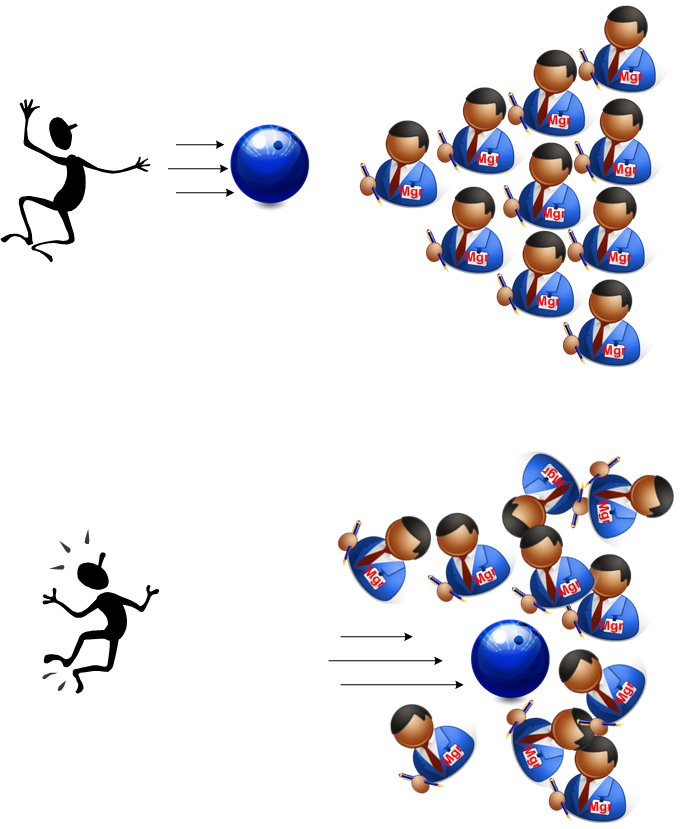 Don’t know what BM means? Check out readme.txt.
Colored Thinking
In his short and pithy “Six Thinking Hats” book, Edward De Bono describes his structured, but diverse, problem solving method for groups of people who are wrestling with an issue. The picture below summarizes Edward’s six thinking hat colors and the modes of thinking that they represent.

Armed with an understanding of the six thinking hats method, the idea is that a group led by a blue hat facilitator could collectively switch colors and express aligned thinking to explore all aspects of an issue/problem/decision under discussion. The good thing about Mr. De Bono’s method is that it is down-to-earth; it’s easily and quickly learned. It’s not anchored in the latest management jargon du jour and you don’t have to attend a 40 hour elitist university MBA course to absorb the subject matter.
The figure below models a typical six thinking hats use case. The group gathering is framed by “blue hat” thinking book ends. At the start of the discussion, the blue hat wearer (usually the meeting instigator) frames and bounds the gathering with answers to the “why we are here” and “what we’re trying to do” questions. Next, under the fluid direction of the blue hat wearing dude, the group iterates on the issue by collectively switching modes of thinking when deemed necessary. Finally, the blue hat director ends the gathering with the answer to the “what we accomplished here” question – which may or may not be nothing. Simple and doable, no?

By applying the six hats thinking method, the hope is that the mold will be broken on the same-old, same-old, rudderless, alpha-dominated, black-hat-only, egofestive modus of operandi that takes place everywhere in command and control hierarchies across the land:

So, what do you think? Substance or snake oil? If substance, would you try to promote the six thinking hats method in your org? If you think the method has potential but you won’t step up to champion it………. why not?
Successful Dictatorship
I’m intrigued by, and respectful of, enigmatic guys like Steve Jobs. Despite reports of being an explosive control freak and a micro-manager, he continuously inspires his troops to greater heights. John Sculley, the CEO at Apple Inc. before Jobs seized the reins, gives a fascinating interview about his time at Apple and working with Mr. Jobs in this blarticle: “John Sculley On Steve Jobs“.
On the dogmatic “the customer is always right” theme:
He (Jobs) said, “How can I possibly ask somebody what a graphics-based computer ought to be when they have no idea what a graphic based computer is? No one has ever seen one before.”
On bucking the traditional advice to avoid micro-managing your people:
“He (Jobs) was a person of huge vision. But he was also a person that believed in the precise detail of every step. He was methodical and careful about everything — a perfectionist to the end.”
On leadership skills:
“He (Jobs) was extremely charismatic and extremely compelling in getting people to join up with him and he got people to believe in his visions even before the products existed.”
On the “bozo” (lol) issue:
“The other thing about Steve was that he did not respect large organizations. He felt that they were bureaucratic and ineffective. He would basically call them “bozos.” “
On the dogmatic “leaders should remain cool, composed and unemotional at all times (to feign an image of complete self-control)”:
“Steve would shift between being highly charismatic and motivating and getting them excited to feel like they are part of something insanely great. And on the other hand he would be almost merciless in terms of rejecting their work until he felt it had reached the level of perfection that was good enough to go into – in this case, the Macintosh.”
On the natural entropy-driven deterioration of once vibrant orgs into corpricracies:
And you can see today the tremendous problem Sony has had for at least the last 15 years as the digital consumer electronics industry has emerged. They have been totally stove-piped in their organization. The software people don’t talk to the hardware people, who don’t talk to the component people, who don’t talk to the design people. They argue between their organizations and they are big and bureaucratic.
On the “power of less” and beating complexity into submission with simplicity:
He’s a minimalist and constantly reducing things to their simplest level. It’s not simplistic. It’s simplified. Steve is a systems designer. He simplifies complexity.
Being a biased and incorrigibly self-serving bozeltine myself, I cherry-picked this Sculley quote for last to promote my real agenda:
Engineers are far more important than managers at Apple — and designers are at the top of the hierarchy.

Don’t Ask, Don’t Tell
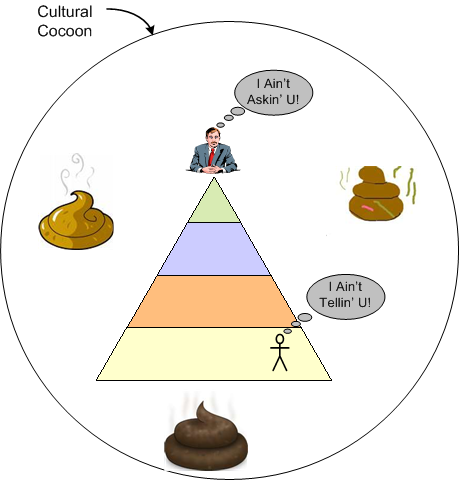
The corpocratic version of the “don’t ask don’t tell” policy is “SCOLs don’t ask what’s wrong, DICs don’t tell what’s wrong“. SCOLs, CGHs, BUTTs, and BOOGLs ensconced in self-images of infallibility don’t need to ask because they always know:
- what’s wrong,
- when it went wrong,
- who’s “responsible” for the wrong.
Likewise, the aforementioned management team always knows how to fix what’s wrong by launching initiatives that “get the job done“. Of course, when you don’t ever establish a baseline or periodically evaluate post-launch progress, initiatives will always be successful and reinforce the image of infallibilty, no? The funny thing is, if SCOLs always know the what, why, and who of dysfunction, how come they didn’t prevent the dysfunction in the first place?
Nested Monarchies
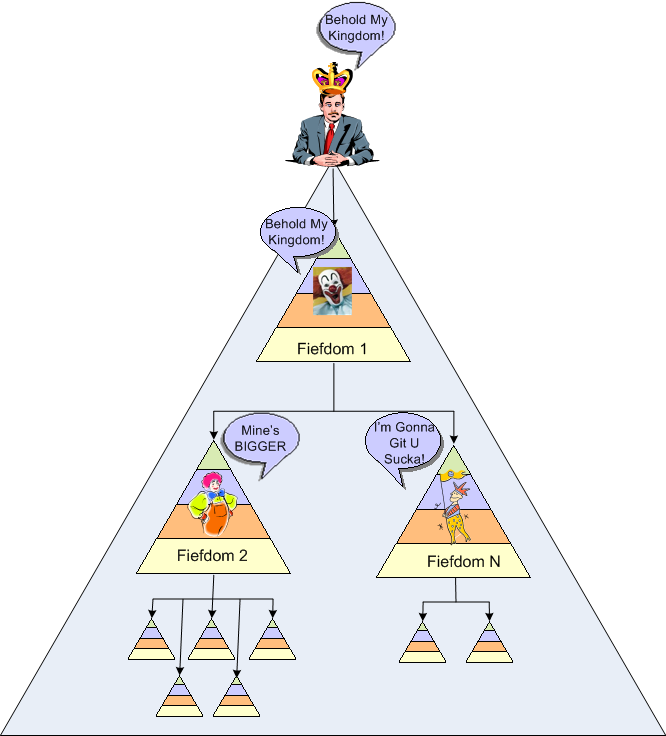
Once again, I’m verklempt, so tawk amongst yourselves. I’ll give you a topic: “nested monarchies”.
Accept And Continue, Or Accept And Change

If you’ve acquired a “bad rep” in a group, regardless of whether you think it’s deserved, it doesn’t matter how you present issues, problems, ideas, or solution options to anyone who perceives you as a “bad” person. Your ideas could have the potential to increase the group’s material or spiritual wealth, but……… fuggedabout getting any help from the “good” people. The “good” people are, by definition, those in positions of power who control the resources of production.
Once you understand the key principle of bad_rep == no_help, the first thing to do is get over any frustration and angst that you have from being “unfairly” adorned (how dare they!) with a scarlet letter. It’s out of your control, bozeltine. The next thing to do is to decide whether:
- to continue on being authentic, reinforcing your “bad rep” perception (if so-be-it) and knowing full well the consequences of your M.O.
- to attempt to force yourself into something you’re not. You know, morph into a “good” person so that the “bad rep” perception slowly dissolves in the minds of other “good” people.
I recommend continuing on and doing your thang as only you can do. You see, once your “bad rep” image gets burned into the UCB of one or more “good” people, it can never be erased. That’s because…… and here comes the usual acronym-laden rant that you may have been waiting for…… “good” BMs, CGH’s, SCOLs and BOOGLs are hoarders. They can add images and perceptions to their UCBs, but since they’re infallible, they are incapable of periodically re-assessing its truthiness and cleaning house. Like the Hotel California, “stuff can check in but it can never leave“.

I hate people who think in terms of “us and them”. You know, people like me. – Bulldozer00
Late Breaking News: After I wrote and queued up this vitriolic post, I discovered that one of my heroes, Scott Berkun, wrote a similar, but much more elegant, less offensive, and insightful one. Check it out here: “How To Keep Your Mouth Shut“, and be sure to watch the classic video snippet he points you to. It’s arguably the best caricature of a BM ever created.
Liked And Respected
Check out this snippet from “Proofiness: The Dark Arts Of Mathematical Deception“. It talks about people lying in the context of being asked questions by pollsters, but it also applies daily in corpricracies everywhere, dontcha think?

It’s an innocent, human-nature-driven, corpo lie-fest: DICs lie to BUTTs; DICs lie to fellow DICs; BUTTs lie to other BUTTs; BUTTs lie to DICs. Got all that?
When a corpo environment is stable, the lying is kept to a minimum. When org stress rises during times of misfortune and financial instability, the lying escalates. Some DICs and BUTTs lie regularly, regardless of org stability. Uh, wait a minute. Maybe it’s just me who lies regularly in my fruitless search for likeability, respectability, honorability, trustability, noblility, integrity, blah-blah-blah; but you don’t.
An arguable, hypothetical case of SCOL-to-SCOL lying is shown below. It’s “arguable” because the repeated, measured shortfalls between planned and actual results could be totally innocent due to market conditions. What do you think the example represents? Lying? Innocent mistakes? Innocent, but culturally forced lying?

How about the example below? What do you think about these results? Can one make a judgment on “data” alone?

A Life Changing Experience?
The article “Undercover Boss’ role opens Republic Airways CEO’s eyes” describes what Republic Airways CEO Bryan Bedford learned while participating on the show “Undercover Boss“. In the show, CEOs go undercover and work on the front lines as a DORK in disguise.

Here’s one thing Mr. Bedford said of his experience:
“What was eye-opening, the most noticeable thing was just the disconnect and (poor) communication between the management team and front-line employees,” Bedford said.
I don’t know what was so eye opening about it. As usual, I just don’t get it. Do you? Do you now understand the meaning of one of the profanely endearing acronyms, CGH, that I often use in this boisterous blog?
Moving on, here’s some more unsurprising (at least to me) commentary :
While working in different roles for the company — including cleaning aircraft, checking baggage, dumping aircraft toilets and standing at the ticket counter — he asked fellow employees why they didn’t take their complaints to management to implore change. The same response came time and time again: “No, I’ve talked to management about this stuff, and they never listen,” Bedford said.
Wow. Huge surprise, no? Why won’t the BMs, BUTTs, and CCRATs in the fatty middle org layers listen to, and act on, DICforce inputs? Because it would require hard work and it could make them look bad. You know, their image of being infallibly in charge might suffer: “Damn the org, it’s all about me and my success“.
“Are you here to build a career or to build an organization?” – Peter Block
I’m almost done with this rant, so bear with me just a couple of more sentences. Summing up his experience, Mr. Bedford relates his epiphany:
When you are actually working side by side and hearing about their struggles, it’s very personal. It’s life-changing. You can never go back to thinking of them as anything other than family.
So, six months from now, after returning to the same-old, same-old business as usual (operating off spreadsheets and powerpoints, communicating solely with his hand picked yes-men junta, caving to pressure from Wall St. and shareholders) do you think Bryan will remember what he said? I hope so, but I doubt it. He’s human just like you and (maybe) me.
How about you? Even if he/she wanted to, would your CEO, or even your immediate manager, be capable of doing your job in order to experience your frustrations at the inefficiency, dysfunction, and red tape that engulfs you?
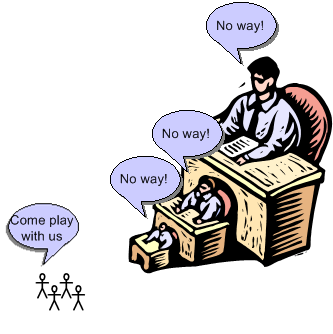
Feedback Insertion
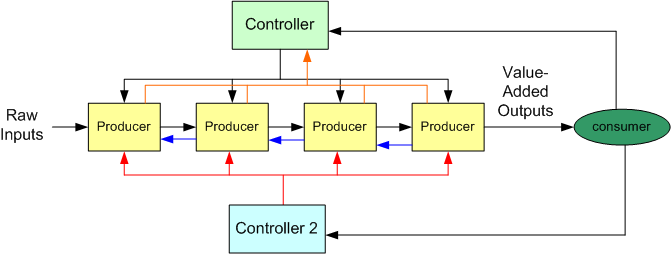
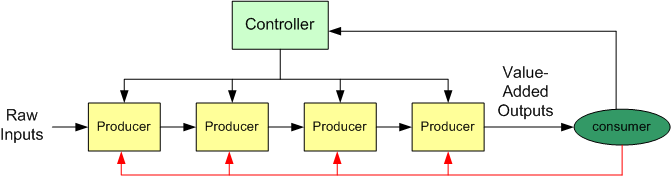
Let’s say that you come up with a great product idea that is both wanted and needed by a large market (ka-ching!). Let’s also say that your product is non-trivial and it requires specialized expertise to produce it from raw inputs to its value-added end state. After mustering up enough courage and scrounging up enough money, you become an entrepreneur – whoo hoo! So, you design the system below, hire the expertise you need, and kick off the enterprise. Of course, you rightly put yourself in the controller position and serve as the system coordinator.
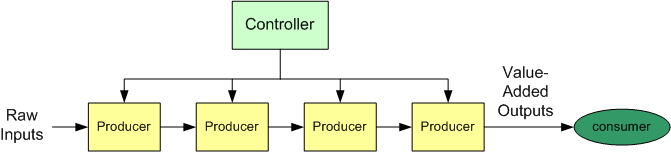
Uh, what’s missing from your design? Does the next picture below help? Still can figure it out?
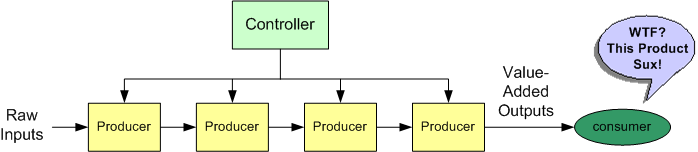
Is feedback missing? Even though your customers need and want and buy your product, how do you know when/if your quality goes down hill and/or your customers want and need new features? Voila! You figure it out and design/install a feedback channel from your customers to you, and only you:
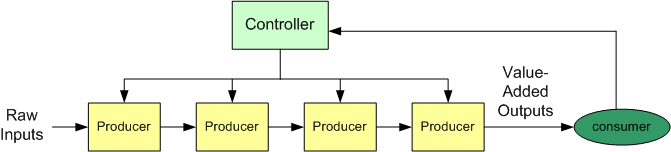
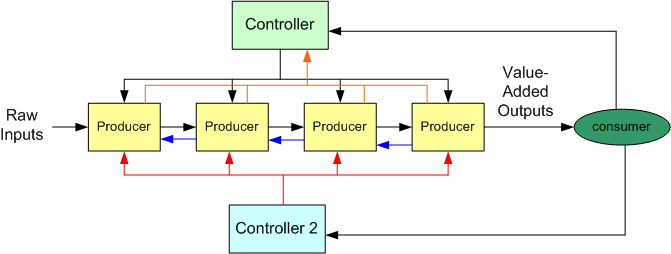
By responsively acting on customer inputs on your new feedback channel, you steer, guide, and direct your team back on track – until the complaints on the feedback channel start rising again. What’s wrong with your system now? Does the system augmentation below answer the question?
Because of increasing product complexity and your lack of in depth knowledge of it, (if you’re not an egomaniacal control freak,) you own up to the possibility that you could be misunderstanding and filtering out some customer feedback and you could be directing your team poorly. Accepting your humility, you set up a second feedback channel from your customers directly to your development team.
Now you’re back on track again – whoo hoo! But wait, something goes awry again and the customer complaint rate starts rising again. Since feedback solved your problems before, you set up additional feedback channels between yourself and your producer team and between your sub-teams:

Will this latest system enhancement work? Hell, I don’t know. Complexity begets complexity. Your increasingly complex system design might implode because of all the communication channels in the system and the fragmentation of contradictory messages that flow at high rates within the channels. If it doesn’t work, you could keep experimenting with changes to fine tune the system for stability and robustness.
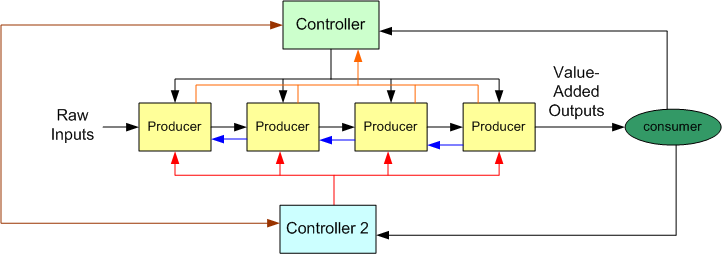
The figure below shows yet another system enhancement possibility – the addition of another controller to ensure that the production sub teams receive coherent and filtered info from your customers. It may work, but it will fail if your second controller issues guidelines, advice, commands, and orders to your production team that contradict yours.
To solve your cross-management problem, you can setup a two way channel between yourself and your second controller to resolve contradictions and ambiguities:
So, what’s the point of this long and boring, multi-picture post? Geez, I don’t know. I wrote it on the fly, in a stream of consciousness with no pre-planned point in mind.
But wait, a possible answer to the question just popped into my head out of nowhere. The point of this post is to keep adapting and trying new things when your external environment keeps changing – which it always will. One thing is for sure: don’t design your operation like the very first picture in this post – open loop. Ensure that feedback channel(s) from your customers are in place and the information that flows on it (them) is acted upon to keep your product in synch with your customers.
Sheesh, I’m finally done!
All Hands Meeting: Open To The Public
Check out this e-mail invite from Zappos.com:
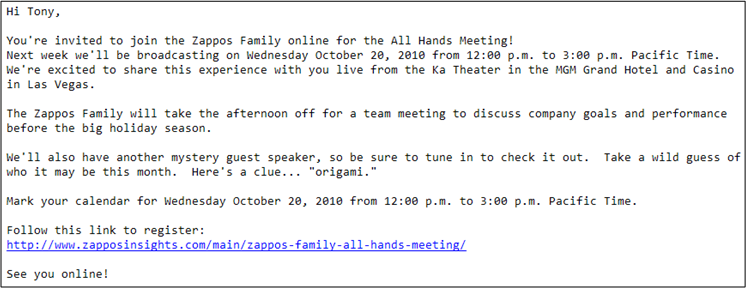
I participated as a cyber-attendee at the previous Zappos.com online all hands meeting. It wasn’t scripted, and some topics were discussed that your grandfather’s company of yesteryear would never air in public. Of course, your grandfather’s company of yesteryear, stuck in its FOSTMA mindset, could never even conceive of the idea of broadcasting an all hands meeting online.
“Few people are capable of expressing with equanimity opinions which differ from the prejudices of their social environment. Most people are even incapable of forming such opinions.” – Albert Einstein
Since clicking on the link in the above graphic won’t work, here’s a clickable signup link: Zappos All Hands Meeting Signup. Attend the meeting if you can and judge for yourself whether or not it’s a pure propaganda play.

Why am I here?
WTF?
Meh!
D'oh!

My BTC Address



 Bulldozer00's Blog