Archive
Directors Of Disasters Wanted
As the title of the following “Directors Are in Demand, Even if Companies Fail” NY Times article states, high paid, do nothing directors who snoozed while the companies they “directed” went right down the tubular chute are still being sought out to “help” corpo survivors prosper.
While in some cases investors are suing members of the boards of the failed companies, shareholder advocates have for the most part focused their energies on other issues. And public outrage over the financial crisis has been mainly focused on the executives in charge of firms like Bear and Lehman.
In many cases during the real estate bubble, directors approved the strategy that paved the way for executives to make risky investments on borrowed money.
In our corporate system the directors are supposed to be in charge, not the C.E.O., yet they rarely get any of the blame because they’re typically dominated by the C.E.O.
The incestuous inbreeding that goes on in the CEO and board of directors stratosphere is so powerful that not even an A-bomb can break the lovefest. Of course, the classic response of board members from failed CCFs (which does have a grain of truth in the unlikely case where they’ve learned something from the failure) is that their hands-on experience will save their new CCFs from suffering the same fate. Uh, OK.

Get Your Beer Here!
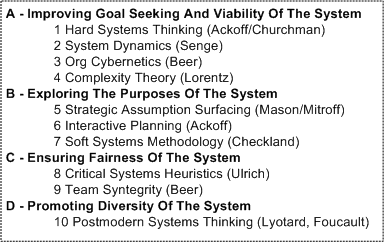
The table below shows a mapping of 10 systems thinking approaches into 4 types based on primary “purpose“. I extracted this table from Michael C. Jackson‘s terrific “Systems Thinking: Creative Holism For Managers“.
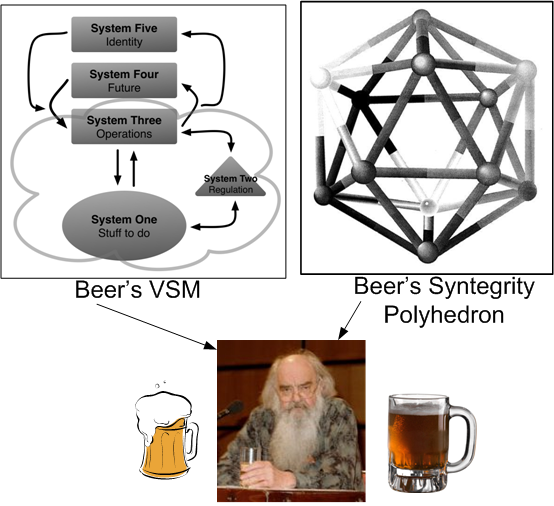
Did you notice that the brilliant Stafford, awesome-last-name, Beer is listed twice and his “Team Syntegrity” approach falls under the “ensuring fairness of the system category“? In Jackson’s opinion, Beer created his cybernetics-based, recursive 5 subsystem, Viable System Model (VSM) for the purpose of improving the goal seeking performance of complex social systems. Beer, both a tasty drink and a staunch anti-hierarchy champion, got so pissed when BMs, BOOGLs, BUTTs, SCOLs and dudes with BFTs interpreted his VSM as just another way of implementing a CCH with omnipotent and omniscient bosses at levels 2-5, that he developed his wildly innovative, polyhedron-based, “Team Syntegrity” approach to ensure fairness in org governance. In his design of the VSM, even though Beer articulated that the sole purpose of subsystems 2-5 is to support the operations of system 1 at the bottom (you know, the DICforce where you and I dwell), people of importance still kept their self-serving UCB blinders on and interpreted his system of management to be hierarchical.
As the figure below shows, the VSM appears to be hierarchical on the surface and, since most (not all) managers operate on the “surface” because they no longer roll up their sleeves to dive into anything difficult to understand, they internalize it as a better way to run their CCH psychic prisons as instruments of domination. However, when one studies Beer’s VSM approach to org management, it’s a self sufficient system of collaboration and intergroup support with each subsystem playing a key role in the holarchy.
Improving, Exploring, Ensuring, Promoting
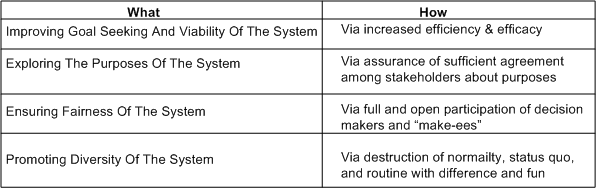
In Michael C. Jackson‘s rich and engrossing “Systems Thinking: Creative Holism For Managers“, Mr. Jackson describes 10 holistic systems thinking approaches designed to solve complex social managerial problems. As the tables below illustrate, Mr. Jackson allocates the approaches to four classes depending on the main purpose of the approach. For example, he asserts that Stafford Beer‘s “Team Syntegrity” approach is employed primarily to ensure fairness during the process of solving a complex social systems problem.
I really like Jackson’s book because of its breadth, vocabulary, and the way he covers each of the 10 systems approaches from its philosophical roots, to theory, to methods. He also supplies a real application example for each approach. In the final part of the book, Jackson integrates all of the approaches into a supra-holistic (?) approach that advocates mixing and matching elements of each approach and tailoring the “Creative Holism” meta-methodology to the specific “mess” at hand.
The last book that I read twice in a row was the brilliant Quantum Enigma by Fred Kuttner and Bruce Rosenblum. I’m gonna do the same with this masterpiece.
Science, Philosophy, Systems Thinking
In Michael C. Jackson‘s rich and engrossing “Systems Thinking: Creative Holism For Managers“, Mr. Jackson describes 10 holistic systems thinking approaches designed to solve complex social managerial problems. As he progressed from the earlier, purely science based, hard-systems thinking approaches to the modern, soft-systems approaches that attempt to fuse science with philosophy, I composed the two pictures below to help clarify my understanding. As usual, I felt an internal urge to externally express my discombobulated thoughts on the topic; so here are the pics.
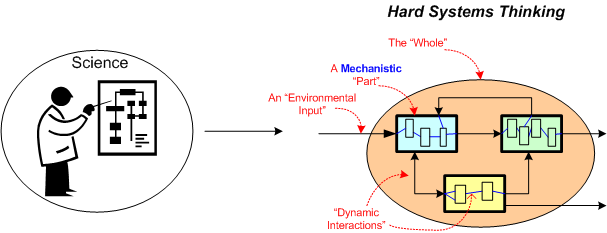
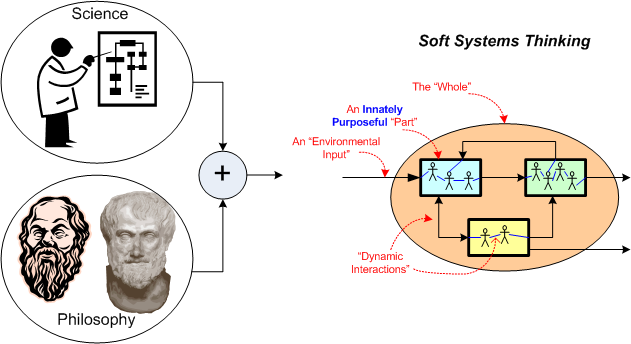 The main distinguishing difference that I see between the hard/soft models is the way that internal system “parts” are characterized. In the hard systems approaches, the system parts are conveniently assumed to have no self-purposes. This, as some people know from experience, is a horribly wrong assumption for systems composed of individual persons – social organizations.
Social org BOOGLs, SCOLs, and BUTTs are forever mired in the hard systems thinking mindset of yesteryear. Their simplistic solution for suppressing any externalization of self-purpose that is at odds with their own is to either consciously or unconsciously apply force to extinguish it. History has shown that this ubiquitously applied technique works – temporarily.
Is This A CEO Talking?
From Who’ll Catalyze Change: Us or Them? – Harvard Business Review, HCL Technologies CEO Vineet Nayar says:
We at HCL have embraced a philosophy that’s based on an inversion of the management pyramid, with managers becoming as responsible to employees as employees are to managers.
Vineet’s joking, right? Nah, he’s fibbing to cover up the reality that he rules with a Stalinistic iron fist at HCL, no? This joker follows up with an even bigger whopper:
Too many people caution us about acting on instinct and conviction. But we must surround ourselves with employees that dare to try new things in new ways. They may not achieve perfect results, but if they focus on getting better each day with one more attempt, they will solve many problems that appear unsolvable.
Acting on “instinct and conviction” and not on objectively measured scientific “proof” (that really camouflages subjective, random, self-serving, opinion)? WTF? This Vineet dude needs to be cast out of the guild of management and “put in his place“, no?

In The “Old Days”
In the “old days”, when companies fell upon hard times and had to let some DICs go, or when the DICforce went on strike, jobs were mechanized enough so that managers could fill the holes and keep the joint running until the situation improved. Of course, in most orgs, that is no longer true today since most managers, certainly those that are BMs, shed and conveniently forget their lowly “worker’s skills” as soon as they are promoted out of the cellar into the clique of elites. Thus, a company that cuts front line DICs without cutting some managers puts itself into a deeper grave. Not only does productivity go down because the holes of work expertise go unfilled, but the overhead cost rises because the same number of managers are left to “supervise” fewer DICs. On the other hand, if all or most of the jettisoned DICs were dead weight, the previous sentence may not be true – unless dead weight BMs were retained. But hey, in the minds of most managers (and all of those who fall into the BM category), fellow comrade managers are not dead weight.
 Update: Shortly after I queued this post up for publication, a friend(?) serendipitously sent me this link: Lockheed Martin press release. Notice the “delay” that took place from the time they shed 10000 DICs to the time they offered some 600 BOOGLs, CGHs, and SCOLs their (no doubt generous) “Voluntary Executive Separation Program“. Better late than never, right?
The executive reductions will help align the number of senior leaders with the overall decline of about 10,000 in the employee population since the beginning of last year, cut overhead costs and management layers, and increase the Corporation’s speed and agility in meeting commitments.
Nice corpo jargon, no?
I Found Another Gem
Whoo hoo! I’ve stumbled upon another rare gem in a massive pile of ugly rocks. As the graphic below shows, I’ve added HCL Technologies to my list of favorite companies. Led by their visionary CEO, Vineet Nayar, HCL is one of the few models for successful companies of the future. Since the vast majority of corpo Executive Teams are stuck in the mechanistic Sloan/Taylor mindset of the 1900s with no intention of changing the way they manage, err, impose control, it’s always refreshing and exciting to discover a new game changer.

So, how do I decide whether a company is a cut above the rest? Via subjective evaluation of external observations, of course. Financial performance, which is of course important, is of secondary concern. Here’s my unscientific list of “research” methods:
* Read third party accounts of experience given by former and current non-management employees.
* Read, listen, and watch interviews with CEOs and executives.
* Scour publicly available mission statements, visions, core values and cultural descriptions for authenticity, lack of corpo jargon, and attention to detail.
* Stay away from glossy annual reports – which are all clones of each other.
* Ignore whatever the hand picked company spokesperson(s) say – propaganda city.
Of course, my methods aren’t perfect, but do you know of any better ones?
Related Articles
- Why HCL Technologies puts employees ahead of customers (tech.fortune.cnn.com)
- HCL Technologies Annual Revenues up 24.1 % YoY; Quarterly Revenues up by 21.5% YoY and 7.7% Sequentially; Europe Annual Revenues up by 20.6% YoY in FY10 (prnewswire.com)
- Management Innovation: Extreme Management Makeover (petervan.wordpress.com)
- Indian outsourcer HCL Technologies quarterly profit up 6.9 percent to $74M on strong demand (taragana.com)
Two Paths
As a small group of people assembled for a purpose greater than each individual grows, some form of structure is required to prevent chaos from reigning. The top path shows the emergence of a group of integral coordinators while the bottom path shows a traditional, stratified CCH being born.
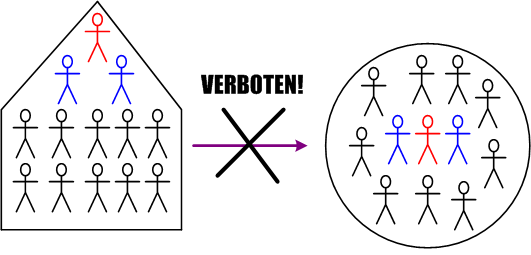
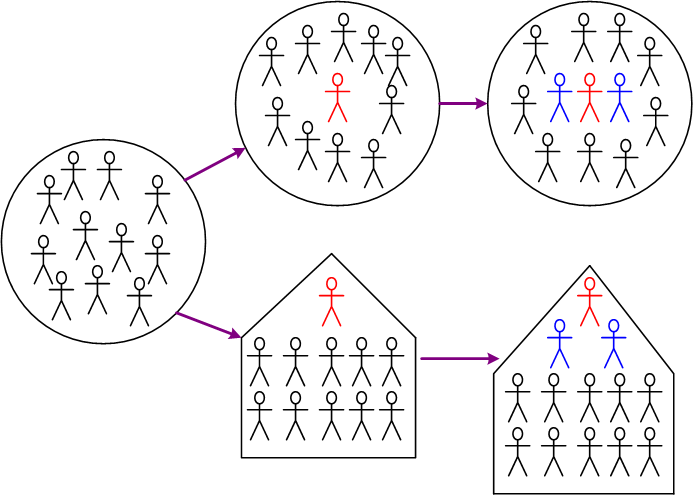 Which group would you rather be a part of? If you say you’d rather be a part of the “circular” group and you’re lucky enough to be a part of one, you’re still likely to get hosed down the road. You see, if your group continues to grow, it will naturally gravitate toward the pyramidal CCH caste system. That is, unless your natural or democratically chosen group leaders don’t morph into CGHs or BOOGLs and they actively prevent the subtle transformation from taking place.
 If you’re currently embedded in a CCH and one of its leaders bravely attempts to change the structure to a circular, participative meritocracy, fugg-ed-aboud-it. The change agent will get crushed by his/her clanthinking BOOGL and SCOL peers, who ironically espouse that they want circular behavior while still preserving the stratified CCH.
Where Is Point A?
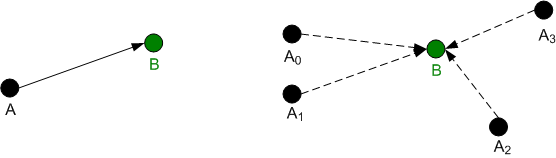
In the “Managing The Unmanageable” techonomy video discussion, HCL Technologies CEO Vineet Nayar says something like: “If your people don’t know where point A is, then they won’t know how to get to point B“. Vineet said this in response to a question regarding the concern that the more transparent your company is, the more your competitors can copy you. Vineet, along with the other two 21st century CEOs on the panel stated that the benefits of transparency far out weigh the risks of “giving away the family jewels“.
Look at the figure below. On the left side, through transparency and continuous full disclosure, your people know where you are (point A) and your people know where you and they want to be in the future (point B). Thus, you and your people can figure out what problems need to be solved and what new actions need to be taken. On the right side of the figure, everyone knows where point B is, but nobody (except for maybe a “select few” high up in the CCH) knows where they’re starting from. Where the frig is point A?
Related Articles
- Techonomy – Managing the Unmanageable: The New Empowered Workforce (nextbigfuture.com)
- Why HCL Technologies puts employees ahead of customers (tech.fortune.cnn.com)
- Techonomy: a new philosophy of progress (petervan.wordpress.com)
Alignment
You can supply your own words for this post…..


Why am I here?
WTF?
Meh!
D'oh!

My BTC Address



 Bulldozer00's Blog