Archive
Patron Saints
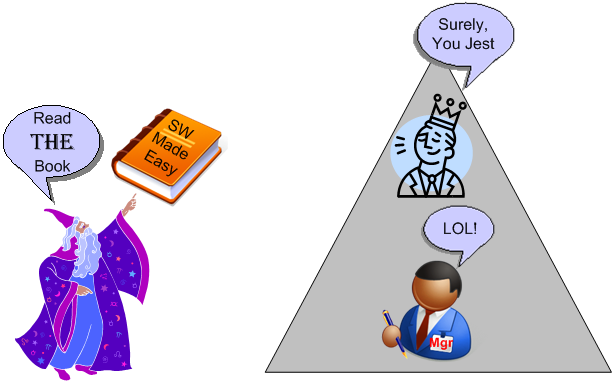
I’m not too fond of books written by experts in a know-it-all, patronizing voice. Check out this blurb from a famous and multi-decorated software management guru:

Besides being targeted at other patronizing know-it-alls by a fellow patronizing know-it-all, one hidden assumption in these words is that “senior executives and managers” actually care about understanding and trying to solve the nasty socio-technical problems that are weaved into the fabric of every large software development project. Another unspoken assumption is that “senior executives and managers“, with their five minute attention spans and disdain for immersive and sustained thinking, would read a whole book – let alone a tome promoting yet another “successful” software development process.
I wish I could follow the sales chart for this book and the hierarchical rankings of those who bought it.
Performance Improvement
ASSume that within the vast lands of a self-described great kingdom, you’re the prince of the little fiefdom below. To keep you comfortably propped up on your throne, the DICforce in each of the 3 little green boxes, under the watchful eye of your enforcer (the faceless BM dude with the white name tag), performs 3 day-to-day functions critical to your, I mean your group’s, “success“. For simplicity, let’s call these functions F1, F2, and F3.

So, everything’s humming along until – BAM! – revenues start declining and costs start rising. D’oh! and WTF? After spending some time down in the puke green boxes and thoroughly observing/investigating/analyzing/evaluating the state of your state, you declare that the performance of the “F2” function is gumming up your well-oiled machine. In your wisdom, you address your minions and boldly proclaim: “F2 Sux!“.
Uh, what change do you decide to make to “improve performance“? One option is to bring in some external “F2 gurus” to train your underperforming F2 DICsters. Another option is to fire your current F2 DICs and permanently hire new, expert, F2 DICs.
After mulling these options over, it hits you like an insight from Gawd…. you’ll hire one expert F2 enforcer dude, give him/her an ego-stroking overhead staff, and move your existing F2 DICsters into his/her newly born sub-fiefdom. So, you implement your brilliant idea and end up with this new borg:
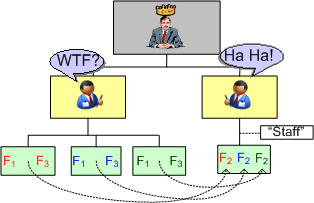
So, besides further fragmenting your borg, increasing your overhead cost structure, pissing off your existing loyal enforcer, and having the same DICsters still supposedly screwing up the F2 function, what else can you pat yourself on the back for?
Gored
In her book, “The Stone Age Company“, author Sally Bibb cites W. L. Gore (which coincidentally is on my list of faves) as one of the exemplar companies that will continue to thrive in an increasingly chaotic future that is sure to be apocalyptic for legions of old guard CLORGs. Sally states that one of the leadership mantras inside Gore is: “Look over your shoulder to make sure someone is following you“. In other words, if people don’t willingly follow you, you won’t be a leader for very long at the company.
Serendipity being what it is, I recently stumbled upon this short essay by W. L. Gore CEO Terri Kelly: No More Heroes: Distributed Leadership. Here’s what Ms. Kelly, in spite of being a real-life CEO, authentically says:
Organizations that hold onto conventional leadership models will find it increasingly difficult to attract and retain top talent.
Leaders will need to recognize that their primary role is to empower others versus build their own power. They will no longer stand behind a title with assumed authority to tell people what to do.
Those who know their leaders best are typically the individuals they lead. If you want individuals to have a voice in the organization, they must also have a voice in selecting and evaluating their leaders.
All associates (at Gore) get the opportunity to rank members of their team, including their leaders. They are asked to create a contribution list in rank order based on who they believe is making the greatest contribution to the success of the enterprise.
Note that followers have a say in who leads them and they evaluate each other and their bosses by perceived contribution – not by rank or status or academic knowledge or “number of years of service”. Now that’s empowerment, no?
So what do you think? Is your company structurally and behaviorally oriented for success in an increasingly networked, complex, and flattened world? Or is it the same old, same old, business as usual….. waiting to get gored to death by competitors who are.

In Memory Of “Chainsaw” Al
ASSume that you’re a member of the infallible leadership team of an impeccable and squeaky clean kingdom like the one shown below. It’s interesting how your “who supervises who” stovepipe chart looks yawningly the same as everyone else’s and yields no clue as to how your borg operates on a day to day basis, no?
Next, assume that everything is cruising along splendidly. The dough is rolling in, everyone feels productive and happy (well, at least you and your cohorts feel that way), and you believe your own rhetoric until — BAM, the fit hits the shan. D’oh!
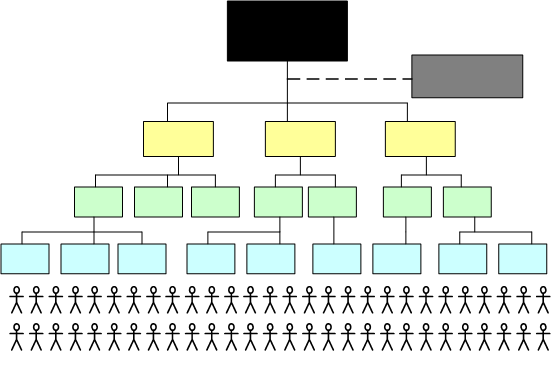 Of course, being a member of the elite and unquestionably infallible team in the penthouse, the crisis was certainly thrust upon you by forces beyond your control. The world suddenly, instantaneously, turned against you in a perfect storm of destruction. Unlike the good times, in which you naturally look in the mirror for the cause of success, in the bad times you conveniently look out the window for the cause of failure.
So, what creative solution do you conjure up to dissolve the crisis? Well, duh, you don your “Chainsaw” Al mask and start hacking away at the roots of your borg while leaving the branches that prop you up into the sky intact….

Whoo hoo, crisis solved! Err…. was it? Can the last remaining method of simplification and a pack of golden parachutes be in the offing?
Hostile, Cruel, And Wasteful
From an interview with C++ creator Bjarne Stroustrup, I give you this:
Corporate practices can be directly hostile to individuals with exceptional skills and initiative in technical matters. I consider such management of technical people cruel and wasteful. – Bjarne Stroustrup
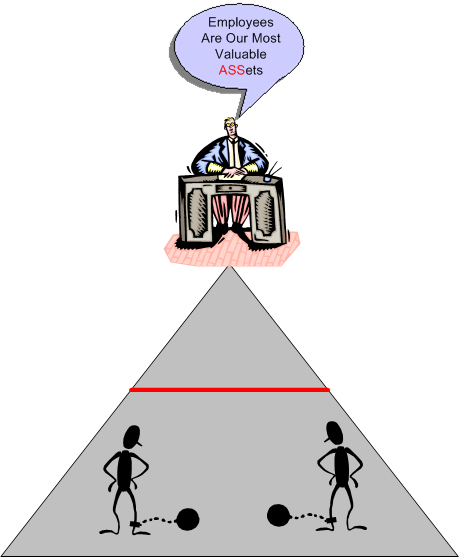
I think this may be the main reason why brilliant technical startup companies are born. In an ironically altruistic twist, the unconsciously idiotic ways in which DYSCO SCOLs treat their best human “resources” (sic) hurt themselves while simultaneously benefiting the world.
Product Team
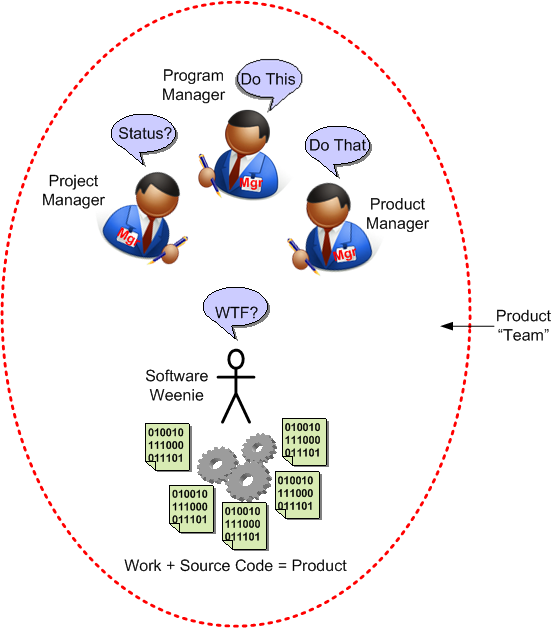
How can a software project have more managers and pseudo-managers “working” on it than developers – you know, those fungible people who write, debug, and test the product code that is the source of the borg’s income. You would think that this comically dysfunctional practice would stick out like a sore thumb and somebody upstairs would put the kabosh on it, no?
Court Jester
Sally Bibb, in her deliciously subversive book, “The Stone Age Company“, states that the executives at British Airways formally appointed a “court jester” to keep their heads out of the clouds and so that they wouldn’t fall victim to their own rhetoric. Kudos to the leadership team at BA.
Sally’s book was published in 2005 (do ya think it sold well?). I wonder if the BA court jester position still exists today and how effective it is/was. I’d love to inteview the CJ(s).

Norm And Dick
Since the main activity of some management chains seems to be preventing deviations from the norm, I propose that all managers change their names to “Norm“. It would complement “DICk” nicely, no?
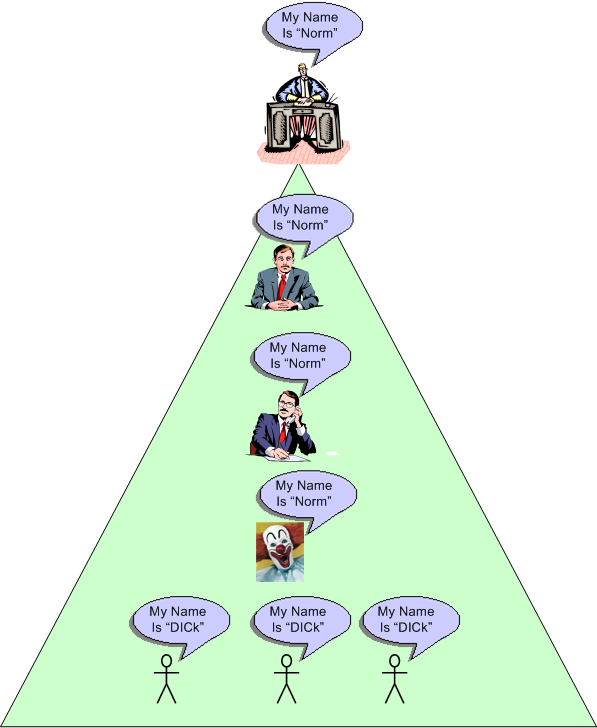
Without deviation from the “Norm“, there can be no progress – Frank Zappa
Team Formation
Assuming all other things equal, which method of forming problem solving teams will produce the best results? Method A, of course. Why? Because Method B has never been tried. Why? Because…. that’s just the way it is – Method A only. Why? Cuz everyone knows, the boss is the smartest dude in the room. Why? Well, just because – dammit!

The led must not be compelled, they must be able to choose their own leader – Albert Einstein
Three Ways
Oh crap! If you think my Rush Limbaugh-like, anti-hierarchical rants are over the top now, they may get “worse” moving forward. I just discovered a small, academic publisher in the U.K. that solely publishes books on alternatives to hierarchical org structures: Triarchy Press. Since books like these are either burned, shunned, or ignored by those they are intended to help, I hope they don’t go out of business.

Have you even ever heard of the “heterarchy” or “autonomous responsibility” alternatives to the hierarchy beast? If not, it shows how firmly entrenched the hierarchical mindset is in most people’s psyches, no?
In one of Triarchy Press’s flagship books, “The Three Ways Of Getting Things Done“, author Gerard Fairtlough postulates that some magic combo of the three legs of triarchy is the most economically efficient and socially redeeming way of achieving org goals.

Hierarchy is so entrenched that a complete replacement, if it does prove desirable, will take centuries. – Gerard Fairtlough
Hierarchy will never go away. Never! – Tom Peters

Why am I here?
WTF?
Meh!
D'oh!

My BTC Address



 Bulldozer00's Blog