Archive
Culture Shift
In the video “Hacking Your Organization“, Lloyd Taylor states that low org productivity is often caused by a mismatch between explicit and implicit culture. When the espoused culture doesn’t align with the actual day-to-day operating culture of an org, people (because they’re not dumb asses) get disillusioned and turned off by the hypocrisy. Hence, it’s only natural that many people will “hang up the phone” and “disconnect & distance” themselves from their work and do what little they can to get by. Of course, the BM hypocrites responsible for keeping the implicit and explicit cultures unsynchronized judge these DICs as lazy under-performers. That’s because there’s no way that they, themselves, can be the catalyst of a disillusioned workforce. In their minds, they’re infallible and whatever they say about the culture is auto-magically true.
Mr. Taylor’s model, and he stresses that it’s just a model, partitions corpo cultures into four archetypes: communal, mercenary, networked, and fragmented. The criteria he uses to diagnose a culture are sociability and solidarity:
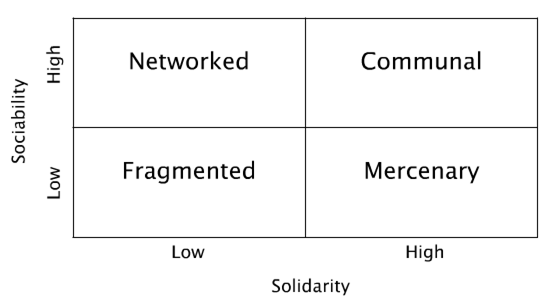 In Lloyd’s view, virtually all startups begin with vibrant communal cultures. As a company grows, because of the physical limitations of the human brain, a cultural shift has to occur at some point:
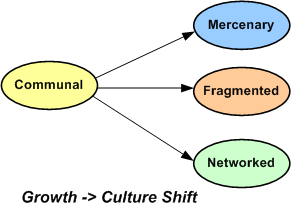
If, during growth, the company’s leaders don’t steer the org toward the culture that they want, or they hard-headedly maintain that their culture is still communal when a shift has occurred, then the implicit-explicit cultural mismatch that triggers low productivity will manifest. Bummer for all involved.
Mr. Taylor stresses that no culture is fully good or bad and that success can be sustained in all four culture types as long as the espoused culture is aligned with the actual culture – especially during cultural shifts. This is possible because each individual will know where they stand and what they need to do to become successful themselves. They can also decide whether they are comfortable operating in the org culture, and when to move on.
The hour long video is highly informative and Mr. Taylor uses all kinds of examples to bolster his theoretical views: Enron, Anderson Consulting, Lehman Brothers, Apple, Zappos.com, Hewlitt Packard, Oracle, etc. Hop on over to InfoQ and check it out if you’re interested in the fascinating topic of group culture.
The BCMT

Print out, copy, distribute, collect, and evaluate. If the results aren’t to your liking, ignore and bury them. Otherwise, toot your horn loudly and frequently.
Culture Convergence?
Many, many articles and books targeted at executives and senior managers spew out all kinds of elixirs, formulas, and lists guaranteed to catapult a business to the top of the heap. For example, take this squeaky clean and slightly redacted list from a book that will remain unnamed.
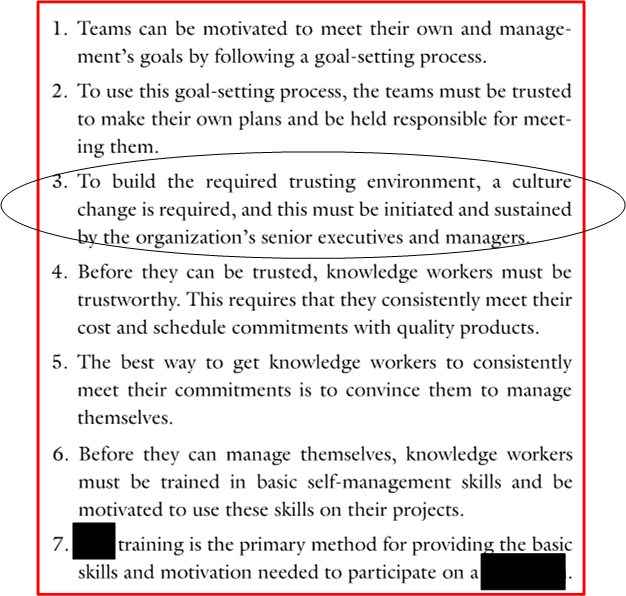
The one common, across the board demand that all these gurus impose on top leadership teams is that “you must change the culture“. The hidden assumption in these words is that one culture exists. Well, does it?…….
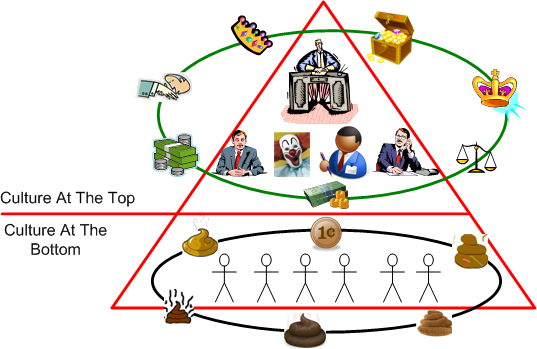
Maybe all these revered business gurus should talk about culture convergence instead of changing “the one culture“…..
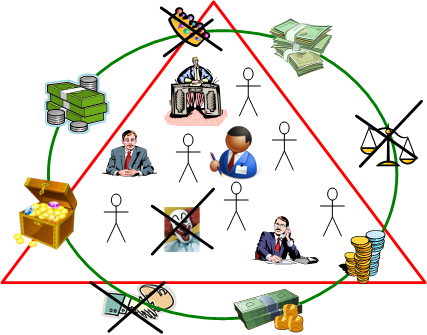
How naive of me to think that there are two or more cultures in an org, no?

Look Ma, No Makeup!
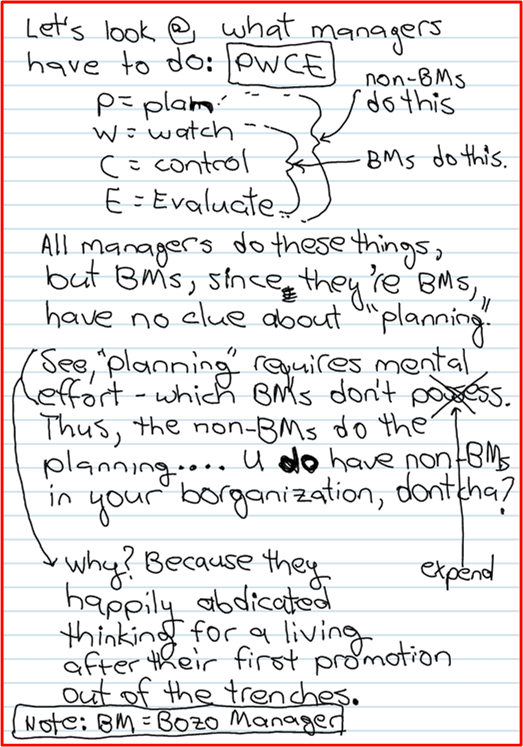
From Livescribe dot-paper directly to blarticle, warts and all:
Chain Of Responsibility
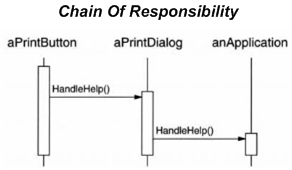
One of the well known design patterns in the object-oriented software world is named “Chain Of Responsibility“. The UML sequence diagram below shows an example of how the software objects in the pattern collaborate with each other in order to ensure that a user initiated help request is handled somewhere in the GUI of an application.
 As you might surmise, the world of hierarchical superiority has an analogous pattern, err anti-pattern, named “Chain Of Irresponsibility“. Do ya think I need to add words to explain the inter-object collaborations for this pattern as shown in the UML sequence diagram that follows?
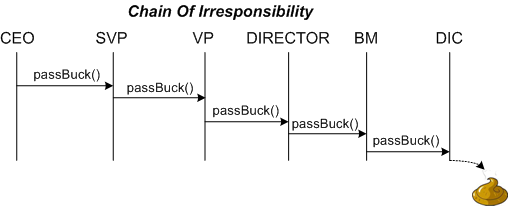
In case you were wondering, S = Senior, BM = Bozo Manager, and DIC = Dweeb In the Cellar.
Exit = Treason, Voice = Mutiny
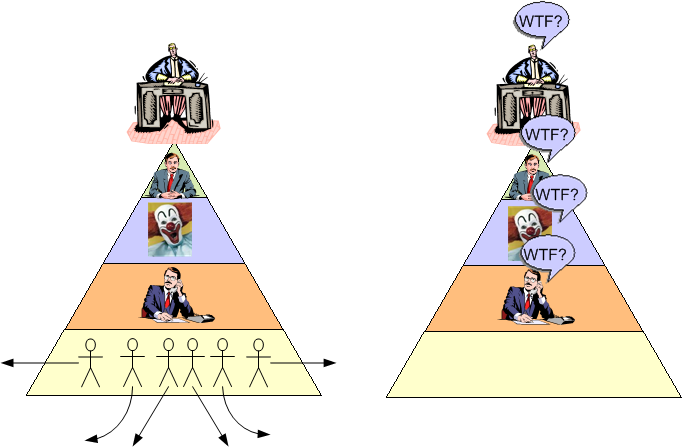
In “Three Ways Of Getting Things Done” (hierarchy, heterarchy, autonomous responsibility), Shell chemicals ex-CEO and Celltech founder Gerard Fairtlough defines the only two ways that subordinates can take action against hierarchies as: exit and voice. Of course, the 2000 year old dictatorial mindset that’s firmly cemented into corpo CGHs everywhere always unconditionally interprets DICster exits as treason and DICster-voiced opinions that counter hierarch-imposed policy, mutiny. The reason: the paternal self-perception of infallibility. If you think you’re perfect, “they” must be traitors and mutineers, no?
In times of institutional stability, when the DIC exit rate is low and the frequency of counter-voice is low, subordinate exits and counter-voices are ignored by the self-proclaimed best and brightest. When the exit and voice rates rise high enough so that their corrosive effects on the corpricracy can’t be ignored any longer, the treason/mutiny interpretation auto-kicks in as a self-medicating defense mechanism – and it’s back to business as usual. Even when the base of the pyramid becomes a hollow and voiceless shell incapable of feeding the ravenous fat cats up the chain of infallibility with spiritual adoration and material wealth, it’s……. still business as usual. In fact, it’s always business as usual until external forces inevitably and surely cause it to become unusual.
Before And After
Networks make organizational culture and politics explicit – Michael Schrage
First there was the industrial revolution, then the information revolution, and now the network revolution. Spontaneous, rapidly forming, and self-organizing networks are popping up everywhere to expose dishonesty, unfairness, and corruption where power is concentrated in the hands of a few self-important fatheads. Look at Wikileaks, the Iranian election, and more recently, Egypt and Tunisia-fish. Networks are slooowly forcing bozeltines, against their gold-plated wills, of course, to behave more honestly and equitably. Who knows, maybe man’s inhumanity to man will be eradicated some day and networks will have played a key role in its demise? Prolly not in my lifetime, but maybe in yours.

Recursive Interpretation
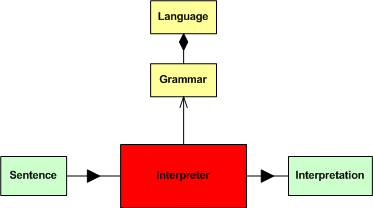
In their classic book, Design Patterns, the GoF defines the intent of the Interpreter pattern as:
Given a language, define a representation for its grammar along with an interpreter that uses the representation to interpret sentences in the language.
For your viewing pleasure, and because it’s what I like to do, I’ve translated (hopefully successfully) the wise words above into the SysML block diagram below.
Moving on, observe the copied-and-pasted pseudo-UML class diagram of the GoF Interpreter design pattern below. In a nutshell, the “client” object builds and initializes the context of the sentence to be interpreted and invokes the interpret() operation – passing a reference to the context (in the form of a syntax tree) down into the concrete “xxxExpression” interpreter objects in a recursive descent so that they can do their piece of the interpretation work and then propagate the results back up the stack.
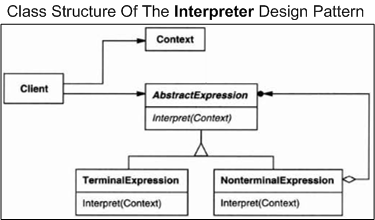
In their writeup of the Interpreter design pattern, the GoF state:
Terminal nodes generally don’t store information about their position in the abstract syntax tree. Parent nodes pass them whatever context they need during interpretation. Hence there is a distinction between shared (intrinsic) state and passed-in (extrinsic) state.
Since the classes in the Interpreter design pattern aren’t thinking, feeling, scheming humans concerned about status and looking good, the collection of collaborating classes do their jobs effectively and efficiently, just like mindless machines should. However, if you try to implement the Interpreter pattern on a project team with human “objects”, fuggedabout it. To start with, the “client” object (i.e. the boss) at the top of the recursion sequence won’t know how to create a coherent sentence or context. Even if the boss does do it, he/she may intentionally or unitentionally withhold the context from the recursion chain and invoke the interpret() operation of the first “XXXExpression” object (i.e. worker) with garbage. When the final interpretation of the garbled sentence is returned to the boss, it’s a new form of useless garbage.
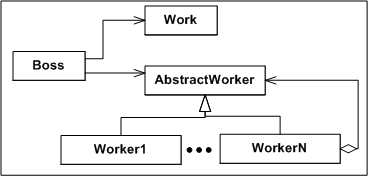
On it’s way down the stack, at any step in the recursive descent, the propagated context can be distorted or trashed on purpose by self-serving intermediate managers and workers. Unlike a software system composed of mindless objects working in lock-step to solve a problem, the chances that the work will be done right, or even defined right, is miniscule in a DYSCO.
Buckshot
Welcome my son, welcome to the machine – Pink Floyd
Is your borg structured like the impending disaster depicted below? Since it’s so ubiquitous, publicly unquestioned, and taken for granted as a “best practice“, the odds are that it is. Note that the products are second class citizens at the bottom of the chart (if they’re even shown at all) and the people supposedly responsible for product integrity are blasted like buckshot across the DYSCO.
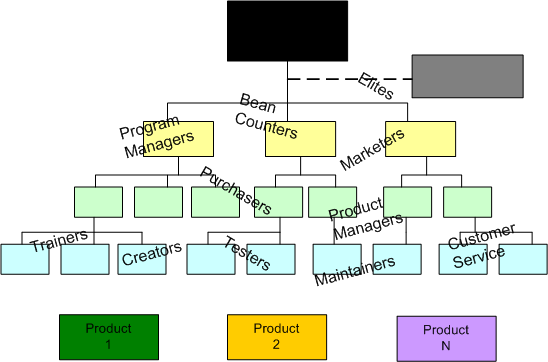
When a self-important SCOL, BOOGL, BUTT, CORKA, or BM is asked to sketch out a model of their beloved borg, you’ll likely get a cookie cutter picture just like it – yawn. In their brainwashed minds, what’s important is who reports to who and who (not what) funds their livelihood. Everybody, including the DICforce, is primarily concerned about who is above and below them in the pecking order. Despite what is espoused, everything else is secondary – especially the real stars in the borg – the product portfolio.
The figure below shows an alternative, flattened, product-centric arrangement highlighted with cross-learning links and dynamic job rotations. How many of these weird animals have you seen? Why not? Is it possible to transform the soulless, stationary borg above into the vibrating pancake below? What would it take? Who could do it? Should it be done?

Over The Wall
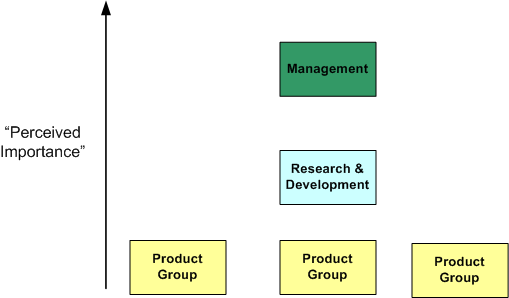
The figure below shows the perceived relative importance of groups in a typical corpricracy. The DICs, because they do the nasty stuff called work, are on the bottom. The R&D staff, because they are academically smarter than the DICsters, are next in line. Management, because….. they are managers, are of the utmost importance. Because of language differences and the entrenched graded scale of importance, there are huge communication gaps between the players in the “system“.
Now that the context has been established, let’s look at the dynamic interactions that take place (if they even do take place) between the R&D and product groups. On the left of the latest dorky Bulldozer00 figure below, we have the classic and ubiquitous “over the wall“, one way anti-pattern of excellence. New product and product enhancement gibberish gets tossed over the barrier and taken out to the trash. Meanwhile, like that liquid metal dude in Terminator II, the once vibrant product line freezes in place and competitors race ahead. Syonara dude.
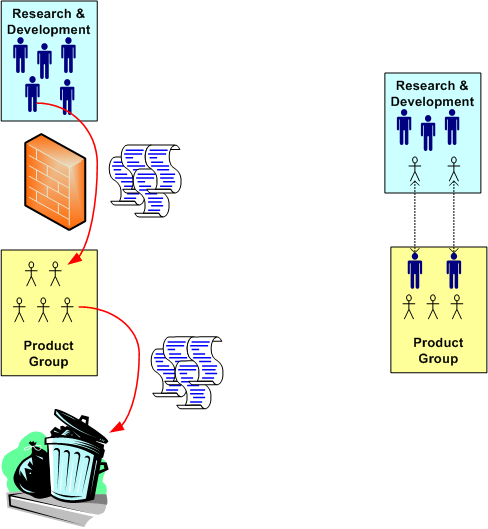
An alternative way of birthing new products and imbuing aging product lines with promising technology enhancements is to temporarily rotate and embed members of the two groups within each other’s sterile environment. Of course, this alternative way of doin’ b’ness is rarely observed in the wild because it would disrupt the pyramid of importance and force members of one guild to learn the language and customs of the other – which is verboten! Meanwhile, Rome burns.

Why am I here?
WTF?
Meh!
D'oh!

My BTC Address



 Bulldozer00's Blog