Archive
Fly On The Wall
Michael “Rands In Repose” Lopp has been one of my heroes for a long time. Here’s one reason why: rands tumbles – Friday Management Therapy. I would have loved to be a fly on the wall at that workshop, wouldn’t you?
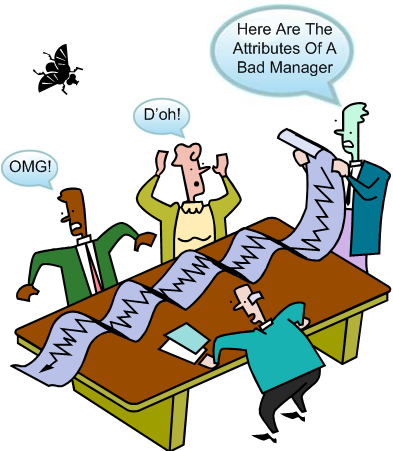
BTW, does anyone know what the”Buzz Kills” attribute means? If you don’t know what I’m talkin’ bout, then you didn’t click on the link and read the list. Shame on you 🙂
The Boundary
Mr. Watts Humphrey‘s final book, titled “Leadership, Teamwork, and Trust: Building a Competitive Software Capability” was recently released and I’ve been reading it online. Since I’m in the front end of the book, before the TSP–PSP crap, I mean “stuff“, is placed into the limelight for sale, I’m enjoying what Watts and co-author James W. Over have written about the 21st century “management of knowledge workers problem“. Knowledge workers manipulate knowledge in the confines of their heads to create new knowledge. Physical laborers manipulate material objects to create new objects. Since, unlike physical work, knowledge work is invisible, Humphrey and Over (rightly) assert that knowledge work can’t be managed by traditional, early 20th century, management methods. In their own words:
Knowledge workers take what is known, and after modifying and extending it, they combine it with other related knowledge to actually create new knowledge. This means they are working at the boundary between what is known and what is unknown. They are extending our total storehouse of knowledge, and in doing so, they are creating economic value. – Watts Humphrey & James W. Over
But Watts and Over seem inconsistent to me (and it’s probably just me). They talk about the boundary ‘tween the known and the unknown, yet they advocate the heavyweight pre-planning of tasks down to the 10 hour level of granularity. When you know in advance that you’ll be spending a large portion of your time exploring and fumbling around in unknown territory, it’s delusional for others who don’t have to do the work themselves to expect you to chunk and pre-plan your tasks in 10 hour increments, no?

Nothing is impossible for the man who doesn’t have to do it himself. – A. H. Weiler
Mangled Model
In their book, “Leadership, Teamwork, and Trust: Building a Competitive Software Capability“, Watts Humphrey and James Over model a typical software project system via the diagram below (note that they have separate Quality Assurance and Test groups and they put the “project office” on top).

Bulldozer00 would have modeled the typical project system like this:

Of course, the immature and childish BD00 model would be “inappropriate” for inclusion into a serious book that assumes impeccable, business-like behavior and maturity emanating from each sub-group. Oh, and the book wouldn’t sell many copies to the deep pocketed audience that it targets. D’oh!
A Free Pass
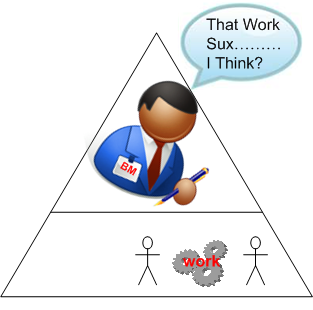
In a culture of blame, and its Siamese twin, fear, any non-manager group member who consistently asks tough questions and points out shoddy, incomplete, ambiguous work becomes a group target for retribution. This defensive peer group behavior is a natural response to redirect attention away from the stank and to squelch criticism. The funny thing is, managers in CCHs are given a free pass to ask tough questions and criticize without fear of retribution. It helps that managers don’t produce any work products that can be scrutinized by DICsters – if they wanted to. Even if managers did pitch in by leading by example, most DICkies wouldn’t point out flaws because of……. fear of downstream retribution.
Ironically, because of the hierarchical mindset ingrained into all members of a DYSCO, and even though bad managers don’t have to worry about being tarred and feathered by the DICforce, most managers at the workface are incapable of asking the tough questions. Watts Humphrey summarizes this managerial shortcoming nicely:
However, as (Peter) Drucker pointed out, managers can’t manage knowledge work. This means that they cannot plan knowledge work, they cannot monitor and track such work, and they cannot determine and report on job status. – Watts Humphrey & James Over
Cultures of blame and fear of retribution go hand in hand with command and control hierarchies like peas and carrots, Jenny and Forrest. To expect otherwise is to be delusional.
Inchies
So, what’s an Inchie? It’s an “INfallibility CHIp“. An Inchie is an invisible, but paradoxically real corpo currency that is the opposite of a demerit. An increasing Inchie stash is required to move up in a corpo caste system. The higher up you are in a CLORG, the more Inchies you have been awarded, and the more infallible you’ve become.
At level 0 down in the basement, you begin the game with 0 Inchies and you start making your moves – climbing the ladder Inchie by Inchie. Be careful and keep watch over your Inchie stash though, cuz your peers will try to steal your Inchies when you’re not looking.
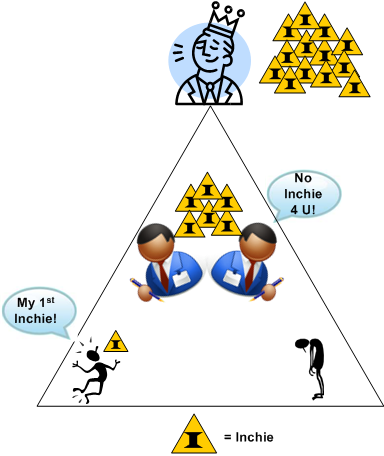 Alas, even though you now know that Inchies exist, don’t get your hopes up. You see, the criteria managers at level N (where N > 0) use for disbursing Inchies down to the less infallible people at level N-1 are random. Even among managers within a given level, the award criteria is arbitrarily different. Plus, to make the game more difficult, the dudes who awarded you your Inchies can take them back whenever they feel the need to “scratch your Inchie” – especially if you piss them off with career ending moves. D’oh!
Once you make it to the top of the pyramid with your big bag o’ Inchies, not only have you amassed the most Inchies in the DYSCO, but you’re given the keys to the Inchie minting machine. This gives you the opportunity to fabricate an unlimited number of Inchies to add to your display case and to sprinkle upon your sycophant crew as you please. You’ve become a 100% infallible god in the DYSCO microcosm. Whoo Hoo and Kuh-nInchie-wah!
Marshal Law
In a time of crisis, some “leadership” experts promote imposing the corpo equivalent of marshal law via the execution of more top-down control and discipline in the form of more frequent, multi-layered, financial reviews and detailed status reporting.
The thinking behind the “more control” approach is that by shining the light more often, and at a higher intensity, on those directly-in-the-soup will cause the crisis to dissolve. Another unquestioned assumption behind the “more control” approach is that the light-shiners will be able to better understand the real problems behind the crisis and offer “helpful” solution idea candidates – inspiring the troops to success.
Sounds great, right? Let’s switch gears, step into the deliciously diabolic role of devil’s advocate, and ask “what’s wrong with this picture?“. Are these thoughts missing:
- those doing the shining may be responsible for the mess in the first place but don’t realize it.
- those doing the shining have been so disconnected from the real world for so long that they are incapable of understanding the problem details well enough to help?
- those being illuminated will batten down the hatches, narrow their thinking, and withhold important information if they think it can be used against them.
Nah, probably not. After all, it’s a no brainer that the best and brightest problem solvers and decision makers sit at the top of the pyramid. If you don’t believe me, simply ask them.
 On the other hand, a different pool of leadership experts promotes the unintuitive loosening of controls and less formality in a time of crisis – to allow more ideas from more people to surface and have a chance of resolving the crisis. Which approach do you think has a better chance of success?
Don’t try to address difficulties by adding more meetings and management. More meetings plus more documentation plus more management does not equal more success. – NASA SW Dev Approach
Boss Building
I recently stumbled upon this interesting NY Times article: “Google’s 8-Point Plan to Help Managers Improve”. Prior to developing their 8-point improvement plan, the management philosophy that propelled Google to superstar status was this:
“For much of its 13-year history, particularly the early years, Google has taken a pretty simple approach to management: Leave people alone. Let the engineers do their stuff. If they become stuck, they’ll ask their bosses, whose deep technical expertise propelled them into management in the first place.”
After collecting inputs from their vast workforce, a Google task force concluded that technical expertise in the management ranks was still important, but it ranked as the lowest priority on their list of desired manager attributes:
… Mr. Bock’s group found that technical expertise — the ability, say, to write computer code in your sleep — ranked dead last among Google’s big eight. What employees valued most were even-keeled bosses who made time for one-on-one meetings, who helped people puzzle through problems by asking questions, not dictating answers, and who took an interest in employees’ lives and careers.
“In the Google context, we’d always believed that to be a manager, particularly on the engineering side, you need to be as deep or deeper a technical expert than the people who work for you,” Mr. Bock says. “It turns out that that’s absolutely the least important thing. It’s important, but pales in comparison. Much more important is just making that connection and being accessible.”
So, let me summarize the management characteristics that Google will value most in the future.
- Being accessible
- Making time for one-on-one meetings and taking an interest in employee’s lives and careers.
- Helping people by asking questions and not dictating answers.
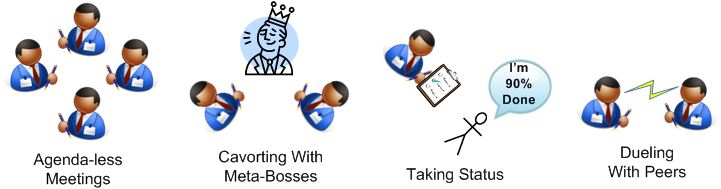
Google’s conclusions weren’t earth shattering, but they’re hard to implement in orgs where bosses spend all of their time going to agenda-less meetings, cavorting with their meta-bosses, taking status from their direct reports, and dueling with their peers, no?
Judgment, Integrity, Credibility, Honesty, And $53M
The often (but not always) incestuous relationship between hand picked corpo board of directors yes-men and CEOs has come to the fore again: “HP orders probe into Hurd’s departure”. Why would Hewlett Packard, as represented by its board of derelicts, I mean directors, investigate their own handling of Hurd’s dismissal? They’re not doing it because it’s the right thing to do. They’re only doing it because they’re being forced to:
“HP’s plan for an outside investigation follows a lawsuit in San Jose, Calif., by shareholders who allege that the company’s directors wasted money by giving Hurd $53 million in severance.”
Yepp, a gift of $53 million to Mr. Hurd for exhibiting:
A profound lack of judgment. It (Hurd’s dismissal) had to do with integrity, it had to do with credibility and it had to do with honesty.” – Mike Holston, HP’s general counsel
After doling out that kind of dough, can’t the same be said about HP’s board? Well, that’s what we may find out after the dust settles. In the meantime, HP’s board may have gotten what they deserved. Mr. Hurd has Madoff nicely by skidaddling over to one of HP’s biggest competitors, Oracle Inc. He and his buddy, Oracle oracle Larry Ellison, sure do know how to make money.
“Mark did a brilliant job at HP and I expect he’ll do even better at Oracle,” said CEO Larry Ellison in a statement.
The real question is: “How isolated are these types of incidents?“. Just because they get reported in the press doesn’t mean that dishonesty runs rampant in the bozone layers of big business. Nevertheless, it begs the question: “Is the taken-for-granted, rarely-questioned process in which CEOs and boards of directors are chosen broken?“. Boards anoint CEOs (who coincidentally are often the chairman of the board) and CEOs nominate board members for election. What do you think of the process? How can it be made better?

Uneducated, Greedy, Fungible, Lazy, Untrustworthy
I enjoy reading Watts Humphrey‘s work, but it’s not because I’m a big fan of his TSP/PSP software development approach. It’s because his writings inspire me to think and inquire. Thus, his writings are full of great blog post seedlings.
In “Leadership, Teamwork, and Trust: Building a Competitive Software Capability“, Watts describes the unquestioned assumptions made by managers regarding workers back in the ole’ days when Frederick Taylor’s scientific management methods were king:
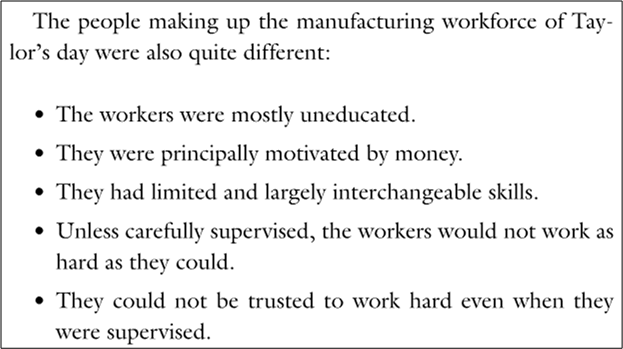
Uneducated, Greedy, Fungible, Lazy, and Untrustworthy – UGFLU. There must not be a vaccine for curing UGFLU because it seems like the affliction has heartily survived 100 years of medical advances. UGFLU is an adaptable and robust little bugger, no?

Taylor’s List
Since his management methods don’t apply to the vast majority of work performed in the 21st century, yet bazillions of managers still cling to them out of cluelessness, I’m constantly ragging against Frederick Winslow Taylor‘s work in this blog (can you say FOSTMA?). However, like all man-made ideas, beliefs, and concepts in the world, it’s not a black and white affair.
In Watts Humphrey‘s final book, “Leadership, Teamwork, and Trust: Building a Competitive Software Capability“, Watts summarizes some less well-publicized tenets of Taylor’s teachings. In the following list, he reproduces Mr. Taylor’s advice to managers:
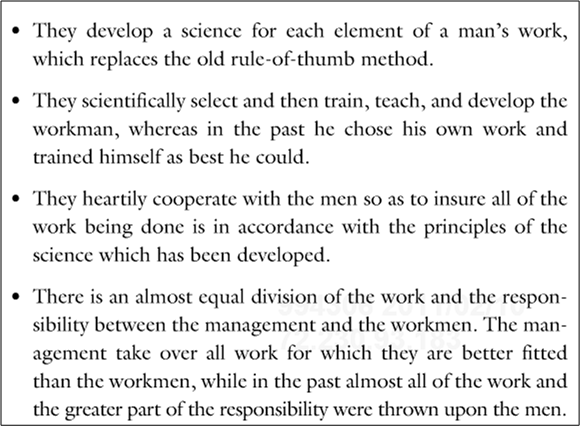
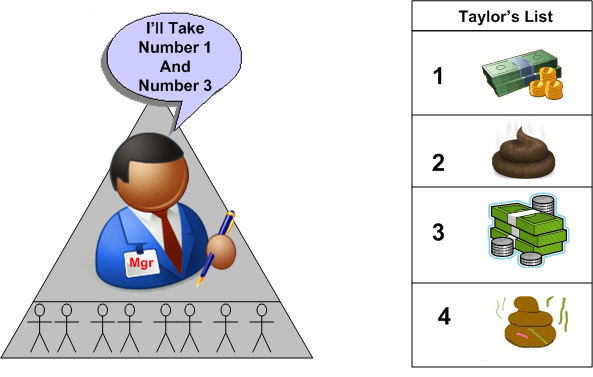
“Heartily cooperate“? “Equal division of work“?”Management takes over all work for which they are better fitted“? WTF? Uh, it seems like Tayloristic managers today (and of course, not all managers fit this bill) have only embraced the non-yucky, self-serving parts of Mr. Taylor’s teaching. They’ve conveniently thrown out the baby with the bath water, no?

Why am I here?
WTF?
Meh!
D'oh!

My BTC Address



 Bulldozer00's Blog