Archive
Stacked Ranking
The title of this post sounds like the stodgy name of some inhumane, BS, corpo process under which “supervisors” evaluate their children, I mean, induhvidual contributors. But wait! It’s the Valve way.
You don’t know who Valve is? Valve is a company that creates massive, multi-player, online games. According to “economist-in-residence“, Yanis Varoufakis, Valve rakes in $1B in revenue even though they have a measly 300 employees. Also, according to Yanis (and their employee handbook), they are totally flat chested. There’s not a single boob, oops, I mean “boss“, in the entire community. D’oh!
The employee handbook spells out the details of the “Stacked Ranking” process, but in summary, peers rate each other once a year according to these four, equally-weighted metrics:
Skill Level/Technical Ability
Productivity/Output
Group Contribution
Product Contribution
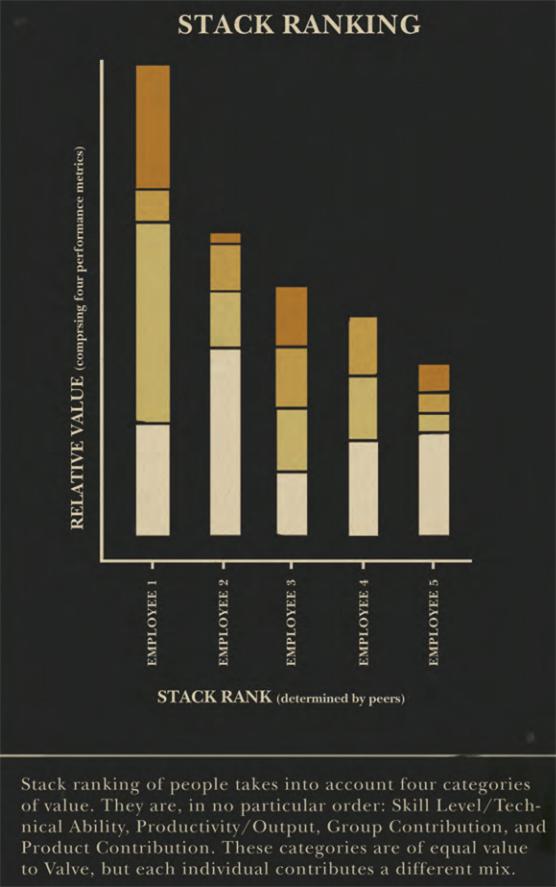
Notice that there’s no long list of patriarchical, corpo-BS ditties like these in the four simple Valve metrics:
- Takes initiative and is a self-starter
- Knows how to acquire resources when needed
- Manages time well
- Knows how to prioritize tasks
- Yada, yada, yada
As you might guess, the stack rankings are used for salary adjustment:
…stack ranking is done in order to gain insight into who’s providing the most value at the company and to thereby adjust each person’s compensation to be commensurate with his or her actual value. Valve pays people very well compared to industry norms. Our profitability per employee is higher than that of Google or Amazon or Microsoft, and we believe strongly that the right thing to do in that case is to put a maximum amount of money back into each employee’s pocket. Valve does not win if you’re paid less than the value you create. Over time, compensation gets adjusted to fit an employee’s internal peer-driven valuation. – The Valve Employee Handbook
Whenever I serendipitously discover jewels in the rough like Valve, SAS Institute, HCL Technologies, Semco, Zappos.com, etc, I always ask myself why they’re rare exceptions to the herd of standard, cookie-cutter corpricracies that dominate the business world. The best answer I can conjure up is this Ackoff-ism:
The only thing harder than starting something new is stopping something old. – Russ Ackoff
But it’s prolly something more pragmatic than that. Since corpo profits seem to keep rising, there is no burning need to change anything, let alone blow up the org and re-design it from scratch to be both socially and financially successful. That would be like asking the king to willingly give up the keys to his kingdom.
“T”, “Hyphen”, And “I” People
In this:
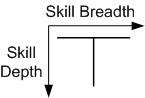
the company talks about “T” people:
We value “T-shaped” people. That is, people who are both generalists (highly skilled at a broad set of valuable things—the top of the T) and also experts (among the best in their field within a narrow discipline—the vertical leg of the T). We often have to pass on people who are very strong generalists without expertise, or vice versa. An expert who is too narrow has difficulty collaborating. A generalist who doesn’t go deep enough in a single area ends up on the margins, not really contributing as an individual.
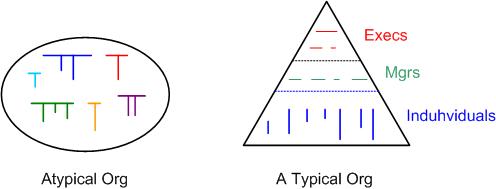
That’s too bad for the typical borg. These beasts actively recruit and develop horizontal “hypen” (mgrs, execs) people and vertical “I” (induhvidual contributors) people. Of course, the stewards of these dinosaurs get what they wish for. On top of that, anybody who tries to self-improve towards a “T” person is silently ignored. It would screw up the nice and tidy employee-in-a-box process of emasculation.
Glad To Be Of Service
Much of my thinking on hierarchy and unconsciously veiled corpo-insanity is founded on the ideas of systems thinkers and cyberneticians like Ackoff, Deming, Beer, Ashby, Wiener, Forrester, Meadows, Senge, Wheatley, Warfield, Bateson, Gall, Powers, etc. But mostly, my dirty thinking is rooted in the life work of William T. Livingston and his most influential mentor, Rudy Starkermann.
Over the years, Bill has always claimed that his work on socio-technical dysfunction may not be right, but it is irrefutable because it is derived from natures laws (mostly thermodynamics and control theory). And in walking his talk, Bill constantly solicits feedback and asks for counterexamples that disprove his theories.

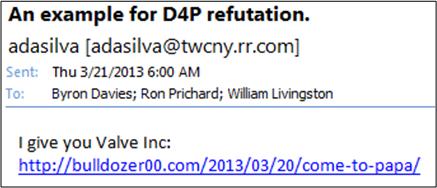
After I discovered and wrote about Valve Inc, I threw this skunk on my friend’s table:
Here’s Bill’s response and my response to his response:
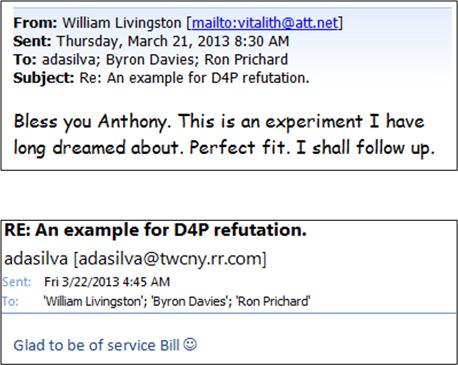
With his approval, which I have no doubt whatsoever that I’ll receive, I’ll try to decode and post the results of Bill’s research when I get it.
Related articles
- D4P Has Been Hatched (bulldozer00.com) ( Download the D4P book for free)
- D4P And D4F (bulldozer00.com)
- D4P4D (bulldozer00.com)
- D4P4D Tweetfest (bulldozer00.com)
Come To Papa!
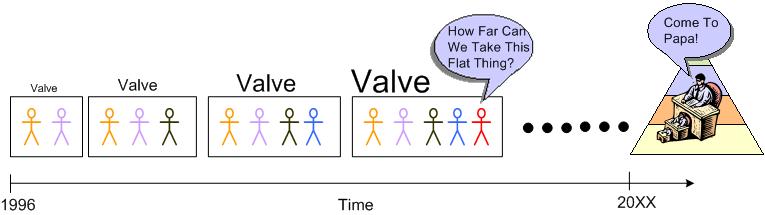
I recently listened to a fascinating podcast interview of Valve Inc‘s “economist-in-residence“, Yanis Varoufakis. According to Yanis, the company is still organizationally flat after 17 years of existence.
The thought early on at Valve was that the maximum limit to flatness would be around 50-60 people. Above that, in order to keep the wheels from falling off, some form of hierarchy would be required for concerted coordination. However, currently at 300+ employees, Valve has managed to blow through that artificial barrier and remain flat. Mind you, this is not a company solely made up of like-thinking engineers. There are also artists, animators, writers, and accountants running around like a herd of cats inefficiently doing the shit that brings in $1B in revenue each year.
According to Yanis, in order to maintain their egalitarian culture, Valve can’t afford to grow too quickly. That’s because they have to deprogram people who are hired in from hierarchical borgs as former bosses who expect others to work for them, and former workers who expect to be “directed” by a boss. If Valve didn’t do this, their culture would get eaten alive by the pervasive and mighty command-and-control mindset. The spontaneity, creativity, and togetherness that power their revenue machine would be lost forever.
Nevertheless, Valve is pragmatic with respect to hierarchy:
“Valve is not averse to all organizational structure—it crops up in many forms all the time, temporarily. But problems show up when hierarchy or codified divisions of labor either haven’t been created by the group’s members or when those structures persist for long periods of time. We believe those structures inevitably begin to serve their own needs rather than those of Valve’s customers. The hierarchy will begin to reinforce its own structure by hiring people who fit its shape, adding people to fill subordinate support roles. Its members are also incented to engage in rent-seeking behaviors that take advantage of the power structure rather than focusing on simply delivering value to customers.” – The Valve employee handbook
Whether Valve knows it or not, their success is due to their respect of some of Gall’s system laws:
- Systems develop goals of their own as soon as they come into existence – and intra-system goals come first.
- Loose systems last longer and work better. Efficient systems are dangerous to themselves and others.
Multiturding
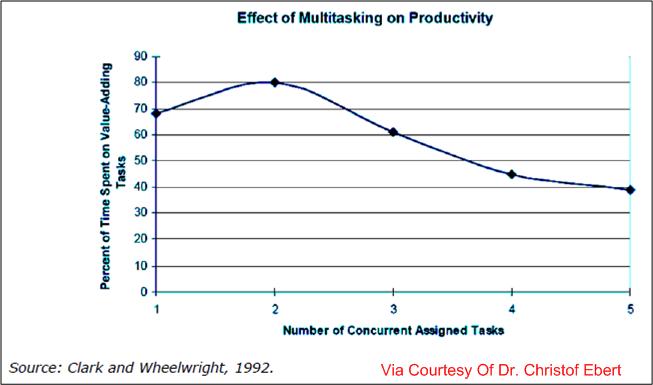
The best graphic I’ve ever seen on the inefficiency of multitasking comes via one of my long-time mentors from afar, Mr. Gerry Weinberg.
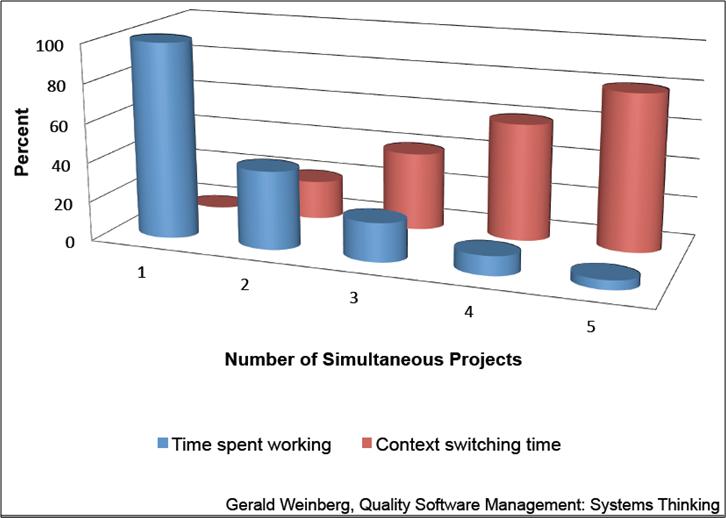
Even though some level of multitasking is pragmatically required once in awhile for getting things done, some orgs explicitly put multiturding up on a pedestal as a desired skill to be developed and honed. In these types of orgs, if you have multiple titles, roles, projects, etc, going on at the same time, you’re probably in the good graces of your bosses and a prime candidate for promotion. Plus, you get to pump up your annual appraisal form with a boatload of (half-assed) “accomplishments“.
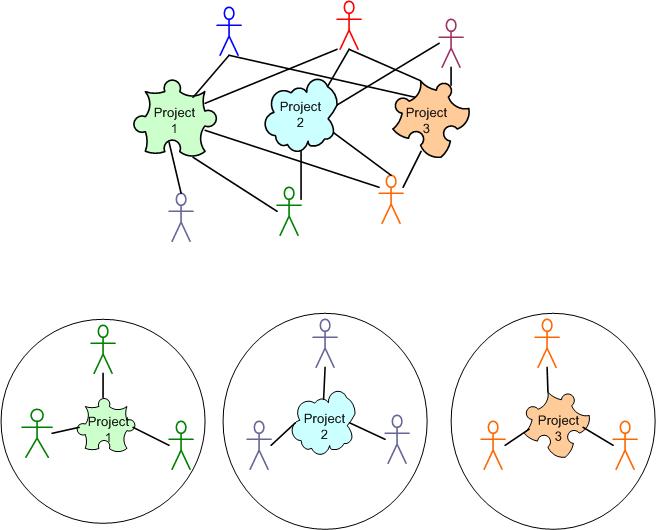
As a test to see if you’re a member of an org that’s hooked on multiturding, try telling your boss that you’d like to work on one project at a time – and then observe the response. Also, observe the feelings that arise within you before you make the request – if you do indeed make the request.

Related articles
- Beware Employees Who Boast About Multitasking (business.time.com)
- The myth of multitasking (smartplanet.com)
- If You Think You’re Good at Multitasking – You Probably Aren’t (richandco.wordpress.com)
- Frequent Multitaskers Aren’t Good At Multitasking, Study Shows (huffingtonpost.com)
- So, you think you can multitask? – Social Grad (thesocialgrad.wordpress.com)
A Friction-Based Separation Of Concerns
Alan Kay is one of the inventors of the Smalltalk programming language and a Turing award winner. During an interview with Dr. Dobbs’s Andrew Binstock, Mr. Kay had this to say:
American business is completely fucked up because it is all about competition. Our world was built for the good from cooperation. – Alan Kay
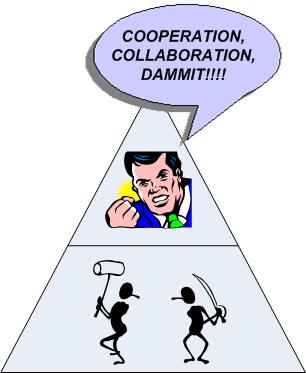
From the moment we stepped foot into the classroom and received our first gold star, we’ve been brainwashed with the BS idea that separation from, and competition with, other individuals is good and noble. In school, collaboration on assignments and tests is akin to “cheating“. In business, subjective reward systems pit team mates against each other for money and stature.
At least in school, everyone knows what the score is. There is no group purpose, vision, or mission; it’s all about individual achievement relative to other individuals. In business, so-called leaders constantly cry out for team work and collaboration while keeping idiotic policies/processes/procedures/structures in place that guarantee a friction-based separation of concerns between individuals and groups within the org. The reason this counterproductive “behavior” will continue unabated ad infinitum is because all the players involved in the game simply take it for granted. To “us” (yes, that includes you and me), it’s simply the way it’s always been and it’s simply the way it always should be. This thinking malady is so acute that not many people even try to search for alternatives. Those poor souls that do, are often ostracized into silence.
Where Are They Now?
The practice of performance appraisal is a mandated process in which, for a specified period of time, all or a group of employees’ work performance, behaviors, or traits are individually rated, judged, or described by a person other than the rated employee and the results are kept by the organization. – Coens, Tom; Jenkins, Mary. Abolishing Performance Appraisals
“Abolishing Performance Appraisals” was written 10 years ago. In their seminal book, Tom Coens and Mary Jenkins provide case studies of the following organizations as having replaced the Annual Performance Appraisal (APR) with something different:
University of Wisconsin Credit Union
Madison,Wisconsin, Police Department
Wheaton Franciscan Services, Inc.
Glenroy, Inc.
Gallery Furniture Company
Entre Computer Service
Memorial Hospital, Fremont, Ohio
Michigan State University
Electronic Data Systems (before being acquired by HP)
GM-Powertrain
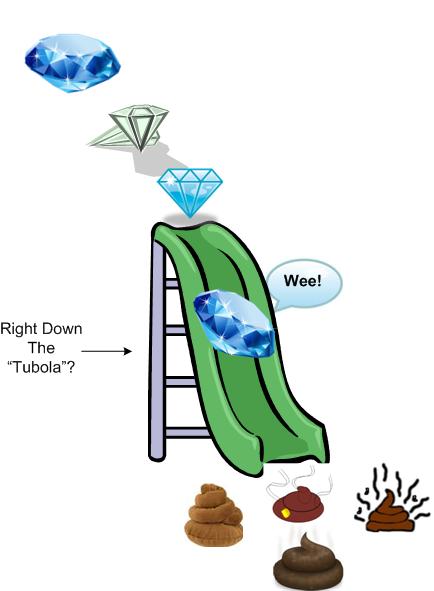
I wonder how these orgs are doing today? Could some/most of them have gone down the tubola like most of the orgs in Tom Peters‘ revered “In Search Of Excellence“? If so, BD00 wouldn’t be surprised. Even when successful new practices are placed into operation, the powerful forces acting on an org to revert back to the old status quo are ever present. These forces usually win out when new management, indoctrinated with old FOSTMA thinking, takes over the reins.
Posing Your Way To Success
On the left-hand side of the diagram below, we have a static system design structure where four “workers” and their manager have their hearts set on producing a world class product. On the right, we have an alternate system design where only one worker has his/her heart set on creating a world class product. The other team members are too busy posing, competing, and jockeying for positional stature in the mind of the manager for their next upward career move. It’s not shown on the diagram, but that manager is also jousting with his peers to advance his/her career.
In orgs where the policies/procedures/incentives/rewards promote individual performance over (and at the expense of) team performance, you’ll most likely find the design structure on the right in operation. Which archetype does your system design map onto?

Man-Made And Person-Specific
George Pransky taught (err, finally convinced) BD00 that all stress is man-made and person-specific. One person’s stress is another’s exhilaration. Nevertheless, environmental and situational factors probably do influence stress levels to some extent, no?
One would think that as one ascends the ladder in a hierarchical institution, his/her stress levels increase with rank, stature, and responsibility. This may be true in general, but there is some research evidence to the contrary:
No Sweat: Less Stress in Higher Ranks. “..this study suggests that those who manage others actually experience less stress — as measured through both biological and psychological assessments — than non-leaders. In fact, the stress level seems to go down as executives climb up the corporate ladder. Leaders with more authority, and more freedom to delegate day-to-day oversight, do better on this front than managers below them.”
The Whitehall Study. “The Whitehall cohort studies found a strong association between grade levels of civil servant employment and mortality rates from a range of causes. Men in the lowest grade (messengers, doorkeepers, etc.) had a mortality rate three times higher than that of men in the highest grade (administrators).”
It all comes down to “control“. If you believe (like BD00 does) in William T. Powers’ Perceptual Control Theory (that every living being is an aggregation of thousands of little control systems interconnected for the purpose of achieving prosperous survival), then the results make sense. It’s simply that people in the higher ranks have more “control” over their environment than those below them.
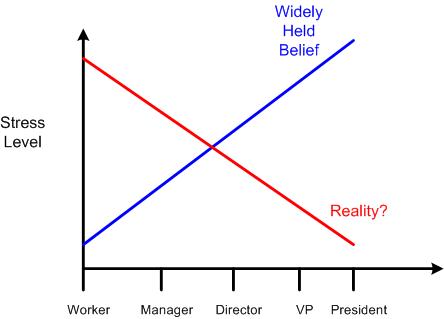
Of course, take this post (along with all other BD00 posts) with a carafe of salt. He likes to make up stuff that confirms his UCB by carefully stitching together corroborating evidence while filtering out all disconfirmatory evidence. But wait! You do that too, no?
Every man, wherever he goes, is encompassed by a cloud of comforting convictions, which move with him like flies on a summer day. – Bertrand Russell
Billiard Balls
The top-down organizational chart became the blueprint for the mechanistic organizational model, lining people up like billiard balls to ostensibly create a predictable chain of reactions. – Tom Coens & Mary Jenkins


Why am I here?
WTF?
Meh!
D'oh!

My BTC Address



 Bulldozer00's Blog