Archive
A Grain Of Salt
Somehow, I stumbled upon an academic paper that compares programming language performance in the context of computing the results for a well-known, computationally dense, macro-economics problem: “the stochastic neoclassical growth model“. Since the results hoist C++ on top of the other languages, I felt the need to publish the researchers’ findings in this blog post :). As with all benchmarks, take it with a grain of salt because… context is everything.
Qualitative Findings
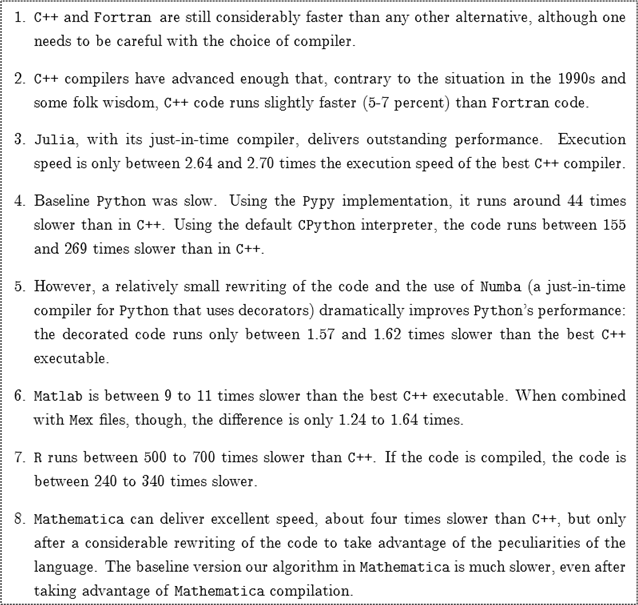
Quantitative Findings
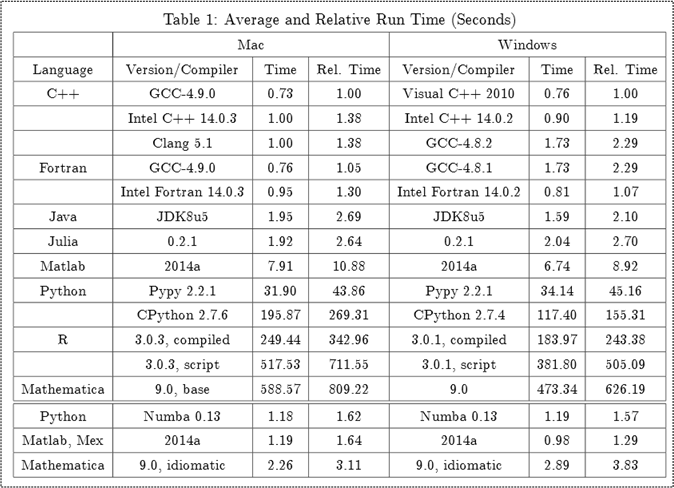
The irony of this post is that I’m a big fan of Nassim Taleb, whose lofty goal is to destroy the economics profession as we know it. He thinks all the fancy, schmancy mathematical models and metrics used by economists (including famous Nobel laureates) to predict the future are predicated on voodoo science. They cause more harm than good by grossly misrepresenting and underestimating the role of risk in their assumptions and derived equations.
FUNGENOOP Programming
As you might know, the word “paradigm” and the concept of a “paradigm shift” were made insanely famous by Thomas Kuhn’s classic book: “The Structure Of Scientific Revolutions“. Mr. Kuhn’s premise is that science only advances via a progression of funerals. An old, inaccurate view of the world gets supplanted by a new, accurate view only when the powerfully entrenched supporters of the old view literally die off. The implication is that a paradigm shift is a binary, black and white event. The old stuff has been proven “wrong“, so you’re compelled to totally ditch it for the new “right” stuff – lest you be ostracized for being out of touch with reality.
In his recent talks on C++, Bjarne Stroustrup always sets aside a couple of minutes to go off on a mini-rant against “paradigm shifts“. Even though Einstein’s theory of relativity subsumes Newton’s classical physics, Newtonian physics is still extremely useful to practicing engineers. The discovery of multiplication/division did not make addition/subtraction useless. Likewise, in the programming world, the meteoric rise of the “object-oriented” programming style (and more recently, the “functional” programming style) did not render “procedural” and/or “generic” programming techniques totally useless.
This slide below is Bjarne’s cue to go off on his anti-paradigm rant.

If the system programming problem you’re trying to solve maps perfectly into a hierarchy of classes, then by all means use a OOP-centric language; perhaps Java, Smalltalk? If statefulness is not a natural part of your problem domain, then preclude its use by using something like Haskell. If you’re writing algorithmically simple but arcanely detailed device drivers that directly read/write hardware registers and FIFOs, then perhaps use procedural C. Otherwise, seriously think about using C++ to mix and match programmimg techniques in the most elegant and efficient way to attack your “multi-paradigm” system problem. FUNGENOOP (FUNctional + GENeric + Object Oriented + Procedural) programming rules!

Staying Sane
Standardization is long periods of mind-numbing boredom interrupted by moments of sheer terror – Bjarne Stroustrup
In his ACCU2013 talk, “C++14 Early Thoughts“, Bjarne Stroustrup presented this slide:
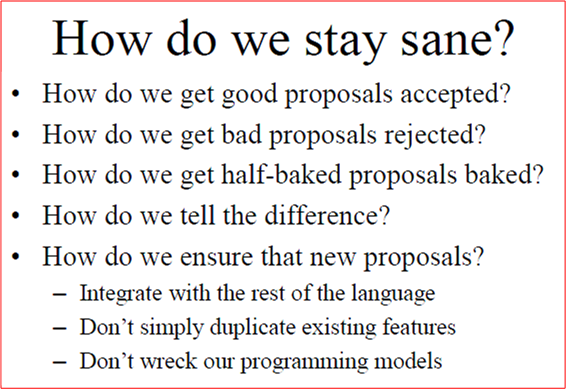
By using “we” in each bullet point, Bjarne was referring to the ISO WG-1 C++ committee and the daunting challenges it faces to successfully move the language forward.
Not only do the committee leaders have to manage the external onslaught of demands from a huge, dedicated user base, they have to homogenize the internal communications amongst many smart and assertive members. To illustrate the internal management problem, Bjarne said something akin to: “There is no topic the committee isn’t willing to discuss at length for two years“.
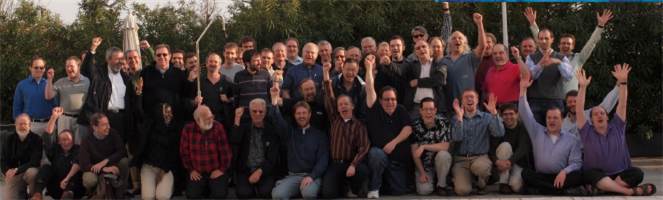
In order to prevent being overwhelmed with work, the committee uses this set of grass roots principles to filter out the incoming chaff from the wheat:
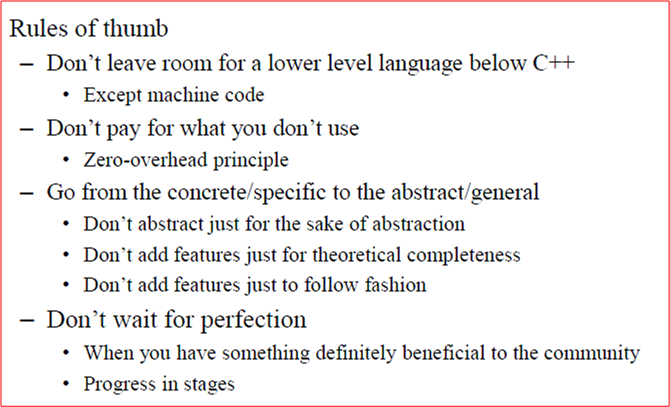
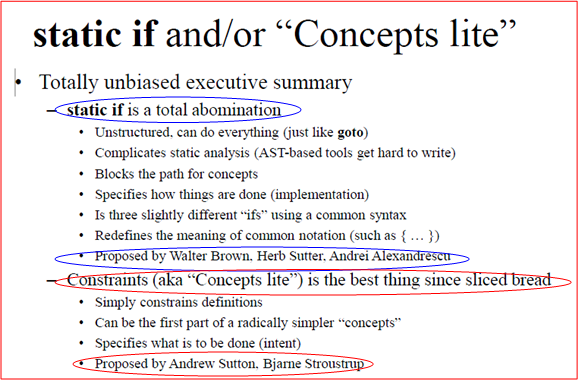
I have no idea how internal conflicts are handled, nor how infinite loops of technical debate are exited, but since the all-volunteer committee is still functioning and doing a great job (IMO) of modernizing the language, there’s got to be some magic at work here:
The Right Tool For The Job
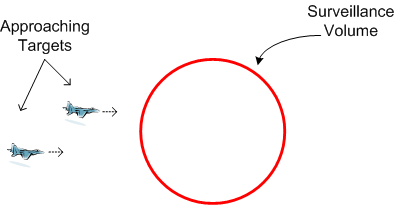
The figure below depicts a scenario where two targets are just about to penetrate the air space covered by a surveillance radar.
The next sequence of snapshots illustrates the targets entering, traversing, and exiting the coverage volume.
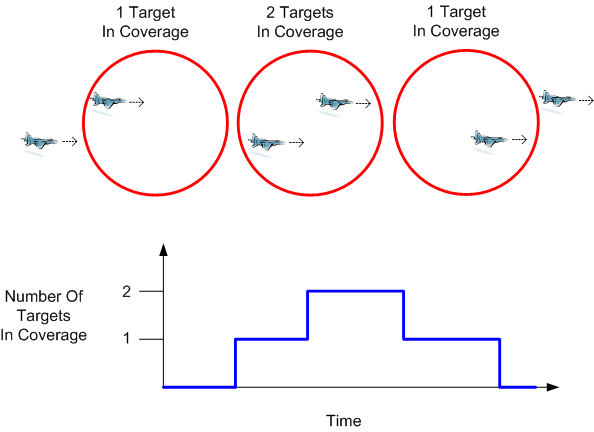
Assume that the surveillance volume is represented in software as a dynamically changing, in-memory database of target objects. On system startup, the database is initialized as empty. During operation, targets are inserted, updated, and deleted in response to changes that occur in the “real” world.
The figure below models each target’s behavior as a state transition diagram (STD). The point to note is that a target in a radar application is stateful and mutable. Regardless of what functional language purists say about statefulness and mutability being evil, they occur naturally in the radar application domain.
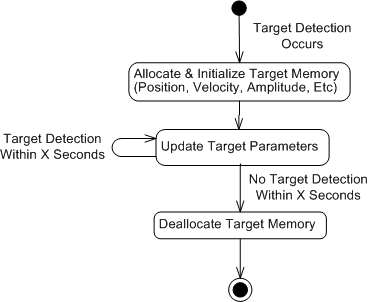
Note that the STD also indicates that the application domain requires garbage collection (GC) in the form of deallocation of target memory when a detection hasn’t been received within X seconds of the target’s prior update.
Since the system must operate in real-time to be useful, we’d prefer that the target memory be deleted as soon as the real target it represents exits the surveillance volume. We’d prefer the GC to be under the direct, local, control of the programmer and not according to the whims of an underlying, centralized, virtual machine whose GC kicks it whenever it feels like it.
With these domain-specific attributes in mind, C++ seems like the best programming language fit for real-time radar domain applications. The right tool for the job, no? If you disagree, please state your case.
Two Opposing Ideas
If you didn’t already know it, I’m a fan of the C++ programming language. Of course, not everybody feels the same way. There are many smart people who are among the “haters“.
C++ is a horrible language. It’s made more horrible by the fact that a lot of substandard programmers use it, to the point where it’s much much easier to generate total and utter crap with it. – Linus Torvalds
When I read anti-C++ tirades like Linus Torvalds’ emotionally charged attack, it always stings a little at first. But then I eventually step back from the “emotional-me” and remember (thanks to the teachings of Byron Katie and Eckart Tolle) that the world will never be the way I “demand!” it to be. The length of time it takes me to disengage from abstract thought-storms like these and return to earth is proportional to how deeply I’m attached to one side of the debate stomping around in my head.
“The test of a first-rate intelligence is the ability to hold two opposing ideas in mind at the same time and still retain the ability to function.” – F. Scott Fitzgerald
Java creator James Gosling, Haskell‘s Bartosz Milewski, and Go creator Rob Pike are three of the more prominent people in the anti-C++ camp. As expected, they have agendas to promote: advocating their own favorite programming languages at the expense of C++.
- Milewski’s rant: “Edward C++Hands“
- Pike’s rant: “Less Is Exponentially More“
- Gosling’s rant: “The Java Language Environment“
Ironically, these rants by smart and well known people can be construed as tributes to C++. That’s probably why this is one of my favorite Bjarne Stroustrup quotes:
There are just two kinds of languages: the ones everybody complains about and the ones nobody use.
Pragmatically Feasible?
From the MISRA web site:
The Motor Industry Software Reliability Association (MISRA), is a collaboration between vehicle manufacturers, component suppliers and engineering consultancies which seeks to promote best practice in developing safety-related electronic systems in road vehicles and other embedded systems.
While browsing through the MISRA C++:2008 standard, I came across this not-unexpected requirement:

I don’t know enough about the standard to know if it’s true, but I interpret this requirement as banning not only the use of “new/delete“, but also as banning the use of the dynamically managed STL container abstractions (vectors, lists, sets, maps, queues) and, hence, the many standard library algorithms that operate on them. I wonder what the MISRA Java specification, if there is one, says about dynamic memory allocation.
If my interpretation of 18-4-1 is correct, then the requirement can severely jack up the cost, schedule, and technical risks of any software component that is required to be compliant with the specification. For non-trivial applications requiring more than low-level, statically allocated arrays…..
Complexity is pushed out of the language and into the application code. The semantics of language features are far better specified than the typical application code. – Bjarne Stroustrup & Kevin Carroll
Because of the safety-critical nature of embedded automotive software, I can understand the reasoning behind the no-dynamic-memory-allocation requirement. But is it pragmatically feasible in today’s world; especially since software components keep getting larger and commensurately more complex over time? In other words, is it one of those requirements that doesn’t scale? Is it too Draconian?
For those C++ programmers who work in the automotive industry and happen to stumble upon this blog (which will probably be none), what has been your experience with this MISRA requirement and some of the other similarly unsettling requirements in the specification? Are “waivers” often asked for and granted? Is it an unspoken truth that people/companies pay public lip service to the requirement but privately don’t comply?

The Biggest Cheerleader
Herb Sutter is by far the biggest cheerleader for the C++ programming language – even more so than the language’s soft spoken creator, Bjarne Stroustrup. Herb speaks with such enthusiasm and optimism that it’s infectious.

In his talk at the recently concluded GoingNative2013 C++ conference, Herb presented this slide to convey the structure of the ISO C++ Working Group 21 (WG21):
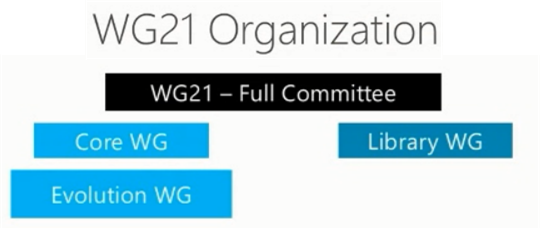
On the left, we have the language core and language evolution working groups. On the right, we have the standard library working group.
But wait! That was the organizational structure as of 18 months ago. As of now, we have this decomposition:
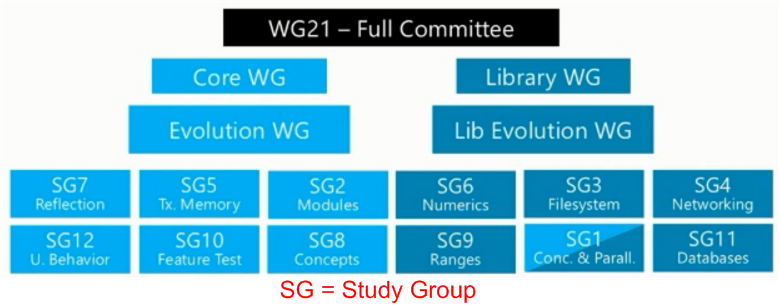
As you can see, there’s a lot of volunteer effort being applied to the evolution of the language – especially in the domain of libraries. In fact, most of the core language features on the left side exist to support the development of the upcoming libraries on the right.
In addition to the forthcoming minor 2014 release of C++, which adds a handful of new features and fixes some bugs/omissions from C++11, the next major release is slated for 2017. Of course, we won’t get all of the features and libraries enumerated on the slide, but the future looks bright for C++.
The biggest challenge for Herb et al will be to ensure the conceptual integrity of the language as a whole remains intact in spite of the ambitious growth plan. The faster the growth, the higher the chance of the wheels falling off the bus.
“The entire system also must have conceptual integrity, and that requires a system architect to design it all, from the top down.” – Fred Brooks
“Who advocates … for the product itself—its conceptual integrity, its efficiency, its economy, its robustness? Often, no one.” – Fred Brooks
I’m not a fan of committees in general, but in this specific case I’m confident that Herb, Bjarne, and their fellow WG21 friends can pull it off. I think they did a great job on C++11 and I think they’ll perform just as admirably in hatching future C++ releases.
The Hodgepodge Myth
There are two kinds of languages. Those that everyone complains about and those that nobody uses. – Bjarne Stroustrup
I’ve seen C++ described as a thoughtless hodgepodge of features and approaches that were carelessly slapped together and foist upon the programming community. However, if any of those detractors read “The Design And Evolution Of C++” and dive deeply into the language’s technical details, they might change their minds and marvel at the essential complexity baked into C++.
As a systems programming language whose target niche is infrastructure and constrained-resource (CPU speed and memory) applications, C++ is all about achieving efficient abstraction (as opposed to increasing programmer productivity). For efficiency, its constructs must not move too far away from how computing hardware actually stores and manipulates data (linear arrays, pointers, stack-based variables). Otherwise, a “hidden” layer of translational code must be inserted between what the programmer actually writes and the code that actually runs on the hardware. To write large, domain-specific programs, C++ must also provide abstraction facilities for implementing domain concepts and inter-concept relationships directly in code (classes, inheritance, friendship, templates, namespaces, exceptions, meta-programming).
Comparatively speaking, no other high level language comes close to achieving the blend of abstraction and efficiency that C++ attains. Sure, there are many newer languages that increase programmer productivity by decreasing verbosity, increasing levels of abstraction, and insulating the programmer from details, but the price paid for this productivity gain is a loss in runtime performance, a shallow understanding of what goes on underneath the covers, and long stretches of optimization/tuning efforts to meet performance requirements.
Once an engineer forms a string opinion on a technical tool or methodology, she is unlikely to change it – no matter what evidence is placed in front of her. As regular readers of this ball-busting blog know, BD00 chronically suffers from this “fan boy” malady all too well. And this post is a prime example of that behavioral trait.

Don’t Panic!
The fourth edition of “The C++ Programming Language” weighs in at 1346 pages and 44 chapters allocated over four partitions. The end of each chapter provides a list of advisory items – yielding a grand total of 699 nuggets of general programming and C++ specific wisdom for the reader to ponder.

The figure below shows a breakdown of the behemoth book’s table of contents. The number of advisories provided in each chapter and each partition are shown on the right side.

As a temporary excursion from reading and studying and writing exploratory snippets of C++11 code, I went through all 699 items and plucked out a subset of the tidbits I found most useful. Of course, your personal list would no doubt turn out differently.
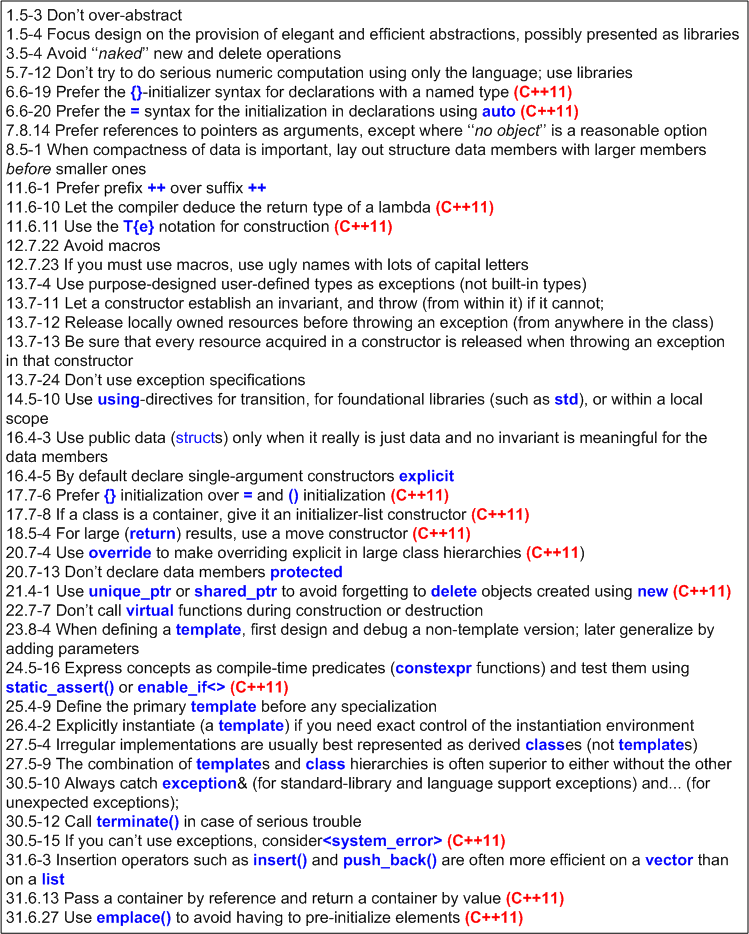
Even though it’s not on my list, my absolute favorite item of advice is the first one presented at the end of chapter 2:

D’oh! Wanna guess at how much time is needed for all to become clear? Maybe Malcolm Gladwell‘s famous “10,000 hours” isn’t enough? But that’s why I love C++. It provides an endlessly rich and deep opportunity for learning.
Two Peas In A Pod
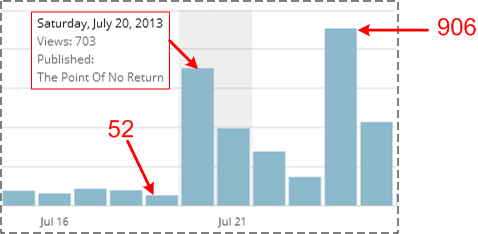
It’s funny how I never know which, if any, of my bogus posts will have the potential to generate an above average number of hits on this blog. The posts that I thought may have triggered a rise above the average daily hit count (approximately 50) never have. The posts that have indeed appreciably crossed the threshold, I never thought would. In four years of blogging, not a single one of my a-priori guesses has come true.
When I stitched together “The Point Of No Return” post, I thought “meh“; it’s just another average, unenlightening BD00 post. However, somehow, somewhere, some kind soul on the blog staff at the official ISO C++ org web site decided otherwise. He/she thought it useful enough to post a link to it right smack on the site’s home page:
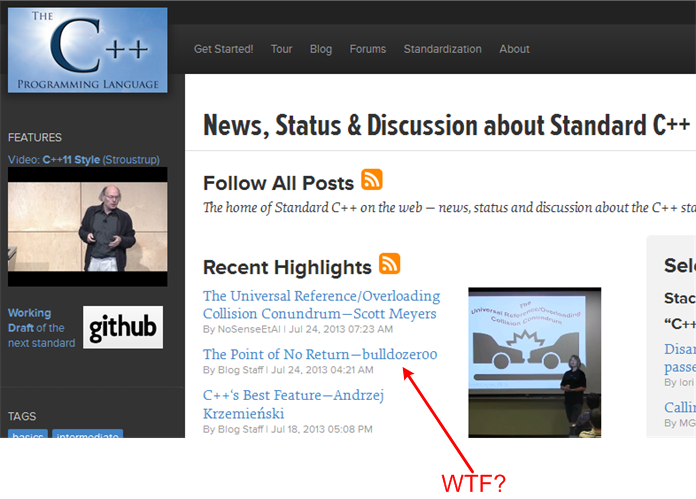
W00T! Me and my man Bjarne Stroustrup on the same page – like two peas in a pod. Do ya think Bjarne would appreciate the BD00 connection?

The dashboard below shows the spike in traffic experienced by BD00’s blog as a result of the generous plug from the blog staff at isocpp.org. I surely hope that the wordpress.com server farm didn’t crash from the sudden surge in traffic!

Why am I here?
WTF?
Meh!
D'oh!

My BTC Address



 Bulldozer00's Blog