Archive
Too Good To Die
On the one hand, the Bitcoin community thinks it doesn’t matter who the real Satoshi Nakamoto is. On the other hand, the less-informed press seems to think it does matter.
To the Bitcoin community, Bitcoin has come of age and has passed the threshold where it requires a creator to nurture its growth. The community is large enough and smart enough to move the technology forward without the real Satoshi directing the show.
To the press, the speculation that one Bitcoin address on the blockchain attributed to the real Satoshi has over 1 million BTC attached to it means that it does matter. The logic is that if those 1 million BTC are sold in a short period of time, the BTC price will collapse.
After assessing all the evidence to date, I (like most of the BTC community) don’t believe Aussie Craig Wright is the real Satoshi Nakamoto. Even if Mr. Wright is the real deal, I’m with the BTC community on the opinion that it doesn’t matter.
I don’t care if Mr. Wright is the real Satoshi and sells all of his 1 million BTC on the open market in one transaction. Sure, the sale would tank the price, but like it has done after the forceful Silk Road web site closure and the Mt. Gox implosion, Bitcoin will bounce back and inexorably continue to rise in price and slowly infiltrate the mainstream. Bitcoin is anti-fragile because it is simply too good for humanity to die anytime soon – if ever. BUT, as always, I could be wrong and I’m prepared to lose my Bitcoin investment in its entirety.

Hoarding AND Spending
Since I’m loooong on Bitcoin, I’ve stashed away some coins in an offline wallet as an investment in the future success of the currency. However, since I also want to actively help the Bitcoin economy flourish and accelerate mainstream acceptance of the technology, I keep some spending money on hand in my mobile Blockchain and online Coinbase.com wallets.
As of today, I’ve only purchased one retail item with some of the BTC I have available for day-to-day commerce. However, I’ve sent $1 worth of BTC to several online friends so that they can personally discover and experiment with the technology. Interestingly, and indicative of the innocent ignorance that keeps Bitcoin flying under the radar for the mainstream individual, some people have “ignored” my $1 offer. They simply:
- have never heard about Bitcoin at all, or
- they don’t know enough about Bitcoin to understand its potential to make the world a more equitable and peaceful place, or
- they’ve only been exposed to Bitcoin’s negative publicity (the collapse of Mt. Gox, the extortion scams, the use of BTC to buy guns/drugs on Silk Road) and are afraid to join the community
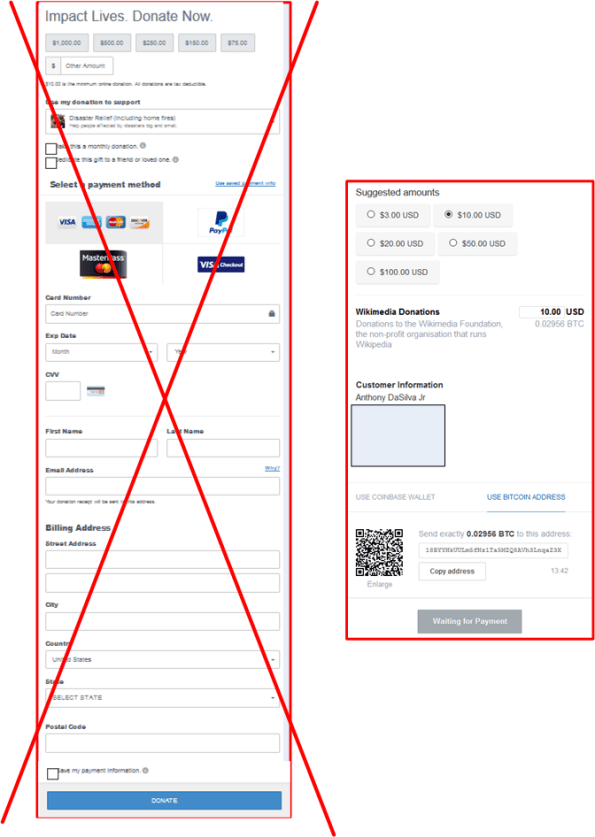
By far, my most frequent usage of BTC as a currency has been to donate small amounts ($1-$5-$10-$25) to non-profit causes and send tips to people that I deem deserving: Wikipedia, Tor, Andreas Antonopoulis, a volunteer-operated Electrum wallet server, etc. If you’re reading this post and you’re associated with a non-profit org that doesn’t accept Bitcoin as a method of donation, you may want to reassess your situation.
The advantage of using Bitcoin over traditional credit cards for donations is huge. By using BTC, I don’t have to expose my credit card details to the payees and I can yield as much or as little personal information as I choose to. There are no long, multi-box, online forms to fill out. I simply copy & paste the recipient’s BTC address into my wallet’s send box, specify the amount to donate, enter my wallet PIN, and click “send“. I’ve discovered that I’ve been donating more with Bitcoin than by using traditional, 50 year old, insecure payment mechanisms. And that’s a good thing, no?
So, I’m not just a BTC “speculator” or “hoarder“, I’m an (almost) everyday user – like you might be one day too. 🙂
Did He, Or Didn’t he?
As the Crypto mailing list exchange snippet below indicates, Satoshi Nakamoto wrote all of the Bitcoin Core C++ source code prior to writing his world-changing white paper.

Hmmm, I wonder if Satoshi used TDD to develop his masterpiece? I also wonder: whether he meticulously tracked his velocity with a burndown chart; what obstacles his scrum master removed during the effort; and how his retrospectives improved the process.

The Mysterious ACH Delay
One of the FAQs on Coinbase.com and other Bitcoin exchanges is: “Why does it take so long to get my bitcoins?“. As the graphic below illustrates, the delay is due to the ancient “Automated Clearing House” (ACH) system that banks employ to process money transfers.
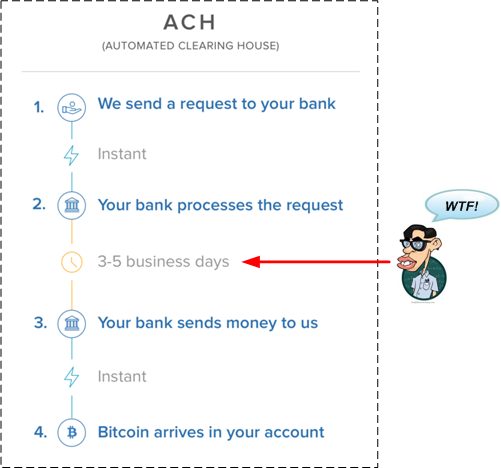
Prior to grokking the topic and personally experimenting with the technology, most people will probably say (as with anything radically new and different) that Bitcoin is too complicated for them. But hey, those same people (like me) most likely have no idea what goes on behind the scenes during the mysterious ACH delay when they use the current, antiquated banking system. And yet, they initiate this complicated process every time they move money between financial institutions. International money movement via wire transfer is an even more perplexing, costly, and delay-inducing process.
As the bitcoin user experience improves as a result of the innovation taking place in the industry, the complexity of bitcoin technology will fade into the background; just like the opaque, byzantinian complexity of the current financial system technology has been pushed behind the scenes.
Instantaneous Entrepreneurship
The best way to acquire Bitcoins is to earn them. If you have a skill, service, or goods to sell, you can instantaneously start your own business. If you accept Bitcoins, no bank or credit card company approvals/fees are required. You can be your own bank. Simply setup a web site, advertise your stuff, and hoist your bitcoin address and/or its QR code on the site.

Of course, if the price of Bitcoin goes to zero, and there is a non-trivial chance it will, all your effort will have been wasted. But hey, entrepreneurship is all about putting skin in the game and taking risks. As for me, I’ll continue exchanging dollars for Bitcoins on Coinbase.com.
The Bitcoin Ambassador
Many people in the bitcoin community call Roger Ver the “Bitcoin Jesus“. I call Andreas Antonopoulos the “Bitcoin Ambassador“. I do this because I’ve seen him eloquently mesmerize the Canadian and Australian governments on what bitcoin is and why its benefits far outweigh its costs.
After watching the following fascinating videos, you can judge for yourself whether I’m right or wrong.
If you’re a bitcoin fan and you appreciate his passionate efforts to disarm the most hostile forces against widespread bitcoin adoption – national governments, hustle on over to Andreas’s site and show your appreciation by sending him a bitcoin tip.
Time To Crack Some Heads!
Whenever tragedy strikes, politicians tend to make a rush to judgment and propose or execute dumbass moves that make it appear like they’re doing something useful. Ebola scare? Ban travel to all! Immigration problem? Build a 1000 mile wall! Terrorist attack? Damn it, close the borders to all!
As long as politicians maintain their cozy relationship with the bankstas who finance their irresponsible deficit spending in return for bailouts waiting in the background, they’ll be on a constant vigil for excuses to inhibit the growth of Bitcoin. On the heels of the Paris attacks, the latest call for action is to “crackdown” on Bitcoin as a means for terrorist financing.
First of all, no one, no matter how powerful and well funded, can “crackdown” on Bitcoin – because there is no head to chop off. All that those who have much to lose when Bitcoin eats their lunch can do is pass laws that attempt to make it annoyingly difficult for fiat currency to get into and out of the bitcoin economy.
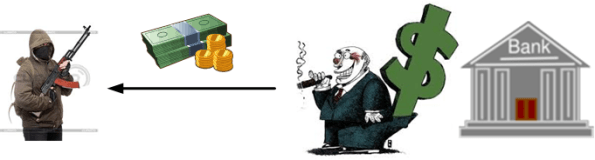
Second, and most important of all, is that Bitcoin is not even a major source of terrorist financing. As the following report, published just last month by the UK treasury for its politicians shows, the terrorist’s predominant financier is, as you might have guessed, your friendly banksta. You know, the one that charges a fee every time you sneeze and “invests” your hard earned cash in risky schemes at no risk to themselves.


Ain’t Gonna Do It – Ever
Straight from the Bitcoin Core source code, which is written in C++ (of course!) and is observable for all the world to see (including federal reserve bankstas and other corrupt government fiat currency debasers), we have….
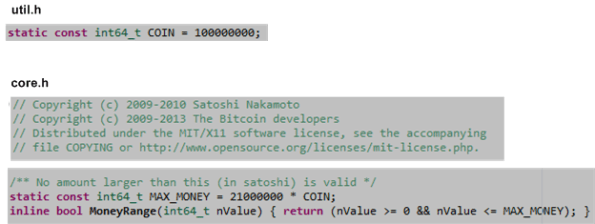
That’s it: no more than 21.0E14 “satoshis” will ever be minted in the Bitcoin world.
Well, you might smugly say, anybody could change the source code to jack up the “MAX_MONEY” and/or “COIN” compile-time constants and release the next update. Uh, yeah, but unless the thousands of BTC miners with peta-flops of hashing power invested in the bitcoin economy voluntarily choose to run the new “inflationary” code, tain’t gonna happen. And, since it would clearly be against their best interests to do so (because it is their money they’re dealing with and not “other people’s money” that they can leach off of) they ain’t gonna do it – ever.
Out Of Thin Air
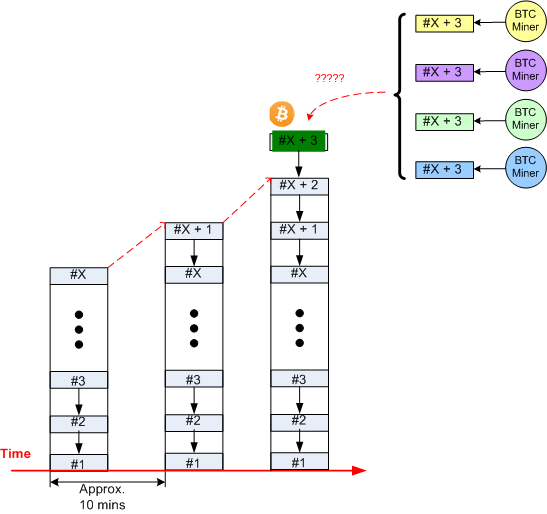
As the figure below attempts to illustrate, a new block of validated financial transactions is added to the Bitcoin blockchain approximately every 10 minutes.

As of today, whenever a block is added to the blockchain, 25 newly minted Bitcoins spring into existence out of thin air. This number of bitcoins-per-block will be cut in half every four years until a total of 21 million BTC have been birthed into existence. The next halving, which will result in 12.5 bitcoins being created per block, will happen in 2016. The last bitcoin will magically appear in the world sometime in the year 2140.
So, who adds the blocks to the chain, and who gets the bitcoins? The answer to both questions is “the miners do“. Bitcoins are a miner’s reward for the energy it expends in solving a computationally intense computing problem whose difficulty may vary from block to block. If blocks get added too quickly, the difficulty of solving the puzzle goes up. If blocks get added too slowly, the difficulty goes down.

A bitcoin miner’s job is to validate the transactions in each block and to preserve the integrity of the blockchain. The bitcoin network is comprised of thousands of these miners working together in accordance with a set of programmed-in protocol rules that ensure they do indeed work together in a consensus-based manner to secure the blockchain from external and internal hack-attacks. As the blockchain grows and more mining power is added to the network, the system becomes more trustworthy and hardened against thievery – including against rogue miner insiders.
After a block is successfully added to the chain, all the miners go to work racing against each other to solve the next cryptographic math problem for the privilege of adding the next block and earning the bitcoin reward. The winner takes all – for that block only. And then the cycle starts over again. Wash, rinse, repeat.
Booms, Busts, Stability, Antifragility
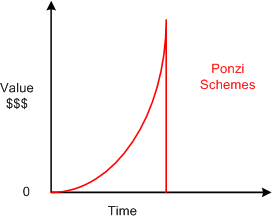
The figure below shows the one time boom-bust pattern of a Ponzi scheme (Bernie Madoff anyone?) We have a meteoric rise in value based on smoke and mirrors where a few get rich, and then an instantaneous dive during which many poor souls lose their shirts. Note that when the bubble pops, the party is over, finished, kaput.
The next figure shows the slow and steady rise in value of a viable, value-creating, system. Since the value the system creates is real, the system achieves stability and remains operational for an enduringly long time. It becomes woven into the fabric of society. At some point, the populace starts taking the system for granted and assumes the system has been influencing their behavior forever.
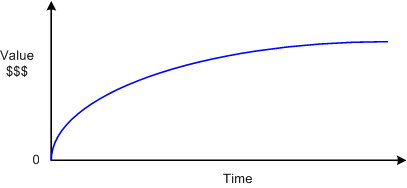
Here is my sketchy interpretation of what’s happening in the Bitcoin space:

Bitcoin has already experienced several heart-stopping boom-bust cycles throughout its steady march toward stability and widespread acceptance. But note that unlike a Ponzi scheme, which many dooms-mongers (like textbook economists and obsolete, fat-cat, bankstas) loudly claim Bitcoin is after every bust, Bitcoin has not gone kaput. It’s robust, resilient, and dare I say, anti-fragile. The system adapts and get stronger after withstanding every technical and political attack – improving itself via the community driven BIPs process.
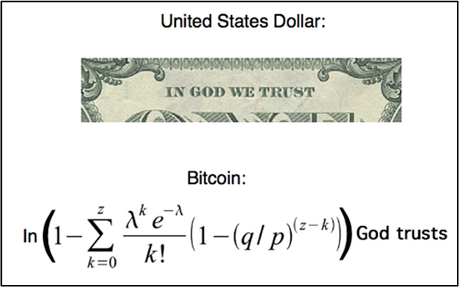 Photo credit imgur.com gallery.

Why am I here?
WTF?
Meh!
D'oh!

My BTC Address



 Bulldozer00's Blog