Archive
Death Wish
Over the span of many years, a handful of people have told me that they admire (lol) my courage for “speaking truth” to power. But it’s not like that. First, I speak my version of the so-called “truth“. Second, I don’t “speak to“, I “write about” power. Third, there’s absolutely no courage involved. The only way I can describe this so-called talent is that it’s a weird “death wish” type of affliction.

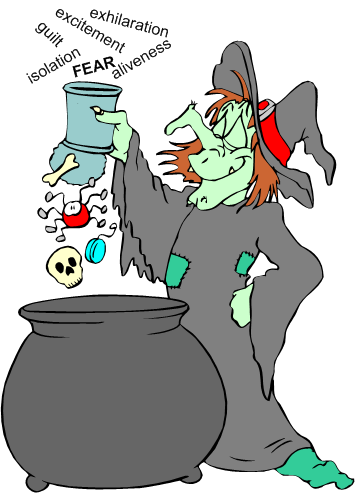
The feelings that rush forth when I spew potentially hurtful (but maybe indirectly helpful?) ideas and assertions are excitement, exhilaration, and aliveness. But wait, that’s not all. Feelings of guilt, isolation, and mostly, fear, also weave themselves into the witches brew. D’oh! I hate when that happens.
Even though it’s (always) about me, enough about me. What about you, dear reader? What’s your story? Do you write, speak, to, about, power? What’s your style, and do you think it’s effective? What feelings emerge in real-time when you skirt the edge of the prevailing power culture’s “appropriateness” threshold?
In addition to fellow DICsters, I’m especially interested in those readers, if any, who are actually in positions of power in a hierarchy. In your particular case, does power speak truth to power? There’s gotta be a couple of you out there willing to share, no?
The Expense Of Defense
The following “borrowed” snippet from a recent Steve Vinoski QCon talk describes the well worn technique of defensive programming:

Steve is right, no? He goes on to deftly point out the expenses of defensive programming:
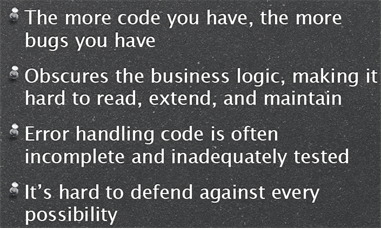
Steve is right on the money again, no?
Erlang and the (utterly misnamed) Open Telecom Platform (OTP) were designed to obviate the need for the defensive programming “idiom” style of error detection and handling. The following Erlang/OTP features force programmers to address the unglamorous error detection/handling aspect of a design up front, instead of at the tail end of the project where it’s often considered a nuisance and a second class citizen:
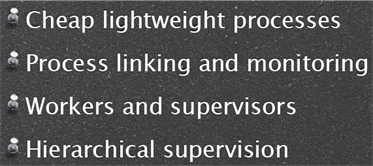
Even in applications where error detection and handling is taken seriously upfront (safety-critical and high availability apps), the time to architect, design, code, and test the equivalent “homegrown” capabilities can equal or exceed the time to develop the app’s “fun” functionality. That is, unless you use Erlang.
Ironic
It’s like ten thousand spoons when all you need is a knife – Alanis Morissette
I find it curiously ironic that despite what may be espoused, software developers are often placed on one of the lowest rungs of the ladder of stature and importance (but alas, the poor test engineers often rank lowest) in many corpricracies whose revenue is dominated by software-centric products. Yet, it seems that many front-line software project managers, software “leads“, and software “rocketects” are terrified of joining the fray by designing and writing a little code here and there to lead by example and occasionally help out. In mediocre corpo cultures, it’s considered a step “backward” for titled ones to cut some code.
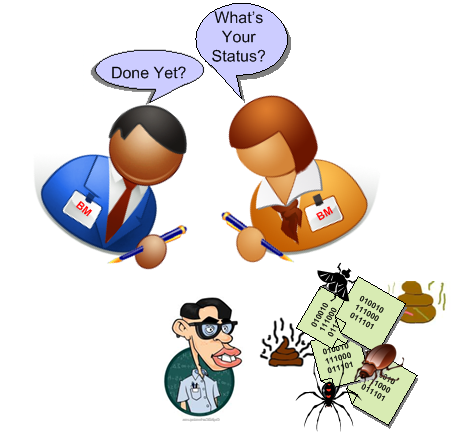
Fuggedaboud writing some code, a lot of the self-pseudo-elite dudes are afraid of even reading code for quality. Hence, to justify their existence, they focus on being meticulous process, schedule, and status-taking wonks – which of course unquestioningly requires greater skill, talent, and dedicated effort than designing/coding/testing/integrating revenue generating code.

Sustained Viability
The figure below shows the sales-vs-time trend chart of a one hit wonder company. The sales from product “A” ramp up, settle out, and then ramp down.
 The ramp up, steady-state, and ramp down time intervals in which sales > $0 varies wildly from one company to another and depends on many factors: how easy the product is to copy, whether the product is obsoleted by another product, how big the market is, whether or not the product keeps evolving to meet new customer demands; yada, yada, yada.
To maintain sustained viability and to avoid being a one hit wonder company, new products must be continuously developed to offset the eventual decline in sales from the aging one hitter. The longer the “flat” segment of sustained sales is, the easier it is to become fat/happy/complacent and stop creating and innovating.
The figure below traces the rise and fall of a three hit company. The green vertical lines are snapshots of the company’s sales at four different points in time.
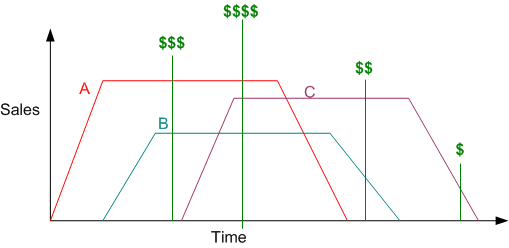
At the peak of success, all three products have leveled off at their maximum sales levels and the good times are a rollin’. Then, for an unknown reason(s), the product pipeline is suddenly empty, and one by one, sales start decreasing for each product.

So what’s the point of this inane post? Hell, I don’t freakin’ know. I was just doodlin’ around with visio, sketchin’ away, makin’ stuff up, and these graphs emerged from the wild blue yonder. Sorry for wastin’ your time. It wasn’t a waste of mine.
Z6
In case you were wondering, Z6 stands for Zappos core value number 6:

I’m a huge Zappos fan and a VIP member (which means free overnight shipping for any purchase!). Thus, I get daily e-mails from zappos.com on special deals. The snippet you see above appeared at the bottom of one of those e-mails.
The joyful reason for this post is that Zappos is (rightfully) tenacious about promoting their 10 core values both internally and externally. CEO Tony Hsieh and his merry band truly understand how difficult it is to sustain and maintain a culture of joy and excellence – which is a pre-requisite to both financial and emotional success. Thus, with every chance they get, which includes the daily e-mail, they spread the word.
How about your company? Do you even know what their core values are, let alone “walk the talk“? Nah, an approach like Zappos’s won’t work there, right? It’s simply auto-assumed that writing down some inarguable altruisms and pontificating about them from time to time does the trick. There are more important issues to tend to, no?
Monkey Mind
For ego-dominated people like me, “I-thoughts” run rampant through the mind. Buddhists call this malady the “monkey mind“, with thoughts jumping randomly to and fro in chaotic happenstance.
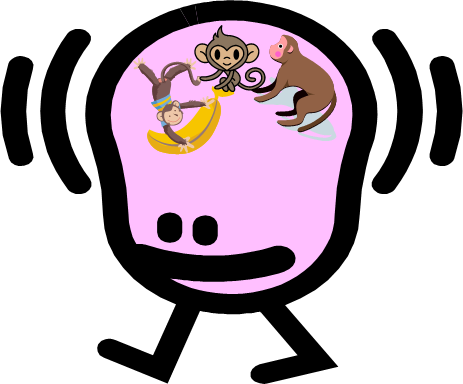
Psychological discord arises because, as one wise man has said, “we can’t bear to sit still with ourselves for one minute“.
Watch And Learn List
After watching Red Hat CEO Jim Whitehurst talk about “cultivating trust” in this refreshing 5 minute MIX video, I put him on my “watch and learn list“. Here are some priceless sound bytes from Jim’s passionate schpeel:
- You truly have to have no consequences.
- Says easy, does hard.
- The biggest insult is to have somebody throw out a comment or idea, and have nobody respond to it.
- Meritocracy does not equal democracy.
- Being called an idiot is not a bad thing. I encourage it and I celebrate it.
- If the senior leadership team isn’t posting on the site, isn’t responding to comments that are being made, then it’s nothing more than an “HR program“.

So, who’s on your watch and learn list?
Asynchronous Evolution
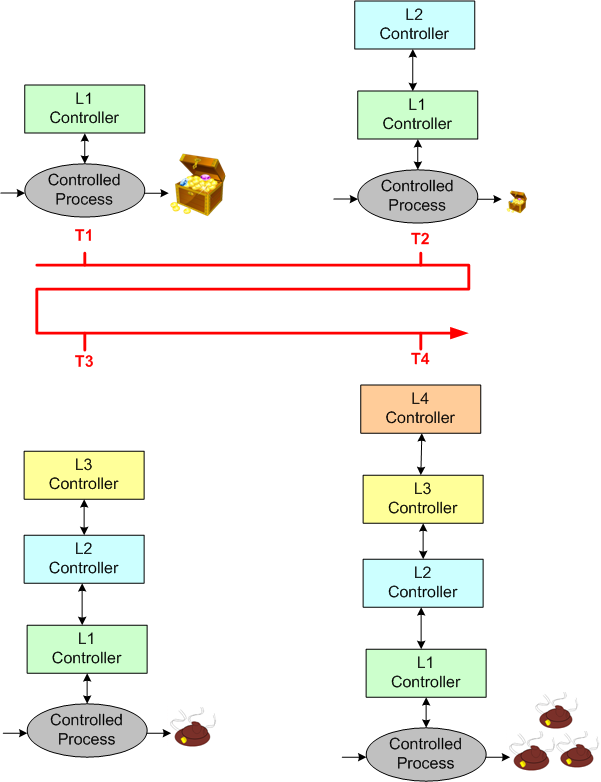
In “Engineering A Safer World“, Nancy Leveson asserts that “asynchronous evolution” is a major contributor to costly accidents in socio-technical systems. Asynchronous evolution occurs when one or more parts in a system evolve faster than other parts – causing internal functional and interface mismatches between the parts. As an example, in a friendly fire accident where a pair of F-15 fighters shot down a pair of black hawk helicopters, the copter and fighter pilots didn’t communicate by voice because they had different radio technologies on board.
As another example, consider the graphic below. It shows a project team comprised of domain analysts and software developers along with two possible paths of evolution.

Happenstance asynchronous evolution is corrosive to product excellence and org productivity. It underpins much misunderstanding, ambiguity, error, and needless rework. Org controllers that diligently ensure synchronous evolution of the tools/techniques/processes amongst the disciplines that create and build its revenue generating products own a competitive advantage over those that don’t, no?
Inner Work Life
The premise behind Theresa Amabile’s “The Progress Principle” is that individual performance in the work place is a function of the quality of one’s “Inner Work Life” (IWL). In addition, the greatest effector of a positive IWL is “continuing progress on meaningful work“.
To set the context for her subsequent findings, at the beginning of the book Ms. Amabile describes her research protocol:
“We recruited 238 people in 26 project teams in 7 companies in 3 industries. Some of the companies were small start-ups; some were well established, with marquee names. But all of the teams had one thing in common: they were composed primarily of knowledge workers, professionals whose work required them to solve complex problems creatively. Most of the teams participated in our study throughout the course of a particular project—on average, about four months. Every workday, we e-mailed everyone on the team a diary form that included several questions about that day. Most of those questions asked for numerical ratings about their inner work lives—their perceptions, emotions, and motivations during that day. The most important question allowed our respondents free rein: “Briefly describe one event from today that stands out in your mind. Amazingly, 75 percent of these e-mailed forms came back completed within twenty-four hours, yielding nearly 12,000 individual diary reports.”
The figure below shows the three tightly integrated and inseparable components of IWL and four major external forces that act upon it.
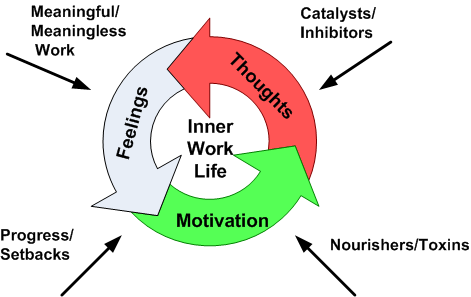
Of course, the quality of IWL can vary from month-to-month, day-to-day, and even hour-to-hour, depending on the presence and magnitude of the external forces acting upon it and the person-specific thoughts/feelings/motivation regarding said forces.
Contributors to an increase in IWL are catalysts, nourishers, meaningful work, and especially, progress on that meaningful work. Detractors are meaningless work, inhibitors, toxins, and setbacks to progress.
In orgs that are setup (either intentionally or unintentionally) as internally competitive command and control hierarchies where “me” is king, inhibitors, toxins, and setbacks abound. In great orgs, which can be structured as collaborative hierarchies or as any other pattern, catalysts, nourishers, and progress are pervasive up and down and across the structure.
Of course, the best parts of Ms. Amabile book are when she exhibits many of the heartfelt entries written by real people from her massive stash of 12,000 diary entries. Read it and weep, or read it and leap for joy, or read it and “meh“.

Related articles
The Law Of Diminishing Returns…

Why am I here?
WTF?
Meh!
D'oh!

My BTC Address



 Bulldozer00's Blog