Archive
Matched Vs. Mismatched
If for some strange reason you wasted some precious time and read yesterday’s post, you might have wondered what this “mismatch” thing is all about. Hopefully, this excerpt from the forthcoming 2012 edition of Bill Livingston’s D4P book (not the layman’s D4P4D) should shed some light on the mystery:
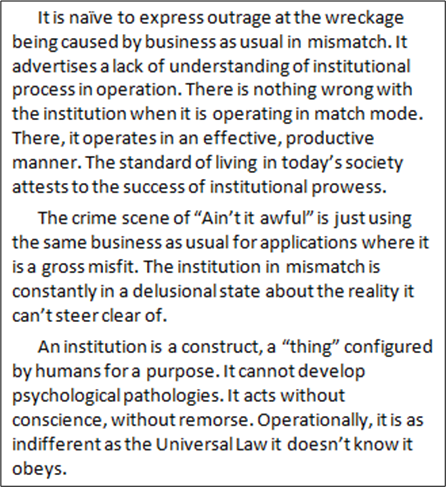
Naive outrage? Lack of understanding? Hmm. Not BD00. He knows everything.
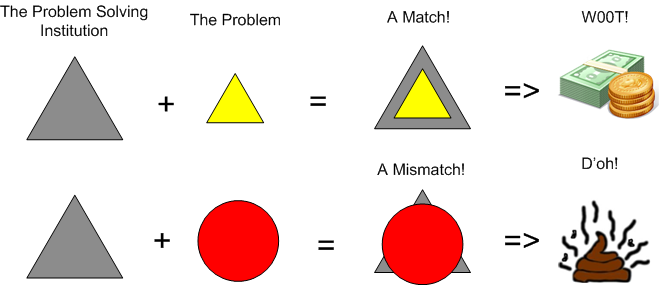
Keystone Koppers
Here’s just one entertaining excerpt from Bill Livingston’s darkly insightful and mind-bending book, “D4P4D“:
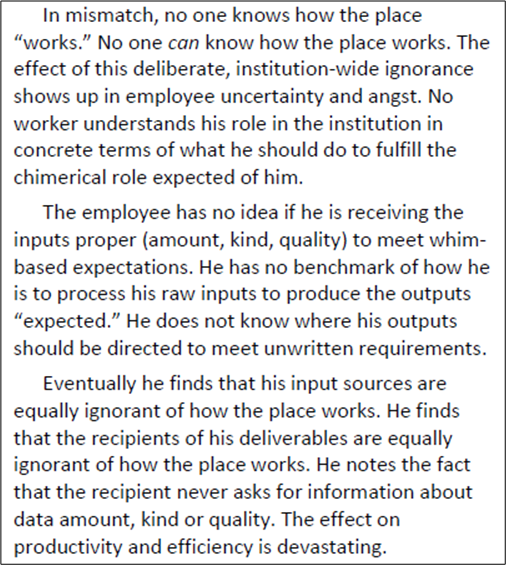
The key word in the whole excerpt is “mismatch“. When there is a “match“, all is well, and “business as usual” gets the job done effectively and efficiently.
So, whadya think? Fearful fact? Funny fiction? A touch of both?

Brain-Bustingly Hard
Unsettlingly, I admire the cross-disciplinary work of William L. Livingston because:
- It’s difficult to place into a nice and tidy category (systems thinking? social science? philosophy?).
- It resonates with “something” inside me but it’s brain-bustingly hard to absorb, understand, and re-communicate.
- The breadth of his vocabulary is astonishing.
- He doesn’t give a shit about becoming rich and famous.
- He digs up quotes/paragraphs from obscure, but insightful “mentors” from the past.
As the boxes below (plucked from the D4P4D) show, Gustave Le Bon is one of those insightful mentors, no?
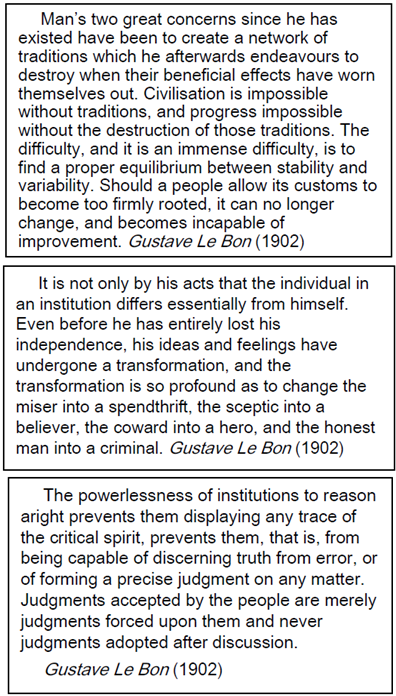
A lot of Mr. Le Bon’s work is available for free online at project Gutenberg.
D4P4D Tweetfest
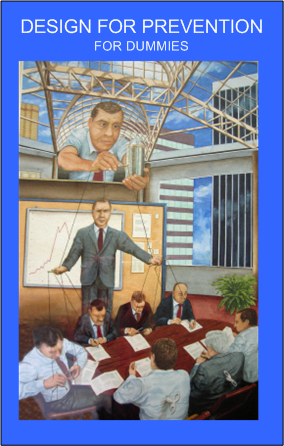
I’m in the process of reading William L. Livingston’s “Design For Prevention For Dummies” (D4P4D). I’m a pretty fast reader, but like my prior consumptions of all of Bill’s other dense and mind-absorbing writings, it’s a slow going affair that’s severely playin’ with my mind. I can only read about 10 fascinating pages per sitting before having to abandon ship and recoup my senses. After a martini, it’s 1 page and done. D’oh!
The book is full of masterful and tweet-worthy quotes like these:
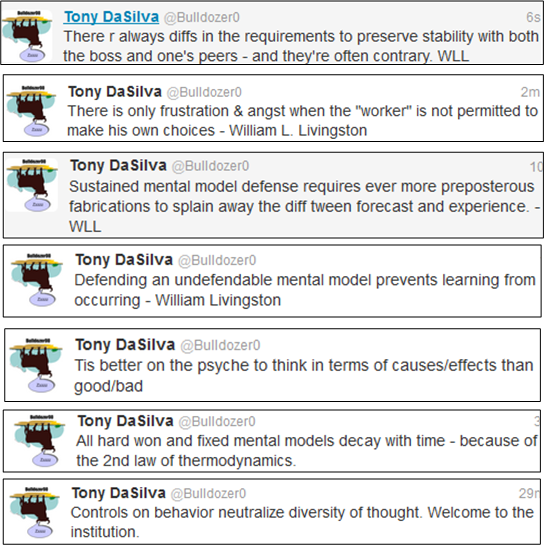
Bill, if you’re reading this bogus blog post, I apologize for the lack of attribution in some of the tweets. I think I know you well enough that you don’t give a chit, but since I twisted your words so much in some of the tweets, I didn’t know if I should attribute them to you. Cheers!
D4P4D
I just received two copies of William Livingston’s “Design For Prevention For Dummies” (D4P4D) gratis from the author himself. It’s actually section 7 of the “Non-Dummies” version of the book. With the addition of “For Dummies” to the title, I think it was written explicitly for me. D’oh!
The D4P is a mind bending, control theory based methodology (think feedback loops) for problem prevention in the midst of powerful, natural institutional forces that depend on problem manifestation and continued presence in order to keep the institution alive.
Mr. Livingston is an elegant, Shakespearian-type writer who’s fun to read but tough as hell to understand. I’ve enjoyed consuming his work for over 25 years but I still can’t understand or apply much of what he says – if anything!
As I slowly plod through the richly dense tome, I’ll try to write more posts that disclose the details of the D4P process. If you don’t see anything more about the D4P from me in the future, then you can assume that I’ve drowned in an ocean of confusion.
Attack And Advance
Check out this recent Grady Booch tweet on the topic of “why” he, James Rumbaugh, and Ivar Jacobson syntegrated their individual modeling technologies into what became the UML standard:

Over 20+ years ago, when the rate of global change was just a mere inkling of what it is today, my friend Bill Livingston stated in HFAW that: “complexity has a bright future“. He was right on the money and I admire people like Bill and the three UML amigos for attacking complexity (a.k.a ambiguity) head-on – especially when lots of people seem to love doing the exact opposite – piling complexity on top of complexity.
Extreme complexity may not be vanquishable, but (I think) it can be made manageable with the application of abstract “systems thinking” styles and concrete tools/techniques/processes created by smart and passionate people, no?
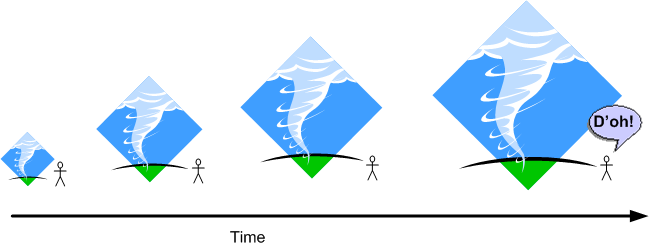
Exactly Two Years Hence
Before going any further, make a note of today’s date. Now, if you want to follow the timeline of a sad story, then perform the following procedure while noting the date of each post:
1 Read this post: My Company
2 Then read this post: The End Of An Era
3 Then read this post: Heartbroken, But Hopeful
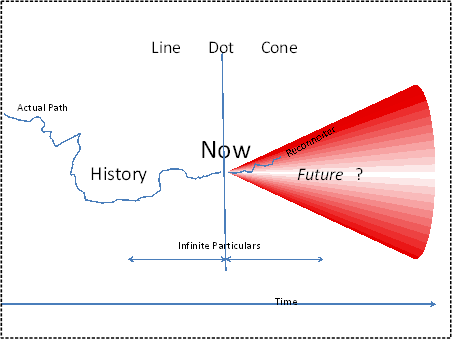
So, what does the future hold? Hell, I don’t freakin’ know. My friend Bill Livingston‘s line-dot-cone sketch says it all:
Healthy And Stress Free
Via the Netflix “Watch Instantly” service, I recently viewed this wonderful and scary National Geographic documentary: “Stress: Portrait Of A Killer“. The program focused on the results of these two studies:
- A thirty year study on African baboon troupes by a dedicated Stanford University professor.
- A forty year study, called the “Whitehall Study“, on 18,000 British civil service employees (hint: hierarchy)
Ready to be surprised? In both studies, the results showed that the higher up in the hierarchy you ascend, the healthier and less stressed you become. Yepp, that’s right. Fuggedabout the crap that’s been drilled into your brain about the increased stress that comes with the so-called increase in “responsibility” as one ascends the corpo ladder. The reality is that the higher up you go:
- the more titles you accumulate (for your impressive LinkedIn profile),
- the more money you make for taking on more responsibility that you’re not held accountable for,
- the less “dirty and visible work” you have to do, uh, except for aimless and agenda-less meetings where you toot your own horn over others,
- the more control over “others” you have – to deflect blame when you screw up – which you never do.
How can that be stressful and detrimental to your health? By all means fellow DICsters, keep scratchin’ and clawin’ your way toward the top. It’s healthy fer ya.
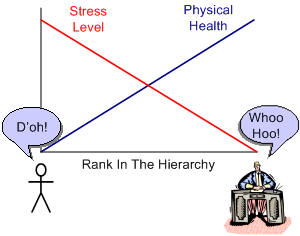
I actually wasn’t surprised by the show. Well over 20 years ago, friend and mentor William L. Livingston opened my eyes to the Whitehall study results in his epically disturbing “Have Fun At Work” book. It stunned me back then, but makes me laugh now.
To be fair, I have no doubt that there are many non-BMs in hierachical DYSCOs who do feel the increased stress their job should bring on. These are the people who thoughtfully and endlessly struggle with the conflicting demands of the wide ranging set of stakeholders who have an interest in the org’s economic and social performance. Thankfully, I have known, and do know, some of these people. How about you?
Note: If you want more detail on the documentary, check out my notes plus audio livescribe pencast on the program here.
D4P And D4F
As some of you may know, my friend Bill Livingston recently finished writing his latest book, “Design For Prevention” (D4P). While doodling and wasting time (if you hadn’t noticed, I like to waste time), I concocted an idea for supplementing the D4P with something called “Design For Function” (D4F). The figure below shows, via a state machine diagram, the proposed marriage of the two complementary processes.
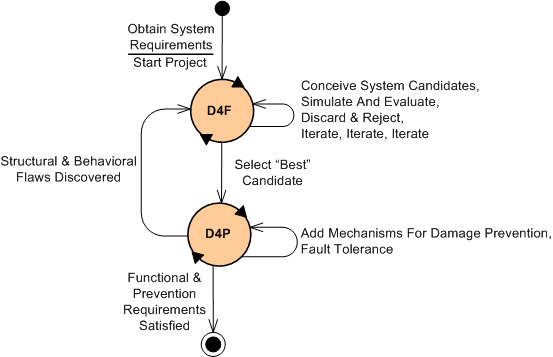
After some kind of initial problem definition is formulated by the owner(s) of the problem, the requirements for a “future” socio-technical system whose purpose is to dissolve the problem are recorded and “somehow” awarded to an experienced problem solver in the domain of interest. Once this occurs, the project is kicked off (Whoo Hoo!) and the wheels start churning via entry into the D4F state. In this state, various structures of connected functions are conceived and investigated for fitness of purpose. This iterative process, which includes short-cycle-run-break-fix learning loops via both computer-based and mental simulations, separates the wheat from the chaff and yields an initial “best” design according to some predefined criteria. Of course, adding to the iterative effort is the fact that the requirements will start changing before the ink dries on the initial snapshot.
Once the initial design candidate is selected for further development, the sibling D4P state is entered for the first (but definitely not last) time. In this important but often neglected problem solving system sub-state, the problem solution system candidate is analyzed for failure modes and their attendant consequences. Additional monitoring and control functional structures are then conceived and integrated into the system design to prevent failures and mitigate those failures that can’t be prevented. The goal at this point is to make the system fault tolerant and robust to large, but low probability, external and internal disturbances. Again, iterative simulations are performed as reconnaissance trips into the future to evaluate system effectiveness and robustness before it gets deployed into its environment.
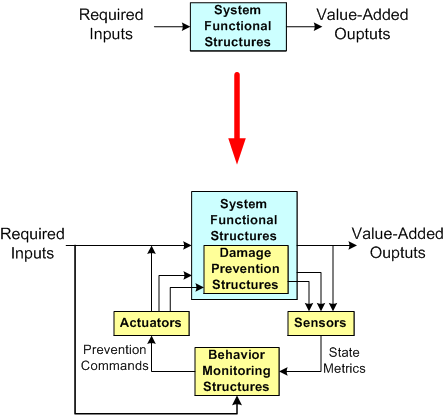
The figure below shows a dorky model of a system design before and after the D4P process has been executed. Notice the necessary added structural and behavioral complexity incorporated into the system as a result of recursively applying the D4P. Also note that the “Behavior Monitoring” structure(s), be they composed of people in a social system or computers in an automated system, or most likely both, need to have an understanding of the primary system goal seeking functions in order to effectively issue damage prevention and mitigation instructions to the various system elements. Also note that these instructions need not only be logically correct, they need to be timely for them to be effective. If the time lag between real-time problem sensing and control actuating is too great (which happens repeatedly and frequently in huge multi-layered command and control hierarchies that don’t have or want an understanding of what goes on down in the dirty boiler room), then the internal/external damage caused by the system can be as devastating as a cheaper, less complex system operating with no damage prevention capability at all.
So what do you think? Is this D4F + D4P process viable? A bunch of useless baloney?
Pick And Own
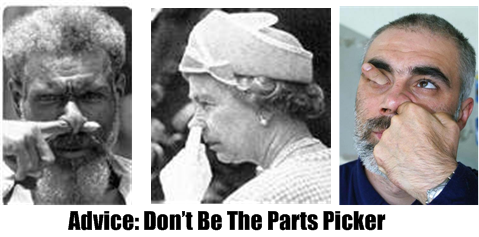
No, the title of this blost (short for blog-post and pronounced “blow-ssst”) is not “pick your nose“. It’s “pick and own“. My friend Bill Livingston uses the following catchy and true phrase throughout his book “Design For Prevention“:
He who picks the parts owns the behavior. – Unknown
This is certainly true in the world of software development for new projects. For maintenance projects, which comprise the vast majority of software work, this dictum also holds:
He who touched the code last owns the stank. – Unknown
Bill also truly but sadly states that when something goes awry, the dude who “picks the parts” or “owns the stank” is immediately sought out for punishment. When everything goes smoothly, the identity of the designer/maintainer magically disappears.
Punishment but no praise. Such is the life of a DIC. BMs, CGHs and CCRATS on the other hand, clever as they are, flip everything upside down. Since they don’t pick or maintain anything, they never get blamed for anything that goes wrong. Going one step further, they constantly praise themselves and their brethren while giddily playing the role of DIC-punisher and blamer.
WTF you say? If you fellow DICsters didn’t know this already, then accept it and get used to it because it’ll sting less when it happens over and over again. Tis the way the ancient system of patriarchical CCH institutions is structured to work. It doesn’t matter who the particular cast of characters in the upper echelons are. They could individually be great guys/gals, but their collective behavior is ubiquitously the same.


Why am I here?
WTF?
Meh!
D'oh!

My BTC Address



 Bulldozer00's Blog