Archive
One Or Many
The figure below models the increase in team stress level versus time for waterfall and time-boxed projects. As a project nears a delivery date, the stress levels increase dramatically as the team fixes turds, integrates individually developed features into the whole, and takes care of the boring but important stuff that nobody wanted to do earlier.
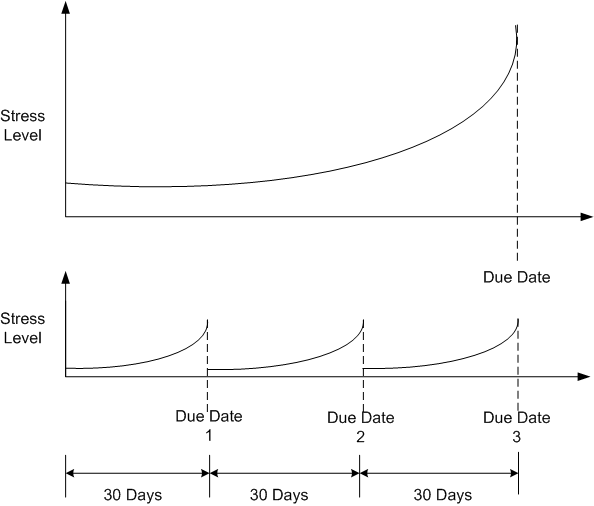
One tradeoff between the two types of projects is maximum stress level vs. number of stressful events. The maximum level of experienced stress is much higher for waterfall than any one time-boxed sprint, but it only occurs once as opposed to monthly. Pick your poison: a quick death by guillotine or a slow death by a thousand cuts.
Agilistas would have everyone believe that time-boxed projects impose a constant but very low level of healthy stress on team members while waterfall quagmires impose heart-attack levels of stress on the team. They may be right, because…..
(In case you haven’t noticed, BD00 is feeling the need to use the Einstein pic above more and more in his posts. I wonder why that is.)
Man-Made And Person-Specific
George Pransky taught (err, finally convinced) BD00 that all stress is man-made and person-specific. One person’s stress is another’s exhilaration. Nevertheless, environmental and situational factors probably do influence stress levels to some extent, no?
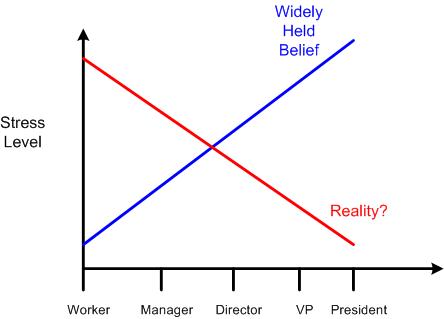
One would think that as one ascends the ladder in a hierarchical institution, his/her stress levels increase with rank, stature, and responsibility. This may be true in general, but there is some research evidence to the contrary:
No Sweat: Less Stress in Higher Ranks. “..this study suggests that those who manage others actually experience less stress — as measured through both biological and psychological assessments — than non-leaders. In fact, the stress level seems to go down as executives climb up the corporate ladder. Leaders with more authority, and more freedom to delegate day-to-day oversight, do better on this front than managers below them.”
The Whitehall Study. “The Whitehall cohort studies found a strong association between grade levels of civil servant employment and mortality rates from a range of causes. Men in the lowest grade (messengers, doorkeepers, etc.) had a mortality rate three times higher than that of men in the highest grade (administrators).”
It all comes down to “control“. If you believe (like BD00 does) in William T. Powers’ Perceptual Control Theory (that every living being is an aggregation of thousands of little control systems interconnected for the purpose of achieving prosperous survival), then the results make sense. It’s simply that people in the higher ranks have more “control” over their environment than those below them.
Of course, take this post (along with all other BD00 posts) with a carafe of salt. He likes to make up stuff that confirms his UCB by carefully stitching together corroborating evidence while filtering out all disconfirmatory evidence. But wait! You do that too, no?
Every man, wherever he goes, is encompassed by a cloud of comforting convictions, which move with him like flies on a summer day. – Bertrand Russell
Stress Particles
In a terrific duo of videos, George Pransky makes the observation that most people believe unequivocally that stress is objectively “out there“. He makes an analogy with fictional “stress particles“. Ya gotta stay away from places and events that are infested with stress particles, lest your physical health, mental health, and quality of life deteriorate as a result of becoming contaminated.
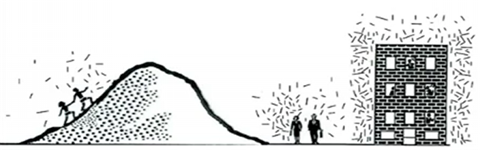
The fact of the matter is that all stress is man-made. To be more specific, all stress is self-made. Granted, it’s hard to argue that events such as job loss, divorce, moving, and the death of a loved one aren’t stressful, but the intensity of suffering one experiences is person-specific, no?
I think the amount of stress one manufactures for oneself is a function of one’s perceived control over situations and the degree with which one expects to have control. Control freaks who are in environments where they can’t or aren’t allowed to exercise control create more stress for themselves than non-control freaks. Control freak or not, environments where an individual can control his/her activities and influence the environment are perceived as less stressful.
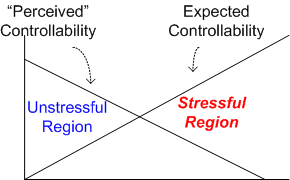
As can be inferred from the diagram, there are at least two ways to increase one’s “unstressful” region while decreasing one’s “stressful” region. Reduce expectations or increase perceived controllability. A better way is to realize the truth of the matter – there is no controllability, there’s only the ability to influence.
Healthy And Stress Free
Via the Netflix “Watch Instantly” service, I recently viewed this wonderful and scary National Geographic documentary: “Stress: Portrait Of A Killer“. The program focused on the results of these two studies:
- A thirty year study on African baboon troupes by a dedicated Stanford University professor.
- A forty year study, called the “Whitehall Study“, on 18,000 British civil service employees (hint: hierarchy)
Ready to be surprised? In both studies, the results showed that the higher up in the hierarchy you ascend, the healthier and less stressed you become. Yepp, that’s right. Fuggedabout the crap that’s been drilled into your brain about the increased stress that comes with the so-called increase in “responsibility” as one ascends the corpo ladder. The reality is that the higher up you go:
- the more titles you accumulate (for your impressive LinkedIn profile),
- the more money you make for taking on more responsibility that you’re not held accountable for,
- the less “dirty and visible work” you have to do, uh, except for aimless and agenda-less meetings where you toot your own horn over others,
- the more control over “others” you have – to deflect blame when you screw up – which you never do.
How can that be stressful and detrimental to your health? By all means fellow DICsters, keep scratchin’ and clawin’ your way toward the top. It’s healthy fer ya.
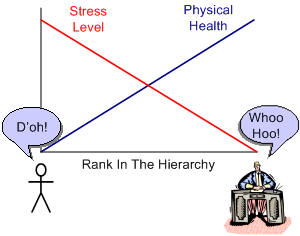
I actually wasn’t surprised by the show. Well over 20 years ago, friend and mentor William L. Livingston opened my eyes to the Whitehall study results in his epically disturbing “Have Fun At Work” book. It stunned me back then, but makes me laugh now.
To be fair, I have no doubt that there are many non-BMs in hierachical DYSCOs who do feel the increased stress their job should bring on. These are the people who thoughtfully and endlessly struggle with the conflicting demands of the wide ranging set of stakeholders who have an interest in the org’s economic and social performance. Thankfully, I have known, and do know, some of these people. How about you?
Note: If you want more detail on the documentary, check out my notes plus audio livescribe pencast on the program here.

Why am I here?
WTF?
Meh!
D'oh!

My BTC Address



 Bulldozer00's Blog