Archive
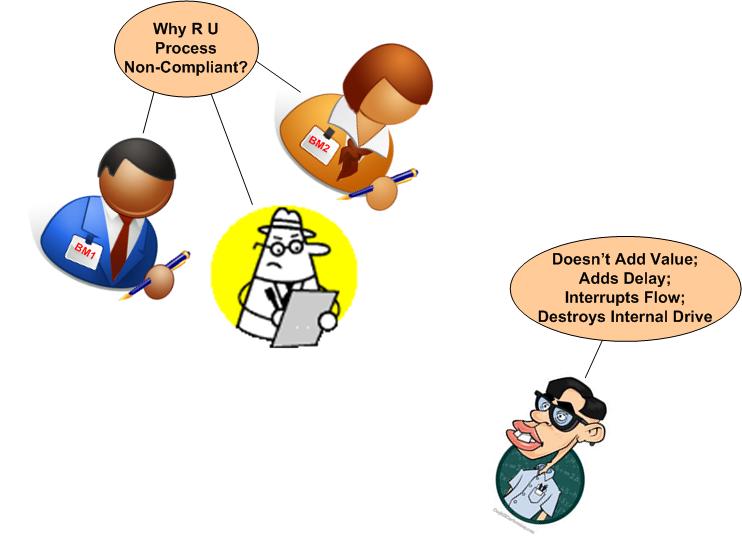
Non-Compliance
Courageous Journey
Here’s a dare fer ya:
If your org has a long, illustrious history of product development and you’re just getting started on a new, grand effort that will conquer the world and catapult you and your clan to fame and fortune, ask around for the post-mortem artifacts documenting those past successes.
If by some divine intervention, you actually do discover a stash of post-mortems stored on the 360 KB, 3.5 inch floppy disk that comprises your org’s persistent memory, your next death-defying task is to secure access to the booty.
If by a second act of gawd you’re allowed to access the “data“, then pour through the gobbledygook and look for any non-bogus recommendations for future improvement that may be useful to your impending disaster, err, I mean, project. Finally, ask around to discover if any vaunted org processes/procedures/practices were changed as a result of the “lessons learned” from innocently made bad decisions, mistakes, and errors.

But wait, you’re not 100% done! If you do survive the suicide mission with your bowels in place and title intact, you must report your findings back here. To celebrate your courageous journey through Jurassic Park, there may be a free BD00 T-shirt in the offing. Making stuff up is unacceptable – BD00 requires verifiable data and three confirmatory references. Only BD00 is “approved” to concoct crap, both literally and visually, on this dumbass and reputation-busting blawg.
Behind One’s Back
Most reasonable people think that “talking behind one’s back” is a dishonorable and disrespectful thing to do. But aren’t many corpo performance evaluation systems designed, perhaps inadvertently, to do just that?
In some so-called performance evaluation systems, an “authorized” evaluator (manager) talks to an evaluatee’s peers to get the “real scoop” on the behavior, oops, I mean the “performance” of the evaluatee. But can’t that be interpreted (by unreasonable people, of course) as a sanctioned form of talking behind one’s back?
In these ubiquitously pervasive and taken-for-granted performance evaluation systems, when the covert, behind-the-back, intelligence gathering is complete and an “objective” judgment is concocted, it’s bestowed upon the evaluatee at the yearly, formal, face-to-face get together.
Wouldn’t it be more open, transparent, and noble to require face-to-face, peer-to-peer reviews before the dreaded “sitdown” with Don Corleone? Even better, wouldn’t it be cool if the evaluatee was authorized by the head shed to evaluate the evaluator?
“Mr. Corleone, just about every action you took last year slowed me down, dampened my intrinsic motivation, and delayed my progess. Hence, you sucked and you need to improve your performance over the next year.“

But alas, hierarchies aren’t designed for equity. Besides, quid pro quo collaboration takes too much time and we all know time is money. Chop, chop, get back to work!
To make the situation more inequitable and more “undiscussable“, some orgs institute two performance evaluation systems: the formal one described above for the brain dead DICsters down in the bilge room; and the undocumented, unpublicized, and supposedly unknown one for elite insiders.
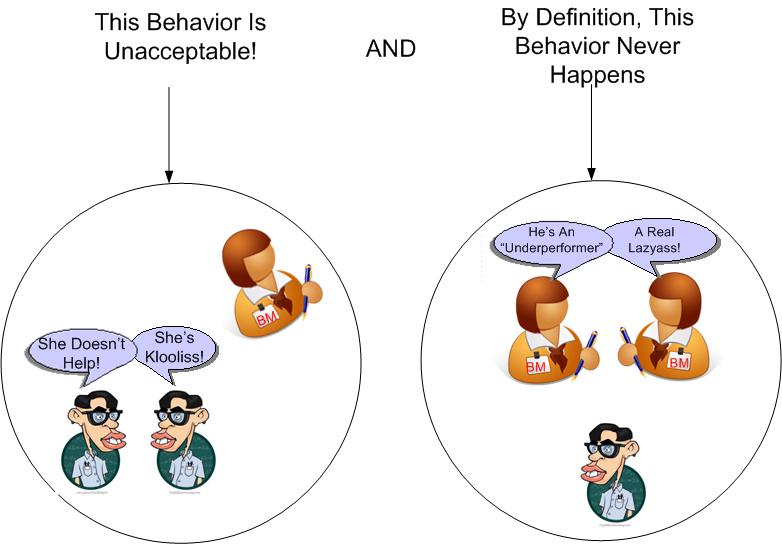
If you work in an org that has a patronizing, behind-your-back performance evaluation system, don’t even think of broaching the subject to those who have the power to change the system. As Chris Argyris has stated many times, discussing undiscussables is undiscussable.
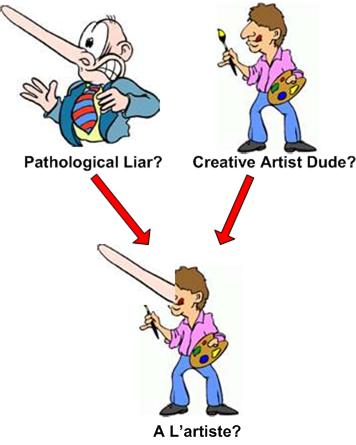
But wait! Snap out of that psychedelic funk you may have found yourself drifting into after reading the above blasphemy. Remember whose freakin’ blog you’re reading. It’s BD00’s blog – the self-proclaimed, mad, l’artiste.
Dependence Over Autonomy
Matthew Gill’s “Accountant’s Truth” provides a fascinating analysis and expose of the attitudes and culture of the accounting industry through a series of in-depth interviews with practicing accountants. As I’m reading the book, I’m using the Kindle’s marvelous “share” feature to tweet snippets like this one out into the ether:
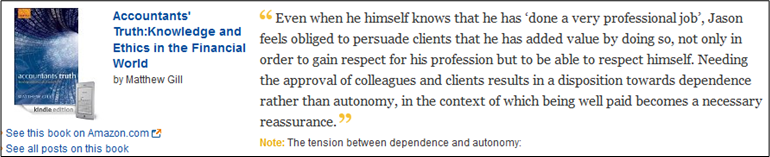
Now, compare this excerpt with the following pair of tweets from one of my fave spiritual teachers, Byron Katie:

Interesting, don’t you think?
Monopolistic Providers
In search of economies of scale, centrally planned and controlled economies in nations and corporations tend to create monopolistic providers of goods and services. For example, in corporations, accounting, personnel, and R&D departments are usually deliberately organized as subsidized monopolies. They are subsidized in the sense that the users of their products or services do not pay for them directly; the supplying units are supported financially by funds that are allocated to them from above. The pool from which these funds are drawn is filled by a “tax” allocated from above to the units served. Monopolistic units that are subsidized are generally insensitive and unresponsive to the users of their services, but they are sensitive and responsive to the desires of the higher-level units that subsidize them. These higher level units are even more removed from the units served than the serving units. As a result, they are often unaware of, or unresponsive to, the needs and desires of the internal users of monopolistically provided goods and services. – Russell Ackoff (Ackoff’s Best: His Classic Writings on Management)
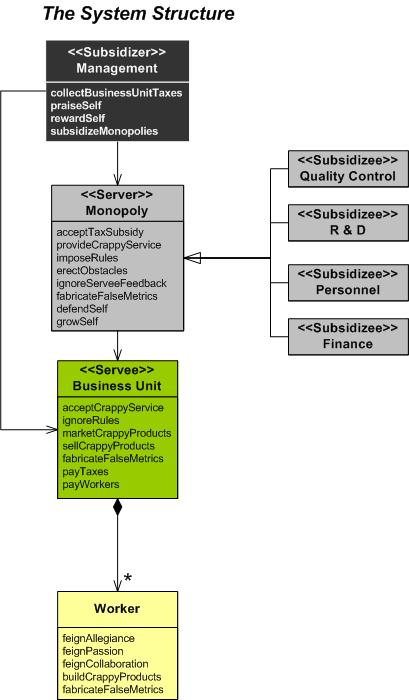
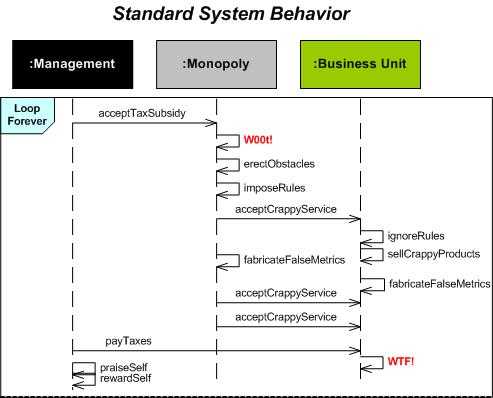
OK, time to practice my “bent” UML modeling skills and test your understanding with the class and sequence diagram pair below. The class diagram provides a structural view of a fictional Ackoffian system. The sequence diagram steps through an amalgam of behaviors in a world where monopolies rule. Any questions, comments, critiques, accolades, WTFs?
Four Reasons
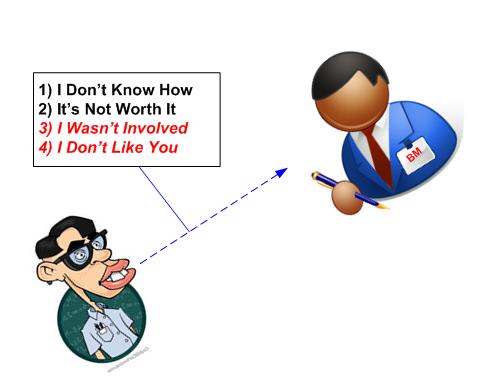
When I don’t do something that I’m “supposed” to do, it comes down to one of two reasons:
- I don’t know how to do it because of a lack of expertise/experience (ability).
- I don’t believe it adds any, or enough, value (motivation).
But wait, I lied! There are also two more potential, but publicly undiscussable reasons. They’re elegantly put into words by Mr. Alexander Hamilton:
Men often oppose a thing merely because they have had no agency in planning it, or because it may have been planned by those whom they dislike. – Alexander Hamilton
How about you? When you don’t do something expected of you, why don’t you do it?
Just One Measly Tweet?
I just found out from this article, “The $1.3 Trillion Price Of Not Tweeting At Work“, that Oracle’s mercurial CEO, Larry Ellison, has tweeted one, and only one, message out onto the ether. And a nasty one it is:
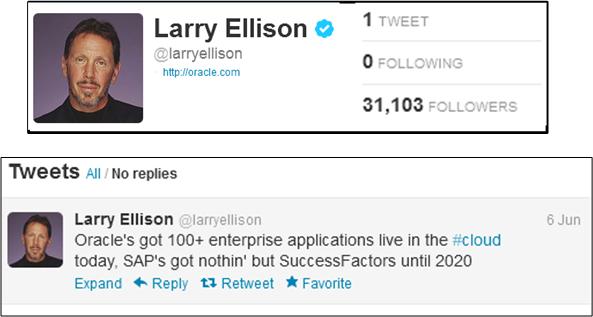
The Fast Company article’s author, HootSuite CEO Ryan Holmes, also states an interesting fact:
Among CEOs of the world’s Fortune 500 companies, a mere 20 have Twitter accounts. As social media spreads around the globe, one enclave has proven stubbornly resistant: the boardroom. Within the C-suite, perceptions remain that social media is at best a soft PR tool and at worst a time sink for already distracted employees. Without a push from the top, many of the biggest companies have been slow to take the social media plunge.
Ryan goes on to speculate that the status quo may change because of the findings in a report from the McKinsey Global Institute:
According to an analysis of 4,200 companies by the business consulting giant, social technologies stand to unlock from $900 billion to $1.3 trillion in value. At the high end, that approaches Australia’s annual GDP. Two-thirds of the value unlocked by social media rests in “improved communications and collaboration within and across enterprises”.
BD00 hopes that Mr. Holmes is right, but there’s a lot of inertia and outdated tradition motivating the mute behavior in the head shed. There’s paranoia about giving away too much information to competitors and there’s a fear that the penthouse occupants might say something that destroys the illustrious image of infallibility unconsciously burned into the minds of themselves and their minions.
Just cutting email out of the picture in favor of social sharing translates to a productivity windfall as “more enterprise information becomes accessible and searchable, rather than locked up as ‘dark matter’ in inboxes.”
Oh man, despite the risk of being served with a cease-and-desist order and/or being slapped with a slander lawsuit, I couldn’t resist the urge to do this:

Besides our buddy Larry, can you name all the faymoose people in this dastardly mugshot collage without using Google? I’d offer up a BD00.com T-shirt to the winner, but I’m all sold out.
Related articles
- CEOs and Social Media (web2.sys-con.com)
- Do Non Tweeting CEOs and Brands Leave Money on the Table? (radian6.com)
- How is Social Media Affecting Your Business? (elocal.com)
- Fortune 500 Increased Use of Social Media in 2012 – Twitter #1 (customerthink.com)
- Social Media’s Productivity Payoff (blogs.hbr.org)
Correlation Coefficients
Please consider these well known, conflicting cliches:
- “Nice guys finish last”
- “What goes around comes around”
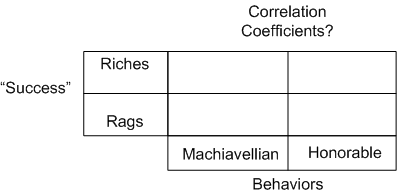
The first implies that in order to succeed, a ruthless, Machiavellian set of behaviors is required (Oracle? Bank Of America?). The second one-liner implies that those same behaviors will boomerang around and precipitate your downfall (Enron?, Lehmann Bros?). Do ya think there’s a strong correlation between org behaviors and financial success? Is there any correlation at all, or is it just a random crap shoot?
Please fill in the boxes below with a value ranging from -1.0 to 1.0 and place the sheet on the teacher’s desk on your way out of the classroom. The “right” answers, obtained from an impeccably executed and extensively peer-reviewed research study, will be disclosed at some random time in the future.
Unexplained Resurrections
If you dive head first into the work of Bill Livingston and/or Rudy Starkermann, you’ll find it easy to either develop or maintain a doomsday mindset of a future increasingly dominated by bigger and more inhumane institutions. Their rigorously developed physics and control engineering-based theories of institutional behavior can seem ironclad and 100% irrefutable. BD00 has drunk the kool-aid, but not the whole glass.
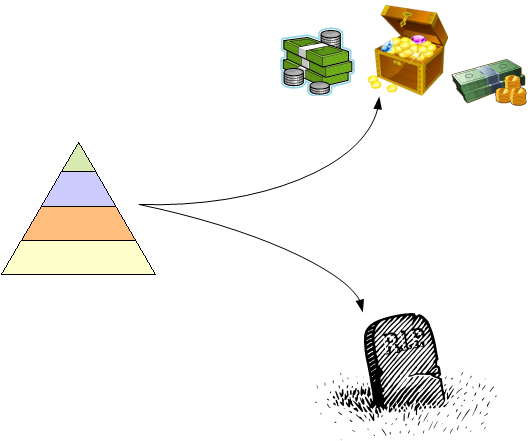
According to BD00’s interpretation of Livingston’s D4P, once an established institution encounters a novel and identity-threatening situation, annihilation is sure to follow because it is incapable of learning and adapting at the expense of losing its identity. I think that to be true in general, but not in the absolute. There are too many counter-examples of resurrection in the real world that go unacknowledged in his work:
- IBM was on its deathbed stuck in a “mainframe hardware” mindset, but it recovered under cookie-man Lou Gerstner by transforming itself into a software services company.
- Apple was on its deathbed, but it recovered under Steve Jobs and a financial bailout from Microsoft (yes, Microsoft!).
- My company, which was consistently losing money, heavily in debt, and arguably on its deathbed, is now debt-free and making money in a wickedly brutal economic environment.
I’ve had the privilege of e-interacting with both Bill and Rudy over the past several years. Bill sends me his draft work regularly for feedback/review and he’s very inviting of criticisms and challenges. However, I’m not satisfied with his answers when I pose cases like those listed above to counter those examples in his books that promote his theories.
When all is said and done, Livingston and Starkermann are two genuine social science originals and much of what they say is true. I highly recommend delving into what they have to say.
Related articles
- Yin And Yang (bulldozer00.com)
- From The Ground Up (bulldozer00.com)
- Building The Perfect Beast (bulldozer00.com)
- Cross-Disciplinary Pariahs (bulldozer00.com)
Marginalizing The Middle
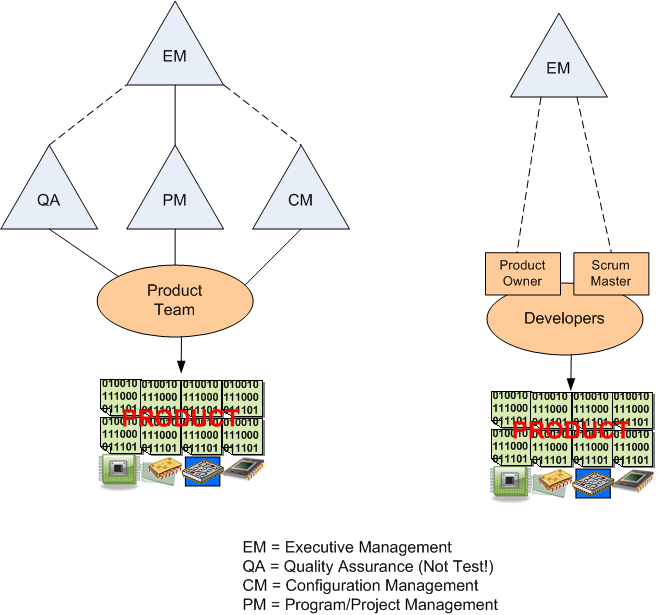
Because they unshackle development teams from heavyweight, risk-averse, plan-drenched, control-obsessed processes promoted by little PWCE Hitlers and they increase the degrees of freedom available to development teams, agile methods and mindsets are clearly appealing to the nerds in the trenches. However, in product domains that require the development of safety-critical, real-time systems composed of custom software AND custom hardware components, the risk of agile failure is much greater than traditional IT system development – from which “agile” was born. Thus, a boatload of questions come to mind and my head starts to hurt when I think of the org-wide social issues associated with attempting to apply agile methods in this foreign context:
Will the Quality Assurance and Configuration Management specialty groups, whose whole identity is invested in approving a myriad of documents through complicated submittal protocols and policing compliance to existing heavyweight policies/processes/procedures become fearful obstructionists because of their reduced importance?
Will penny-watching, untrusting executives who are used to scrutinizing planned-vs-actual schedules and costs in massive Microsoft Project and Excel files via EVM (Earned Value Management) feel a loss of importance and control?
Will rigorously trained, PMI-indoctrinated project managers feel marginalized by new, radically different roles like “Scrum Master“?
Note: I have not read the oxymoronic-titled “Integrating CMMI and Agile Development” book yet. If anyone has, does it address these ever so important, deep seated, social issues? Besides successes, does it present any case studies in failure?
… there is nothing more difficult to carry out, nor more doubtful of success, nor more dangerous to handle, than to initiate a new order of things. For the reformer makes enemies of all those who profit by the old order, and only lukewarm defenders in all those who would profit by the new order… – Niccolo Machiavelli

Why am I here?
WTF?
Meh!
D'oh!

My BTC Address



 Bulldozer00's Blog