Archive
A Democratic Workplace? No Freakin’ Way!
“We’ll send our sons anywhere in the world to die for democracy,” says Ricardo Semler (CEO of Semco), “but don’t seem to apply the concept to the workplace. This is a tragic error, because people on their own developing their own solutions will develop something different“.
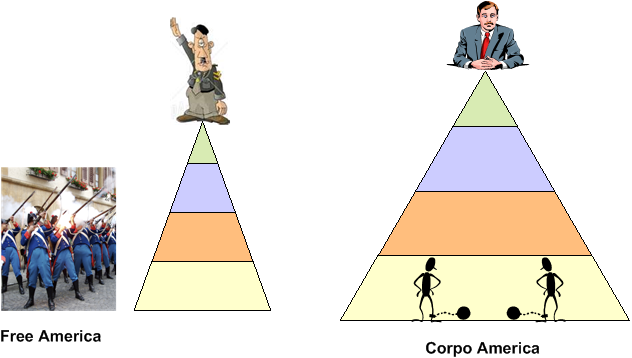
In Semler’s own firm, there are no five-year business plans (which he views as wishful thinking), but rather “a rolling rationale about numbers.” A project takes off only if a critical mass of employees decides to get involved. Staff determine when they need a leader, and then choose their own bosses in a process akin to courtship, says Semler, resulting in a corporate turnover rate of 2% over 25 years.
Interested in hearing more from Mr. Semler? Then check out this video of a lecture he gave to elite MIT business students way back in 2005:
Blasphemy! We know what’s best for all the cake eaters in our kingdom because we’re infallible, of course. That couldn’t possibly work here because our business is too different. It’s “not applicable“.
Four Managers And An Engineer
A lot of people have heard of the blockbuster movie “Four Weddings And A Funeral”, but no one has heard of the cinematic release in incubation titled “Four Managers And An Engineer“. The story line goes like this:
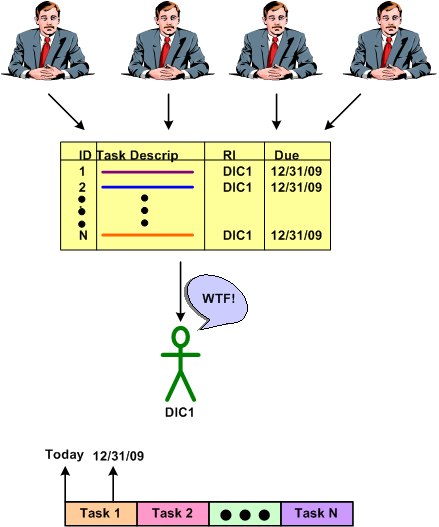
- One manager calls a “planning” meeting and invites three peer managers (actually two peers and one pseudo-manager) and one enginerd.
- The meeting host manager presents an initial powerpoint plan to the group.
- At the bottom of each and every plan page, the one enginerd’s name appears in a colored box coupled with a non-trivial task to do and a critical “need by” date.
- The enginerd points out the irony of the four-to-one ratio of managers to enginerds present at the meeting when other more important managers up the chain are crying out for higher profit numbers.
- To further build tension in the melodrama, the enginerd asks why no one else on the team was assigned any of these critically important tasks.
- One more Hershey kiss is added to the pile of poop when the enginerd graphically shows that sequentially placing the task boxes end-to-end (since they’re assigned to one bottleneck taskee) would blow the “planned” schedule out of the water.
- As the coup de grace, the enginerd asks what non-technical management tasks the managers assigned to themselves, and why they’re not in the plan with their names next to them.
- In a coordinated rage, the managers attack the engineer and bludgeon him/her to death with their blackberrys and leather bound Covey planners.
- The managers then; hide the body, replace the name of the deceased engineer on every page of the powerpoint plan with that of another enginerd, call another meeting, and invite themselves along with the next victim to their group-conspired serial killing spree.
Like another blockbuster movie, “Ground Hog Day”, the cycle repeats itself ad-infinitum. Unlike Ground Hog Day, there’s no breaking out of the loop and no transitioning to a happy Hollywood ending. The movie drones on until the audience gets bored to death and leaves the theater or the projector breaks down, whichever comes first. Wanna role in my movie? Wanna be the director? Wanna finance it?
Cog Diss
If interested, check out Mary Jo Foley‘s hindsight blog post regarding Microsoft CEO Steve Ballmer‘s screw-up on the Vista fiasco: Feedback Failure. Mary laments:
“As a result, I’m left wondering about Vista, as many are/were about the current financial crisis: Why didn’t anyone inform us sooner of the impending meltdown? Weren’t there warning signs? Where was everybody?”
Surely Mary, you’re joking, right? You’re wondering where everybody was and why nobody informed us? In short, at least some Microsoft DICS who weren’t deeply and personally invested in the Vista project either:
- knew about the impending doom but were afraid to speak up,
- did have the courage to speak up but were “ignored” or slapped down,
- “disconnected and distanced” themselves from the project because they didn’t give a chit about it (apathy)
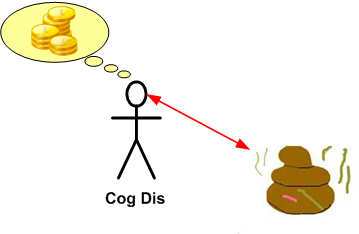
Those who were fully ensconced in the quagmire were blinded by the light. They suffered from the common and pervasive human malady called “cognitive dissonance“. Cog Diss is where you convince yourself that you’re looking at a pile of gold when in reality you’re staring at a pile of poop. However, deep down, you sense the mismatch and experience uneasy feelings as a result.
All the dysfunctional behaviors described above are caused by living life too long within the confines of an unchanging and soul-busting CCH bureaucracy.
Stunning, But Not Surprising
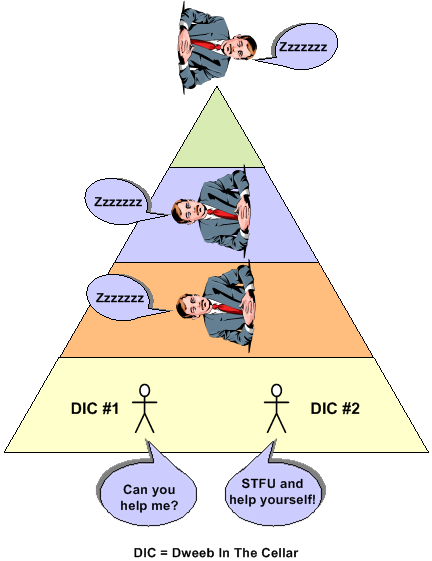
Suppose you had an innately complex product to sell. Now suppose that a potential customer comes up to you and asks for a user’s starter guide to help him/her understand your product for the purpose of making a buy decision. Would you tell that customer “We’re short-handed and have schedules to meet, so write It yourself!“? WTF!
For people who work in CCH bureaucracies but don’t know it (or who do know it, but conveniently ignore it and don’t do squat to dissolve it), this behavior between internal groups is ubiquitous, systemic, and so pervasive that it’s taken for granted. It’s stunning, but not surprising.
Incremental Watts
I don’t know which name I like better, Watts Wacker or Soupy Sales, but this post is about Watts. Watts Wacker is a CEO and futurist who uttered one of my favorite quotes:
You can’t increment your way into the future – Watts Wacker
I think this quote is directed toward leaders of cushy, static, and stanky CCH companies who are so afraid of the future that they move by inches at a time in passive response to external changes. The only way to leapfrog your competitors, since they’re just as afraid as you and are inching along like molassess running up hill, is to make a disruptive leap into the future.
It takes revolutionaries to trigger disruptive leaps into the unknown. Someone (actually, two people) with an innocent but assuredly incremental mindset recently said to me: “Revolutionaries are usually lined up in front of a wall and shot“. My response was “that’s why there are so few of them“. Bummer.

Watercooler Whining
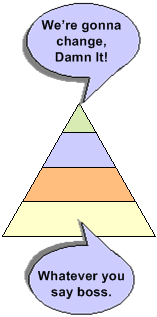
Regardless of whether they work for a world class org or a brutal and oppressive CCH bureaucracy, I assert that most DICs “discuss” among themselves what they think is wrong with their org at all layers in the caste system. The difference is that in CCH abominations, the discussions are confined to the local environment and well out of earshot of the BMs in charge (In CCHs, BMs, as opposed to PHORS, are always in charge). As soon as the whiff of cologne and bright beams of light emitted by an approaching self-important BM is detected by the “whining” DICs, all dialog stops and the malcontents disperse as if someone let loose an SBD stanker.
 It doesn’t take Sherlock’s genius to realize that most of the water-cooler discussions ‘tween DICs are self-serving and myopic BS stories about how they are “victims” and how they have been “wronged” by other fellow DICs and disconnected BMs. However, some, just maybe some complaints are about legit, systemically baked-in problems that, if competently addressed, would improve corpo performance. In most cases, the DICs don’t know how to solve the org issue or they don’t have the authority and clout to try out their solutions.
“The day soldiers stop bringing you their problems is the day you have stopped leading them. They have either lost confidence that you can help or concluded that you don’t care. Either case is a failure of leadership.” – Karl Popper
I’d like to mangle Popper’s brilliant quote with:
“If you haven’t setup and maintained your corpo culture so that your soldiers feel comfortable bringing their problems to you, or you have done so but have continuously ignored their concerns by doin’ nuthin’ of substance to help them, they have either lost confidence that you can help or concluded that you don’t care. Either case is a failure of leadership.” – bulldozer00.
Of course, I just make stuff up and I’m not fit to lead anybody, so don’t pay attention to anything I say.
Conflict Aversion And Cultures Of Fear
With no scientific backing or personal credentials to provide me with any semblance of credibility, I assert that conflict aversion and cultures of fear go together like hand and glove; Jenny and Forrest; peas and carrots; peanut butter and chocolate.
In an org that operates in accordance with a culture of fear, inter-personal and inter-group conflicts are avoided at all costs because of the fear of post-conflict consequences. If a culture of fear doesn’t already exist, all it takes is one or two publicly visible rebukes of a conflict initiator to snap a “culture of fear” into place. Common forms of rebuke are: peek-a-boo visits, compensation ceilings, withholding of career development opportunities, placement on a formal performance improvement plan (affectionately called a “PIP”), and covert persecution. The closer to home that a conflict initiator treads to a hairball problem that is eroding performance of the whole, the more severe the rebuke.
In a culture of fear, because there’s no sane incentive for motivating well-meaning people to point out emergent org problems that everybody already knows about, nobody does nuthin’ of substance until there’s a crisis. When a crisis inevitably manifests because of problem neglect, conflict aversion temporarily goes out the window because real feelings and passions bubble to the surface. Under the duress of a crisis, the conflicts that do emerge in a normally conflict averse org are much more explosive and damaging than those that occur in a continuously conflict-accepting org. Thus, when the crisis passes, the left over socio-communication system infrastructure wreckage breeds poorer future performance and a regression back into – you guessed it – the same old, same old, conflict averse way of operation. Bummer.
We Promise To Change, And We Really Mean It This Time
GM is a classic example of a toxic Command and Control Hierarchical (CCH) corpocracy. In this NY Times article, the newly anointed hierarchs and their spin doctors promise that “things will be different” in the future. Uh, OK. If you say so.
According to corpo insiders, here’s the way things were.
…employees were evaluated according to a “performance measurement process” that could fill a three-ring binder.
“We measured ourselves ten ways from Sunday,” he said. “But as soon as everything is important, nothing is important.”
Decisions were made, if at all, at a glacial pace, bogged down by endless committees, reports and reviews that astonished members of President Obama’s auto task force.
“Have we made some missteps? Yes,” said Susan Docherty, who last month was promoted to head of United States sales. “Are we going to slip back to our old ways? No.”
G.M.’s top executives prized consensus over debate, and rarely questioned its elaborate planning processes. A former G.M. executive and consultant, Rob Kleinbaum, said the culture emphasized past glories and current market share, rather than focusing on the future.
“Those values were driven from the top on down,” said Mr. Kleinbaum. “And anybody inside who protested that attitude was buried.”
In the old G.M., any changes to a product program would be reviewed by as many as 70 executives, often taking two months for a decision to wind its way through regional forums, then to a global committee, and finally to the all-powerful automotive products board.
“In the past, we might not have had the guts to bring it up,” said Mr. Reuss. “No one wanted to do anything wrong, or admit we needed to do a better job.”
In the past, G.M. rarely held back a product to add the extra touches that would improve its chances in a fiercely competitive market.
“If everybody is afraid to do anything, do we have a chance of winning?” Mr. Stephens said in one session last month.
The vice president would say, ‘I got here because I’m a better engineer than you, and now I’m going to tell you how bad a job you did.’ ”
The Aztek was half-car, half-van, and universally branded as one of the ugliest vehicles to ever hit the market. … but his job required him to defend it as if it were a thing of beauty.
Here’s what they’re doing to change their culture of fear, malaise, apathy, and mediocrity:
G.M.’s new chairman, Edward Whitacre Jr., and directors have prodded G.M. to cut layers of bureaucracy, slash its executive ranks by a third, and give broad, new responsibilities to a cadre of younger managers.
Replacing a binder full of job expectations with a one-page set of goals is just one sign of the fresh start, said Mr. Woychowski.
Mr. Lauckner came up with a new schedule that funneled all product decisions to weekly meetings of an executive committee run by Mr. Henderson and Thomas Stephens, the company’s vice chairman for product development.
Mr. Stephens has been leading meetings with staff members called “pride builders.” The goal, he said, was to increase the “emotional commitment” to building better cars and encourage people to speak their minds.
“But now we need to be open and transparent and trust each other, and be honest about our strengths and weaknesses.”
So, what do you think? Do you think that these “creative” CCH dissolving solutions and others like them will do the trick? Do you think they’ll pull it off? Is it time to invest in the “new” GM’s stock?
Orchestrated Reviews
If you think your design is perfect, it means you haven’t shown it to anyone yet – Harry Hillaker
Open, frequent, and well-engineered reviews and demonstrations are great ways to uncover and fix mistakes and errors before they grow into downstream money and time sucking abominations. In spite of this, some project cultures innocently but surely thwart effective reviews.
Out of fear of criticism, designers in dysfunctional cultures take precautions against “looking bad“. Camouflage is generated in the form of too much or too little detail. Subject matter experts are left off the list of reviewers in order to uphold a false image of infallibility.
Another survival tactic is to pre-load the reviewer list with friends and cream puffs who won’t point out errors and ambiguities for fear of losing their status as nice people and good team players. In really fearful cultures, tough reviewers who consistently point out nasty and potential budget-busting errors are tarred and feathered so that they never provide substantive input again. In the worst cases, reviews and demonstrations aren’t even performed at all. Bummer.

Standard CCH Blueprint
The figure below is a “bent” UML (Unified Modeling Language) class diagram of a standard corpo CCH (Command and Control Hierarchy). Association connectors were left off because the diagram would be a mess and the only really important relationships are the adjacent step-by-step vertical connections. Each box represents a “classifier”, which is a blueprint for stamping out objects that behave according to the classifier blueprint. The top compartment contains the classifier name, the second compartment contains its attributes, and the third compartment houses the classifier’s behaviors. Except for the DIC Product Development Team, the attributes of all other classifiers were elided away because the intent was to focus on the standard cookie-cutter behaviors of each object in the “system”. Of course, the org you work for is not an instantiation of this system, right?


Why am I here?
WTF?
Meh!
D'oh!

My BTC Address



 Bulldozer00's Blog