Archive
In Defense Of Incompetence.
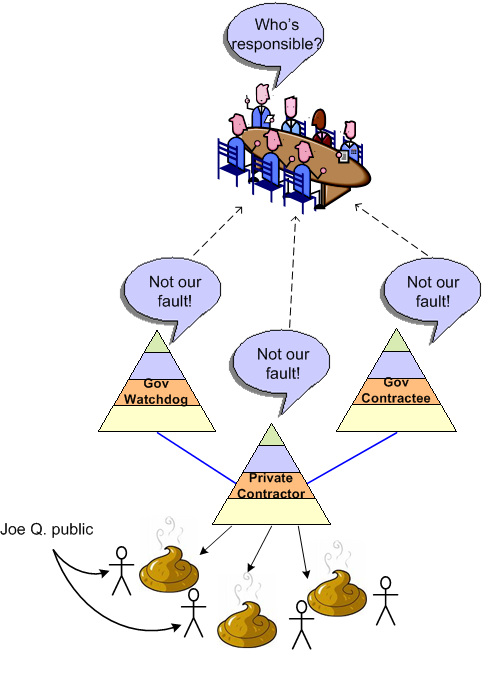
When a government contractor is exposed as incompetent by an external observer (e.g. the press or a civilian group), the government agency that hired them almost always comes to its defense. That shouldn’t be surprising to you because those bureaucratic, and thus, mindless agencies:
- Will do anything to avoid looking incompetent in front of congress for hiring the nin-cum-poops
- Spend other people’s money (yours and mine) instead of their own – and we’re not talkin pocket change here
In addition, the “esteemed” government watchdog agencies (e.g. SEC and FDA and EPA) responsible for ensuring that contractors don’t perpetuate gargantuan disasters make up all kinds of excuses for not detecting the incompetence before massive stakeholder damage has been manifest (lost money, lost lives, lost livelihoods). They do this, of course, because these dudes don’t want to look incompetently asleep at the wheel either.
The system sux and the exhibited behavior is encrusted in its hierarchical, silo+caste system structure that crushes individual conscience. Expect this behavior to go on and on since complexity and the intertwining of interests and agendas will no doubt keep increasing as the world’s population increases. After all, if we can’t fix it, it ain’t broke.
How Do You Like It?
Stunningly, I was once (and only once) asked by a manager how I liked my raise. It was stunning because I speculate that cosmic events like this rarely happen. Has it ever happened to you?
I told the manager that I was happy to get a raise at all. I also told him that since it was the same amount as the average company given raise, I perceived that he thought of me as an average employee. He, and no other manager has ever asked me for “raise feedback” again.
Of course, fairness and unfairness are in the eye of the beholder, or, in physicist-speak, the “observer”.

What A Deal!
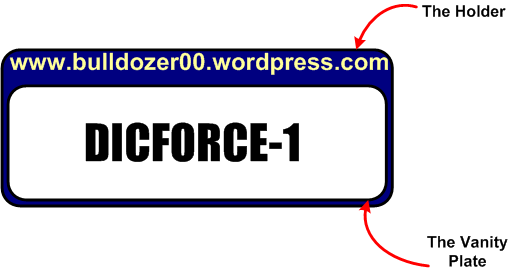
Do you know those dorky self-promotional license plate holders that car dealers attach to your sparkling new vehicle before you drive it off the lot? Well, the Gold’s gym that I religiously go to has had a stack of them publicly available for sale over the past couple of months. When I first saw them next to the other items for sale, I said to myself:
“WTF? Do the clueless BMs in charge of this place really expect to sell any of those stupid, self-serving contraptions? Hell, even if they offered to pay gym members to take them, they’d still gather dust and waste shelf space until someone in the corpo chain of elites finally took responsibility and owned up to the grumpy they pinched in public.”
About a week ago, management placed the stack of crap right on the check-in counter with a sign that proudly displayed a massive reduction in price from $5 to 1$. What a deal, no?
I finally couldn’t take it anymore and I asked my fellow DIC manning the counter if her management really thought they’d be able to sell those abominations. She said she didn’t know and that she personally hadn’t sold a single one over the time they’d been placed on the market. Surprise!
I left the gym that day suggesting that she tell her bosses that a customer said that they should concentrate more on continuously satisfying their customers instead of thinking of them as moronic walking wallets. As an example of customer satisfaction, I told her to ask “them” if they could refill the woefully deflated balance balls every once in awhile. I even suggested (and it wasn’t the first time) that if they put a pump near the ball rack, I’d fill them occasionally and maybe other users would too. Knowing the typical BM mindset, they probably auto-rejected the idea because they’d be afraid that their “customers” would steal the pump.
How much would you pay for my license plate holder?
Plan, Plan, Plan…. Blah, Blah, Blah.
Preface
People followed Martin Luther King of their own free will because he had a dream, not a plan. – Simon Sinek
On the other hand, know-it-all business school trained weenies will profess (in a patriachical and condescending tone):
Failing to plan is planning to fail – Unknown
Irrelevant Intro
When I started this relatively loooong blarticle, I had no freakin’ idea where it would go but I followed where it led me. Led by the unknown into the unknown – it was the keystone cops leading the three (nyuk nyuk nyuk) stooges (whoo, whoo, whoo, boink, plunk, pssst!).
As usual, I didn’t have a meticulously well formed plan for this time-waster ( <- for you, heh, heh) in my fallible cranium and I made many mid-course corrections as I crab-walked like a drunken sailor toward the finish line. Hell, I didn’t even know where the freakin’ finish line was. I stopped iteratively writing/drawing when I subjectively concluded that….. tada, “I’ve arrived!”. Such is the nature of exploration, discovery, and exposition, no? If you disagree, why?
Pristine Profile – Full Steam Ahead!
The figure below shows the shape of a pristine, planned, cost vs time profile at “project start” for a long term, resource-intensive, project to do something “big and grand for the world”. Some one or some group has consulted their crystal ball and concocted a cost vs schedule curve based on vague, subjective criteria, and bolstered by a set of ridiculously optimistic assumptions and a bogus risk register “required for signoff“. To coverup the impending calamity, the schedule has been enunciated to the troops as “aggressive“. BTW, have you ever heard of a non-aggressively scheduled big project?

It’s interesting to note that the dudes/dudettes who “craft” cost profiles for big quagmire projects are never the ones who’ll roll up their sleeves, get dirty, and actually do the downstream work. Even if the esteemed planners are smart enough to actually humbly ask for estimates from those who will do the work, they automatically chop them down to size based on whim, fancy, and political correctness. <- LOL!
Typical Profile – Bummer
The figure below shows (in hindsight) the actual vs planned cost curve for a hypothetical “bummer” project. The project started out overestimated (yes, I actually said overestimated), and then, as the cost encroached into uncomfortable territory, the plan became, uh, optimistic. Since it was underestimated for “political reasons” (what other reason is there?), but no one had a clue as to whether the plan was sane, no acknowledgement of the mistake was made during the entire execution and no replanning was done. The loss accumulated and accumulated until end game – whatever that means.

Crisis Profile – We’re Vucked!
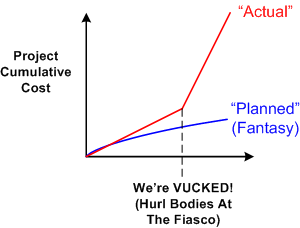
The figure below shows (in hindsight) the actual vs planned cost curve for a hypothetical “vucked” project. Cost-wise, the project started out OK, but because it was discovered that technical progress wasn’t really, uh, technical progress, bodies were thrown onto the bonfire. Again, the financial loss accumulated and accumulated until end game – whatever that means.
Replan Profile – Fantasy Revisited
The figure below shows (in hindsight) the actual vs planned cost curve for a hypothetical “fantasy revisited” project. Cost-wise, the project started out OK (snore, snore, Zzzzz), but because it was discovered that technical progress wasn’t really, uh, technical progress, bodies were thrown on the bonfire. But his time, someone with a conscience actually fessed up (yeah, some people are like that, believe it or not) and the project was replanned in real-time, during execution. Alas, this is not Hollywood and the financial loss accumulated and accumulated until end game – whatever that means.

Iterative, Incremental Profile – No Freakin’ Way
Alright, alright. As everyone knows, and this especially includes you, it’s easy to rag about everyone and everything – “everything sux and everyone’s an a-hole; blah, blah, blah…. aargh!”. What about an alternative, Mr. Smarty Pants? Even though I have no idea if it’ll work, try this one on for size (and it’s definitely not original).
The figure below shows (in hindsight) the actual vs planned cost curve for a hypothetical “no freakin’ way” project. But wait a minute, you cry. There’s only one curve! Shouldn’t there be two curves you freakin’ bozeltine? There’s only one because the actual IS the planned. This can be the case because if the planning increments are small enough, they can almost equate to the actual expenditures. At each release and re-evaluation point, the real thing, which is the product or service that is being provided (product and service are unknown concepts to bureaucrats and executive fatheads), is both objectively and subjectively evaluated by the people who will be using the damn thing in the future. If they say “This thing sux!”, its fini, kaput, end game before scheduled end game. If they say “Good job so far! I can envision this thing helping me do my job better with a few tweaks and these added features”, then it’s onward. The chances are high that with this type of rapid and dynamic learning SCRBF system in place, projects that should be killed will be killed, and projects that should continue will continue. Agree, or disagree? What say you?

This hypothetical project is called “No Freakin’ Way” because there is “no freakin’ way” that the system of co-dependent failure designed and kept in place by hierarchs in both contractor and contractee institutions will ever embrace it. What do you think?
Viable, Vulnerable, Doomed II
As the title indicates, this blow-sst is an extension of yesterday’s inane blabberfest. While yesterday’s lesson (<— lol!) dealt with the static structure of Viable, Vulnerable, and Doomed (VVD) orgs, today’s BS-fest talks about the dynamic behavior of VVD social groups. Behold that if you’re conscious and you concentrate on observing the world around you, the structure plus behavior of an org will clearly and unambiguously reveal over time what it does. Forget what its so-called leaders say it does, observe for yourself how the stratified monolith is structured, how it behaves, and what it actually produces. If you’re diligent and astute, you’ll discover the principle of POSIWID: the Purpose Of a System Is What It Does (not what it’s leadership says it does).
The UML diagram below shows a state machine model of: the mutually exclusive states of a VVV system, the transitions between the states, and the events that trigger the transitions. But wait…… VVV? What happened to VVD? Well, in a dumbass attempt to inject levity and fruitlessly retain your interest, I changed the name of the “Doomed” state to “”Vucked” so that all states start with the letter “V”. Stupid, no?
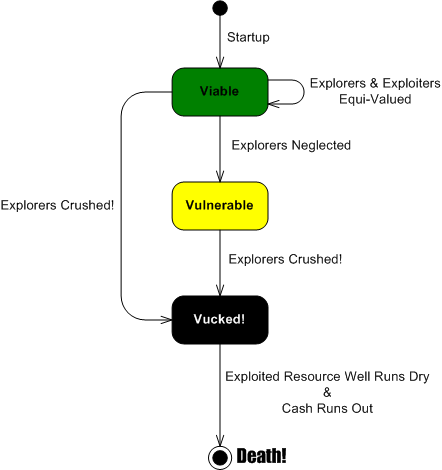
Virtually all startup companies initialize into the viable state. After all, if they didn’t have a product or service that a market didn’t want to consume, they wouldn’t be born as a viable entity, right? Over time, if they neglect their explorers and single mindedly, greedily, milk their product/service to death, eventually they’d become vulnerable to competitors. If the leadership becomes drunk with success and their heads expand too far, they start resenting and rejecting their explorers – they become vucked!
Unless, as the figure below shows, an epiphany in the head shed occurs (and the chances of that occurring in fat headed executives rolling in dough are incredibly slim) it’s death to the org and all its membership – including the innocents who had no hand in the implosion. This ain’t a hollywood story so there’s no happy ending.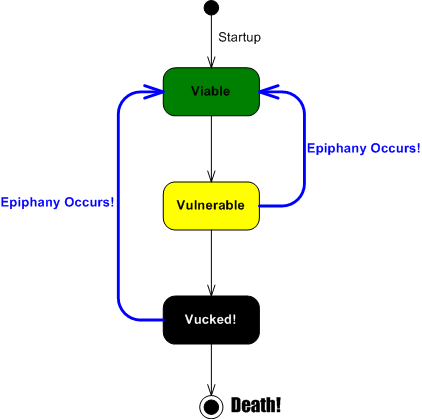
Viable, Vulnerable, Doomed
Unless an org is subsidized without regard to its performance (e.g. a government agency, a pure corpocracy overhead unit like HR), it must both explore and exploit to retain its existence. Leaders explore the unknown and managers exploit the known, so competence in both these areas is required for sustained viability.
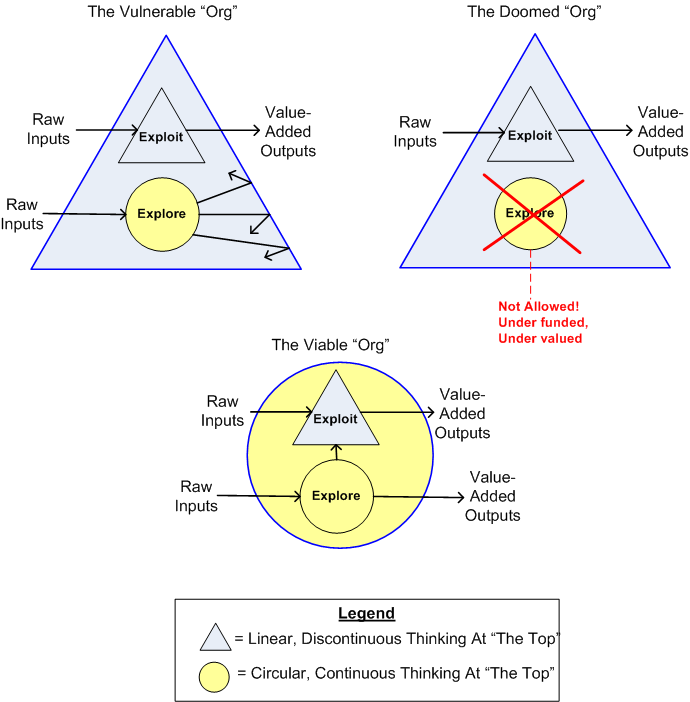
Exploitation is characterized by linear thinking (projecting future trajectory solely based on past trajectory) and exploration is characterized by loop thinking. Since these two types of thinking are radically different and prestigious schools teach linear thinking exclusively, all unenlightened orgs have a dearth of loop thinkers. Sadly, the number of linear thinkers (knowers) increases and the number of loop thinkers (unknowers) decreases as the management chain is traversed upward. This is the case because linear thinkers and loop thinkers aren’t fond of one another and the linear thinkers usually run the show.
The figure below hypothesizes three types of org systems: vulnerable, doomed, and viable. The vulnerable org has a loop thinking exploration group but most new product/service ideas are “rejected” by the linear thinkers in charge because of the lack of ironclad business cases. Those new product/service ideas that do run the gauntlet and are successful in the marketplace inch the org forward and keep it from imploding. The doomed org has an exploration group, but it’s just for show. These orgs parade around their credentialed rocket scientists for the world to see and hear but nothing of exploitable substance ever comes out of the money sucking rathole. The viable org not only has a productive explorer group, but the top leadership group is comprised of loop thinkers too – D’oh! These extraordinary orgs (e.g. Apple, Netflix, Zappos, SAS) are perpetually ahead of their linear thinking peers and they continually (and unsurprisingly) kick ass in the marketplace.
What type of org are you a member of?
Preserving The Problem
Because I’m a shirker, I love Clay Shirky. Not only does he have a kool name, the guy is an innovative thinker:
“Institutions will try to preserve the problem to which they are the solution.” — Clay Shirky
Like many rich and insightful quotes that I stumble upon, I didn’t quite get this one at first. But after thinking about it, I conjured this one up:
While espousing that they want unity of purpose, collaboration, esprit de corps, teamwork, and yada-yada-yada, the juntas in head sheds everywhere unwittingly (wittingly?) preserve the very same problem they supposedly want solved. In this example, the problem is poor corpo performance caused by fragmentation, isolation, stratification, disengagement, and mis-communication. CCRATS not only preserve the performance problem, I’ll go one better than the Clayster. I’ll assert that CGHs amplify the stank by nurturing and perpetuating their hand made caste system of divisive titles, arbitrary reward systems, and socially disconnected working units/departments/groups. It’s silo city – by design.
So why do head sheds everywhere perpetuate this Alice In Wonderland behavior in spite of the ominously growing evidence that it doesn’t work in an increasingly flat and globally connected world? Because changing the entrenched system they collectively built to take care of themselves would flatten the hierarchy and cause them to come tumbling down from the heavens. Do you think many of the “honorable and infallible” talking heads of our institutions want, or have the will, to give up their elevated personal standing for the greater good of the whole? I suspect not many, but those who can and do will prosper in this age of rapid change.
Rules, Exceptions, Guidelines
Unlike natural laws (on the macroscopic level) which unremorsefully allow no exceptions, I think all human concocted rules should be flexible to exceptions, no? If you believe that, then maybe the word “rule” should be replaced with “guideline”. Doing this can be interpreted as splitting hairs, but I think it may positively affect those who are required to operate by the “rules”. It shows respect and implies that some freedom is allowed to continuously improve things. Since the yearning for freedom is built into the fiber of every human being, those in positions of authority who conjure up the “rules” should take heed.
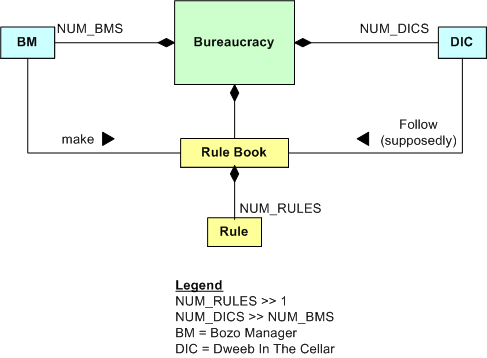
Note: The model above is a UML “class diagram”, which is used to depict the static structure of a system. Other UML diagrams can be used to model the behaviors of a system. The diagram can be interpreted as follows:
- A bureaucracy has NUM_BMS BMs and NUM_DICS DICs and a Rule Book.
- The BMs make the rule book, which has NUM_RULES (usually a boatload) rules.
- The DICs are obliged to follow the rules, written or unwritten (but understood) – or else.
Leverage Points
In Places to Intervene in a System, systems thinker Donella Meadows lists the following 9 leverage points for keeping a system “on the rails” and in continuous pursuit of its goals.
9. Numbers (subsidies, taxes, standards).
8. Material stocks and flows.
7. Regulating negative feedback loops.
6. Driving positive feedback loops.
5. Information flows.
4. The rules of the system (incentives, punishment, constraints).
3. The power of self-organization.
2. The goals of the system.
1. The mindset or paradigm out of which the goals, rules, feedback structure arise.
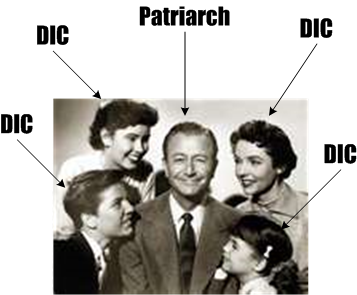
The items are listed in increasing order of difficulty. Of particular interest is number 1, the “mindset” of the system controller(s). In so-called “modern” corpricracies, the patriarchical mindset of “we’re in charge and we know what’s best, so STFU and do what you’re told“, has ruled the day since the Henry Ford era. In that day, since the typical workforce was under-educated and managers actually knew how to perform and teach the work that kept a company viable, patriarchy worked well. These days, since the situation has changed (and continues to change) immensely, patriarchy can drive a company into the ground.
When managers don’t have a clue how to do the work, they ignore problems, issues, and ideas floated up from the bottom by the DICforce. This crucial feedback loop for sustained viability gets severed and the org suffers greatly for it. BMs collectively, and often unconsciously, behave this way in order not to look stupid and preserve their aura of infallible superiority. Ideas that can save six or seven figures in costs and product enhancements that may increase competitiveness go un-investigated or are killed via “it’s not in the budget”.
Maybe surprisingly to some, the vast majority of the DICforce actually buys into the patriarchical mindset because that’s the way it’s been for eons. DICs that initially don’t buy into patriarchy fall in line as soon as they are ignored or are slapped down a couple of times. Those that continue to buck the patriarchy after being “warned” are shackled or expelled for “insubordination” – another great term that reinforces the patriarchical mindset.
D4P Has Been Hatched
Friend and long time mentor Bill Livingston has finished his latest book, “Design For Prevention” (D4P). I mildly helped Bill in his endeavor by providing feedback over the last year or so in the form of idiotic commentary, and mostly, typo exposure.
Bill, being a staunch promoter of SCRBF feedback and its natural power of convergence to excellence, continuously asked for feedback and contributory ideas throughout the book writing process. Being a blabbermouth and having great respect for the man because of the profound influence he’s had on my worldview for 20+ years, I truly wanted to contribute some ideas of substance. However, I struggled mightily to try and conjure up some worthy input because even though I understood the essence of this original work and it resonated deeply with me, I couldn’t quite form (and still can’t) a decent and coherent picture of the whole work in my mind.
D4P is a socio-technical process for designing a solution to a big hairy problem (in the face of powerful institutional resistance) that dissolves the problem without causing massive downstream stakeholder damage. Paradoxically, the book is a loosely connected, but also dense, artistic tapestry of seemingly unrelated topics and concepts such as:
- Alan Turing’s thesis of infallibility vs. intelligence
- Leveraging nature’s physical laws, with a special emphasis on suspending the 2nd law of thermodynamics and entropy growth
- W. Ross Ashby‘s cybernetic law of requisite variety
- Thorstein Veblen’s theory of the leisure class
- Nash Equilibriums in game playing
- Rudolf Starkermann‘s mathematical analysis of social group system behavior
Bill does a masterful and unprecedented job at connecting the dots. The book will set you back, uh, $250 beaners on Amazon.com, but wait….. there’s a reason for that astronomical price. He doesn’t really care if he sells it. He wants to give it away to people who are seriously interested in “Designing For Prevention”. Posers need not apply. If you’re intrigued and interested in trying to coerce Bill into sending you a copy, you can introduce yourself and make your case at vitalith “at” att “dot” net.
Update 12/29/12:
The D4P book is available for free download at designforprevention.com. The second edition is on its way shortly.

Why am I here?
WTF?
Meh!
D'oh!

My BTC Address



 Bulldozer00's Blog