Archive
Yahoo! Boohoo!
Unless you were born yesterday, you’ve probably heard about the death spiral that former internet great Yahoo! has commenced. In this blarticle from TechCrunch, “Former Yahoo Engineers Shed Light On Why Delicious And Other Acquisitions Failed“, a couple of quotes from former employees brought a tear to my eye.
…it does provide a picture of a company that bogged its acquired-startups down in its company’s administrative BS. As Chad Dickerson, former Yahoo developer evangelist and the current CTO of Etsy comments, “In my experience, entrepreneurs moving into Yahoo! often got stuck doing PowerPoints about “strategy” instead of writing code and shipping products.”
Elliott-McCrea writes: I recently pulled up a worklog I was keeping in 2008-2009, and I found 18 meetings scheduled over a 9 month period discussing why Flickr’s API was poorly designed and when we’d be shutting it down and migrating it to the YOS Web Services Standard.
What I’d like to know is: “Did any of the layers of corpo honchos have any conscious clue that the patriarchical and bureaucratic monster they brought to life was killing the golden goose?” What do you think?

Leader Or Dictator?

After reading Chetan Dhruve’s “Why Your Boss Is Programmed To Be A Dictator“, I’ve had a change of heart. I’ve concluded that hierarchy is a symptom and not the dominant cause of dysfunctional corpricracies. In his book, Mr. Dhruve skillfully develops a compelling case that the lack of the right to vote managers into and out of higher status slots in the hierarchy is the real cause of poor org-wide performance and DIC-force suffering in the workplace.
Mr. Dhruve asserts that there are two canonical forms of power systems: leaderships and dictatorships. By his definition, leaders are elected into power by those they lead, and dictators assume power by any other means. In corpricracies, dictators don’t assume power by shedding blood, they assume power in a civilized manner; by anointment from higher status dictators.
The unquestioned assumption in dictatorships is that superior status equates directly with superior knowledge and judgment. In corpo dictatorships, un-submissive subjects aren’t killed. They’re marginalized at best, and fired at worst. Chetan closes his masterpiece with a brilliant quote targeted at anyone in any power structure:
If you aren’t elected, you’re a dictator – Chetan Dhruve

Monitoring And Learning
Courtesy of this Scott Berkun retweet,

I latched onto this Harvard Business School paper abstract:
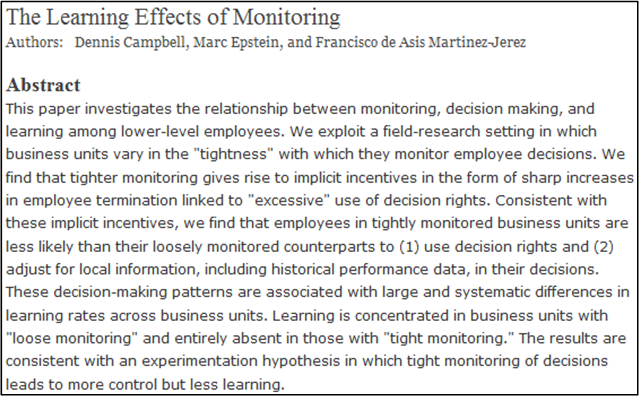
Even though the paper is laced with impeccable math and densely “irrefutable” logic, the conclusion of “looser monitoring -> more learning -> more creativity & innovation” seems intuitively obvious, doesn’t it?
Assume that the top leaders in your org embrace the idea and sincerely want to put it into action to detach the group from the status quo and propel it toward excellence. Well, fuggedaboutit. The scores of mediocre middle managers within the institution who do the monitoring will instantaneously switch into passive-aggressive mode and thwart any attempt to institute the policy. They’ll do this because it will most likely expose the fact that they are not only suppressing creativity and innovation where the rubber hits the road, but they are not adding much value to the operation themselves. How do I know this? Because that’s what I’d feel culturally forced to do. But not you, right?
Don’t You Wish….
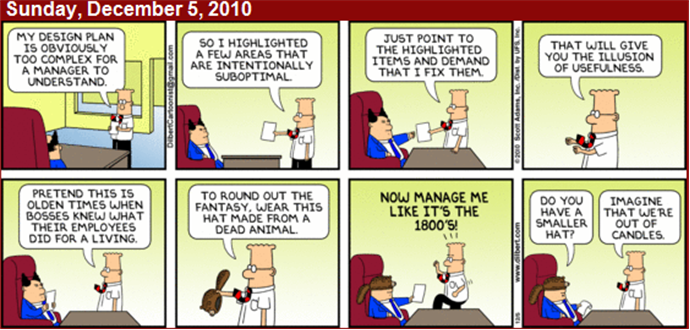
…you can have a Dilbertonian conversation with a BM (past or present) like the one below without getting fired? Of course, the elegant genius of Dilbert is that former cubicle-dweller-turned-gazillionaire Scott Adams makes you want to laugh and cry simultaneously.
Recursive Behavior
Information hoarding by individuals and orgs used to lead to success in the past, but information sharing is one necessary but insufficient key to success today.
In this century, if the dudes in the penthouse at the top of the pyramid keep all the good stuff locked up in the unspoken name of mistrust, it’s highly likely that this anti-collaborative behavior will be recursively reproduced down the chain of command. Hell, if that behavior led to success for the corpo SCOLs and CGHs, then it will work for the DIC-force too, no?
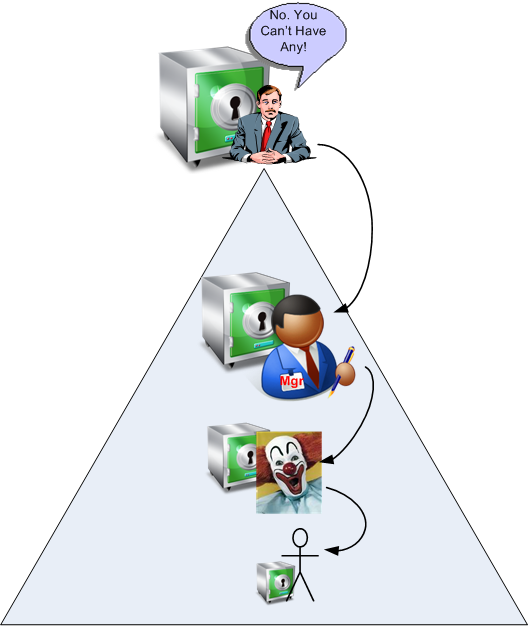
“Trust is the bandwidth of communication.” – Karl-Erik Sveiby
Are You Still Working On That?
It’s funny enough when you work for a one dimensional manager (one dimension = schedule), but it’s even funnier when another 1D manager that has nothing to do with your project stops by to chit chat and he/she inevitably asks you:
Are you still working on that?
LOL! Being 1D, and even though he/she has no idea what it takes (or should take) to finish a project, the question can be interpreted as: Since you’re not done, you’re lazy or you’re screwing up.
When the question pops up, try this Judo move:
Should I be done? How long should it have taken?
Or, you can be really nasty and retort with:
Yes I am still working on it. Sorry, but it’s not a shallow and superficial management task like signing off on a document I haven’t read or attending an agenda-less meeting that I could check off on my TODO list.
Come on, I dare you.

Aggressive Substitution
One incredibly overused word heard repeatedly like a metronome across the vast corpo wasteland is “aggressive“. We will “aggressively pursue new opportunities“, “aggressively cut costs“, yada, yada, yada. It’s most commonly used by anointed BMs everywhere in long winded inspirational sentences that contain its most beloved twin: “schedule“. Here’s what my corpo jargon decoder ring tells me what it means:
Aggressive Schedule (AS) = Work your ass off at least 12 hours a day for months on end without receiving any overtime pay and expecting the same 1% yearly raise as the rest of the DICforce that smartly exits the psychic prison after five to seven hours of work per day. Oh, and I’ll get a bonus if you meet schedule.
The AS(s) phrase is always wielded by someone with no real skin in the game except for the possibility of fewer stock options if the “S” isn’t met. Since chronic overuse of any word takes the sting out of it, how about creatively mixing it up from time to time with a synonym replacement:
- Barbaric schedule
- Contentious schedule
- Destructive schedule
- Disruptive schedule
- Disturbing schedule
- Intrusive schedule
- Pugnacious schedule
- Rapacious schedule
I can’t decide on my favorite surrogate replacement. It’s either “pugnacious” or “rapacious”. What’s yours?

Disconnect And Distance
If professional social networks like LinkedIn.com were around in the 1980’s, it’s highly likely that you’d be branded as an unloyal traitor for joining one. Even today, didn’t you feel a slight twinge of exhilarating fear when you joined? Uh, not me (LOL!).
If the leaders (or should I say the “SCOL“s?) in your org are ostriches and they cling to outdated, mechanistic, FOSTMA ideas like the demand for one way loyalty without even a hint of self awareness that they need to change their mindsets, then head for the hills because your sugar daddy is most likely going downhill. If, for some reason beyond your control you think you’re stuck where you are, then simply disconnect and distance yourself from the daily shenanigans that take place in your environment.

Infinitely Late
In deference to Fred Brooks‘s “adding more people to a late project makes it later“, I present you with the enhanced version: “adding more people to a late project makes it later, and at some critical size K, adding more people makes it infinitely late“.
 As more smart and competent people are added to an org or project, the capability of the group to accomplish great things increases. The really sad thing about poor management is that this increased capability is countered by increased fragmentation and growth in fatty middle corpo layers that slowly snuff out productivity. The lag time between the addition of people and degraded org productivity can be can be so great that the correlation is totally missed and the probability of recovery goes to zero.
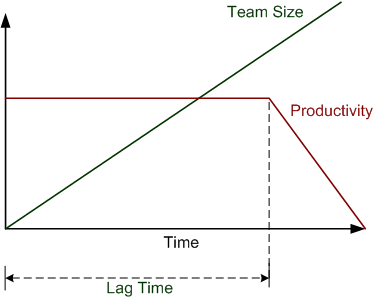
At a really dysfunctional institution, productivity plummets to zero and the immobilized institution withers away – unless some sugar daddy starts subsidizing the beast without regard to performance.
In the cases where the hapless institution is a government, it can become is its own sugar daddy. Since it has the bullying power to subsidize itself via taxation of its constituency, it can maintain its comatose state for essentially infinity. DYSCOs are not so lucky. They can, and often do, run out of money before they even know what hit them.
DYSCO Dancer
The figure below shows the top three levels of an N level textbook corparchy. Virtually all corpo monarchs present some visual camouflage like this to model their beloved corpricracy. The massive illusions that a diagram like this intends to project are:
- an orderly flow of timely, accurate status information upward;
- intelligent direction and guidance downward;
- cooperative collaboration both sideways and diagonally;
- a paragon of efficiency and excellence for all external and (especially) internal observers to embrace without inquiry.
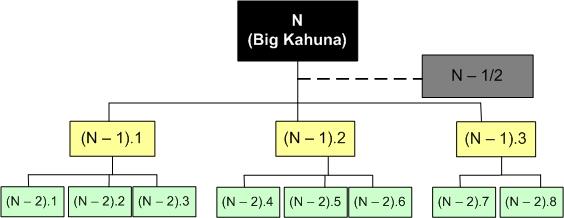
Now, splash some cold water on your face and observe an example of a pseudo-realistic model of a typical DYSCO dance:
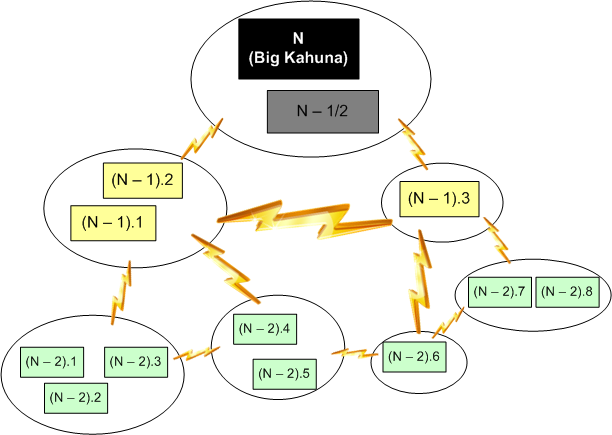 If you’ve inferred that the lightning bolt connections represent clever, but antagonistic and counterproductive relationships between rival DYSCO dancing factions, then you’d be right.
Some of my friends(?) have told me that I’m an elite DYSCO dancer. Are you?


Why am I here?
WTF?
Meh!
D'oh!

My BTC Address



 Bulldozer00's Blog