Archive
Inchies
So, what’s an Inchie? It’s an “INfallibility CHIp“. An Inchie is an invisible, but paradoxically real corpo currency that is the opposite of a demerit. An increasing Inchie stash is required to move up in a corpo caste system. The higher up you are in a CLORG, the more Inchies you have been awarded, and the more infallible you’ve become.
At level 0 down in the basement, you begin the game with 0 Inchies and you start making your moves – climbing the ladder Inchie by Inchie. Be careful and keep watch over your Inchie stash though, cuz your peers will try to steal your Inchies when you’re not looking.
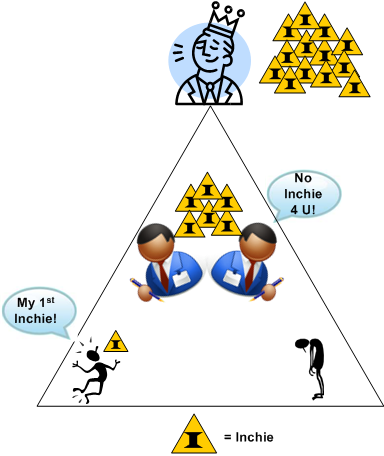 Alas, even though you now know that Inchies exist, don’t get your hopes up. You see, the criteria managers at level N (where N > 0) use for disbursing Inchies down to the less infallible people at level N-1 are random. Even among managers within a given level, the award criteria is arbitrarily different. Plus, to make the game more difficult, the dudes who awarded you your Inchies can take them back whenever they feel the need to “scratch your Inchie” – especially if you piss them off with career ending moves. D’oh!
Once you make it to the top of the pyramid with your big bag o’ Inchies, not only have you amassed the most Inchies in the DYSCO, but you’re given the keys to the Inchie minting machine. This gives you the opportunity to fabricate an unlimited number of Inchies to add to your display case and to sprinkle upon your sycophant crew as you please. You’ve become a 100% infallible god in the DYSCO microcosm. Whoo Hoo and Kuh-nInchie-wah!
Marshal Law
In a time of crisis, some “leadership” experts promote imposing the corpo equivalent of marshal law via the execution of more top-down control and discipline in the form of more frequent, multi-layered, financial reviews and detailed status reporting.
The thinking behind the “more control” approach is that by shining the light more often, and at a higher intensity, on those directly-in-the-soup will cause the crisis to dissolve. Another unquestioned assumption behind the “more control” approach is that the light-shiners will be able to better understand the real problems behind the crisis and offer “helpful” solution idea candidates – inspiring the troops to success.
Sounds great, right? Let’s switch gears, step into the deliciously diabolic role of devil’s advocate, and ask “what’s wrong with this picture?“. Are these thoughts missing:
- those doing the shining may be responsible for the mess in the first place but don’t realize it.
- those doing the shining have been so disconnected from the real world for so long that they are incapable of understanding the problem details well enough to help?
- those being illuminated will batten down the hatches, narrow their thinking, and withhold important information if they think it can be used against them.
Nah, probably not. After all, it’s a no brainer that the best and brightest problem solvers and decision makers sit at the top of the pyramid. If you don’t believe me, simply ask them.
 On the other hand, a different pool of leadership experts promotes the unintuitive loosening of controls and less formality in a time of crisis – to allow more ideas from more people to surface and have a chance of resolving the crisis. Which approach do you think has a better chance of success?
Don’t try to address difficulties by adding more meetings and management. More meetings plus more documentation plus more management does not equal more success. – NASA SW Dev Approach
Judgment, Integrity, Credibility, Honesty, And $53M
The often (but not always) incestuous relationship between hand picked corpo board of directors yes-men and CEOs has come to the fore again: “HP orders probe into Hurd’s departure”. Why would Hewlett Packard, as represented by its board of derelicts, I mean directors, investigate their own handling of Hurd’s dismissal? They’re not doing it because it’s the right thing to do. They’re only doing it because they’re being forced to:
“HP’s plan for an outside investigation follows a lawsuit in San Jose, Calif., by shareholders who allege that the company’s directors wasted money by giving Hurd $53 million in severance.”
Yepp, a gift of $53 million to Mr. Hurd for exhibiting:
A profound lack of judgment. It (Hurd’s dismissal) had to do with integrity, it had to do with credibility and it had to do with honesty.” – Mike Holston, HP’s general counsel
After doling out that kind of dough, can’t the same be said about HP’s board? Well, that’s what we may find out after the dust settles. In the meantime, HP’s board may have gotten what they deserved. Mr. Hurd has Madoff nicely by skidaddling over to one of HP’s biggest competitors, Oracle Inc. He and his buddy, Oracle oracle Larry Ellison, sure do know how to make money.
“Mark did a brilliant job at HP and I expect he’ll do even better at Oracle,” said CEO Larry Ellison in a statement.
The real question is: “How isolated are these types of incidents?“. Just because they get reported in the press doesn’t mean that dishonesty runs rampant in the bozone layers of big business. Nevertheless, it begs the question: “Is the taken-for-granted, rarely-questioned process in which CEOs and boards of directors are chosen broken?“. Boards anoint CEOs (who coincidentally are often the chairman of the board) and CEOs nominate board members for election. What do you think of the process? How can it be made better?

Performance Improvement
ASSume that within the vast lands of a self-described great kingdom, you’re the prince of the little fiefdom below. To keep you comfortably propped up on your throne, the DICforce in each of the 3 little green boxes, under the watchful eye of your enforcer (the faceless BM dude with the white name tag), performs 3 day-to-day functions critical to your, I mean your group’s, “success“. For simplicity, let’s call these functions F1, F2, and F3.

So, everything’s humming along until – BAM! – revenues start declining and costs start rising. D’oh! and WTF? After spending some time down in the puke green boxes and thoroughly observing/investigating/analyzing/evaluating the state of your state, you declare that the performance of the “F2” function is gumming up your well-oiled machine. In your wisdom, you address your minions and boldly proclaim: “F2 Sux!“.
Uh, what change do you decide to make to “improve performance“? One option is to bring in some external “F2 gurus” to train your underperforming F2 DICsters. Another option is to fire your current F2 DICs and permanently hire new, expert, F2 DICs.
After mulling these options over, it hits you like an insight from Gawd…. you’ll hire one expert F2 enforcer dude, give him/her an ego-stroking overhead staff, and move your existing F2 DICsters into his/her newly born sub-fiefdom. So, you implement your brilliant idea and end up with this new borg:
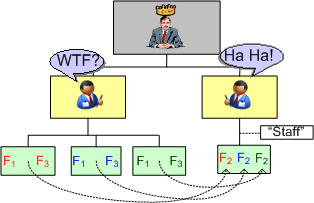
So, besides further fragmenting your borg, increasing your overhead cost structure, pissing off your existing loyal enforcer, and having the same DICsters still supposedly screwing up the F2 function, what else can you pat yourself on the back for?
Loops Of Distrust
Mistrust reigns everywhere. Governments distrust big businesses and vice versa. Big business heads (and I mean it both literally and figuratively), even though they often superficially espouse otherwise, distrust their low level, non-executive people.
The two cause-effect loop diagrams below crystallize the situation, no? On the left, more regulation begets more lobbying and lawyering – which begets more regulation. Bummer. On the right, more red tape begets more subversion – which begets more red tape. Double freakin’ bummer.
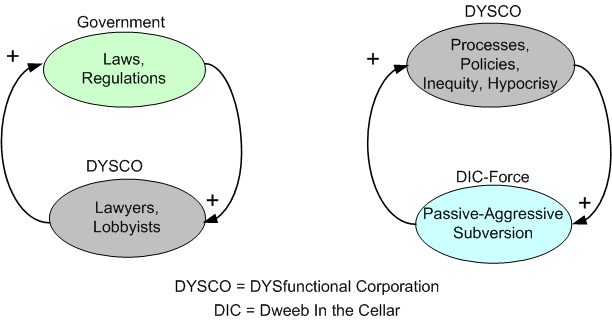
In the government-DYSCO cat-and-mouse duel, government, even though it’s a massively dysfunctional CCH itself, wants its version fairness and equity to prevail. In the DYSCO-DICforce scenario, the DICforce wants its version of fairness and equity to prevail. In both scenarios, the DYSCO DJs want an unfair advantage.
Note: Not all companies are DYSCOs. Only DYSCOs are DYSCOs. Every once in a blue moon I state a disclaimer like this because some people may think I’m a black-and-white binary thinker.Those that do may be binary thinkers themselves?
Gored
In her book, “The Stone Age Company“, author Sally Bibb cites W. L. Gore (which coincidentally is on my list of faves) as one of the exemplar companies that will continue to thrive in an increasingly chaotic future that is sure to be apocalyptic for legions of old guard CLORGs. Sally states that one of the leadership mantras inside Gore is: “Look over your shoulder to make sure someone is following you“. In other words, if people don’t willingly follow you, you won’t be a leader for very long at the company.
Serendipity being what it is, I recently stumbled upon this short essay by W. L. Gore CEO Terri Kelly: No More Heroes: Distributed Leadership. Here’s what Ms. Kelly, in spite of being a real-life CEO, authentically says:
Organizations that hold onto conventional leadership models will find it increasingly difficult to attract and retain top talent.
Leaders will need to recognize that their primary role is to empower others versus build their own power. They will no longer stand behind a title with assumed authority to tell people what to do.
Those who know their leaders best are typically the individuals they lead. If you want individuals to have a voice in the organization, they must also have a voice in selecting and evaluating their leaders.
All associates (at Gore) get the opportunity to rank members of their team, including their leaders. They are asked to create a contribution list in rank order based on who they believe is making the greatest contribution to the success of the enterprise.
Note that followers have a say in who leads them and they evaluate each other and their bosses by perceived contribution – not by rank or status or academic knowledge or “number of years of service”. Now that’s empowerment, no?
So what do you think? Is your company structurally and behaviorally oriented for success in an increasingly networked, complex, and flattened world? Or is it the same old, same old, business as usual….. waiting to get gored to death by competitors who are.

In Memory Of “Chainsaw” Al
ASSume that you’re a member of the infallible leadership team of an impeccable and squeaky clean kingdom like the one shown below. It’s interesting how your “who supervises who” stovepipe chart looks yawningly the same as everyone else’s and yields no clue as to how your borg operates on a day to day basis, no?
Next, assume that everything is cruising along splendidly. The dough is rolling in, everyone feels productive and happy (well, at least you and your cohorts feel that way), and you believe your own rhetoric until — BAM, the fit hits the shan. D’oh!
 Of course, being a member of the elite and unquestionably infallible team in the penthouse, the crisis was certainly thrust upon you by forces beyond your control. The world suddenly, instantaneously, turned against you in a perfect storm of destruction. Unlike the good times, in which you naturally look in the mirror for the cause of success, in the bad times you conveniently look out the window for the cause of failure.
So, what creative solution do you conjure up to dissolve the crisis? Well, duh, you don your “Chainsaw” Al mask and start hacking away at the roots of your borg while leaving the branches that prop you up into the sky intact….

Whoo hoo, crisis solved! Err…. was it? Can the last remaining method of simplification and a pack of golden parachutes be in the offing?
Hostile, Cruel, And Wasteful
From an interview with C++ creator Bjarne Stroustrup, I give you this:
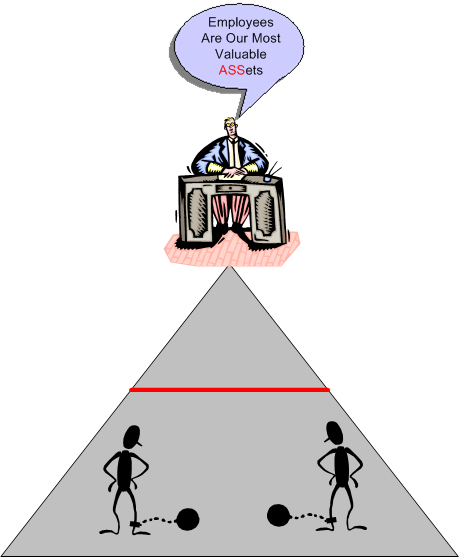
Corporate practices can be directly hostile to individuals with exceptional skills and initiative in technical matters. I consider such management of technical people cruel and wasteful. – Bjarne Stroustrup
I think this may be the main reason why brilliant technical startup companies are born. In an ironically altruistic twist, the unconsciously idiotic ways in which DYSCO SCOLs treat their best human “resources” (sic) hurt themselves while simultaneously benefiting the world.
Product Team
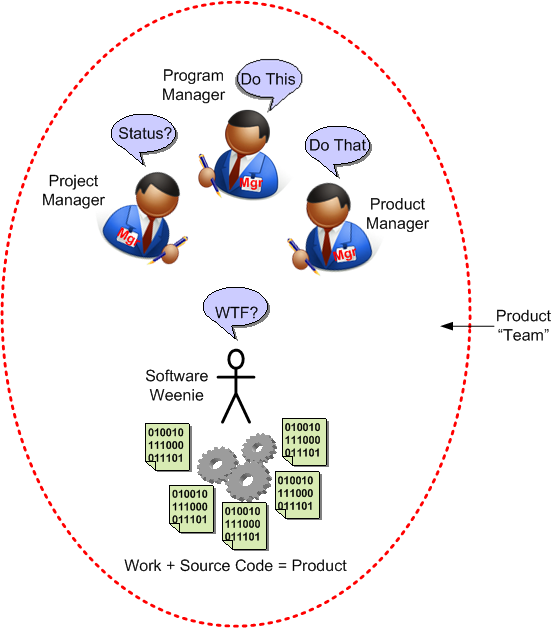
How can a software project have more managers and pseudo-managers “working” on it than developers – you know, those fungible people who write, debug, and test the product code that is the source of the borg’s income. You would think that this comically dysfunctional practice would stick out like a sore thumb and somebody upstairs would put the kabosh on it, no?
Court Jester
Sally Bibb, in her deliciously subversive book, “The Stone Age Company“, states that the executives at British Airways formally appointed a “court jester” to keep their heads out of the clouds and so that they wouldn’t fall victim to their own rhetoric. Kudos to the leadership team at BA.
Sally’s book was published in 2005 (do ya think it sold well?). I wonder if the BA court jester position still exists today and how effective it is/was. I’d love to inteview the CJ(s).


Why am I here?
WTF?
Meh!
D'oh!

My BTC Address



 Bulldozer00's Blog