Archive
Idea Approvability
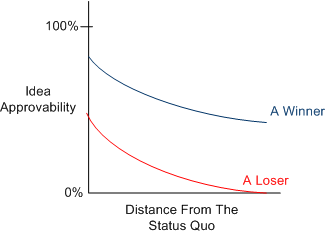
The scientifically backed and indisputable graph below shows the “approvability” percentage of an idea as a function of the perceived (by the person(s) who have the power to approve the idea) distance of the idea’s implications from the status quo. For reference, traces for two example orgs are shown. How would you plot your org’s behavior on the graph?
P Equals R Minus C
Being a dufus, I’m constantly trying to use the power of abstraction (a.k.a selective ignorance) to syntegrate complex issues, problems, situations, and relationships up into ridiculously simple generalizations that are, of course, wrong. For example, take the classic business performance equation below.
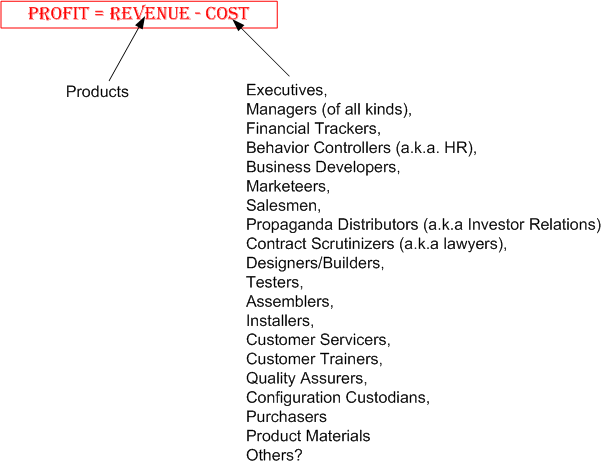
In the sliver of dufus-land that aligns with reality, if revenues don’t consistently exceed costs, it’s just a matter of time before a new or established business goes kaput, no?
When a company starts up, by definition, it has only a handful of people who fulfill all of the roles in the right hand side of the above figure needed to prosper and develop. Over time, “approved” micro-specialization, infectious hubris, empire-building, and a whole lotta BS accompanies the obsession to”grow the enterprise“. These sanctioned behaviors usually (but not always) lead to an unsustainable and cost heavy behemoth that brings the party to an end – all under the eyes of the self-proclaimed brilliant dudes who run the show. Bummer.
The Only Means
Setting an example is not the main means of influencing another, it is the only means. – Albert Einstein
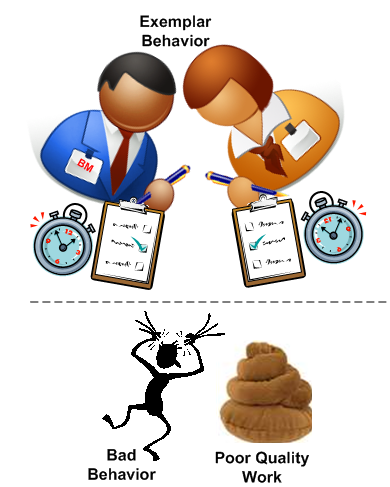
I stumbled upon the above Einstein quote while browsing Chetan Dhruve’s twitter page. One can set a good/bad example by:
- their day-to-day behavior,
- the quality of their work output, or
- (preferably) both of the above.
Since managers in DYSCOs and CLORGs are “above” work (shhhh – you’re not allowed to know and think that), they can only set an example by behavior. DICsters, however, can set an example using both approaches. Alas, it’s a real challenge to produce high quality work and behave as a role model when you’re continuously saddled with un-articulated goals that change on a whim, unreasonable schedules, and cleverly ego-centric managers. Nevertheless, it can still be done in spite of being immersed in a toxic environment. How do you do it?
Telltale Signs Of A Failed Software Project
Like everyone else who’s worked on a slew of team-based software development projects, uber C++ blogger Danny Kalev has his own thoughts on why projects fail. In “Telltale Signs of a Failed Software Project, Part I“, Danny ominously describes “The Emperor’s New Clothes Syndrome” as follows:
The first ominous sign is the emperor’s new clothes syndrome — as a new recruit, you try to study the project. You’re reading the specifications, perusing those lovely Data Flow Diagrams (DFDs) or UML charts and you still can’t get the hang of it. “What on earth were they thinking? It simply doesn’t add up!” you’re muttering silently. At some point you realize that it’s not you — it’s the project itself. What you’ve been reading is simply a collection of smoke and mirror effects meant to appease the high management. Little by little you get the picture: your colleagues know that it’s not working but they won’t admit it in public. If you dare exposing the truth you’ll be denounced as an ignorant, misfit traitor. You have two choices: quit silently, or join the rest, pretending all is well.
Hmm, I think Mr. Kalev may have missed the point that his second-to-last sentence; “exposing the truth and being denounced as an ignorant, misfit traitor“, is also a choice – albeit one that is auto-discarded by all sane persons. Ya see, if you’re not perceived to be a cross-eyed Columbo, a court-jester, or an innocent (but naive) child when you state your concern, you’re sure to get hosed down by the powers that be.

Have you ever tried to call-it-like-ya-see-it in front of the papal infallibles? If so, which halloween costume did you don? Columbo, Court-Jester, Innocent Child, or “other“? Surely, you’ve done it at least once, right? If not, why not? If so, then what kinda blowback did you receive – and did it force you into “quiet desperation” mode? Come onnnnnnnnn, don’t be shy – share your story with BD00 and the two other regular readers of this blog.
Don’t Be Evil

If you don’t know that Google’s informal corporate motto is “Don’t Be Evil“, then either you were born yesterday or you shouldn’t be reading this ridiculously inane blog – or both.
While reading Stephen Levy‘s well written, informative, and entertaining book, “In The Plex“, Mr. Levy tells the story of how the controversial and tough-to-live-up-to Google war cry came into existence. Here, he describes the first triggering event:
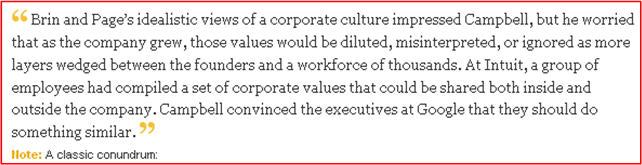
Mr. Levy goes on to say:

Note that 15 employees were assembled from across a broad swath of the company. Do you notice something amiss? Uh, how about the fact that the two founders, Sergey Brin and Larry Page weren’t involved?
As the group debated the motto, here’s what one group member said:

Note that everyone had a chance to weigh in, and thus, “Don’t Be Evil” was internalized by the whole org. It wasn’t handed down from on high by a politburo or junta or God-like individual that “obviously knows what’s best for all the children in the borg“.
Did, or do, you have the chance to provide feedback on your corpo values or philosophy? Are they authentic like Google’s and Zappos.com’s, or are they a copy-and-paste job from a 1970’s vintage management book? If they’re a copy-and-paste job, have you suggested revisiting them? If so, how was your suggestion received?
Structure And Behavior
One of the principles of systems thinking is that structure facilitates or inhibits specific behaviors. For example, if we didn’t have hands (or, in some cases, neither hands or feet), we wouldn’t be able to write – the structure wouldn’t allow it. If we didn’t have vocal chords, we wouldn’t be able to speak – the structure wouldn’t allow it. If a car’s engine didn’t connect to the drive shaft, it wouldn’t be able to “transport” – the structure wouldn’t allow it. If a system didn’t have redundant elements, it wouldn’t be able to automatically recover from failures – the structure wouldn’t allow it.
The same holds true for organizational structures that group people together for a purpose. The org structure can be an enabler or inhibitor of the behaviors required to fulfill the purpose for which the group has been assembled. A mismatch between purpose and structure usually leads to failure at some unknown time in the future.
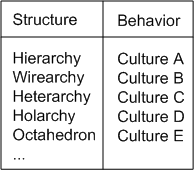
The table below lists several org structures concocted by BD00, including the ubiquitously pervasive and manager-revered “hierarchy“, along with the obscure, Fuller/Beer “octahedron“. What are the strengths and weaknesses of each structure?
Expertise And Position
In Seeing Your Company as a System, Andrea Gabor cites Weick and Sutcliffe’s book, “Managing the Unexpected: Resilient Performance in an Age of Uncertainty“:
Mindful organizations, they (Weick and Sutcliffe) explain, are characterized by a broadly defined “deference to expertise” in a setting where “expertise is not necessarily matched with hierarchical position.” Mindful organizations are also capable of seeing weak signals of systemic failure and responding with vigor. To support this capability, such organizations strive for open communication, recognizing that if people refuse to speak up out of fear, this capability will be undermined.
In unmindful orgs (“unmindful” is the politically correct way of referring to CLORGs and DYSCOs), most people in the borg are conditioned to auto-think that expertise equates to hierarchical position. Thus, the infallibles in the upper layers, while espousing otherwise, don’t strive for open communication and they ignore both weak and strong negative feedback signals from the DICs in the lower, less “expert” layers. To add insult to injury, since the DICsters down in the boiler room are conditioned to auto-think the same expertise-position relationship, they don’t “speak up” out of fear of looking, or being told that they are, stupid. Bummer.

The Ideal Quadrant
Zappos.com operates on the simple principle that happy people make productive workers and productive workers make a successful enterprise. Thus, the policies and cultural accoutrements instituted at Zappos.com are thoughtfully and proactively designed to foster happiness without totally abdicating control. For Zappos.com, it’s not enough to have a “competitive” benefits and pay package – everyone (still in business) has to have one.
With that in mind, let’s explore the four quadrants in the simplistic table below. Right off the bat, we can ditch the two quadrants in the second row. After all, no org can remain viable for very long with an unproductive workforce – regardless of whether the emps are happy. No?

So that leaves us with the two quadrants in the first row. One would think that the holy grail for excellence-seeking orgs is the Productive-And-Happy (PAH) quadrant. However, a multitude of circumstantial evidence leads me to believe that most orgs are either consciously or unconsciously incompetent at catalyzing the development of a PAH workforce – regardless of what is espoused in the annual report. The legions of enterprises that fall into the CLORGs and DYSCOs category don’t even make an effort to develop “happy” employees. The SCOLs that run the show are too macho and they delude themselves into thinking that happiness doesn’t matter or it’s “not in their job description“. Should it be?
What comes first, productivity or happiness? Is one attribute a pre-requisite for attaining the other?
Level Of Loyalty
Checkout the sketch below. Everyone knows why too little loyalty is detrimental to purposeful organizations of people, but why is too much loyalty a problem? (And no, that’s not a swastika.)

UCB Reinforcement
Oh crap! I’ve done it again. I’ve scanned the horizon and found more evidence to further cement my Unshakable Cognitive Burden. I’ve started reading the classic “Human Side Of Enterprise“. It’s a classic because it was written in 1960 by Douglas McGregor and much of it remains relevant today – over 50 years later.
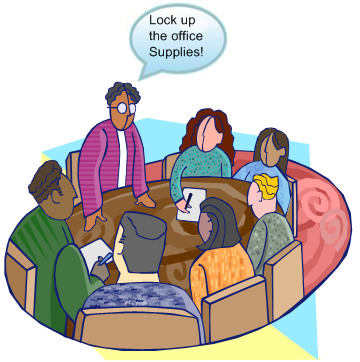
At the beginning of the book, Mr. McGregor asks his targeted audience, corporate managers, to truly “tune in” the next time they’re at a policy making meeting. By “tune in“, he means “listen to what hidden, implicit assumptions about human behavior are embedded within the discussions“.
Mr. McGregor asserts that the probability is high that policy discussions will be based on the assumption that those who will be affected by the policy are stupid, lazy, and not-to-be-trusted people. Has your personal experience indicated that he was, and still is, right?

Why am I here?
WTF?
Meh!
D'oh!

My BTC Address



 Bulldozer00's Blog