Archive
Cribs And Complaints
HCL Technologies CEO Vineet Nayar‘s “Employees First, Customers Second” is one of the most refreshing business books I’ve read in awhile. One of the bold measures the HCLT leadership team considered implementing to meet their goal of “increasing trust through transparency” was to put up an intranet web site called “U & I“. After weighing the pros and (considerable) cons, the HCLT leadership team decided to go for it. Sure enough, the naysayers (Vineet calls naysayers the “Yes, But“s) were right:
The U&I site was clogged with cribs and complaints, harangues and imprecations that the company was wrong about everything. The continents and questions came pouring in and would not stop. Most of what people said was true. Much of it hurt.
However, instead of placing draconian constraints on the type of inputs “allowed“, arbitrarily picking and choosing which questions to answer, or taking the site down, Vineet et al stuck with it and reaped the benefits of throwing themselves into the fire. Here’s one example of a tough question that triggered an insight in the leadership team:
“Why must we spend so much time doing tasks required by the enabling functions? Shouldn’t human resources be supporting me, so I can support customers better? They seem to have an inordinate amount of power, considering the value they add to the customer.”
This question suggested that organizational power should be proportionate to one’s ability to add value, rather than by one’s position on the pyramid. We found that the employees in the value zone were as accountable to finance, human resources, training and development, quality, administration, and other enabling functions as they were to their immediate managers. Although these functions were supposed to be supporting the employees in the value zone, the reality was sometimes different.
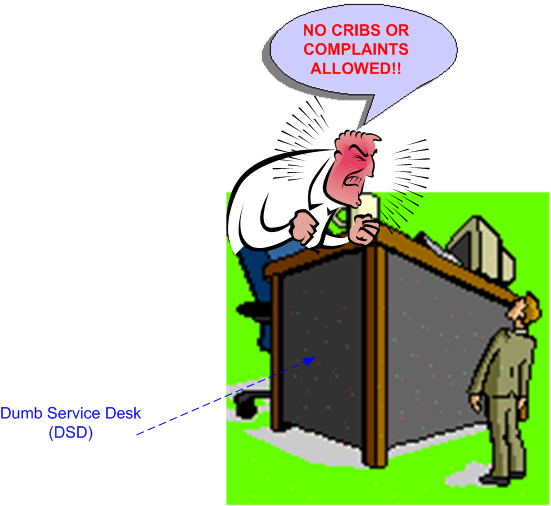
That question led to the formation of the Smart Service Desk (SSD), which helped the company improve its operations, morale, and financial performance.
So, how did the SSD work, you ask? It worked like this: SSD. Not like this:
Ooh Ooh, Pick Me, Pick Me!
Quiz time! Who’s this kid….

In “You’re Not So Smart“, David McRaney describes how to overcome the debilitating scourge of “groupthink” in hierarchical organizations:
True groupthink depends on three conditions—a group of people who like one another, isolation, and a deadline for a crucial decision. It turns out, for any plan to work, every team needs at least one asshole who doesn’t give a shit if he or she gets fired or exiled or excommunicated. For a group to make good decisions, they must allow dissent and convince everyone they are free to speak their mind without risk of punishment.
Tome Peters said much the same thing is one of his bazillion books: “Put someone on your staff you don’t like“.
Semi-enlightened orgs hire consultants to fill the asshole role. Even though that’s a viable alternative, it’s only going half-way. The fact that an inside employee (or rotating employees) isn’t (aren’t) placed in the role says as much about the org’s culture as not “allowing” the role at all.
BD00 just had an epiphany! He’s concluded that he was put on this earth to fulfill “The Yes Asshole Rule“, and he’s willing to take job offers from far and near to fulfill his destiny. How many offers do you think will be forthcoming?

Related articles
- You Are Not So Smart: A Field Guide to the Psychology of Our Stupidity (brainpickings.org)
- Clanthink, Groupthink, Spreadthink (bulldozer00.com)
Behavior Compression
I’m gonna be an “absolutist” in today’s post. I’m gonna use the word “all” instead of “most“.
In all man-made orgs, as one ascends the hierarchy, the range of behaviors exhibited by members of a given level is compressed relative to the level below it:

So, why is this? It’s because org members unconsciously understand that as one’s stature rises via anointed promotion, an unseen pressure to project an image of infallibility increases. In order to be perceived as perfectly omniscient and omnipotent, behaviors that can be interpreted as less than impeccably pristine by the population below must be jettisoned. So, why is this? Well, it’s just… because BD00 said so.
The sad thing about this system behavior is that it takes a lot of energy and work to shed deviant behaviors and exude a false image of perfection. Instead of asking “Do you have what it takes to get to the top?“, maybe the question that should be asked is “Do you have what it doesn’t take to get to the top?“.

The D’oh Threshold
The figure below introduces the concept of the “D’oh Threshold“. Every institution has their own purely subjective “D’oh Threshold“. It is arbitrarily set by whoever is in charge.
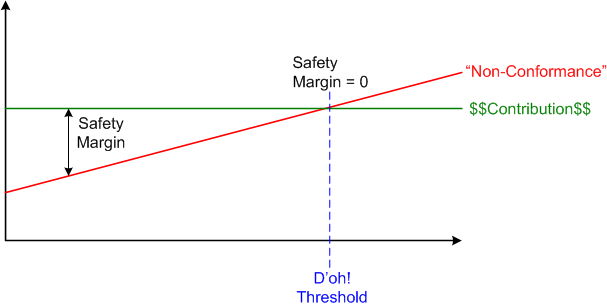
The more bureaucratic or dictatorial the org, the more the threshold shifts to the left (the less the positive safety margin and the more the negative safety margin). Since bureaucrats and dictators care more about conformance to their arbitrary and personally concocted rules than contribution to the “whole“, the “D’oh Threshold” wobbles all over the place. Its setting can vary month to month, day to day, minute to minute, group to group, individual to individual – depending on the emotional state and perceptions of those who run the circus.
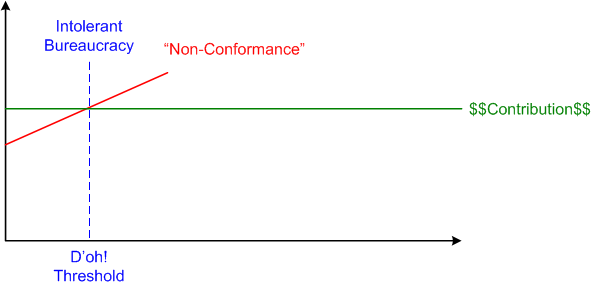
When humans are involved in organized group efforts, there is no escape from subjectivity. But in high performing orgs, the “D’oh Threshold” set point is relatively stationary, far to the right, and everybody knows where they stand.
B and S == BS
About a year ago, after a recommendation from management guru Tom Peters, I read Sidney Dekker’s “Just Culture“. I mention this because Nancy Leveson dedicates a chapter to the concept of a “just culture” in her upcoming book “Engineering A Safer World“.
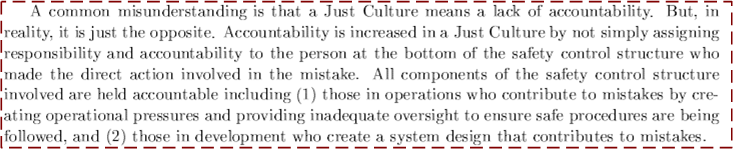
The figure below shows a simple view of the elements and relationships in an example 4 level “safety control structure“. In unjust cultures, when a costly accident occurs, the actions of the low elements on the totem pole, the operator(s) and the physical system, are analyzed to death and the “causes” of the accident are determined.
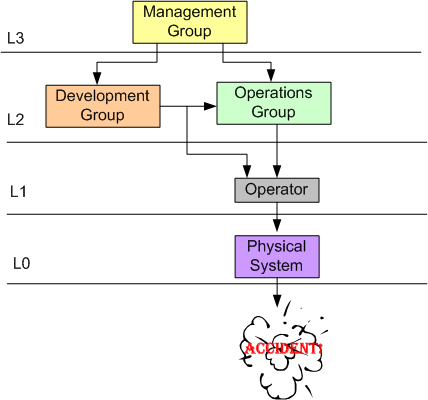
After the accident investigation is “done“, the following sequence of actions usually occurs:
- Blame and Shame (BS!) are showered upon the operator(s).
- Recommendations for “change” are made to operator training, operational procedures, and the physical system design.
- Business goes back to usual
- Rinse and repeat
Note that the level 2 and level 3 elements usually go uninvestigated – even though they are integral, influential forces that affect system operation. So, why do you think that is? Could it be that when an accident occurs, the level 2 and/or level 3 participants have the power to, and do, assume the role of investigator? Could it be that the level 2 and/or level 3 participants, when they don’t/can’t assume the role of investigator, become the “sugar daddies” to a hired band of independent, external investigators?
Chain Of Disapproval

Cronies Need Not Apply
In great orgs, cronies need not apply for influential positions because there’s no chance of them getting appointed. In DYSCOs, CLORGs, and BOOGs, cronies need not apply because they’re guaranteed to get anointed.

Reckless Meritocracies
Being a staunch advocate of democratic meritocracy, when I stumbled across the title of this potentially UCB-loosening op-ed by Ross Douthat; “Our Reckless Meritocracy“, I dove right in. I was intrigued by the use of the word “reckless” in the title.
Ross commences his opinion piece by telling the rags-to-riches-to-rags story of Jon Corzine:
- Boy grows up in rural Illinois
- Boy’s grandfather was a farmer who lost everything in the great depression
- Boy graduates from Illinois state university
- Boy goes into Marine Corps
- Boy gets MBA
- Boy works for regional bank
- Boy works for Goldman Sachs
- Boy becomes Goldman Sachs CEO
- Boy serves in US senate
- Boy serves as governer of NJ
- Boy returns to Wall St. as CEO of MF Global
- MF Global files for bankruptcy after “mislaying” $600M
- Boy resigns in disgrace (but with plenty of dough in the bank)
Ross uses this lead-in to postulate that the US has “created what seems like the most capable, hardworking, high-I.Q. elite in all of human history – and we’ve watched this same elite lead us off a cliff“.
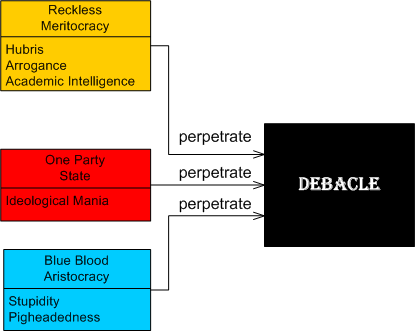
Ross then theorizes on how catastrophies are perpetrated by the rich and powerful in reckless meritocracies, hereditary aristocracies, and one-party states:
- Hereditary aristocracies: debacles caused by stupidity and pigheadedness
- One Party States: debacles caused by ideological mania
- Reckless Meritocracies: debacles caused by hubris
Relative to the other two forms of governance, at least scores of little people aren’t physically massacred in reckless meritocracies. They’re simply thrust into poverty. The real genius of reckless meritocracy is that when a meritocrat falls, he/she isn’t beheaded. At worst, he/she goes to jail. At best, he/she gets away with a huge bag of loot.
So, what’s a democratically run institution to do? Mr. Douthat rightly states that “it will do America no good to replace the arrogant with the ignorant, the overconfident with the incompetent“. (Didn’t you see the movie “Idiocracy“?)
We need intelligent leaders with a sense of their own limits, experienced people whose lives have taught them caution. We still need the best and brightest, but we need them to have somehow learned humility along the way. – Ross Douthat
If you made it thus far into this post, you may be wondering why BD00 is wasting your time by simply parroting Ross Douthat in yet another meta-blog post? It’s because BD00 wanted to display his fledgling UML skill again:
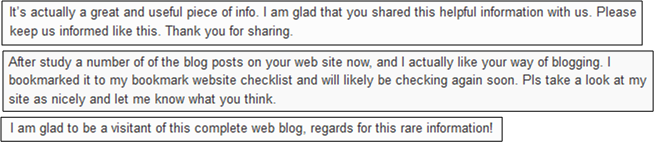
But wait! It may ironically be because of BD00’s own personal lack of humility and the fact that BD00 gets off on reading funny spammer comments like these:
Concealing Outrage
In “The Progress Principle: Using Small Wins to Ignite Joy, Engagement, and Creativity at Work“, Harvard B-school professor and researcher Theresa Amabile writes:

Did she say “most” orgs ? Thank Allah she didn’t say “all” orgs, no?
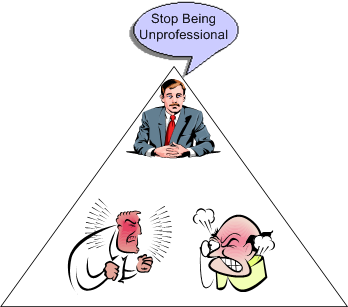
If you think Ms. Amabile’s assertion is true, why do you think it is true? Could it be that the culture at those orgs is unintentionally, but irreversibly, toxic? Could it be that “suppression of emotionally strong opinions” is an innate attribute of hierarchically structured orgs? What about your org? If you’ve never seen a test of Theresa’s assertion at your org, why is that? If you have directly seen, indirectly heard about, or have been a participator in a “strong emotional, strong opinion” situation, how did it turn out and how did you feel? What about the “loath to reveal themselves to superiors” assertion? Got any thoughts about that?
Ironic
It’s like ten thousand spoons when all you need is a knife – Alanis Morissette
I find it curiously ironic that despite what may be espoused, software developers are often placed on one of the lowest rungs of the ladder of stature and importance (but alas, the poor test engineers often rank lowest) in many corpricracies whose revenue is dominated by software-centric products. Yet, it seems that many front-line software project managers, software “leads“, and software “rocketects” are terrified of joining the fray by designing and writing a little code here and there to lead by example and occasionally help out. In mediocre corpo cultures, it’s considered a step “backward” for titled ones to cut some code.
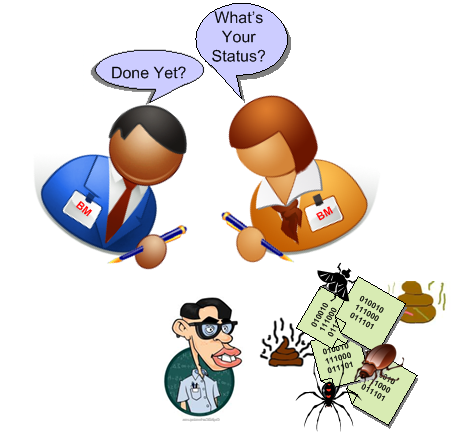
Fuggedaboud writing some code, a lot of the self-pseudo-elite dudes are afraid of even reading code for quality. Hence, to justify their existence, they focus on being meticulous process, schedule, and status-taking wonks – which of course unquestioningly requires greater skill, talent, and dedicated effort than designing/coding/testing/integrating revenue generating code.


Why am I here?
WTF?
Meh!
D'oh!

My BTC Address



 Bulldozer00's Blog