Archive
Behind The Scenes
In really dysfunctional orgs, do you think much of this goes on……?
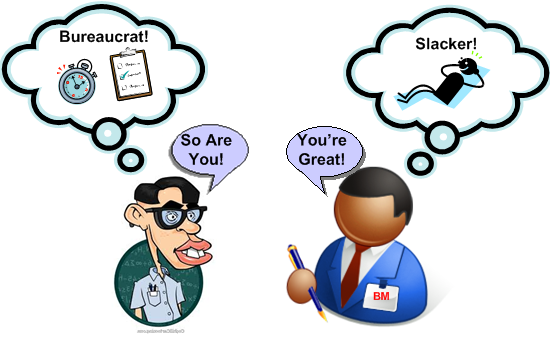
Dynamic Loop Of Demise
Uh Oh! Is Google going down the turd hole? First, in “Why I Left Google“, newly minted Microsoft employee James Whittaker says:
..my last three months working for Google was a whirlwind of desperation, trying in vain to get my passion back. The Google I was passionate about was a technology company that empowered its employees to innovate. In such an environment you don’t have to be part of some executive’s inner circle to succeed. The Google I left was an advertising company with a single corporate-mandated focus.
Then, in “Google’s Mounting Trash Pile“, Paul Whyte writes:
Google’s engineering culture has been an incredible asset. But the record shows that without some discipline, that asset can subtly but inevitably work against Google in its mission as a titan of Internet search and software.
On the one hand, Mr. Whittaker bailed because he felt the dense fog of bureaucracy and a narrowing focus descending upon the company. On the other hand, the (not unreasonable) pressure to jettison bogus research projects with no revenue stream in sight seems to be draining the passion and engagement out of the workforce. Can a vicious, self-reinforcing loop be in the making? Increase In Pressure For Profits -> Decrease In Reseach Funding -> Decrease In Employee Passion -> Decrease In Number And Quality Of Products -> Increase In Pressure For Profits.

I don’t think this dynamic loop of demise is one of Peter Senge‘s “Fifth Discipline” archetypes, but maybe it should be.
Four Attributes
Assume that every commercial enterprise can be “objectively” (LOL!) characterized by the following four discrete attributes:
- Trustworthiness [untrustful | trustful]
- Transparency [closed | open]
- Fairness [unfair | fair]
- Product_Quality [crappy | meh | excellent]
If I did the math right, there are 2*2*2*3 = 24 attribute combos. At one end of the spectrum, we have orgs that are untrustful, closed, unfair producers of crappy products and services. At the other end of the spectrum we have enterprises that are trustful, open, fair producers of excellent products and services.
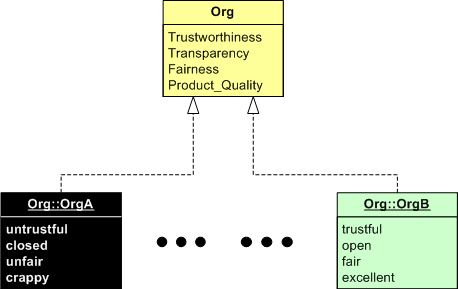
So, what do you think the ratio of OrgAs to OrgBs is in the world, and why? Do you think the ratio is increasing or decreasing as civilization advances? Do you think the four attributes are uncorrelated or are they intimately coupled? Can an untrustful, closed, and unfair org produce excellent products and services? Given an OrgA, can it transform into an OrgB? Given an OrgB, can it transform into an OrgA? Which transformation is more likely?
Fish On Fridays III
It’s Friday, so it’s time to eat some more fish. Guest blogger “fishmeister” has fried up another tasty treat for you and me to savor.
Firefighter or Fire-proofer: The Tyranny of Today
Software coder. Designer. Thinker.
In those jobs, your primary purpose is to take a blank page and fill it with something that solves an identified problem or need. Often, this requires a great deal of cognitive thinking–noodling out an idea ahead of any actual work. And this takes time.
Unlike a laborer, who’s efforts are immediately apparent as their manual activities produce something tangible, cognitive thinking does not take place on a schedule. You can’t just sit down and say “at 10:30 on Tuesday, I’m going to have a brilliant thought“. It takes time. Sometimes lots of time. And sometimes it happens at odd times when you least expect it.
That ‘eureka moment’ can happen in the car, in the shower, at your desk, in line for coffee–anywhere, anytime. Which brings me to the real reason for this post.
If your work time is spent on putting out fires and solving immediate issues at the expense of thinking strategically about long-term solutions–innovation–you end up getting stuck in the Tyranny of Today–being a fireman instead of a fire-proofer.
Jeffrey Phillips writes a blog that I follow regularly. (BD00’s humble writings and Jeffrey’s are #1 and #2 on my daily morning reading list). ((I won’t say in which order, though)). 🙂
The other day he wrote about The Tyranny of Today. It resonated with me on so many levels that I had to share it with my boss. He outlines everything that we are currently struggling with in our business every day.
We have a large cadre of Designers in our organization, yet we are always being challenged because we don’t think ‘creatively‘. Our deadlines are short–sometimes less than a day between being given a project and expecting a solution to be generated. This creates a dilemma that up until now, I didn’t quite understand. Mr. Phillips puts it most succinctly…
…[The tyranny of today is] An “all hands on deck” mentality, which means that all available resources are focused on today’s issues, today’s needs, today’s problems. Ever more efficient operating models have pared organizations to the bone, meaning that anyone not working on today’s issues seem superfluous. Until the new products and services cupboard is bare because no one was working on new products and services.
We’ve created very powerful “business as usual” engines, and increasingly, these engines no longer serve us, we serve them. The BAU models dictate how we think, how we deploy resources and how we reward people. The tyranny of today is based on our business as usual operating models and the perverted ways in which they drive our strategies, our thinking and the way we apply resources.
We live in an immediate-gratification society these days. Technologies surrounding us have been developed to speed up the processes required to get things done. Back when “I was a kid” designer, developing a concept meant several days of pencil sketches, thumbnails, doodling, and eventually working out a refined concept, that required an artistic skill to draw, paint, and color in a visual representation of an idea up to a sufficient level that someone else (with the purse-strings) would be willing to shell out cash for your idea. All this effort meant that you were “off-line” for any other projects that came along, and as a result, the # of Designers and Freelancers in our studio would increase or decrease based on the workload at the time.
These days, I can bang out a 3-dimensional computer model–complete with textures, surfaces, lighting, and visuals–that looks so convincing that you’d think I’d just taken a picture of a real object in the real world. And I can do this in less than an hour. The tech around me has allowed the mechanical process of simulation to occur at the click of a mouse. But my brain still works the same old way.
At the same time, the down economy has meant that we’ve been cutting back on personnel, letting Designers go and not refilling those positions immediately. Those remaining have to just pick up the load. (“Leveraging resources” is the euphemism we hear every day.) Which means that we rely on our tech to an even greater degree just to get today’s workload completed.
As a result, we have bursts where there is more work that is due right now, than we have bodies in place to handle. Which means that in order to get it all done, I have to take off my propeller-equipped beanie hat and put on my fireman’s helmet. And with all the immediate issues of short-term needs–the fires that take place every day-I put out those fires and sacrifice the time needed to think creatively on another project. I become a victim of the Tyranny of Today.

How about you–do you spend your day sitting under an apple tree waiting for the fruit to smack you on your noggin, or do you piss on fires all day? What can you do in your business to escape the pattern and grow?
Thoers
In case you were wondering how to pronounce the title of this post, it’s “thoo-errs“. It rhymes with “Dewar’s“.
During the rise of the “institution” in the 1900s, Taylorism produced the segregated thinkers/doers model of operation (as shown on the left in the figure below) in order to get things done. Most doers were uneducated and assumed to be lazy/unmotivated barbarians.The “superior” thinkers created the framework of how/what/when work was done; hired some doers; tightly monitored and controlled the process of production.

Relative to the institution-less past, the segregated Thinkers/Doers modus of operandi was an improvement. Via an exchange of pay for work done, institutions provided the means for doers to satisfy Maslow‘s level one/two physiological needs for themselves and their families.
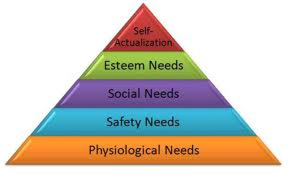
The vast majority of institutions today still operate in accordance with (a milder and veiled form of) Taylor’s segregated thinker-doer model. However, there are some gems (Zappos, Morningstar, Semco, Gore, HCL) out there that operate according the “thoer” model – where everyone is both a thinker and a doer. Although they’re hard to ferret out, these gems proactively provide a work environment in which all 5 levels of Maslow’s hierarchy are attainable to all stakeholders within the organization – not just those in the upper echelons.
Environmental Influence
In “Engineering A Safer World“, Nancy Leveson states:
Human behavior is always influenced by the environment in which it takes place. Changing that environment will be much more effective in changing operator error than the usual behaviorist approach of using reward and punishment. Without changing the environment, human error cannot be reduced for long. We design systems in which operator error is inevitable and then blame the operator and not the system design.
So why is that? Could it be because the system designers and environment caretakers are also the same people who have the power to assign blame – and it’s much easier to blame than to change the environment?

Interdisciplinary Team Effort
Where are the clowns? Send in the clowns. – Shirley Bassey
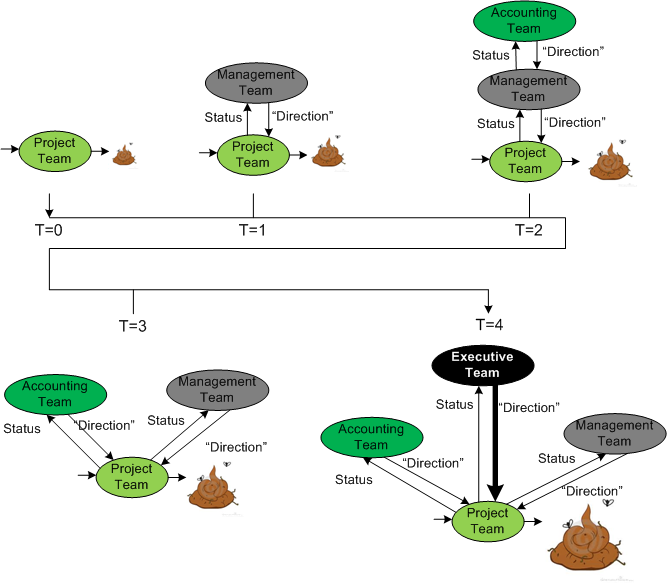
Customer Suffering
For some context, assume that your software-intensive system can actually be modeled in terms of “identifiable C”s:
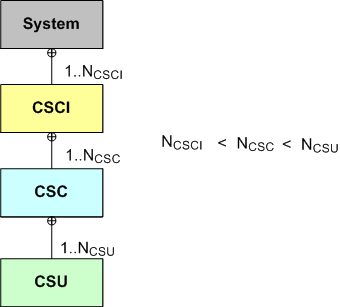
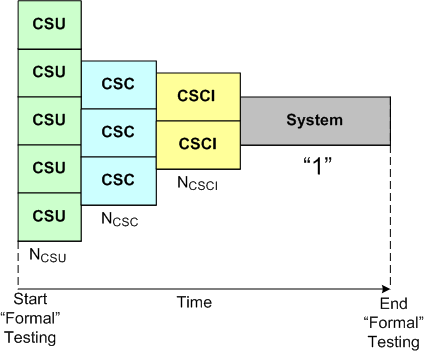
Given this decomposition of structure, the ideal but pragmatically unattainable test plan that “may” lead to success is given by:
On the opposite end of the spectrum, the test plan that virtually guarantees downstream failure is given by:
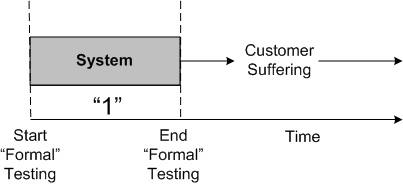
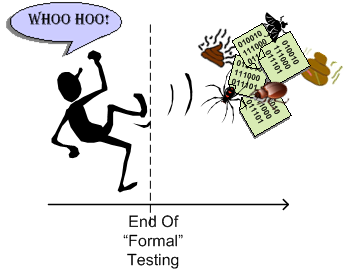
In practice, no program/project/product/software leader in their right mind skips testing at all the “C” levels of granularity. Instead, many are forced (by the ubiquitous “system” they’re ensconced in) to “fake it” because by the time the project progresses to the “Start Formal Testing” point, the schedule and budget have been blown to bits and punting the quagmire out the door becomes the top priority.
The Uncrossable Threshold
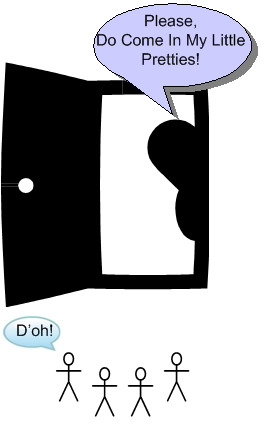
Unless you work in a Chinese sweatshop, the likelihood is high that your management has an “open door” policy. After all, it’s been the right thing to do since the 80’s, right? However, the likelihood that anyone but their “direct reports” casually cross the threshold to chat about problems and ideas for improvement at any level in the org is low, no?
So why is that? Could it be an unwritten rule in hierarchies that “little” people aren’t allowed to “whine” to stratospheric luminaries? Could it be a culture of fear of reprisal? Could it be a dearth of trust? Could it be the perception that bosses don’t like to hear bad news? What do you think it could be?
Resource And Asset Ban
Stocks and bonds are assets; water and iron ore are resources. Assets and resources are “its“. People are not resources and they’re not assets and they’re not “its“. Get it? So, stop parroting your moo-herd peers if you want to distinguish yourself from the pack like you say you do.

Hitherto, the unesteemed BD00 proposes a federal law (Phil, if your reading this, the last two words are fer you 🙂 ) that will ban all orgs from using the MBA-inspired, utterly unauthentic, and Taylor-esque words “resource” and “asset” when their PR spinners and glossy annual report writers refer to their “people“.
Referring to people as assets is a vestige of the so-yesterday theory X management mindset that is so ingrained in the psyches of both SCOLs and DICs everywhere that this standard practice remains unexamined even today by most orgs. So, please consider replacing the phrases on the left with those on the right:
- Deploy our assets -> deploy our people
- Utilize our resources -> utilize our people
- Allocate some resources -> allocate some people, time, and money
- People are our greatest asset -> People are our greatest strength
You may think that BD00 is being anal when he brings up such minutia, and that’s OK. BD00 thinks that the little things matter, and this is one of those little things that matter. What little things matter to you?

Why am I here?
WTF?
Meh!
D'oh!

My BTC Address



 Bulldozer00's Blog