Archive
We’d Do This?
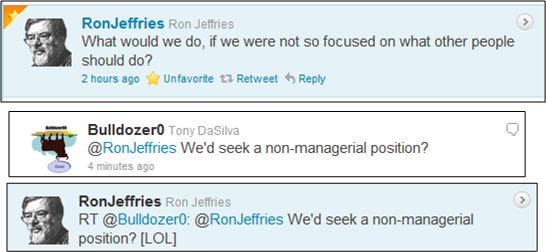
Wise ole’ Ron Jeffries and dumb ole’ Bulldozer00 go back… way, way back. Ron prolly won’t remember the multi-week e-exchange we had, but back in the 90’s we engaged in a passionate, tete-ah-tete tango on the merits and “perceived lack-thereof” of the eXtreme Programming (XP) software development process. That historic exchange (which changed the course of history!) actually happened before the invention of social networking and effortless person-to-person comm – OMG!.
After the dust was settled, the chaw was spat, the pistols were re-loaded, and the ‘nads were comfortably repositioned back into the sack, Ron graciously sent me a signed copy of “Extreme Programming Installed“. I’ll never forget his generous gesture.
Don’t You Wish….
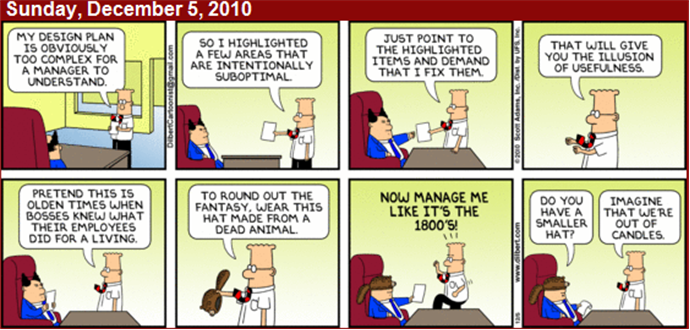
…you can have a Dilbertonian conversation with a BM (past or present) like the one below without getting fired? Of course, the elegant genius of Dilbert is that former cubicle-dweller-turned-gazillionaire Scott Adams makes you want to laugh and cry simultaneously.
Are You Still Working On That?
It’s funny enough when you work for a one dimensional manager (one dimension = schedule), but it’s even funnier when another 1D manager that has nothing to do with your project stops by to chit chat and he/she inevitably asks you:
Are you still working on that?
LOL! Being 1D, and even though he/she has no idea what it takes (or should take) to finish a project, the question can be interpreted as: Since you’re not done, you’re lazy or you’re screwing up.
When the question pops up, try this Judo move:
Should I be done? How long should it have taken?
Or, you can be really nasty and retort with:
Yes I am still working on it. Sorry, but it’s not a shallow and superficial management task like signing off on a document I haven’t read or attending an agenda-less meeting that I could check off on my TODO list.
Come on, I dare you.

Fierce Protection
Delicious, just delicious. Pitches from Fred Brooks, Scott Berkun, Tom DeMarco, Tim Lister, and Steve McConnell all in one place: the Construx (McConnell’s company) Software Executive Summit. You can download them from here: Summit Materials.
Here’s a snapshot of one of Fred Brooks’s slides that struck me as paradoxical:
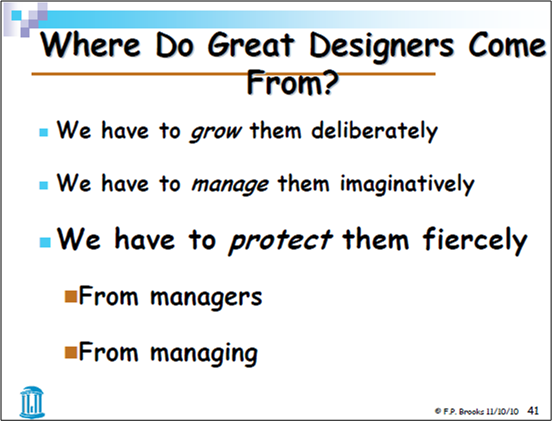
So…. who’s the “we” that Fred is addressing here and what’s the paradox? I’m pretty sure that Fred is addressing managers, right? The paradox is that he’s admonishing managers to protect great designers from…… managers. WTF?
But wait, I think I get it now. Fred is telling PHOR managers to “fiercely” protect designers from Bozo Managers (but in a non-offensive and politically correct way, of course). Alas, the fact that this slide appears at all in Fred’s deck implies that PHORs are rare and BMs are plentiful, no?
How do you interpret this slide?
Status Seekers And Superheroes
Some people don’t like the dude, but I love Richard Branson. Why? Because he breaks the mold of CEOs who steadfastly cling to their self-image of infallibility and hide within their enclaves for fear of ruining said image and appearing human. Check out this paragraph from “It’s all About the People“.
Try to avoid hiring status seekers, as they tend to distance themselves from their employees. Look for people who care passionately about the company and not simply their status within it. In my experience, they must want to build a business that all its employees can all be proud of – one that will look after its staffers and customers alike. Of course, you can’t get it right every time. When you do make the wrong management decision, it’s vital to act decisively. As the saying goes, “Rot starts at the top”. – Richard Branson
The trick, of course, is knowing how to separate the wheat from the chaff; the bozos from the non-bozos. Mr. Branson goes on to talk about the importance of ferreting out problems before they mushroom into full blown crises:
How will you know when things are going wrong? In the early days at Virgin, I would give out my phone number to all our music company staffers and tell them to call me whenever they felt we were doing something really wrong. This was key to our development as a business, both because it helped me to identify problems early on and, more importantly, because it let the employees know that management was ready to listen to them. Fostering this kind of dialogue is essential if you want to build a company that will grow and thrive. Your staff will feel more valued and committed if they really believe you are listening to them, and you will benefit from hearing a lot of great ideas from the people on the front lines. – Richard Branson
I think the two points that Richard illuminates go hand in hand. When a SASS (who shouldn’t have been hired in the first place) is the primary cause of a problem, he/she will cleverly camouflage and redirect the blame. Having successfully moved him/her self out of harm’s way, our SASS will next offer to step up, don his/her superhero suit, and dissolve the crisis. Of course, the SASSholes situated above our superhero in the CCH will happily guzzle the full glass of koolaid.

Responsibilities And Compensation
If you’re in the blue box, better shoot for the yellow box ASAP and start accumulating titles (to post on LinkedIn.com) before your compensation curve flattens. Since there are fewer multividual contributors in an org pyramid, by auto-assumption they must be more valuable and deserving, right? Of course, the graphic below is an extreme exaggeration, but how far off the mark do you really think it is?

The DORK Is Born
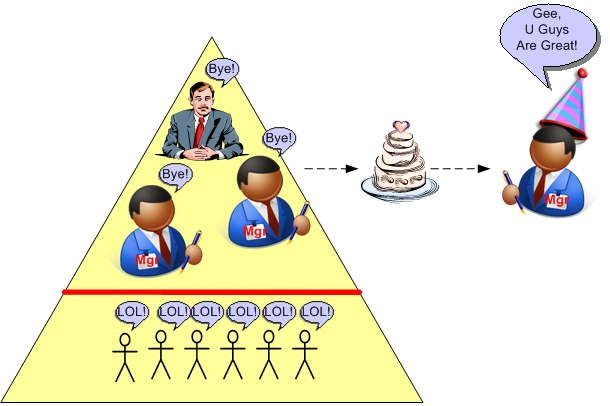
Unlike upstanding citizens, I’m both internally and externally verbally weird. For example, I think that when a proven, in-the-trenches, problem-solving, core worker jumps ship to another org it often hurts a corpricracy more than when a BM, CCRAT, BUTT, CGH or other non-DORK leaves. Because of anointed (not necessarily earned) positional power, non-DORK managerial workers are given the opportunity to positively influence an org’s social and economic performance. However, as all of us know, not all managers exert any positive influence at all. Au contraire, the really “bad ones” just flit from meeting to meeting conjuring up innovative procedural and financial obstacles to getting work done while simultaneously collecting super-sized paychecks. Who says managers aren’t innovative?
Because of this so-called distorted (and “bad”?) attitude, it makes me laugh when I hear of frantic counter offers being made when non-DORK managers leave, while nary a whisper is uttered when a highly productive, problem solving DORK rides off into the sunset. I laugh even more heartily when a non-DORK SCOL is presented with a going away cake or even better; an org-financed buh-bye party. Why laugh? Because the alternatives are much less palatable.
Breaking News: One of the byproducts of writing this stupidly RUU blarticle was the emergence of the “DORK” acronym from the bad-person corner of my psyche. I’m giddy with excitement cuz now I can interchange usage of the venerable “DIC” acronym with “DORK” in my future ramblings. Whoo Hoo, a landmark event!
In The “Old Days”
In the “old days”, when companies fell upon hard times and had to let some DICs go, or when the DICforce went on strike, jobs were mechanized enough so that managers could fill the holes and keep the joint running until the situation improved. Of course, in most orgs, that is no longer true today since most managers, certainly those that are BMs, shed and conveniently forget their lowly “worker’s skills” as soon as they are promoted out of the cellar into the clique of elites. Thus, a company that cuts front line DICs without cutting some managers puts itself into a deeper grave. Not only does productivity go down because the holes of work expertise go unfilled, but the overhead cost rises because the same number of managers are left to “supervise” fewer DICs. On the other hand, if all or most of the jettisoned DICs were dead weight, the previous sentence may not be true – unless dead weight BMs were retained. But hey, in the minds of most managers (and all of those who fall into the BM category), fellow comrade managers are not dead weight.
 Update: Shortly after I queued this post up for publication, a friend(?) serendipitously sent me this link: Lockheed Martin press release. Notice the “delay” that took place from the time they shed 10000 DICs to the time they offered some 600 BOOGLs, CGHs, and SCOLs their (no doubt generous) “Voluntary Executive Separation Program“. Better late than never, right?
The executive reductions will help align the number of senior leaders with the overall decline of about 10,000 in the employee population since the beginning of last year, cut overhead costs and management layers, and increase the Corporation’s speed and agility in meeting commitments.
Nice corpo jargon, no?
Esther Tweets
I’m passionate about all aspects of software development, including, uh, project management (I really am). Since Esther Derby is an insightful and pragmatic thinker filled with valuable tips, techniques, and methods for successfully executing hairball software projects, I follow her on Twitter. Check out this trio of sequential tweets.
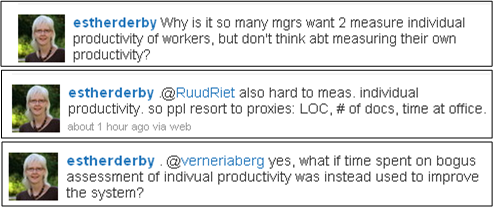
My answer to Esther’s last question is: “It would be great!“. Alas, most managers don’t, or aren’t allowed to, think in terms of systems. Systems thinking isn’t valued in siloed, CCH corpricracies, so managers have no incentive to learn or apply it’s principles and techniques for continuous improvement. In really badly run orgs, it’s too dangerous for one’s career to think or act horizontally in silo-city. It’s too bad, because orgs of people are richly interactive dynamic systems of systems that require constant shepherding to keep every person and every group and every unit aligned and connected.
Lopp-Sided
Michael Lopp is an engineer’s kind of manager. Besides having a great last name (can you say Lopp-sided?) and an even better pen name (“Rands In Repose“), the guy still understands and relates to down-in-the-trenches engineering work. He even drops an occasional F-bomb in his writing for dramatic effect. The dude is a rare bird and I pay attention to what he says.
Although I think the name of his latest book, “Being Geek“, is meh, there’s a lot of great stuff in there for both managers and DICs. Here’s a sampling of “culled” passages:
The story we tell ourselves when someone we like chooses to leave the group or the company is, “Everyone is replaceable.” This is true, but this is a rationalization designed to lessen the blow that, crap, someone we really like is leaving. We are losing part of the team. Professional damage is done when a team member leaves, and while they are eventually replaceable, productivity and morale take a hit.
A manager’s job is to forget. That’s what they do. They get promoted and begin the long processes of forgetting everything that got them promoted in the first place. I’m not joking. Manager amnesia will be the source of much professional consternation throughout your career.
My management strategy is to assume those closest to the problem can make the best decisions. That’s how I scale.
In defense of my brethren managers, we don’t forget everything, and during all that forgetting, we’re learning other useful things like organization politics, meeting etiquette, and the art of talking for 10 minutes without saying a thing.
The list of words that define management are revealing: direct, in charge, handle, control, and force. Looking at this list, it’s not a surprise that the term “management” has a distasteful Orwellian air.
If it’s been six months, you’ve been actively looking, and no one has told you a great story about how engineering shaped the fortunes of your company, there’s a chance that engineering doesn’t have a seat at the culture table in your company.
There’s the been-here-forever network, the I-survived-the-layoff people, and the untouchable did-something-great-once crew.
It pains me to write this, but my first question about your boss is this: is he taking the time to talk with you in a private setting? A 1:1 is a frequent, regularly scheduled meeting between you and your boss, and if it’s not happening, I, uh, don’t really know where to start. The absence of a 1:1 is the absence of mentorship, and that means your need to gather your experience in the trenches. And while there is nothing to replace “real-world experience,” I’m wondering what the value add of your boss is.
My impression is that the presence of status reports is an indication that your boss doesn’t trust the flow of information in your organization.
We’re knowledge workers, which is an awkwardly lame way of stating that we don’t actually build physical things with our hands.
Asking for the impossible is an advanced management technique, and it’s one that is particularly abhorrent to engineers. Frequent impossible requests result in an erosion of respect and a decaying of credibility.
You’re not going to engage if you don’t respect the person who is asking you to do something.
Management by crisis is exhilarating, but it values velocity over completeness; it sacrifices creativity for the illusion of progress.
Everyone is an adjustment. When you’re interacting with anyone, you leave the core you and become slightly them.


Why am I here?
WTF?
Meh!
D'oh!

My BTC Address



 Bulldozer00's Blog