Archive
A Valiant Try
Google recently re-appointed Larry Page as it’s CEO after a 10 year hiatus. From the following blurb in “The Product Shakeup At Google Begins”, it seems like Google is valiantly trying to return to its roots:
(Larry) Page famously has a low opinion of managers, especially product managers who try to tell engineers what to do. “People don’t want to be managed,” he is quoted in Steven Levy’s new book, In the Plex. Page is a big believer in self-management. At one point early on in the company’s history, he and Brin tried to get rid of all managers.
Even though it is certainly impractical to get rid of all managers once an org grows to a certain size, ya gotta love the irony of anti-management CEOs like Page, Nayar, and Semler, no? With guys like that watching over an org, you can be confident that they’ll be vigilant in keeping the manager-to-worker ratio low and that they’ll make sure managers do more than just plan, watch, control, command, and evaluate others. Of course, this philosophy doesn’t guarantee success, but it sure does make working for a company more enjoyable for the majority of people who work there – not just the management minority.

No Obvious Deficiencies
While perusing my favorite quotes page for blog post seedlings, this one spoke to me:
“There are two ways of constructing a software design: One way is to make it so simple that there are obviously no deficiencies, and the other way is to make it so complicated that there are no obvious deficiencies. The first method is far more difficult.” – C.A.R. Hoare.
Being the mangler, distorter, and exaggerator that I am, here’s my version:
“There are two ways of camouflaging crappy work: One way is to present it so simply that there are no obvious deficiencies, and the other way is to make the presentation so complicated that there are no obvious deficiencies. Both ways are equally effective.” – C.A.R. Hoare + Bulldozer00.

To Prevent Asking, Simply Don’t Ask
One of the dudes that I follow on Twitter is Don Harkey. His handle is “LeaderBook“, and he’s got a neat gig going on. When he tweets, it’s always a phrase or sentence from a book on leadership:

If you have a culture where your employees don’t even think about asking for, let alone actually asking for, a projector, a white board, a second computer monitor, a professional membership, a training class, or (heaven forbid) a tool that costs money, you get what you deserve.
So, how do you get a culture of “non-asking“? It’s so easy it comes naturally. There’s no work required – and that’s a good thing for work-averse managers. All ya gotta do is “lead by example” by never asking your employees what they need to do their jobs better. To really discourage the practice of employees from asking for things to help them do their jobs better (because employees can’t be trusted and they’ll take advantage of your goodwill, of course), you can ensure that the acquisition process is an unknowable labyrinth littered with approvals required by bureaucratic little Hitlers. See, I said it was easy.
I Wuv What I Do
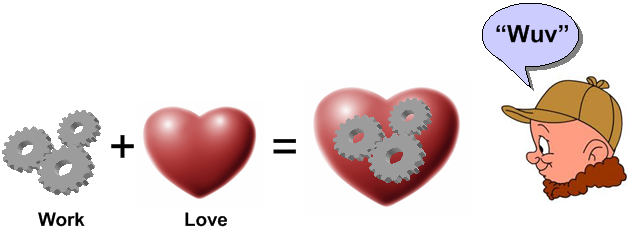
In the splendid “Evil Plans: Having Fun on the Road to World Domination“, Hugh MacLeod asks us to “unify work and love“. His reasoning is sound:
“After family and friends, what else is there?” – Hugh MacLeod
Because I’m lucky to love what I do, I feel like I’ve been blessed. How about you?
Are you feelin’ lucky today, punk? – Dirty Harry
The Boundary
Mr. Watts Humphrey‘s final book, titled “Leadership, Teamwork, and Trust: Building a Competitive Software Capability” was recently released and I’ve been reading it online. Since I’m in the front end of the book, before the TSP–PSP crap, I mean “stuff“, is placed into the limelight for sale, I’m enjoying what Watts and co-author James W. Over have written about the 21st century “management of knowledge workers problem“. Knowledge workers manipulate knowledge in the confines of their heads to create new knowledge. Physical laborers manipulate material objects to create new objects. Since, unlike physical work, knowledge work is invisible, Humphrey and Over (rightly) assert that knowledge work can’t be managed by traditional, early 20th century, management methods. In their own words:
Knowledge workers take what is known, and after modifying and extending it, they combine it with other related knowledge to actually create new knowledge. This means they are working at the boundary between what is known and what is unknown. They are extending our total storehouse of knowledge, and in doing so, they are creating economic value. – Watts Humphrey & James W. Over
But Watts and Over seem inconsistent to me (and it’s probably just me). They talk about the boundary ‘tween the known and the unknown, yet they advocate the heavyweight pre-planning of tasks down to the 10 hour level of granularity. When you know in advance that you’ll be spending a large portion of your time exploring and fumbling around in unknown territory, it’s delusional for others who don’t have to do the work themselves to expect you to chunk and pre-plan your tasks in 10 hour increments, no?

Nothing is impossible for the man who doesn’t have to do it himself. – A. H. Weiler
Inchies
So, what’s an Inchie? It’s an “INfallibility CHIp“. An Inchie is an invisible, but paradoxically real corpo currency that is the opposite of a demerit. An increasing Inchie stash is required to move up in a corpo caste system. The higher up you are in a CLORG, the more Inchies you have been awarded, and the more infallible you’ve become.
At level 0 down in the basement, you begin the game with 0 Inchies and you start making your moves – climbing the ladder Inchie by Inchie. Be careful and keep watch over your Inchie stash though, cuz your peers will try to steal your Inchies when you’re not looking.
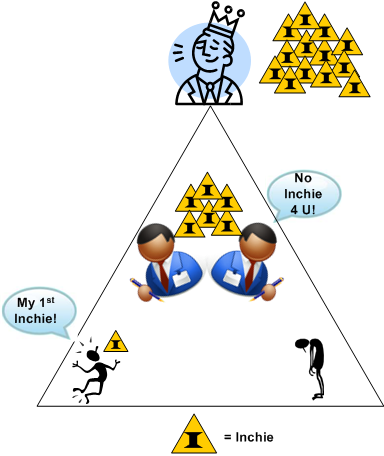 Alas, even though you now know that Inchies exist, don’t get your hopes up. You see, the criteria managers at level N (where N > 0) use for disbursing Inchies down to the less infallible people at level N-1 are random. Even among managers within a given level, the award criteria is arbitrarily different. Plus, to make the game more difficult, the dudes who awarded you your Inchies can take them back whenever they feel the need to “scratch your Inchie” – especially if you piss them off with career ending moves. D’oh!
Once you make it to the top of the pyramid with your big bag o’ Inchies, not only have you amassed the most Inchies in the DYSCO, but you’re given the keys to the Inchie minting machine. This gives you the opportunity to fabricate an unlimited number of Inchies to add to your display case and to sprinkle upon your sycophant crew as you please. You’ve become a 100% infallible god in the DYSCO microcosm. Whoo Hoo and Kuh-nInchie-wah!
Boss Building
I recently stumbled upon this interesting NY Times article: “Google’s 8-Point Plan to Help Managers Improve”. Prior to developing their 8-point improvement plan, the management philosophy that propelled Google to superstar status was this:
“For much of its 13-year history, particularly the early years, Google has taken a pretty simple approach to management: Leave people alone. Let the engineers do their stuff. If they become stuck, they’ll ask their bosses, whose deep technical expertise propelled them into management in the first place.”
After collecting inputs from their vast workforce, a Google task force concluded that technical expertise in the management ranks was still important, but it ranked as the lowest priority on their list of desired manager attributes:
… Mr. Bock’s group found that technical expertise — the ability, say, to write computer code in your sleep — ranked dead last among Google’s big eight. What employees valued most were even-keeled bosses who made time for one-on-one meetings, who helped people puzzle through problems by asking questions, not dictating answers, and who took an interest in employees’ lives and careers.
“In the Google context, we’d always believed that to be a manager, particularly on the engineering side, you need to be as deep or deeper a technical expert than the people who work for you,” Mr. Bock says. “It turns out that that’s absolutely the least important thing. It’s important, but pales in comparison. Much more important is just making that connection and being accessible.”
So, let me summarize the management characteristics that Google will value most in the future.
- Being accessible
- Making time for one-on-one meetings and taking an interest in employee’s lives and careers.
- Helping people by asking questions and not dictating answers.
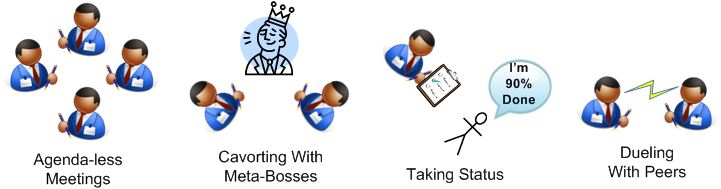
Google’s conclusions weren’t earth shattering, but they’re hard to implement in orgs where bosses spend all of their time going to agenda-less meetings, cavorting with their meta-bosses, taking status from their direct reports, and dueling with their peers, no?
Uneducated, Greedy, Fungible, Lazy, Untrustworthy
I enjoy reading Watts Humphrey‘s work, but it’s not because I’m a big fan of his TSP/PSP software development approach. It’s because his writings inspire me to think and inquire. Thus, his writings are full of great blog post seedlings.
In “Leadership, Teamwork, and Trust: Building a Competitive Software Capability“, Watts describes the unquestioned assumptions made by managers regarding workers back in the ole’ days when Frederick Taylor’s scientific management methods were king:
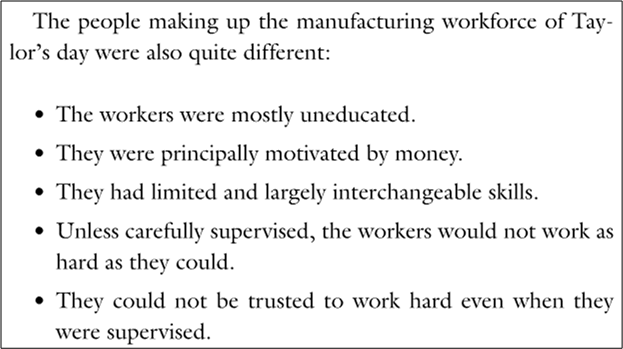
Uneducated, Greedy, Fungible, Lazy, and Untrustworthy – UGFLU. There must not be a vaccine for curing UGFLU because it seems like the affliction has heartily survived 100 years of medical advances. UGFLU is an adaptable and robust little bugger, no?

In Memory Of “Chainsaw” Al
ASSume that you’re a member of the infallible leadership team of an impeccable and squeaky clean kingdom like the one shown below. It’s interesting how your “who supervises who” stovepipe chart looks yawningly the same as everyone else’s and yields no clue as to how your borg operates on a day to day basis, no?
Next, assume that everything is cruising along splendidly. The dough is rolling in, everyone feels productive and happy (well, at least you and your cohorts feel that way), and you believe your own rhetoric until — BAM, the fit hits the shan. D’oh!
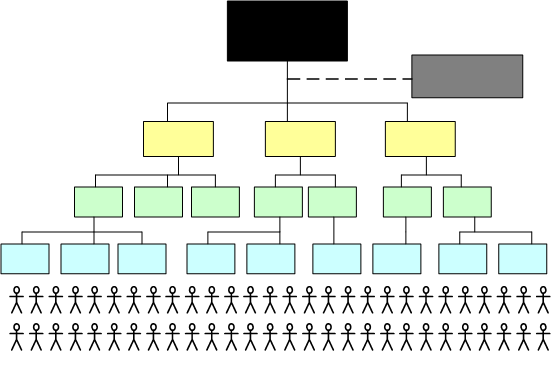 Of course, being a member of the elite and unquestionably infallible team in the penthouse, the crisis was certainly thrust upon you by forces beyond your control. The world suddenly, instantaneously, turned against you in a perfect storm of destruction. Unlike the good times, in which you naturally look in the mirror for the cause of success, in the bad times you conveniently look out the window for the cause of failure.
So, what creative solution do you conjure up to dissolve the crisis? Well, duh, you don your “Chainsaw” Al mask and start hacking away at the roots of your borg while leaving the branches that prop you up into the sky intact….

Whoo hoo, crisis solved! Err…. was it? Can the last remaining method of simplification and a pack of golden parachutes be in the offing?
Norm And Dick
Since the main activity of some management chains seems to be preventing deviations from the norm, I propose that all managers change their names to “Norm“. It would complement “DICk” nicely, no?
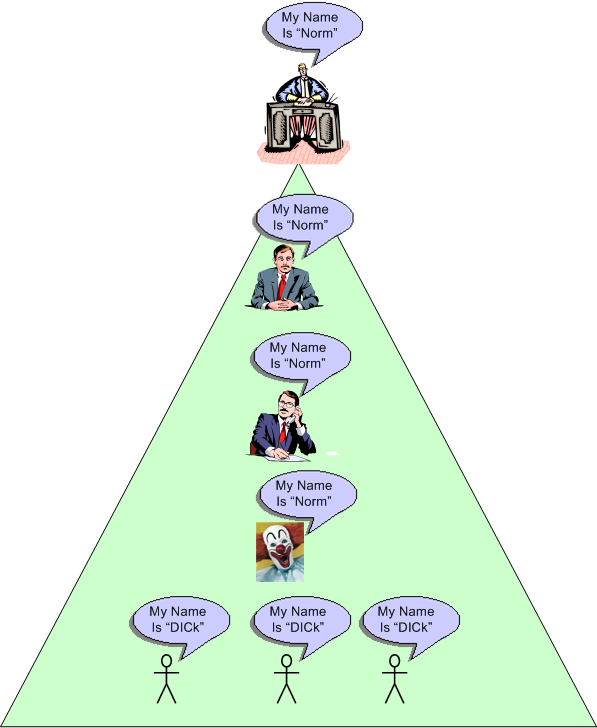
Without deviation from the “Norm“, there can be no progress – Frank Zappa

Why am I here?
WTF?
Meh!
D'oh!

My BTC Address



 Bulldozer00's Blog