Archive
Leverage Points
In Places to Intervene in a System, systems thinker Donella Meadows lists the following 9 leverage points for keeping a system “on the rails” and in continuous pursuit of its goals.
9. Numbers (subsidies, taxes, standards).
8. Material stocks and flows.
7. Regulating negative feedback loops.
6. Driving positive feedback loops.
5. Information flows.
4. The rules of the system (incentives, punishment, constraints).
3. The power of self-organization.
2. The goals of the system.
1. The mindset or paradigm out of which the goals, rules, feedback structure arise.
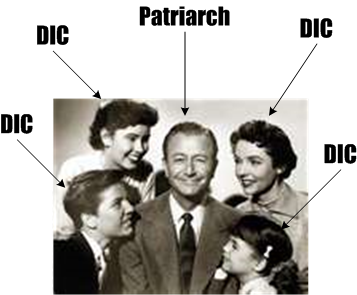
The items are listed in increasing order of difficulty. Of particular interest is number 1, the “mindset” of the system controller(s). In so-called “modern” corpricracies, the patriarchical mindset of “we’re in charge and we know what’s best, so STFU and do what you’re told“, has ruled the day since the Henry Ford era. In that day, since the typical workforce was under-educated and managers actually knew how to perform and teach the work that kept a company viable, patriarchy worked well. These days, since the situation has changed (and continues to change) immensely, patriarchy can drive a company into the ground.
When managers don’t have a clue how to do the work, they ignore problems, issues, and ideas floated up from the bottom by the DICforce. This crucial feedback loop for sustained viability gets severed and the org suffers greatly for it. BMs collectively, and often unconsciously, behave this way in order not to look stupid and preserve their aura of infallible superiority. Ideas that can save six or seven figures in costs and product enhancements that may increase competitiveness go un-investigated or are killed via “it’s not in the budget”.
Maybe surprisingly to some, the vast majority of the DICforce actually buys into the patriarchical mindset because that’s the way it’s been for eons. DICs that initially don’t buy into patriarchy fall in line as soon as they are ignored or are slapped down a couple of times. Those that continue to buck the patriarchy after being “warned” are shackled or expelled for “insubordination” – another great term that reinforces the patriarchical mindset.
Closed Systems
In “Entropy Demystified“, Arieh Ben-Naim states an often forgotten fact about entropy:
The entropy of a system can decrease when that system is coupled with another system (e.g. a heating system connected with a thermostat). The law of ever increasing entropy is only valid in an isolated system.
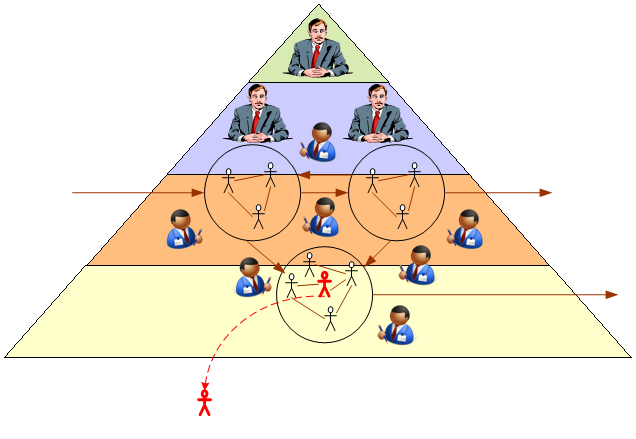
In the figure below, the system on the left is coupled with the external environment and its members can use the coupling to learn how to adapt, dynamically self-organize, and arrest the growth in entropy that can destroy systems. In the isolated system on the right, which models a typical corpo mediocracy run by fat headed and infallible BMs who ignore everything outside their cathedral walls, there is no possibility of learning – and entropy marches forward.

Jumpin’ Out
If you’re deeply embedded in a complex social system, it’s incredibly difficult to gain any insight into what the system you’re enmeshed in really does, or how it does what it does. Even though you’re an integral element of the system, your view is most likely obscured by your lack of interest in finding out or, more likely, by a lack of communication from the dudes in the penthouse. All you can see are trees. No forest, and no sun above the treetops.
A great way of “jumping out of the system” to get a better view and understanding is by modeling. By taking a stab at modeling the static structures and dynamic behaviors of the system you’re in, you can get a much better feel for what’s going on.
 A formal language like UML or SysML paired with a good visual drawing tool like Visio can be a powerful tool set to help you gain perspective, but all you really need is a pencil and paper to start things off. Since your first few iterations will suck and be totally wrong, you’ll be throwing away lots of wood pulp if you don’t use an electronic tool. If you stick with it, you’ll acquire an understanding of what really happens in your system as opposed to what is espoused by those in charge.
All models are wrong, but some are useful. – George Box
Truth And Fear
The association of truth and fear, which would be highly artificial at most, is particularly inappropriate in the minds of those who do not know what truth is. All this could mean is that you are arbitrarily associating something beyond your awareness with something you do not want. It is evident, then, that you are judging something of which you are totally unaware. You have set up this strange situation so that it is impossible to escape from it without a guide who does know what your reality is. The purpose of this guide is to merely remind you. – A Course In Miracles
Alrighty then. Let’s break this passage down, analyze it to death, and see how much of it applies to me and you.
- The association of truth and fear, which would be highly artificial at most, is particularly inappropriate in the minds of those who do not know what truth is : this statement applies directly to me. I have no clue of what (the) truth is. (you too?)
- You are arbitrarily associating something beyond your awareness with something you do not want: I do associate things beyond my awareness with fear – which is something I don’t want. (you too?)
- You are judging something of which you are totally unaware: Since I like to make stuff up, I’m constantly judging stuff I’m not aware of. (you too?)
- You have set up this strange situation so that it is impossible to escape from it without a guide who does know what your reality is: Ok, I’ll buy into that. But who’s the freakin’ guide? (you wanna know too?)
The purported guide is supposedly: Jesus Christ as channeled through the “A Course In Miracles” author duo. There’s a lot to like in this work but, because I’m not a big fan of organized religion, I’m having a tough time reading more than one or two pages at a time.

Close Spatial Proximity
Even on software development projects with agreed-to coding rules, it’s hard to (and often painful to all parties) “enforce” the rules. This is especially true if the rules cover superficial items like indenting, brace alignment, comment frequency/formatting, variable/method name letter capitalization/underscoring. IMHO, programmers are smart enough to not get obstructed from doing their jobs when trivial, finely grained rules like those are violated. It (rightly) pisses them off if they are forced to waste time on minutiae dictated by software “leads” that don’t write any code and (especially) former programmers who’ve been promoted to bureaucratic stooges.
Take the example below. The segment on the right reflects (almost) correct conformance to the commenting rule “every line in a class declaration shall be prefaced with one or more comment lines”. A stricter version of the rule may be “every line in a class declaration shall be prefaced with one or more Doxygenated comment lines”.

Obviously, the code on the left violates the example commenting rule – but is it less understandable and maintainable than the code on the right? The result of diligently applying the “rule” can be interpreted as fragmenting/dispersing the code and rendering it less understandable than the sparser commented code on the left. Personally, I like to see necessarily cohesive code lines in close spatial proximity to each other. It’s simply easier for me to understand the local picture and the essence of what makes the code cohesive.
Even if you insert an automated tool into your process that explicitly nags about coding rule violations, forcing a programmer to conform to standards that he/she thinks are a waste of time can cause the counterproductive results of subversive, passive-aggressive behavior to appear in other, more important, areas of the project. So, if you’re a software lead crafting some coding rules to dump on your “team”, beware of the level of granularity that you specify your coding rules. Better yet, don’t call them rules. Call them guidelines to show that you respect and trust your team mates.
If you’re a software lead that doesn’t write code anymore because it’s “beneath” you or a bureaucrat who doesn’t write code but who does write corpo level coding rules, this post probably went right over your head.
Note: For an example of a minimal set of C++ coding guidelines (except in rare cases, I don’t like to use the word “rule”) that I personally try to stick to, check this post out: project-specific coding guidelines.
Positive Or Negative, Meaning Or No Meaning?
In Claude Shannon‘s book, “The Mathematical Theory Of Communication“, Mr. Shannon positively correlates information with entropy:
Information = f(Entropy)
When I read that several years ago, it was unsettling. Even though I’m a layman, it didn’t make sense. After all, doesn’t information represent order and entropy represent its opposite, chaos? Shouldn’t a minus sign connect the two? Norbert Wiener, whom Claude bounced ideas off of (and vice-versa) thought it did. His entropy-information connection included the minus sign.
In addition, Shannon’s theory stripped “meaning”, which is person-specific and unmodel-able in scrutable equations, from information. He treats information as a string of bland ‘0’ and ‘1’ bits that get transported from one location to another via a matched, but insentient, transmitter-receiver pair. Wiener kept the “meaning” in information and he kept his feedback loop-centric equations analog. This enabled his cybernetic theory to remain applicable to both man and the machine and make assertions like: “those who can control the means of communication in a system will rule the roost“.

Like most of my posts, this one points nowhere. I just thought I’d share it because I think others might find the Shannon-Wiener differences/likenesses as interesting and mysterious as I do.
The Commencement Of Husbandry
The figure below was copied over from yesterday’s post. Derived from Joseph Tainter’s “The Collapse of Complex Societies”, it simply illustrates that as the complexity of a social organizational structure necessarily grows to support the group’s own growth and survival needs, the adaptability of the structure decreases. The flat and loosely coupled institutional structures originally created by the group’s elites (with the willing consent of the commoners) start hierarchically rising and coalescing into a rigid, gridlocked monolith incapable of change. At the unknown future point in time where an external unwanted disturbance exceeds the group’s ability to handle it with its existing complex problem solving structures and intellectual wizardry, the whole tower of Babel comes tumbling down since the monolith is incapable of the alternative – adapting to the disturbance via change. Poof!
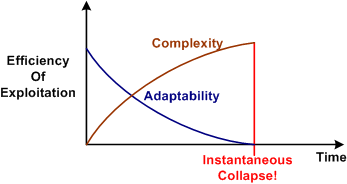
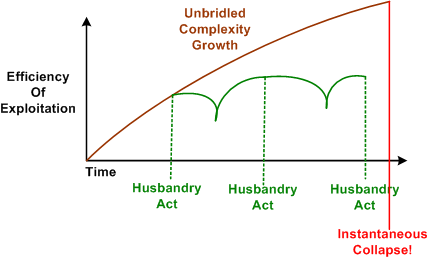
According to Tainter, once the process has started, it is irreversible. But is it? Check out the figure below. In this example, the group leadership not only awakens to the dooms day scenario, it commences the process of husbandry to reverse the process by:
- Re-structuring (not just tinkering and rearranging the chairs) for increased adaptability – by simplifying.
- Scouring the system for, and delicately removing useless, appendix-like substructures.
- Discovering the pockets of fat that keep the system immobile and trimming them away.
- Loosening dependencies between substructures and streamlining the interactions between those substructures by jettisoning bogus processes and procedures.
- Installing effective, low lag time, internal feedback loops and external sensors that allow the system to keep moving forward and probing for harmful external disturbances.

If the execution of husbandry is boldly done right (and it’s a big IF for humongous institutions with a voracious appetite for resources), an effectively self-controlled and adaptable production system will emerge. Over time, and with sustained periodic acts of husbandry to reduce complexity, the system can prosper for the long haul as shown in the figure below.
The Last Remaining Method Of Simplification
In this blog post, “The Collapse of Complex Business Models”, uber-thinker Clay Shirky predicts the impending instantaneous implosion of many (all?) unfathomably complex business models that are currently thought by many to be unassailable. The cruxt of Clay’s compelling argument is based on eerily similar collapses of past complex cultures as told by Joseph Tainter in his aptly named book, The Collapse of Complex Societies.
Tainter’s thesis is that when society’s elite members add one layer of bureaucracy or demand one tribute too many, they end up extracting all the value from their environment it is possible to extract and then some. – Clay Shirky
Adding layer upon layer of bureaucracy (to disconnect themselves from the commoners, of course) and demanding “tributes” in the form of exotic titles, awards, astronomical salaries, and perks (to satisfy their egomania and bolster the false image that they “know what’s best for all“) pushes their elite system over the precipice.
In such systems, there is no way to make things a little bit simpler – the whole edifice becomes a huge, interlocking system not readily amenable to change. When the value of complexity turns negative, a society plagued by an inability to react remains as complex as ever, right up to the moment where it becomes suddenly and dramatically simpler, which is to say right up to the moment of collapse. Collapse is simply the last remaining method of simplification. – Clay Shirky
In this 5 minute video talk, “the current economy“, my favorite spiritual guru, Eckhart Tolle, trumps Clay by rising up one level of abstraction. Eckhart predicts the impending collapse of many of the societal structures that are ego based. Ego loves complexity. And how many large, man-made, socio-technical structures (a.k.a institutions) do you think are not ego based?
The problem is not the content, it’s the conditioned structure of the human mind – Eckhart Tolle
Knowledge, Understanding, And Wisdom
Like growth and development, I’d say that most people tend to equate knowledge with understanding. Until relatively recently, I did too.
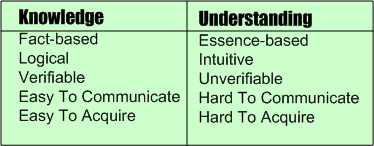
Via memorization, akin to “copying and pasting“, a person can be loaded with knowledge but devoid of understanding. Application of knowledge without understanding in an intellectually challenging endeavor like programming can, and does, lead to future messes for others to clean up.
Always code as if the guy who ends up maintaining your code will be a violent psychopath who knows where you live. – Damian Conway
Wisdom, a close cousin of understanding, can also be orthogonal to knowledge. However, the gap between wisdom and understanding can be much greater than the gap ‘tween understanding and knowledge. Wisdom can be acquired over time, but profound wisdom only arrives on the wings of grace, unscheduled. How do I know this? I don’t. I just like to make stuff up.
Knowledge is knowing a tomato is a fruit; Wisdom is not putting it in a fruit salad. – Peter Kay
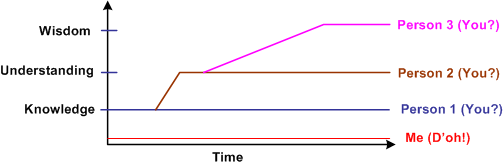
The rocket science financial dudes who literally engineered the global financial disaster have lots of knowledge and understanding in their area of “expertise”, but zero wisdom. Ditto, the eminently credentialed economic Nobel Laureates who championed the downfall of the LTCM hedge fund twelve, yes twelve, freakin’ years ago. It seems that their elegant equation set was devoid of any simple control variables that accounted for the risk of the Russian financial crisis that caused the fund to implode.
As long as people continue to unquestioningly and passively accept the word of narrowly focused knowledge experts with zero wisdom, the saying “history tends to repeats itself” won’t fade away, ever.
All I can say is, beware of geeks … bearing formulas. – Warren Buffet
D4P Has Been Hatched
Friend and long time mentor Bill Livingston has finished his latest book, “Design For Prevention” (D4P). I mildly helped Bill in his endeavor by providing feedback over the last year or so in the form of idiotic commentary, and mostly, typo exposure.
Bill, being a staunch promoter of SCRBF feedback and its natural power of convergence to excellence, continuously asked for feedback and contributory ideas throughout the book writing process. Being a blabbermouth and having great respect for the man because of the profound influence he’s had on my worldview for 20+ years, I truly wanted to contribute some ideas of substance. However, I struggled mightily to try and conjure up some worthy input because even though I understood the essence of this original work and it resonated deeply with me, I couldn’t quite form (and still can’t) a decent and coherent picture of the whole work in my mind.
D4P is a socio-technical process for designing a solution to a big hairy problem (in the face of powerful institutional resistance) that dissolves the problem without causing massive downstream stakeholder damage. Paradoxically, the book is a loosely connected, but also dense, artistic tapestry of seemingly unrelated topics and concepts such as:
- Alan Turing’s thesis of infallibility vs. intelligence
- Leveraging nature’s physical laws, with a special emphasis on suspending the 2nd law of thermodynamics and entropy growth
- W. Ross Ashby‘s cybernetic law of requisite variety
- Thorstein Veblen’s theory of the leisure class
- Nash Equilibriums in game playing
- Rudolf Starkermann‘s mathematical analysis of social group system behavior
Bill does a masterful and unprecedented job at connecting the dots. The book will set you back, uh, $250 beaners on Amazon.com, but wait….. there’s a reason for that astronomical price. He doesn’t really care if he sells it. He wants to give it away to people who are seriously interested in “Designing For Prevention”. Posers need not apply. If you’re intrigued and interested in trying to coerce Bill into sending you a copy, you can introduce yourself and make your case at vitalith “at” att “dot” net.

Update 12/29/12:
The D4P book is available for free download at designforprevention.com. The second edition is on its way shortly.

Why am I here?
WTF?
Meh!
D'oh!

My BTC Address



 Bulldozer00's Blog