Archive
Holiday Cheer!
From the cast and crew at Bulldozer00.com:

Annoying And Disappointing
Atego’s Artisan Real-Time Studio, Sparx’s Enterprise Architect, and IBM’s Rational Rhapsody are big and expensive UML modeling tools. You would think they support all of the basic visual modeling elements of the UML, no?
On the left side of the figure below, I show the four fundamental, visual UML symbols for conjuring up (wrong, incomplete, and inconsistent) structural views of an object-oriented software system in the form of class diagrams, deployment diagrams, component diagrams, etc.
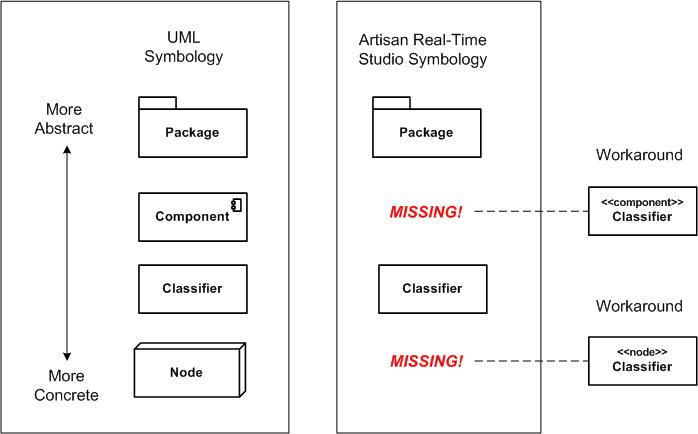
It blows BD00’s already incoherently twisted mind that Artisan Studio doesn’t provide visual elements for a UML Node or a Component. As can be seen on the right side of the figure, the work-around is to use stereotyped Classifier elements to fill the void. It’s annoying and disappointing, dontcha think?
But hey, not many people (especially extreme left-wing agile zealots) buy into the potential of the UML for shortening the development time and long-term cost of big, sprawling, long-lived software systems . So, “meh” to this irrelevant post.
Note: I’m a relatively newbie user of Artisan Studio. If you’re an advanced user and you know that I’m mistaken here, then please speak up and tell me how to find these two seemingly-hidden buggers.
Preventers, Not Managers
The worst companies directly contribute to the physical and emotional deterioration of their DICforces by unceasingly imposing ridiculous schedules and ratcheting up the (unspoken) pressure to work massive amounts of unpaid overtime for long stretches of time. Average companies do the same under the tired old mantra of “it’s a hostile business environment“, but they take good care of their DICsters after much damage is done. The best of the breed are highly self-aware systems that actively practice “crisis prevention” – not “crisis management“. They diligently monitor the “system’s” vital signs and know when things are getting too toxic for their people. Unlike the worst and the average, the best actually take effective action to relieve the stress on their people before the wreckage accumulates. They’ll sacrifice some almighty dollars by relaxing schedules, or giving some extra days off, or frequently providing small tokens of appreciation to counter the toxicity of the operational environment. They are preventers, not managers.

Wouldn’t it be kool if the role of “manager” was jettisoned in favor of “preventer“? If anything, it would at least drive home what those in charge of others should really be doing – preventing, not managing.
A Real Renaissance
For quite some time now, I’ve been hearing that C++ has been undergoing a resurgence of interest; a renaissance. However, until recently, I couldn’t tell if the claim was real, or just some hype coming out of the C++ community to fruitlessly combat the rise of a plethora of new languages.
Well, I’m convinced that the renaissance is legit. The slides below, pilfered from Herb Sutter‘s “The Future Of C++” talk at Microsoft Build 2012, introduced the formation of a new C++ trade group, the “Standard C++ Foundation“.

Note that there are some big guns with deep pockets backing the foundation along with a cadre of brilliant and dedicated directors at the helm.
It’s a good time to be a C++ programmer, so join the renaissance and start learning the new features and libraries offered up in C++11. Of course, if your technical management is not forward looking and it’s tight with training dollars, you’ll have to do it on your own time, covertly, behind the scenes. But it will not only be fun, it will enhance your marketability.
The C++ Product Roadmap
Fresh from the ISO C++ chairman himself, Herb Sutter, I present you with the C++ product roadmap:

If all goes according to plan, a minor release of the ISO standard will be hatched in 2014. By minor, Herb means that it will be mostly bug fixes to C++11, plus a filesystem library based on Boost.org‘s brilliant work. The networking library, which is big and being developed by a large group of smart people, will be hatched incrementally in a series of Technical Specifications (TS).
The main point that Herb stressed when he hoisted the slide was that “the past is not a good predictor of the future“. If all goes according to plan, the time between major releases of the standard will have been cut from 13 years to 6.
So Professional That It’s Unprofessional
Mike Williams is one of the big three Erlang creators (along with Joe Armstrong and Robert Virding) and the developer of the first Erlang Virtual Machine. Since then, he’s “moved up” and has been working as a software engineering manager for 20+ years. In his InfoQ talk titled “The Ideal Programmer – Why They Don’t Exist and How to Manage Without Them?“, Mike presents this hilarious slide:

It’s hilarious because, if you browse web sites like LinkedIn.com and Monster.com, you’ll find tons of similar, impossible-to-satisfy job descriptions. Everybody, especially the job description writer, knows that exhaustive “requirements” lists like these are a crock of BS. This practice is so professional that it’s unprofessional. So, why does it persist?

Leaders, Followers, Standers
Everybody knows what leaders and followers are, but what about “standers“? A stander is not a slacker. It’s a capable person who is content to stay within his/her comfort zone doing the same thing over and over again.

BD00 thinks that all people are capable and they innately want to “move” forward either as a leader or a follower. It’s a social system’s culture that molds “standers” out of capable people.
In cultures where mistakes of commission are penalized and mistakes of omission go undetected and unacknowledged, the optimum strategy, courtesy of Russell Ackoff, is simply to do as little as needed to elude ex-communication. It’s stagnation city with a burgeoning population of standers; sad for the people and sad for the org.
Not Either, But Both?
I recently dug up an old DDS tutorial pitch by distributed system middleware expert extraordinaire, Doug Schmidt. The last slide in the pitch shows a side-by-side, high-level feature comparison of CORBA and DDS:
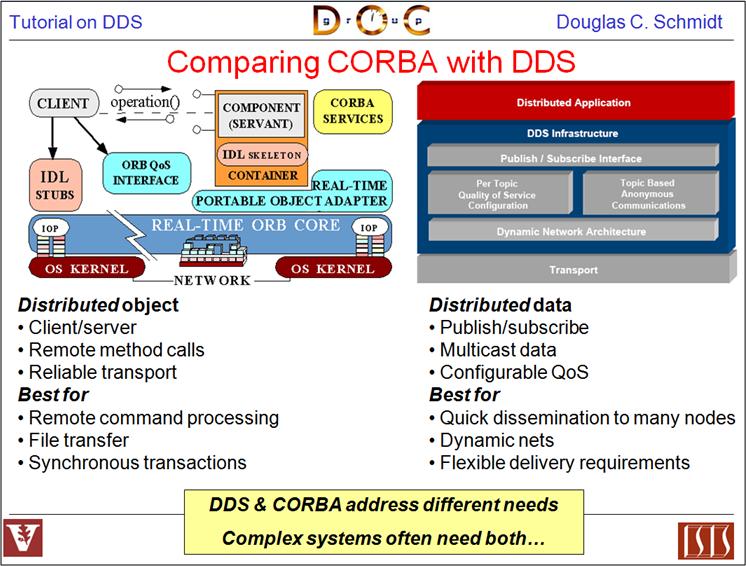
High performance middleware technologies like CORBA and DDS are big, necessarily complex beasts that have high learning curves. Thus, I’m not so sure I agree with Doug’s assessment that complex software systems (like sensor-based command and control systems) need both. One can build a pub-sub mechanism on top of CORBA (using the notification, event, or messaging services) and one can build a client-server, request-response mechanism on top of DDS (using the TCP/IP-like “reliability” QoS). What do you think about the tradeoff? Fill the holes yourself with a tad of home-grown infrastructure code, or use both and create a two-headed, fire-breathing dragon?

The Experiences Of Others
When you think “differently” about the world than the majority, there’s a tendency to start feeling isolated and alone. Such is the power of authority and peer pressure to impose thought conformance to the prevailing world view.

When you encounter others, either in person or more likely in prose, whose “different” thoughts overlap with yours, a sense of kinship and belonging, which all human beings crave, blossoms.

Whenever you find that you are on the side of the majority, it is time to reform. – Mark Twain
One of the main reasons I read a lot of non-fictions books and articles is because I love to discover and learn through the direct experiences of others. Because of the constraints imposed by the limits of physical space and time, I cannot do and directly experience everything in all the areas that interest and impact me. Thus, I rely on the written expressions of others to feed my thirst for knowledge, understanding, and wisdom. To do otherwise would be to live life in a closed bubble, devoid of richness and variety.
Too Detailed, Too Fast
One of the dangers system designers continually face is diving into too much detail, too fast. Given a system problem statement, the tendency is to jump right into fine-grained function (feature) definitions so that the implementation can get staffed and started pronto. Chop-chop, aren’t you done yet?
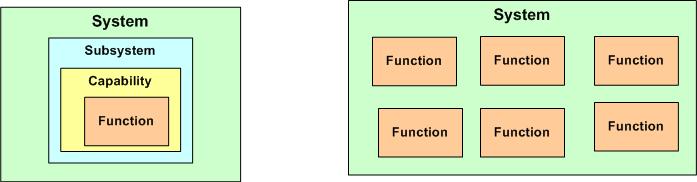
The danger in bypassing a multi-leveled analysis/synthesis effort and directly mapping the problem elements into concrete, buildable functions is that important, unseen, higher level relationships can be missed – and you may pay the price for your haste with massive downstream rework and integration problems. Of course, if the system you’re building is simple enough or you’re adding on to an existing system, then the skip level approach may work out just fine.
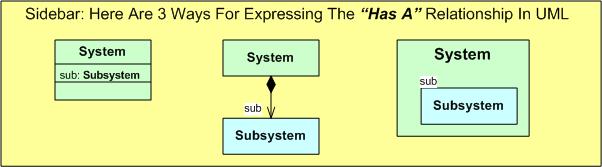

Why am I here?
WTF?
Meh!
D'oh!

My BTC Address



 Bulldozer00's Blog