Archive
Messmatiques And Empathic Creators
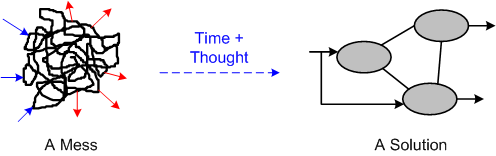
Assume that you have a wicked problem that needs fixing; a bonafide Ackoffian “mess” or Warfieldian “problematique” – a “messmatique“. Also assume (perhaps unrealistically) that a solution that is optimal in some sense is available:
The graphic below shows two different social structures for developing the solution; individual-based and group-based.
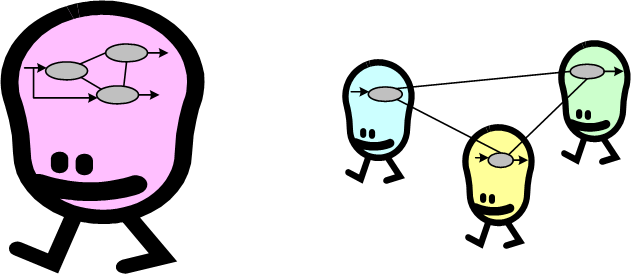
If the messmatique is small enough and well bounded, the individual-based “structure” can produce the ideal solution faster because intra-cranial communication occurs at the speed of thought and there is no need to get group members aligned and on the same page.
Group efforts to solve a messmatique often end up producing a half-assed, design-by-committee solution (at best) or an amplified messmatique (at worst). D’oh!
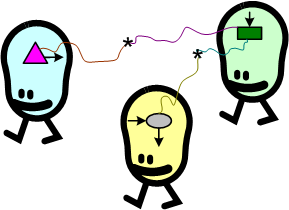
Alas, the individual, genius-based, problem solving structure is not scalable. At a certain level of complexity and size, a singular, intra-cranial created solution can produce the same bogus result as an unaligned group structure.
So, how to resolve the dilemma when a messmatique exceeds the capacity of an individual to cope with the beast? How about this hybrid individual+group structure:
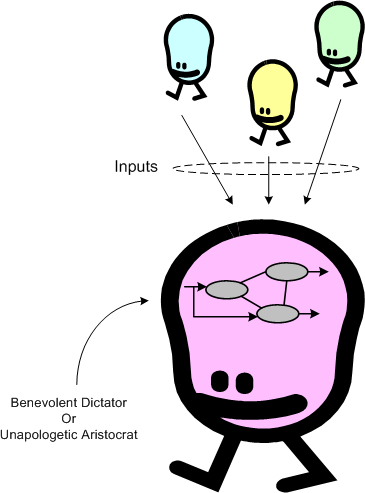
Note: The Brooksian BD/UA is not a “facilitator” (catalyst) or a hot shot “manager” (decider). He/she is both of those and, most importantly, an empathic creator.
Composing a problem resolution social structure is necessary but not sufficient for “success“. A process for converging onto the solution is also required. So, with a hybrid individual+group social structure in place, what would the “ideal” solution development process look like? Is there one?
The Gap Of Woe
In “Why Software Fails”, the most common factors that contribute to software project failure are enumerated as:
- Unrealistic or unarticulated project goals
- Inaccurate estimates of needed resources
- Badly defined system requirements
- Poor reporting of the project’s status
- Unmanaged risks
- Poor communication among customers, developers, and users
- Use of immature technology
- Inability to handle the project’s complexity
- Sloppy development practices
- Poor project management
- Stakeholder politics
- Commercial pressures
Yawn. These failure factors have remained the same for forty years and there are no silver bullet(s) in sight. Oh sure, tools and practices and methodologies have “slightly” improved project performance over the decades, but the increase in size/complexity of the software systems we develop is outpacing performance improvement efforts by a large margin.

A Dearth Of Libraries
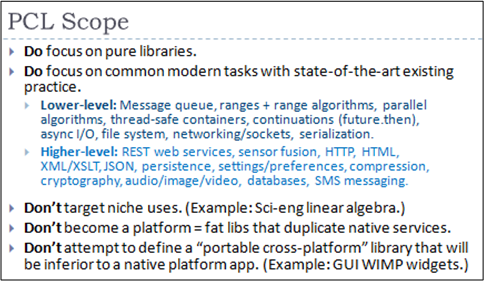
In Herb Sutter’s talk at GoingNative 2012, he opined that the biggest weakness of C++11 is its dearth of libraries; which causes programmers to waste lots of time ($$$) writing their own code to implement mundane functionality like XML parsing, cryptography, networking/sockets, thread-safe containers (<- I’ve had to spend quite a bit of time doing this!), serialization, etc.
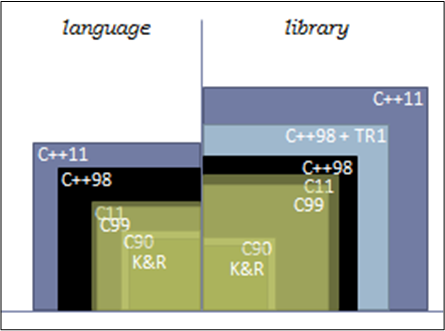
Using language and library specification page counts, Herb started out by showing the progressive growth of C and C++ over time:
Next, Herb presented this eye-popping chart of relative library size for C++11, .NET, and Java:

Yes, that’s C++11 down in those tiny blue boxes. WTF! Note that the core language specifications on the left side of the chart are roughly the same size.
To address the issue, Herb proposed the formation of a an open-source Portable C++ Libraries (PCL) organization with the following guiding principles:
Herb also addressed the issue of how the PCL would interact with the C++ standards committee with this chart:

Basically, the PCL would serve as a front end vetter and integrator of library submittals in order to unburden the committee from the responsibility and allow it to concentrate more on tricky core language features (concepts, modules, static if, etc). The C++ committee would serve as the final fine-grained scrutinizer and approver of library additions to the language. In practice, libraries like poco and Qt could be shipped with every standards-compliant C++ compiler in the future.
I think Herb’s idea is a good one and I hope it blossoms into the real deal. How about you? What do you think?
BD00 – The Physicist
In case you haven’t noticed, BD00 liberally conjures up and uses abstract pictures to promote his rants and lies – just like a physicist:
The use of abstract pictures or symbols to represent real things is absolutely fundamental in physics –this is essentially what physicists use mathematics for. The power of the approach comes when the abstract pictures can be manipulated using simple rules to make firm predictions about the real world. – Cox, Brian; Forshaw, Jeff (2012-01-31). The Quantum Universe: (And Why Anything That Can Happen, Does) (Kindle Locations 512-514). Perseus Books Group. Kindle Edition.
Notice any resemblance?

Hijacked By Thought
In “The Most Direct Means To Eternal Bliss“, Michael Langford nails BD00 personally with a bullet to the forehead:

Confusing “knowing-insight-awareness” with “conceptual knowing“. That’s exactly the rut I’m in. What rut are you in?

Self Made Myth
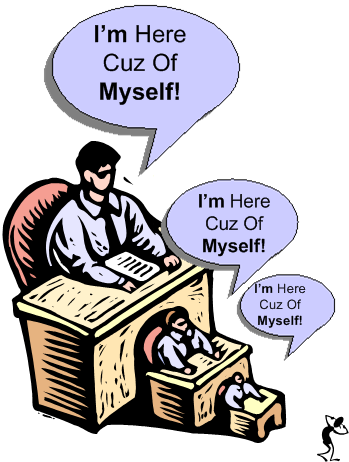
Western societies, especially the good ole USA, revere the myth of the “self-made” man. Even though many people might consider some of my greatest influencers; Seth Godin, Leo Babauta, Hugh MacLeod, and Scott Berkun self-made men, all of them depend on what Godin defines as “tribes” for their livelihood. And they’ll all humbly admit it – which is why I’m a fan.
I recently listened to Leo interview Seth on the subject of tribe-building for writers. Here are some tidbits of sage advice served up by Mr. Godin:
- Don’t get upset by the fact that you don’t have a vision and can’t tell what’s coming next.
- The core of any worthwhile, enduring business is not about maximizing profit.
- You’ve got to embrace a willingness to fail.
- Get that voice out of your head so you can do your best work. (D’oh!)
- Don’t write for strangers – you don’t need a huge “tribe“, and thus, you don’t have to dilute your message.
- Forget about writing “how to” books anymore. People just look it up online.
- People hate reading, so keep it short.
The first four bullets are not just applicable to aspiring writers, no?
The Uncrossable Threshold
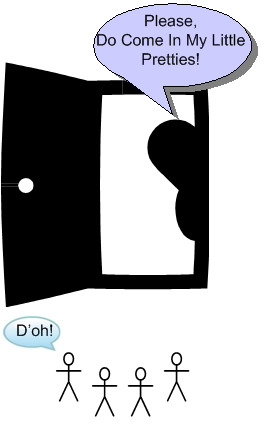
Unless you work in a Chinese sweatshop, the likelihood is high that your management has an “open door” policy. After all, it’s been the right thing to do since the 80’s, right? However, the likelihood that anyone but their “direct reports” casually cross the threshold to chat about problems and ideas for improvement at any level in the org is low, no?
So why is that? Could it be an unwritten rule in hierarchies that “little” people aren’t allowed to “whine” to stratospheric luminaries? Could it be a culture of fear of reprisal? Could it be a dearth of trust? Could it be the perception that bosses don’t like to hear bad news? What do you think it could be?
Resource And Asset Ban
Stocks and bonds are assets; water and iron ore are resources. Assets and resources are “its“. People are not resources and they’re not assets and they’re not “its“. Get it? So, stop parroting your moo-herd peers if you want to distinguish yourself from the pack like you say you do.

Hitherto, the unesteemed BD00 proposes a federal law (Phil, if your reading this, the last two words are fer you 🙂 ) that will ban all orgs from using the MBA-inspired, utterly unauthentic, and Taylor-esque words “resource” and “asset” when their PR spinners and glossy annual report writers refer to their “people“.
Referring to people as assets is a vestige of the so-yesterday theory X management mindset that is so ingrained in the psyches of both SCOLs and DICs everywhere that this standard practice remains unexamined even today by most orgs. So, please consider replacing the phrases on the left with those on the right:
- Deploy our assets -> deploy our people
- Utilize our resources -> utilize our people
- Allocate some resources -> allocate some people, time, and money
- People are our greatest asset -> People are our greatest strength
You may think that BD00 is being anal when he brings up such minutia, and that’s OK. BD00 thinks that the little things matter, and this is one of those little things that matter. What little things matter to you?
The Chairman Was Wrong
Frank Sinatra was wrong. New York is NOT the city that never sleeps. Nawlins is the city that never sleeps – at least during Mardi Gras.

From Within, From Without
With exceptions (and there are always exceptions) everyone knows that the view “from within” is different than the view “from without“.

While viewing “from without“, there is typically less emotional attachment of the viewer to the viewed. The more one is attached to the view “from within“, the more difficult it is to extricate oneself from that view and form a secondary view “from without“.
On product development projects, it’s much easier for a project team member to step outside of the intricate details “from within” to form a view “from without” than it is for an “outsider” to form a view “from within“. But just because it’s easier, it doesn’t mean that it’s done often.
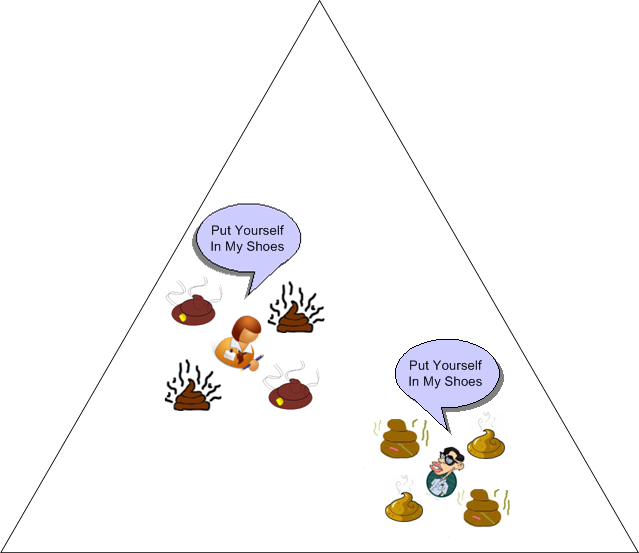
This “from within” and “from without” crap is simply a twist on the old “put yourself in someone else’s shoes” advice…..

Why am I here?
WTF?
Meh!
D'oh!

My BTC Address



 Bulldozer00's Blog