Archive
The Lost Decade?
I think you’ll be hard pressed to find many knowledgeable C++ programmers who won’t admit that managed languages provide higher per-programmer productivity than native languages (because they’re easier to learn, have bigger libraries, and are not as “picky“). Likewise, I think you won’t find many “reasonable” managed language advocates who won’t admit that native language programs are more efficient (smaller and faster for a given solution) than their managed language counterparts. Having said that, take a look at this chart:

According to Herb Sutter, efficiency has(will) usurped(usurp) productivity as the dominating cost factor for software-intensive products in this decade (battery life in mobile devices, power consumption in the data center). Agree?
If you’re interested in watching the video and/or downloading Herb’s slides, here’s the link: “C++ and Beyond 2011: Herb Sutter – Why C++?“.
Unstated, But Deeply Rooted
Maturity is a state that most companies eventually reach. To break out of – or avoid – maturity, innovation is required: new products or services, new marketing or markets, more of what is different, not more of the same. – Russell Ackoff
Not only is “maturity” reached by most orgs, it is actively pursued in order to fulfill an unstated, but deeply rooted amygdalayian desire to transition from org to borg. The hilarity of the situation is that while a “maturing” org’s behaviors and processes unceasingly and silently nudge it toward rigid borgdom, the esteemed leadership continuously cries out for innovation. Do as I say, not as I do. D’oh!

Hameltonian Gems
Hameltonian == Hamiltonian, get it? I know, I know – that’s the worst free-association joke you’ve ever heard.
When it comes to eloquently cracking good jokes while talking about serious matters, Gary Hamel is right up there with fellow heretical management genius Russell Ackoff. Check out these gems from Mr. Hamel’s latest book, “What Matters Now“:
- Unfortunately, the groundwater of business is now heavily contaminated with the runoff from morally blinkered egomania.
- It was a perfect storm of human delinquency. Deceit, hubris, myopia, greed, and denial were all luridly displayed.
- “ninja” loans (no income, no job, no assets).
- Among the powerful, blame deflection is a core competence.
- As ethical truants, big business seems to rank alongside Charlie Sheen and Lindsay Lohan.
- If life had adhered to Six Sigma rules, we’d still be slime.
- …they seem to have come from another solar system—one where CFOs are servants rather than gods.
- …you’d have an easier time getting a date with a supermodel or George Clooney than turning your company into an innovation hottie.
- Unlike Apple, most companies are long on accountants and short on artists. They are run by executives who know everything about cost and next to nothing about value.
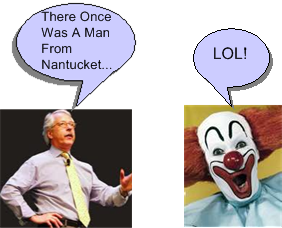
Dumb And Dumber And Dumbest

In case this is your first look at this awful blawg, that’s Bulldozer00 with the colorful Katy Perry-like locks on the right.
Please do not forward, reblog, share, or link to this post. After all, I’ve got a respectable reputation to uphold and an impeccable image to protect. It’ll be our leetle shared secret; an exercise in spiritual E-bonding.
If I do catch you, yes you, dear reader, violating my edict, then I’ll hunt you down and brand your forehead with the BD00 seal of unapproval:

The Nightly News Template

Call For Artists!
Are you a fledgling e-artist who wants to show off his/her work and earn a few bux? If so, then BD00 wants to partner with you in a book project. Like Elton John and Bernie Taupin did with music and lyrics, we can do with graphics and words.
The majority of posts on this site fall into the “management” category. Thus, I’m gonna try to write a self-published e-book that showcases my utter lack of understanding and unparalleled ignorance of the subject. The biggest hurdle I have to overcome is the fear of being sued by Microsoft, and perhaps others, from the commercial use of their graphics. Thus, I need someone to draw up legit replacements for the icons I plan to use in my so-called work; and to be on standby for others that I might need during the effort.
Here’s a categorized collage of images that I need to be redrawn:
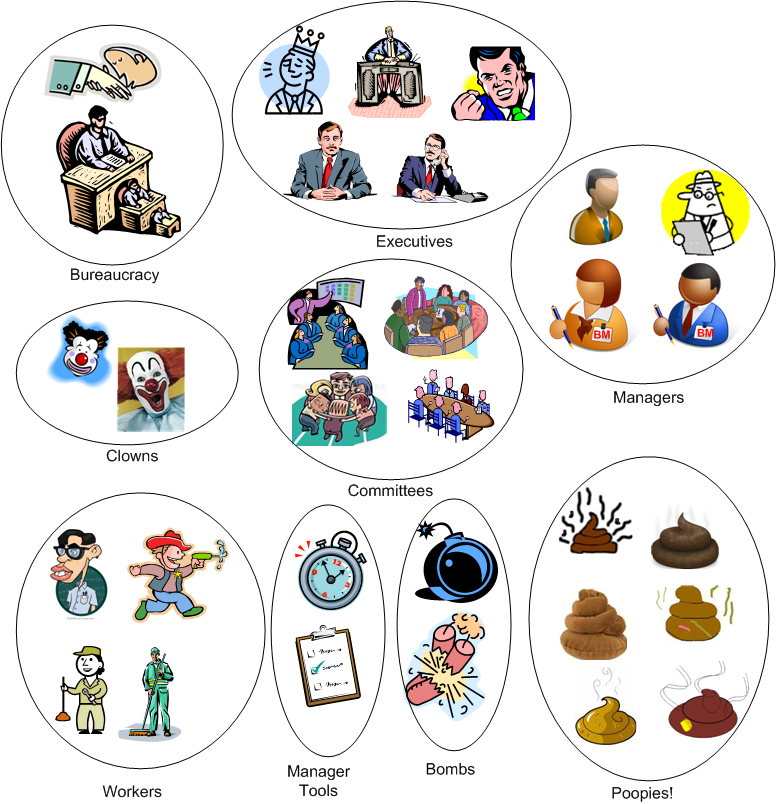
If you’re interested, please give me a shout out in the comments section so that we can get the business negotiation process started.
Searching For A Title
Look at the e-mail gift that BD00 recently received from a shy cohort in crime:

I’ve been searching for a title to the book that I probably won’t ever write. TEWKTHN seems as good as any. Got any other suggestions?
Will Work For….
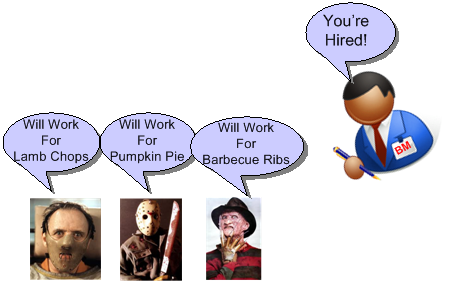
Perhaps disturbingly, I’ve always been curious about the factors and causes of individual and (especially) group psychopathy. Thus, this Ronald Schouten piece, “Psychopaths on Wall Street” (which is a PR pitch for his forthcoming book “Almost a Psychopath“), caught my attention. Specifically, Mr. Schouten’s “good news” paragraph triggered a sinister, internal BD00 “LOL!“.
But there is good news. First of all, it is possible to screen out “almost” and “full-blown” psychopaths during the hiring process and after. Some of the key indicators are:
Glibness and superficial charm (BD00?)
Lack of empathy (BD00?)
Consistent decisions in their self interest, even where it is ethically questionable (BD00?)
Chronic, sometimes transparent lies, even with regard to minor things (BD00?)
Lack of remorse (BD00?)
Failure to take responsibility for their actions, and instead blaming others (BD00?)
Shallow emotions (BD00?)
Ignoring responsibilities (BD00?)
Persistent focus on gratifying their own needs at the expense of others (BD00?)
Conning and manipulative behavior (BD00?)
How can one possibly confirm or disconfirm these traits during a job interview – especially since psychopaths are brilliant at masking their agendas? But wait! On second glance, the list looks like it could serve as a bona fide set of prerequisites for executive team membership at Enron and Goldman Sux type borgs, no?
Product Line Blueprint
Here it is, the blueprint (patent pending) you’ve been waiting for:
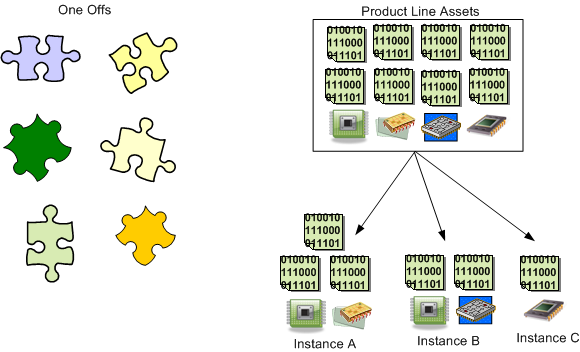
Need a little less abstraction? Well, how about this refinement:
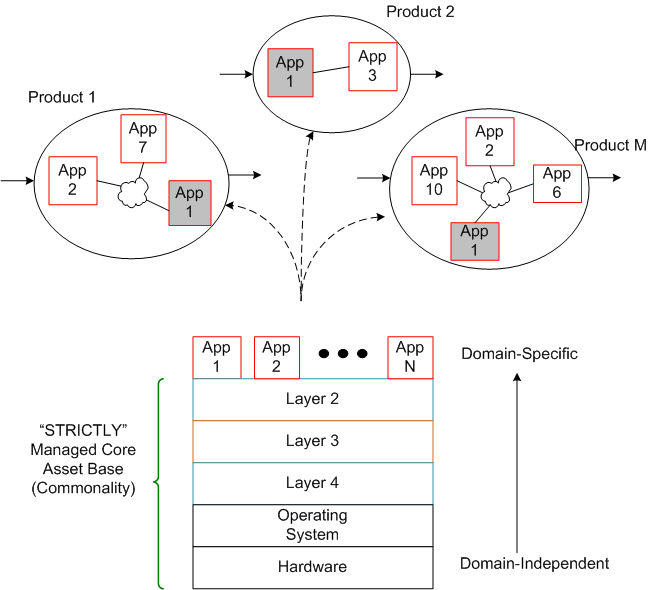
Piece of cake, no? It’s easy to “figure out“:
- the number of layers needed in the platform,
- the functionality and connectivity within and between each of the layers in the stack
- the granularity of the peer entities that go into each layer and which separates the layers
- the peer-to-peer communication protocols and dependencies within each layer
- the interfaces provided by, and required by, each layer in the stack
- what your horizontally, integrate-able App component set should be for specific product instantiations
- how much time, how much money, and how many people it will take to stand up the stack
- how many different revenue-generating product variants will initially be needed for economic viability
- how to secure all the approvals needed
- how to manage the inevitable decrease in conceptual integrity and increase in entropy of the product factory stack over time – the maintenance problem
Perhaps easiest of all is the last bullet; the continuous, real-time management of the core asset base IF the product factory stack is actually built and placed into operation. After all, it’s not like trying to herd cats, right?
Please feel free to use this open source (LOL!) product line template to instantiate, build, and exploit your own industry and domain specific product line(s). Enough intellectualizing and “strategizing” about doing it in useless committees, task forces, special councils, tiger teams, and blue ribbon panels. There’s money to be made, joy to be distributed, and toes to be stepped on; so just freakin’ do it.
Is this post still too abstract to be of any use? Let’s release some more helium from our balloon and descend from the sky just a wee bit more so that we can get a glimpse of what is below us. Try out “revision 0” of this blueprint instantiation for a hypothetical producer of radar systems:
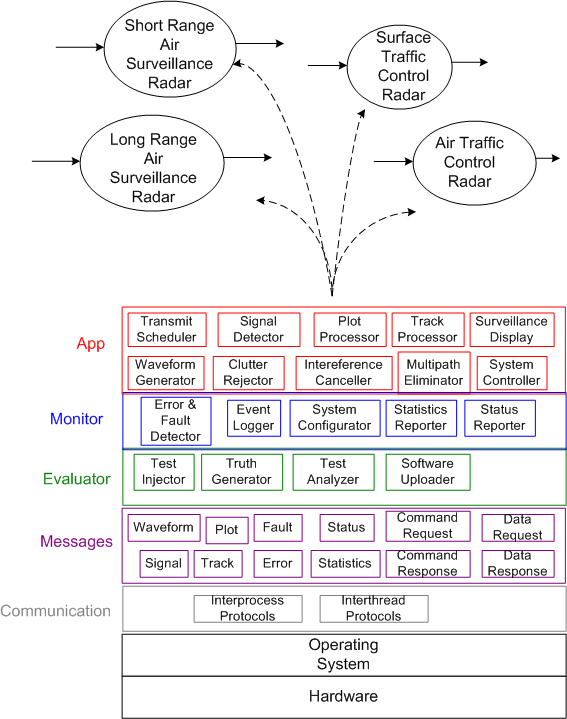
Did you notice the increase in tyranny of detail and complexity as we transcended the 3 levels of abstraction in this post? Well, it gets worse if we continue on cuz we don’t yet have enough information, knowledge, or understanding to start cutting code, building, testing, and standing up the stack – not nearly enough. Thus, let’s just stop right here so we can retain a modicum of sanity. D’oh! Too late!
Fellow Tribe Members
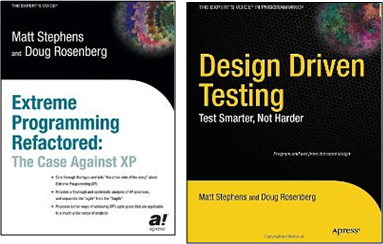
Being a somewhat skeptical evaluator of conventional wisdom myself, I always enjoy promoting heretical ideas shared by unknown members of my “tribe“. Doug Rosenberg and Matt Stephens are two such tribe members.
Waaaay back, when the agile process revolution against linear, waterfall process thinking was ignited via the signing of the agile manifesto, the eXtreme Programming (XP) agile process burst onto the scene as the latest overhyped silver bullet in the software “engineering” community. While a religious cult that idolized the infallible XP process was growing exponentially in the wake of its introduction, Doug and Matt hatched “Extreme Programming Refactored: The Case Against XP“. The book was a deliciously caustic critique of the beloved process. Of course, Matt and Doug were showered with scorn and hate by the XP priesthood as soon as the book rolled off the presses.
Well, Doug and Matt are back for their second act with the delightful “Design Driven Testing: Test Smarter, Not Harder“. This time, the duo from hell pokes holes in the revered TDD (Test Driven Design) approach to software design – which yet again triggered the rise of another new religion in the software community; or should I say “commune“.
BD00’s hat goes off to you guys. Keep up the good work! Maybe your next work should be titled “Lowerarchy Design: The Case Against Hierarchy“.

Why am I here?
WTF?
Meh!
D'oh!

My BTC Address



 Bulldozer00's Blog