Archive
D4P4D Tweetfest
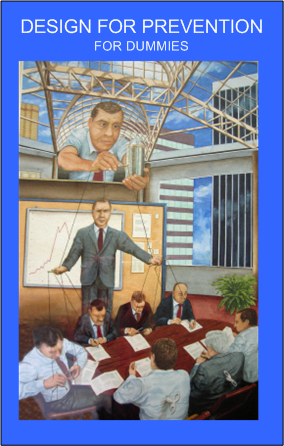
I’m in the process of reading William L. Livingston’s “Design For Prevention For Dummies” (D4P4D). I’m a pretty fast reader, but like my prior consumptions of all of Bill’s other dense and mind-absorbing writings, it’s a slow going affair that’s severely playin’ with my mind. I can only read about 10 fascinating pages per sitting before having to abandon ship and recoup my senses. After a martini, it’s 1 page and done. D’oh!
The book is full of masterful and tweet-worthy quotes like these:
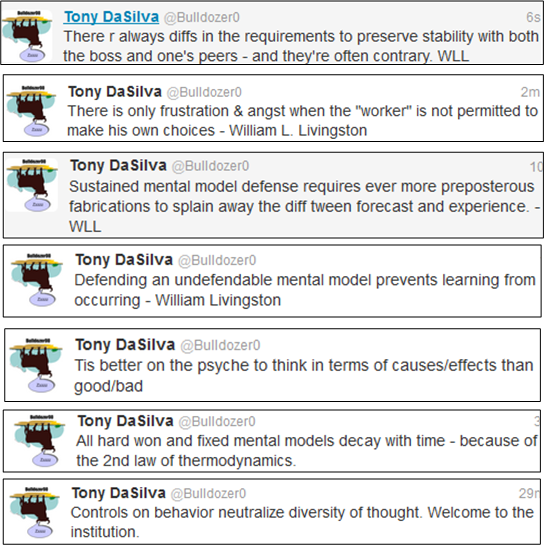
Bill, if you’re reading this bogus blog post, I apologize for the lack of attribution in some of the tweets. I think I know you well enough that you don’t give a chit, but since I twisted your words so much in some of the tweets, I didn’t know if I should attribute them to you. Cheers!
Skepticism, Cynicism, Transparency, Openness
Much as reassurance is the antidote to insecurity, transparency and openness are the antidotes to skepticism and cynicism. Surgical strikes on cynics and skeptics only exacerbate the problem by creating a new batch of more deeply embedded bretheren who fly below the corpo radar. Because of their formless and distributive natures, ya can’t just “shout it out” or spray WD-40 on the stifling rust that keeps skepticism and cynicism firmly in place.
The best large scale example I can cite for the trumping of skepticism/cynicism by courageous transparency/openness is the HCL Technologies transformation as told by CEO Vineet Nayar in his book “Employees First, Customers Second“. The HCL story is amazing because once unbridled skepticism and cynicism seep into the fabric of an org, it takes an act of god to clean the laundry. Mr. Nayar and crew must have consulted with god because they pulled it off at a huge company filled with the most hard core skeptics and cynics known to man – freakin’ engineers.
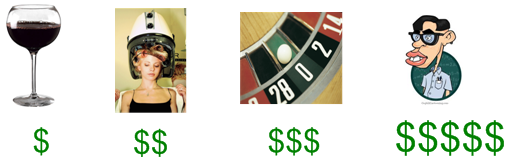
The fastest ways to bankruptcy are wine, women, gambling, and (cynical and skeptical) engineers. – Unknown
Shifting The Burden
In a capitalist society, borgs that ship crap to their customers go out of business sooner or later:

In a corpo-socialist society, big, arrogant, and self-important borgs that ship crap to their customers get bailed out by both customers and non-customers in the form of taxpayer-financed government bailouts:
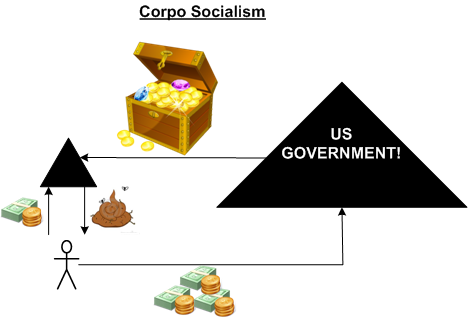
Note the feedback loop in action: crap -> customer -> money -> US Gov -> money -> to borg -> crap -> customer. It reminds me of the “shifting the burden” system archetype presented by Peter Senge in his classic book “The Fifth Discipline“. In corpo-socialist societies, the burden of staying in business is shifted from the borg itself to the American people. So much for the ideal of being responsible and accountable for your own success. It applies to individuals and small companies, but not to corpo behemoths.
Respect From The Top, Disdain From The Bottom
In Scott Berkun‘s blog post, “Why Project Managers (PM) get no respect“, he gets to the heart of his assertion of why “output producers” don’t harbor much professional respect for “output managers“:
The core problem is perspective. Our culture does not think of movie directors, executive chefs, astronauts, brain surgeons, or rock stars as project managers, despite the fact that much of what these cool, high profile occupations do is manage projects. Everything is a project. The difference is these individuals would never describe themselves primarily as project managers. They’d describe themselves as directors, architects or rock stars first, and as a projects manager or team leaders second. They are committed first to the output, not the process. And the perspective many PMs have is the opposite: they are committed first to the process, and their status in the process, not the output.
If one doesn’t understand the “project output” to some degree, especially what makes for a high quality output, there is no choice but to focus on process over output. And as one goes higher up in the corpo status chain, the preference for concentrating on process and its artifacts (spreadsheets, specifications, presentations, status reports) over output tends to increase because meta-managers have much in common with lesser “output managers” and not much in common with “output producers“. It is what it is, and unless so-called process champions are continuously educated on the specific types of “outputs” their institutions produce, it will remain what it is.

Approval Barriers
All business advice is founded on the core principle of “delighting the customer“. However, not all customers are created equal. Most mainstream business advice seems to “assume” that the “customer” is an individual point source payer and user of the product/service.

However, the really big bux business deals occur between social systems of orgs where it’s hard to discern the payer(s) from the actual product end user(s). The seller has to navigate through the customer’s org to influence the right payers and users.

When the end user is some struggling group deeply nested within a behemoth command and control structure (like the US government or a Fortune 500 company), the system is setup for all kinds of mischief to occur. The gauntlet of approval barriers erected by bureaucrats and disinterested little Hitlers in the customer org often makes it impossible to get the right problem solving product into the hands of the problem holders. Tis what it is.
Peace And Despair II
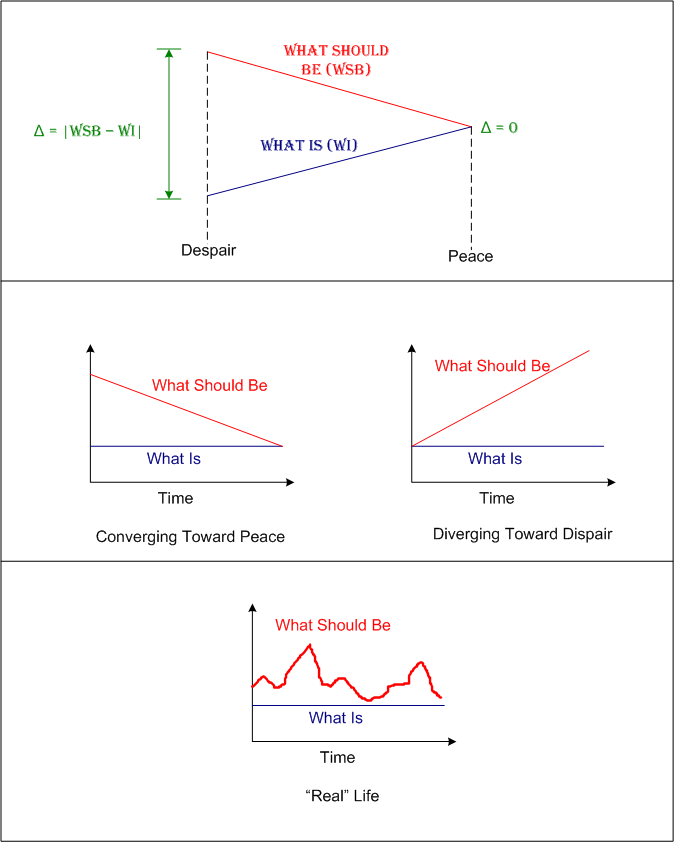
What causes your “delta” to increase? Decrease? How does your delta vary with time? Are your delta’s mean and variance both close to zero? What do you think the Buddha, Lao Tzu, and Jesus’s deltas were?
Problems, Symptoms, Solutions
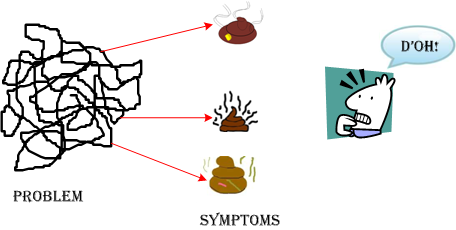
I haven’t done a stupid-poopy-pic in awhile… uh, since yesterday, so here’s one fer ya:
And here’s the follow on:
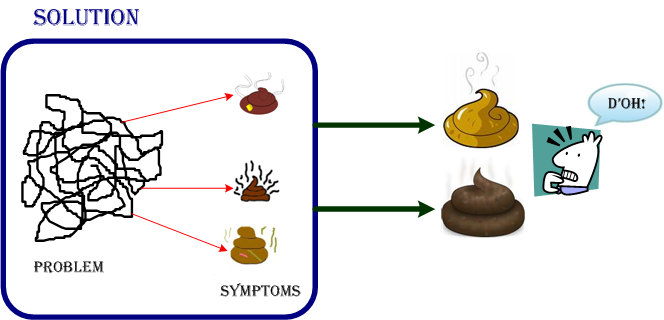
It’s a good thing I have 5 different poopy clips in my plagiarized BD00 graphic toolbox, no?
Opaque, Transparent, Closed, Open
All other things being equal (and they never are), which type of org would you expect to flourish?

The IDEs Of March
I’m an Integrated Development Environment (IDE) man. I like the way IDEs (Eclipse, Visual Studio) provide an overarching dashboard overview and uniform control over the tool set needed to build software. Plus, I’m horrible at remembering commands; and as I get older, it gets worse.
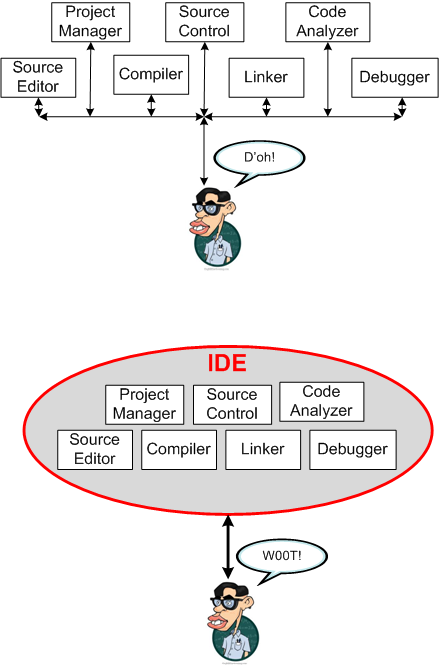
How about you? Are you an IDE user or a command line person?
D4P4D
I just received two copies of William Livingston’s “Design For Prevention For Dummies” (D4P4D) gratis from the author himself. It’s actually section 7 of the “Non-Dummies” version of the book. With the addition of “For Dummies” to the title, I think it was written explicitly for me. D’oh!
The D4P is a mind bending, control theory based methodology (think feedback loops) for problem prevention in the midst of powerful, natural institutional forces that depend on problem manifestation and continued presence in order to keep the institution alive.
Mr. Livingston is an elegant, Shakespearian-type writer who’s fun to read but tough as hell to understand. I’ve enjoyed consuming his work for over 25 years but I still can’t understand or apply much of what he says – if anything!
As I slowly plod through the richly dense tome, I’ll try to write more posts that disclose the details of the D4P process. If you don’t see anything more about the D4P from me in the future, then you can assume that I’ve drowned in an ocean of confusion.

Why am I here?
WTF?
Meh!
D'oh!

My BTC Address



 Bulldozer00's Blog